
The term plasma generator can describe anything from industrial equipment used to treat materials to a small scientific demonstrator that makes a glowing gas. On this website, it means something more specific: a handcrafted, Tesla-inspired system that uses high-frequency electricity, resonance and a traditional spark gap to produce visible plasma inside two handheld bulbs.
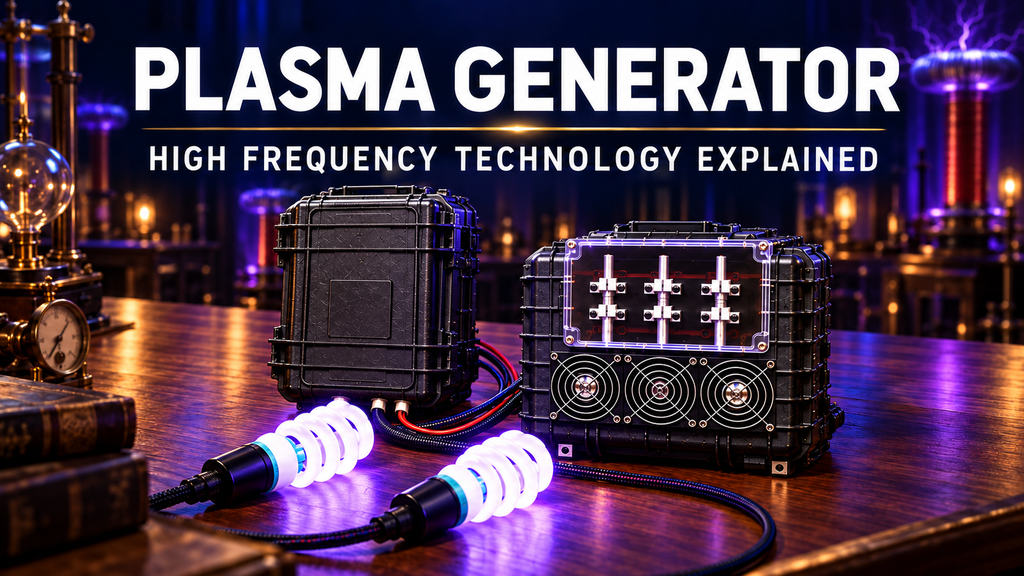
My High Frequency Plasma Generator is designed for people interested in Nikola Tesla, historical electrical technology, meditation, relaxation and personal experimentation. It combines two illuminated bulbs, an audible spark gap and a serviceable two-part machine.
It is not a medical device and I do not claim that it diagnoses, treats, cures or prevents disease. Historical researchers used many different machines and experimental conditions, so their findings cannot automatically be applied to my generator.
With that distinction established, we can explore what a plasma generator is, where the technology came from, what old research actually found and why my £3,333 system may be an attractive alternative to significantly more expensive equipment.
What Is a Plasma Generator?
Plasma is often called the fourth state of matter. If enough energy is transferred to a gas, some electrons separate from atoms or molecules. The resulting mixture of charged and neutral particles is described as ionised gas, or plasma. The MIT Plasma Science and Fusion Center provides a useful introduction to the underlying science.
A plasma generator supplies the energy and electrical conditions needed to create and sustain that ionisation. However, generators vary enormously.
- Industrial systems may clean, coat or modify surfaces.
- Cold atmospheric plasma devices can create a discharge in open air.
- Plasma globes produce luminous filaments inside sealed glass.
- Violet-ray devices use small glass electrodes and high voltage.
- Tesla-inspired systems use high-frequency oscillations, resonant circuits and gas-filled bulbs or tubes.
These categories should not be treated as interchangeable. Sharing the word “plasma” does not mean two machines have the same output, construction, intended use or evidence.
My machine belongs to the last category. It energises low-pressure gas sealed inside two bulbs. The glow demonstrates that ionisation is taking place inside the glass; the gas does not leave the bulb and the system is not an open-air plasma jet.
How Does My High Frequency Plasma Generator Work?
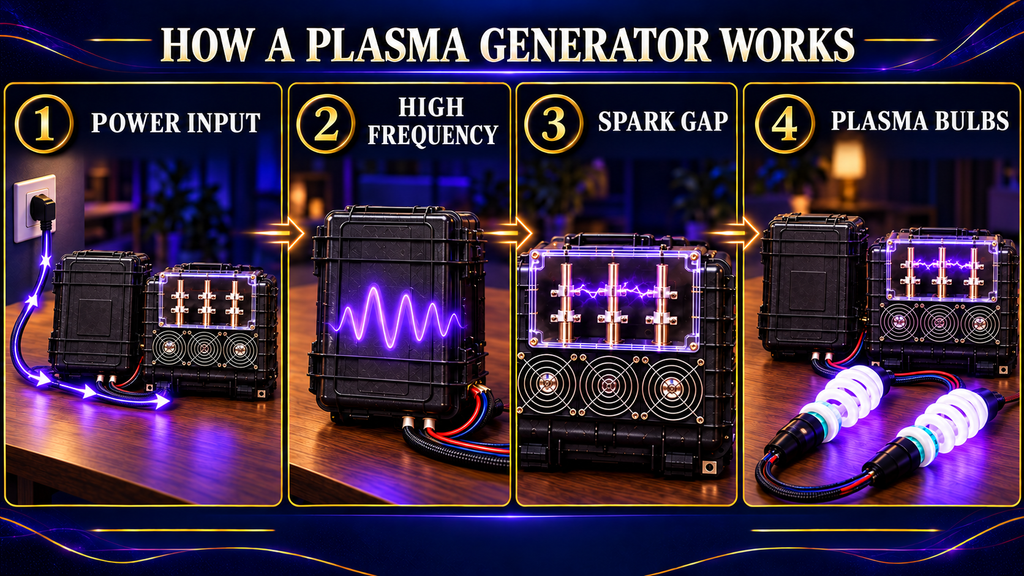
The machine has a high-frequency producer and a separate spark-gap enclosure, keeping the principal sections easy to recognise and access.
The electrical process can be understood as a sequence:
- Electrical power enters the high-frequency producer.
- Internal circuitry drives a high-voltage transformer.
- Capacitors store electrical charge.
- The charge rises until the air gap between the electrodes breaks down.
- The spark gap fires repeatedly, creating rapid electrical switching.
- A resonant circuit produces high-frequency electrical oscillations.
- Insulated leads carry the output to two gas-filled bulbs.
- The low-pressure gas becomes ionised and produces visible plasma.
For a more detailed explanation, read How Does a Plasma Generator Work?.
Rather than hiding all switching inside sealed electronics, my plasma generator uses adjustable, replaceable 100% zinc rods. The discharge can be seen through a protective cover. After disconnection, the rods can be inspected, cleaned, aligned and eventually replaced.
Two cooling fans help maintain airflow through the producer. They must remain unobstructed whenever the machine is operating.
From Tesla’s Experiments to Early High-Frequency Machines
Nikola Tesla’s work in the 1890s demonstrated that rapidly alternating high-voltage currents could produce striking electrical discharges and illuminate partially evacuated tubes.
Tesla’s 1892 lecture, Experiments with Alternate Currents of High Potential and High Frequency, is available as a public-domain scan. His 1893 lecture, Light and Other High Frequency Phenomena, can be viewed through the Library of Congress.
These documents demonstrate transformers, capacitors, resonance, disruptive discharges and gas-filled tubes. They are not clinical trials of modern wellness products.
At approximately the same time, French physician and physicist Jacques-Arsène d’Arsonval investigated high-frequency currents and living systems. This led to the field historically known as d’Arsonvalisation. Spark coils, resonators and vacuum-glass applicators became common features of early equipment.
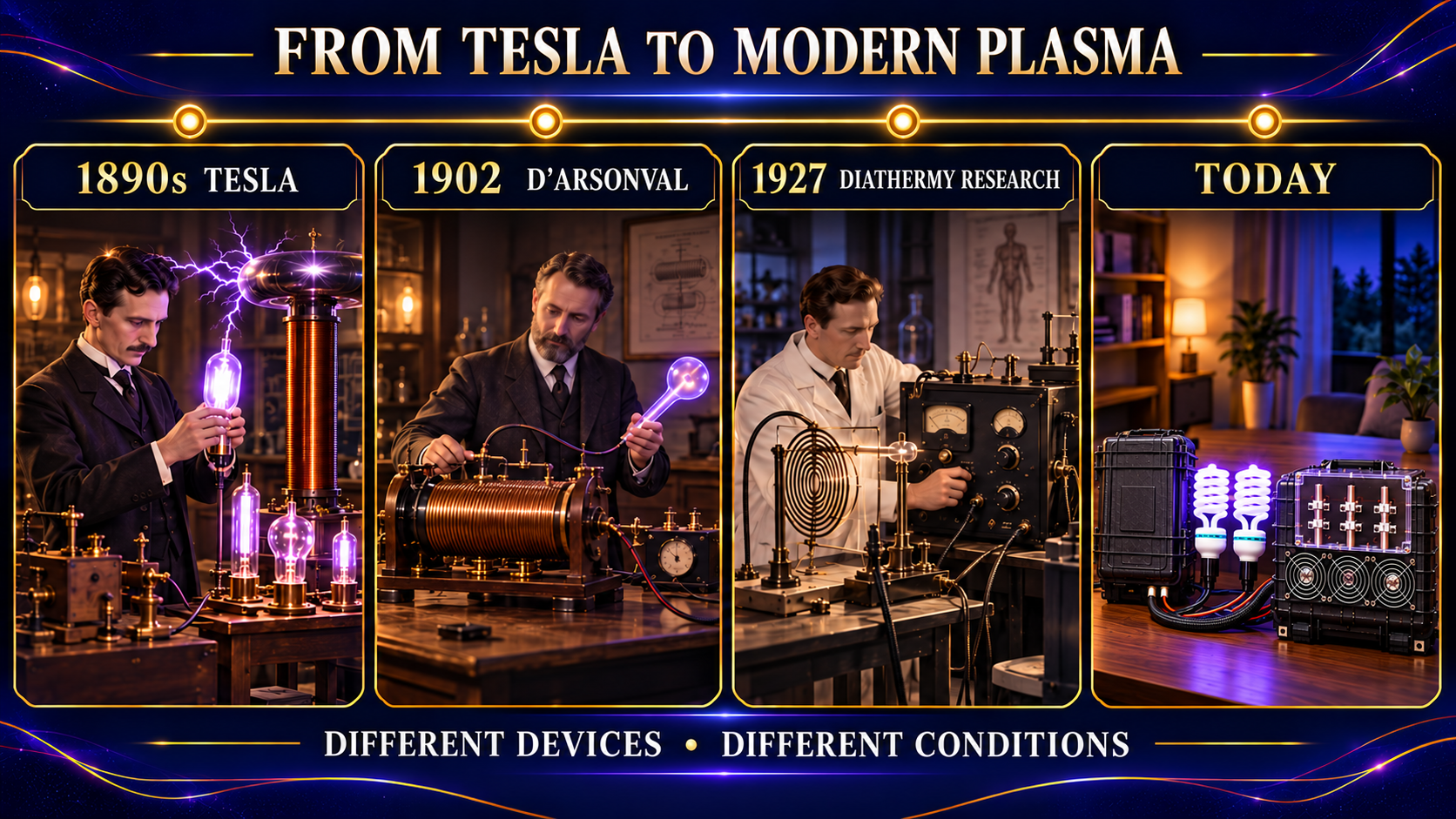
A 1902 British Medical Journal paper titled The Therapeutic Employment of High Frequency Currents (“D’Arsonvalisation”) records how the equipment and its effects were understood at the time. Chisholm Williams’ 1903 book, High-Frequency Currents in the Treatment of Some Diseases, is also freely viewable through the Wellcome Collection.
Early case descriptions rarely meet today’s standards for controlled research. They record what practitioners tried and claimed, not proof of safety or efficacy.
What Did the Old High-Frequency Studies Find?
By the 1920s, researchers were attempting to measure high-frequency effects more systematically.
In 1927, Ronald Christie and Carl Binger published An Experimental Study of Diathermy: Evidence for the Penetration of High Frequency Currents Through the Living Body. Their animal experiments examined current paths and heat production. They reported that electrical resistance and current concentration influenced where heating occurred and found evidence of deeper heating under their diathermy conditions.
A later paper in the same series, Conduction of High Frequency Currents Through the Living Cell, investigated the behaviour of diathermy currents in biological material.
These experiments show that high-frequency systems can create measurable physical effects. They do not establish a benefit from my plasma generator. Diathermy apparatus was designed to heat tissue, used different electrodes and delivered energy under controlled conditions. My handheld plasma-bulb system is not a diathermy machine.
This distinction matters. “High frequency” describes a broad property, not a standardised treatment. Frequency, waveform, voltage, current, duty cycle, electrode geometry, exposure time and coupling method can all change what a device does.
A Modern Study of a Historical Plasma Tool
One of the most relevant modern papers was published in 2015: On the History of Plasma Treatment and Comparison of Microbiostatic Efficacy of a Historical High-Frequency Plasma Device with Two Modern Devices.
The researchers compared a historical violet-wand plasma source with two modern cold atmospheric plasma devices. Five microbial isolates were grown on agar and exposed directly to the different plasma sources. All three systems produced antimicrobial effects in the treated areas under those laboratory conditions.
The finding shows that an old high-frequency device produced measurable plasma-related activity. The researchers also warned that many historical clinical descriptions did not meet modern evidence-based standards and required reassessment.
There are three essential limitations:
- The experiment was conducted on microorganisms grown on laboratory agar, not on people.
- The historical device was a violet wand, not my two-bulb plasma generator.
- The study tested direct plasma exposure at the electrode, not the experience of holding sealed bulbs.
It would therefore be inaccurate to say this study proves that my generator kills microbes in or on the human body. What it provides is evidence that particular historical plasma apparatus can produce measurable effects in a carefully defined setup.
What Positive Effects Might an Owner Experience?
The responsible way to discuss possible positives is to separate direct experience from unproven medical conclusions.
A distinctive relaxation ritual
Many owners sit comfortably, hold one bulb in each hand and use the session as quiet personal time. The violet-white glow, changing plasma patterns and regular spark-gap sound create a sensory environment unlike an ordinary meditation app.
Some people describe the routine as calming or enjoyable, but this does not establish a sedative or anti-anxiety effect.
A visual focus for meditation
The plasma glow can provide a point of attention during breathing, mindfulness or reflection. Owners can also close their eyes, listen to suitable music from equipment positioned safely away or simply sit quietly.
The experience comes from the complete routine, not proof that plasma changes brainwaves or forces a mental state.
Time away from screens and interruptions
A planned session can mark a boundary between a busy day and quiet time. Setting aside 15 to 30 minutes may encourage consistency.
Curiosity and practical learning
The system offers a visible introduction to plasma, capacitance, resonance, high voltage and spark-gap technology. For many owners, learning how the generator works is part of its value.
Personal wellness exploration
Some owners report positive subjective experiences. Testimonials can show how a product is used, but they are not controlled evidence and results cannot be guaranteed.
The historical literature is a reason for curiosity and further research—not permission to promise disease treatment.
Why Are Some Plasma Devices So Expensive?
Specialist plasma equipment can be expensive because prices may include low-volume manufacturing, custom components, training, membership programmes, logistics and marketing.
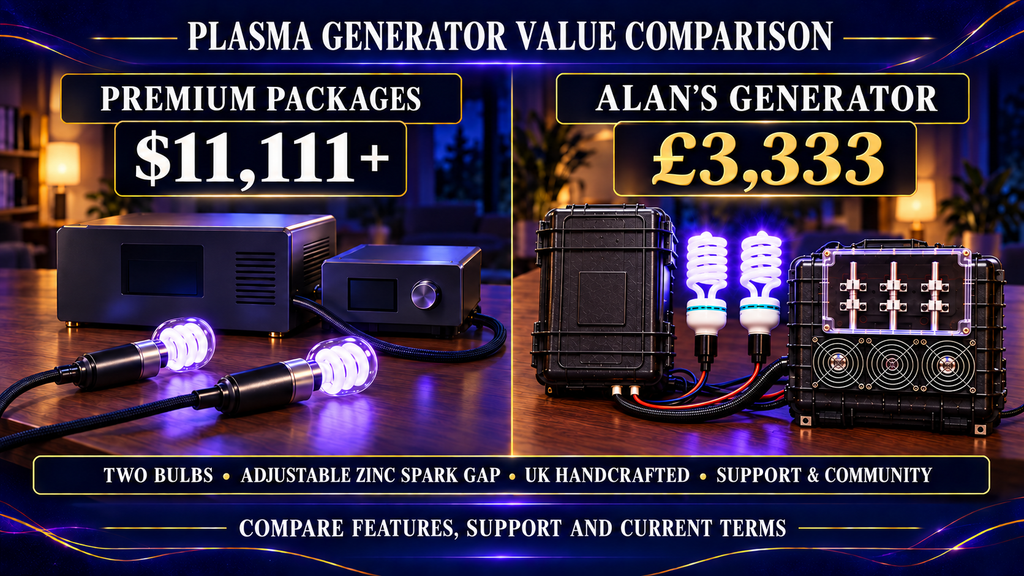
In this niche, prospective buyers may encounter plasma packages advertised at around $11,111 or more. Exchange rates vary, but that represents well over twice the price of my system for many UK customers.
A high price does not by itself prove that a machine produces a better output or a greater wellness effect. Equally, a cheaper machine is not automatically equivalent. Buyers should compare the physical design, included components, maintenance arrangements, warranty, support and intended use instead of relying on price or extraordinary claims.
Questions worth asking include:
- Is the price for a machine, membership, training or a combined package?
- Are bulbs, delivery, charges and support included?
- Can wearing parts be inspected and replaced?
- Are the output, contraindications and warranty explained clearly?
- Does the seller distinguish evidence from testimonials?
Transparent answers are more useful than an impressive price tag.
My £3,333 Plasma Generator
My High Frequency Plasma Generator is available for £3,333. I chose that price to offer a handcrafted Tesla-inspired system without pushing ownership into the five-figure range.
The current package includes:
- Two handheld plasma bulbs
- One high-frequency producer
- One separate spark-gap generator
- Adjustable, replaceable 100% zinc spark-gap rods
- Built-in cooling fans
- Operating and maintenance instructions
- Shipping under the published terms
- Direct customer support
- Access to the private High Frequency Plasma Community Group
- A 12-month warranty on the machine under the warranty terms
The glass plasma bulbs are consumable components and are not covered by the 12-month machine warranty.
Every generator is individually assembled and tested by me in the UK. Buyers communicate with the person who built their machine rather than an anonymous reseller or call centre.
Practical Advantages of My Design
Traditional spark-gap operation
The visible, audible spark gap reflects the principles that made early Tesla-style apparatus distinctive. It is not a decorative effect controlled by an app.
Serviceable zinc electrodes
Spark-gap electrodes gradually develop deposits and wear. My adjustable zinc rods can be inspected, cleaned with the recommended 0.40 mm feeler gauge and replaced when required. Always disconnect the equipment before maintenance and follow the Owner’s Guide.
Two handheld plasma bulbs
Two bulbs allow the owner to hold one in each hand. Their sealed low-pressure gas provides a visible indication of operation.
No software or subscription
There are no programmes to download, frequency databases to understand or recurring software subscriptions. The machine is designed for straightforward physical operation.
Direct support and owner community
Owners receive help with setup, operation and maintenance, plus access to the private community.
Built for long-term ownership
Separate enclosures, an accessible spark gap and replaceable electrodes make the main service points understandable.
How to Use the Generator Responsibly
Read the complete Owner’s Guide before operating the machine.
Place both enclosures on a dry, flat and stable surface with the cooling vents unobstructed. Check the bulbs, leads and spark-gap cover before every session. Keep the generator well away from televisions, computers, mobile phones, storage devices and other sensitive electronics because high-frequency fields can cause interference.
New owners should begin at approximately 15 minutes. The guide increases the duration gradually over the first week to a maximum of around 30 minutes per session. These times are operating guidance for becoming familiar with the equipment; they are not medical doses.
Do not use the generator during pregnancy or if you have a pacemaker, implanted defibrillator, neurostimulator, insulin pump, cochlear implant or another implanted or body-worn electronic medical device. Keep it away from water, children, pets, flammable vapours and oxygen-enriched environments.
Never remove covers, touch internal components or adjust the spark gap while the machine is connected to power.
Frequently Asked Questions
Is this plasma generator the same as a cold atmospheric plasma jet?
No. My machine produces plasma inside sealed low-pressure gas bulbs. An atmospheric plasma jet creates an external plume. The technologies, exposure conditions and supporting evidence are different.
Is it a violet-ray machine?
It shares historical themes with violet-ray equipment, including high voltage, high frequency and gas-filled glass. However, it is a larger two-bulb spark-gap system with its own circuit and operating characteristics.
Does historical research prove health benefits?
No. Historical papers document experiments, measurements and clinical claims involving many different devices. Their findings cannot be transferred automatically to a modern plasma generator.
Can it treat pain, infection or another condition?
No. It is not a medical device and is not intended to diagnose, treat, cure, mitigate or prevent any condition. Seek qualified professional advice about symptoms or treatment.
Why are the bulbs important?
The high-frequency output ionises the sealed gas, producing visible plasma and the changing glow owners see.
Why use a spark gap instead of silent electronic switching?
It provides rapid switching in a traditional resonant design. Trade-offs include noise, electrode maintenance and interference.
What does £3,333 buy?
It buys the complete two-part generator, two bulbs, instructions, shipping under the published terms, direct support, community access and the stated machine warranty. Check the product page and terms for the latest details before ordering.
Is This the Right Plasma Generator for You?
My system may appeal if you value Tesla-inspired engineering, visible plasma, traditional spark-gap technology, meditation or relaxation rituals, direct access to the builder and straightforward maintenance.
It may not be right if you need a silent device, selectable digital frequency programmes, a compact battery-powered product or clinically approved treatment equipment.
The best buying decision begins with honest expectations. A plasma generator can be technically fascinating, visually impressive and personally meaningful without being presented as a medical cure.
Final Thoughts
High-frequency plasma technology has a remarkable history. Tesla demonstrated resonant high-voltage discharges and illuminated tubes. Early practitioners explored d’Arsonvalisation and diathermy. Later researchers measured current paths and heating, while modern scientists demonstrated antimicrobial effects from particular plasma sources under controlled conditions.
That history deserves to be explored carefully. It does not prove that every plasma generator produces the same effect, and it does not justify medical promises about my machine.
What my generator offers is clear: a handcrafted UK-built system with two plasma bulbs, traditional adjustable zinc spark-gap technology, simple operation, serviceable components, direct support and community access. At £3,333, it provides an alternative to specialist packages promoted at substantially higher prices.
If that combination of history, engineering, visual plasma and personal exploration interests you, visit the High Frequency Plasma Generator product page for current specifications and ordering information.
Important Disclaimer
This article is provided for educational and general product information. The High Frequency Plasma Generator is intended for education, experimentation, research, meditation, relaxation and general wellness. It is not a medical device and is not intended to diagnose, treat, cure, mitigate or prevent any disease or medical condition. Historical publications and studies cited here examined different apparatus, outputs and experimental conditions; their results should not be attributed to this product. Never delay or replace professional medical care because of information about a wellness device.