
📚 High Frequency Plasma Learning Centre
📘 Lesson 1 of 24

What Is High Frequency Plasma?
High frequency plasma is one of the most fascinating intersections of physics, electricity, and engineering. Inspired by the pioneering work of Nikola Tesla in the late nineteenth century, high frequency plasma generators continue to capture the imagination of engineers, researchers, hobbyists, and enthusiasts around the world.
Unlike cosmetic plasma devices used in beauty clinics, high frequency plasma generators use electrical energy to create visible plasma inside specially designed gas-filled bulbs or tubes. These glowing plasma effects are produced by high-voltage, high-frequency electrical oscillations and are often associated with Tesla’s early experiments into wireless energy and resonance.
If you’ve ever wondered what high frequency plasma is, how it works, or why so many people are interested in Tesla-inspired plasma technology, this guide will answer those questions and introduce you to the key concepts behind these remarkable machines.
What Is Plasma?
Plasma is often referred to as the fourth state of matter.
Most people are familiar with three states of matter:
- Solid
- Liquid
- Gas
When enough energy is added to a gas, some of its atoms lose electrons and become electrically charged. This process is called ionisation, and the resulting mixture of charged particles is known as plasma.
Plasma occurs naturally throughout the universe and is actually the most common state of visible matter.
Examples include:
- Lightning
- The Sun and other stars
- Aurora Borealis (Northern Lights)
- Neon signs
- Plasma globes
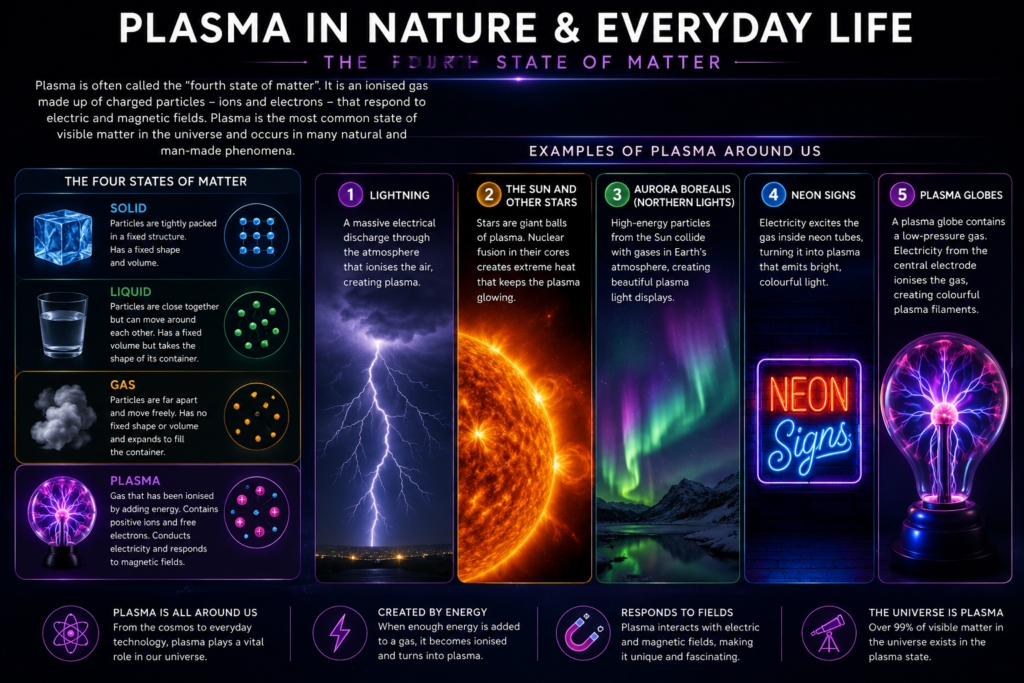
In a high frequency plasma generator, a gas sealed inside a glass bulb is energised by high-frequency electrical energy, causing it to glow with colourful streams of plasma.
What Does “High Frequency” Mean?
Electrical frequency describes how many times an electrical signal oscillates every second.
Frequency is measured in Hertz (Hz).
For example:
- Household mains electricity in the UK operates at 50 Hz.
- Radio transmitters operate at frequencies thousands or millions of times higher.
- High frequency plasma generators operate in frequency ranges far above standard mains electricity.
These rapid oscillations allow energy to behave very differently from ordinary household electrical power, producing the striking plasma effects associated with Tesla-inspired devices.
How Is High Frequency Plasma Generated?
Although designs vary, the basic process is surprisingly straightforward.
Step 1 – Electrical Power
The system begins with an electrical power source that supplies energy to the generator.
Step 2 – High Frequency Generation
A high-frequency circuit converts the incoming electrical power into rapidly oscillating electrical energy.
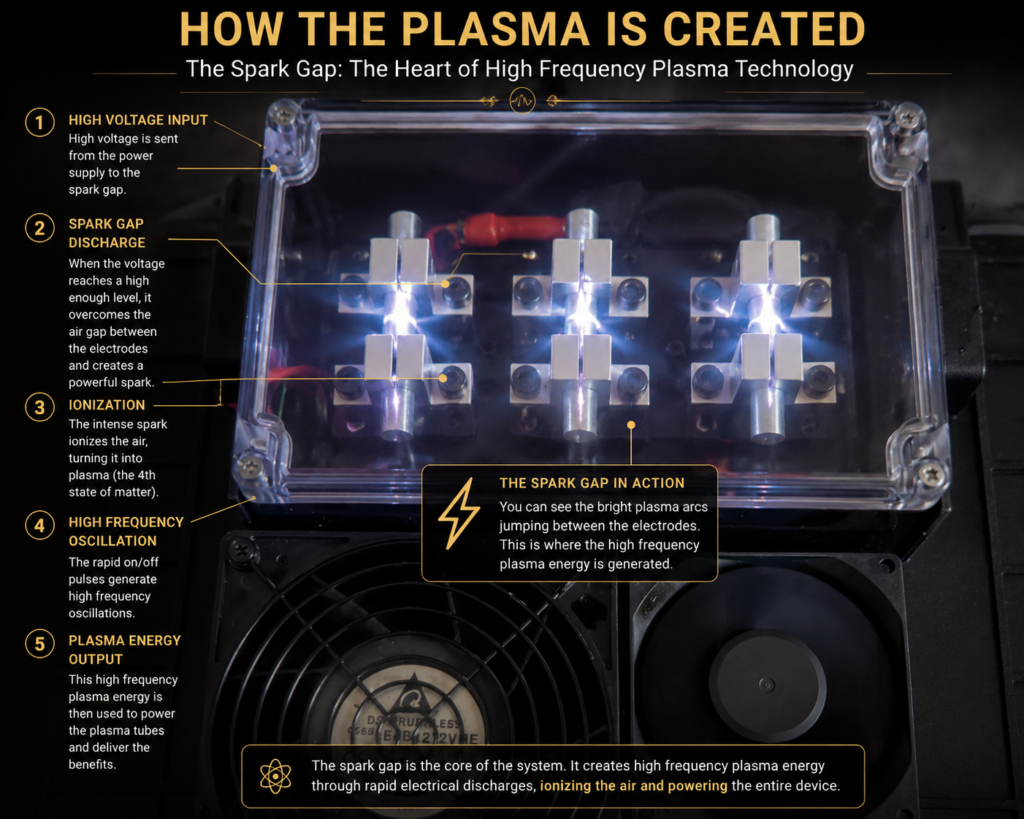
Step 3 – Spark Gap
Many traditional plasma generators use a spark-gap assembly.
As voltage increases, electricity jumps across the small gap between two electrodes, producing rapid electrical oscillations.
Step 4 – High Voltage Output
The energy is transferred through the generator to specially designed plasma bulbs.
Step 5 – Ionisation
Inside each bulb is a low-pressure gas.
The high-frequency electrical field ionises this gas, producing visible plasma.
Step 6 – Plasma Formation
The result is the familiar glowing streams of coloured plasma moving inside the bulb.
The History of High Frequency Plasma
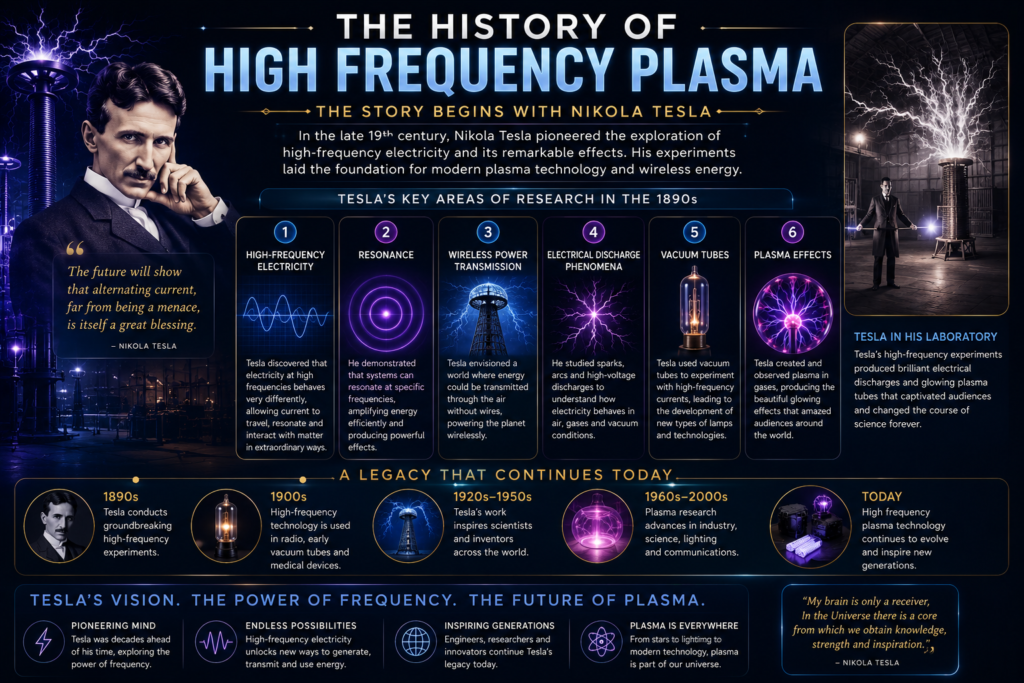
The story of high frequency plasma begins with Nikola Tesla.
During the 1890s Tesla devoted much of his research to:
- High-frequency electricity
- Resonance
- Wireless power transmission
- Electrical discharge phenomena
- Vacuum tubes
- Plasma effects
One of his most famous demonstrations involved holding glowing gas-filled tubes in his hands while standing inside powerful electrical fields generated by Tesla coils.
These demonstrations amazed audiences because the tubes glowed without being physically connected to wires.
Tesla believed high-frequency electricity would play an important role in the future of science and technology.
Although many aspects of his work remain subjects of discussion and research, his experiments inspired generations of engineers and inventors.
Why Are People Interested in High Frequency Plasma Today?
Interest in plasma technology continues to grow for many reasons.
Engineering
Many enthusiasts enjoy understanding the electrical principles involved in plasma generation.
History
Tesla’s inventions remain among the most celebrated achievements in electrical engineering.
Education
Building and operating plasma generators provides an engaging way to learn about:
- Electricity
- Resonance
- High voltage
- Ionisation
- Electrical safety
- Circuit design
Visual Appeal
The glowing plasma produced inside the bulbs creates a striking display that many people find fascinating.
Personal Exploration
Some users incorporate high frequency plasma devices into relaxation or meditation routines. While many people report enjoying these experiences, consumer plasma generators are not medical devices and should not be viewed as treatments for health conditions.
Inside My High Frequency Plasma Generator
My High Frequency Plasma Generator has been designed around traditional Tesla-inspired principles while focusing on simplicity, reliability, and ease of maintenance.
Key features include:
Adjustable Spark Gap
The spark gap is fully adjustable, allowing owners to fine-tune the system and carry out routine maintenance with ease.
100% Zinc Spark Gap Rods
I use solid zinc spark-gap rods because they provide consistent spark characteristics, are easy to maintain, and are straightforward to replace when required.
Handcrafted Construction
Each machine is individually assembled and tested before it leaves my workshop.
Plug-and-Play Operation
The system has been designed to be easy to set up. Simply connect the plasma bulbs, plug in the unit, and begin exploring the technology.
Community Support
Owners also receive access to a dedicated Telegram community where they can ask questions, share experiences, and learn more about Tesla-inspired plasma technology.
Frequently Asked Questions

Is high frequency plasma the same as cosmetic plasma treatment?
No. Cosmetic plasma devices used in beauty treatments work on different principles and are designed for aesthetic procedures. Tesla-inspired high frequency plasma generators are educational and experimental devices that produce visible plasma inside gas-filled bulbs.
Why does plasma glow?
When the gas inside the bulb becomes ionised, excited atoms release energy as light. Different gases produce different colours.
Why does the spark gap make a buzzing sound?
The buzzing or crackling sound comes from rapid electrical discharges jumping across the spark gap. This is a characteristic feature of many traditional spark-gap designs.
Why are zinc rods used in your machine?
Zinc rods are chosen for their consistent spark characteristics, ease of adjustment, and straightforward maintenance. They are an engineering choice rather than a health-related feature.
Is plasma hot?
The gas inside a plasma bulb can reach high temperatures, but the outer glass remains much cooler because the plasma is contained within the sealed bulb.
Continue Your Plasma Learning Journey
Now that you understand the basics of high frequency plasma, you may also enjoy these guides:
- How Does a Plasma Generator Work?
- What Is a Spark Gap?
- Why Does My Machine Use Zinc Rods?
- What Happens Inside a Plasma Bulb?
- Tesla’s High Frequency Experiments Explained
Together, these articles form part of the High Frequency Plasma Learning Centre and are designed to help you build a deeper understanding of this fascinating technology.
Disclaimer
High Frequency Plasma Generators are intended for educational, experimental, research, meditation, and personal wellness purposes only. They are not medical devices and are not intended to diagnose, treat, cure, mitigate, or prevent any disease or medical condition. Always seek advice from a qualified healthcare professional regarding medical concerns.