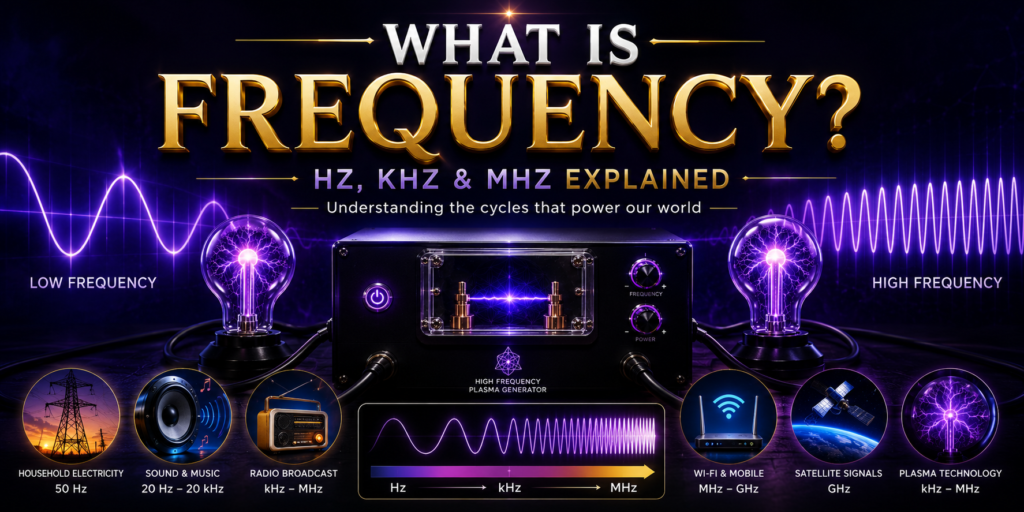
What Is Frequency? Have you ever heard someone say: “This device operates at 50 Hz.” Or perhaps you’ve seen frequencies written as 10 kHz or 1 MHz.
But what do these numbers actually mean?
The answer is surprisingly simple.
It is a measurement of how many times something repeats in one second.
Whenever something vibrates, oscillates or moves in a repeating pattern, it has a frequency.
It exists in sound waves, radio waves, electricity, visible light, wireless communications and even inside your Plasma Generator.
Understanding frequency is one of the most important steps in understanding how plasma technology works.
What You’ll Learn
By the end of this lesson you’ll understand: What it is. ✔
What Hertz (Hz) means. ✔
The difference between Hz, kHz and MHz. ✔
Why its important. ✔
Where we encounter it in everyday life. ✔
How it relates to high frequency plasma technology. ✔
Imagine a Swing
A simple way to understand frequency is to imagine a child on a swing.
Each time the swing travels forwards and returns to its starting point, it has completed one full cycle.
If the swing completes one cycle every second, its frequency is:
1 Hertz (1 Hz)
If it completes ten cycles every second, its frequency is:
10 Hertz (10 Hz)
The faster the swing moves backwards and forwards, the higher it becomes.
Electrical waves behave in exactly the same way.
What Is Hertz?
Frequency is measured in Hertz, named after the German physicist Heinrich Hertz, whose work helped demonstrate the existence of electromagnetic waves.
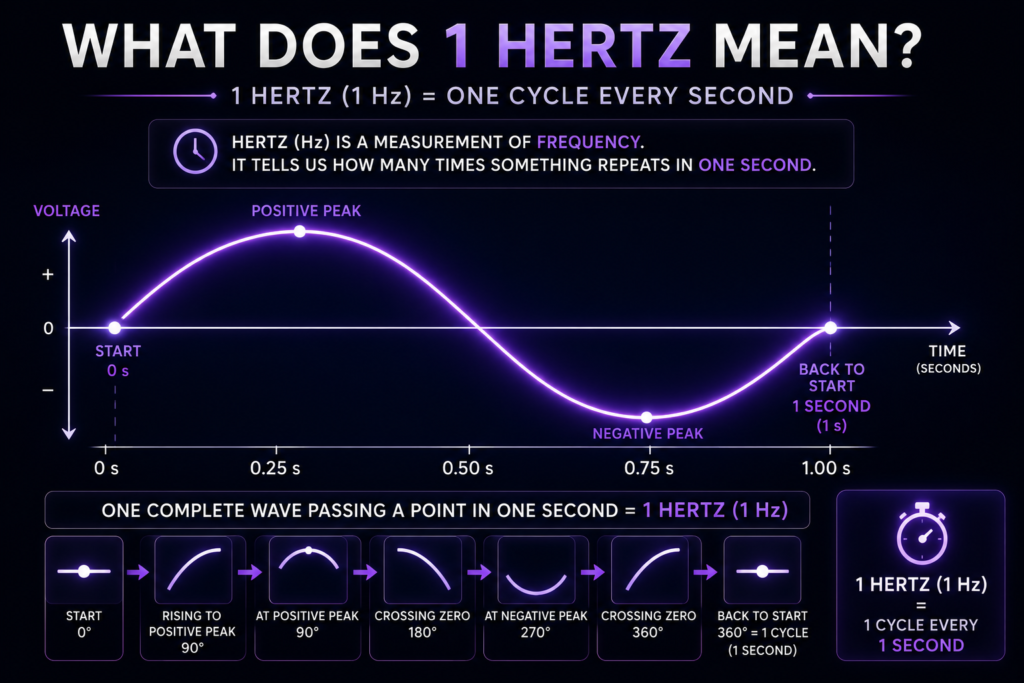
One Hertz simply means:
One complete cycle every second.
If something repeats:
- Once each second = 1 Hz
- Ten times each second = 10 Hz
- One hundred times each second = 100 Hz
- One thousand times each second = 1 kHz
The unit is simple, but it is used throughout science and engineering.
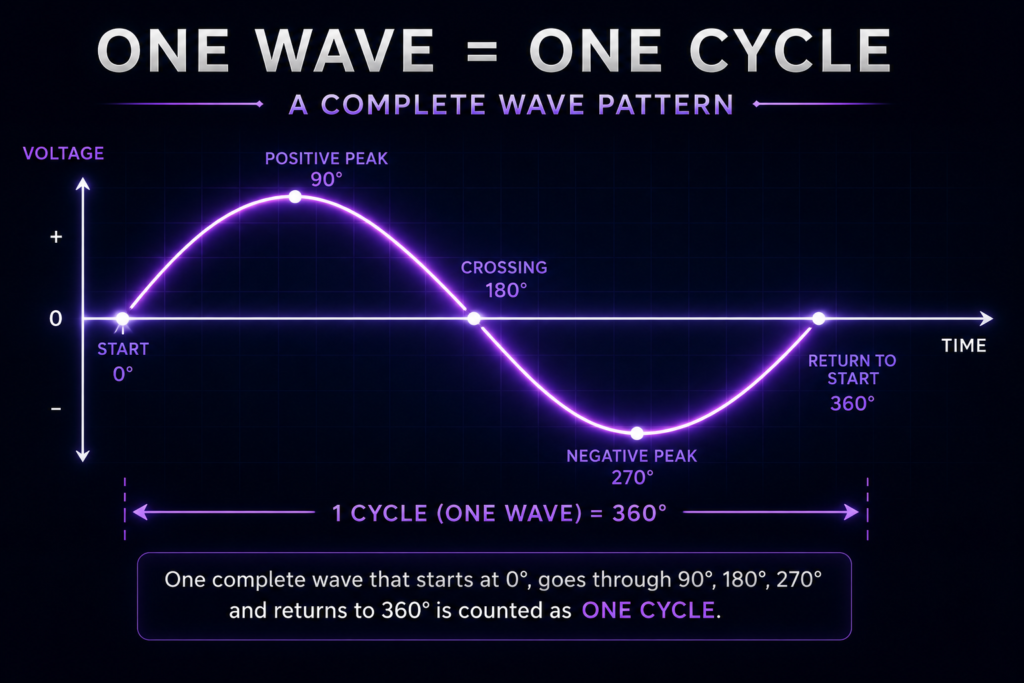
What Does One Cycle Look Like?
A complete electrical cycle consists of a repeating wave.
Starting point →
Positive peak →
Back through the centre →
Negative peak →
Return to the starting point.
That entire journey is counted as one cycle.
The number of complete cycles occurring every second is the frequency.
Frequency Is Everywhere
Once you understand it, you’ll begin to notice it all around you.
Examples include:
- Household electricity.
- Musical notes.
- Radio stations.
- Mobile phone signals.
- Wi-Fi networks.
- Microwave ovens.
- Plasma generators.
Although these systems perform very different jobs, they all rely on waves repeating at specific frequencies.
Hz vs kHz vs MHz – What’s the Difference?
As technology has advanced, scientists and engineers have needed ways to describe increasingly higher frequencies.
Rather than writing extremely large numbers, we use prefixes that make them much easier to understand.
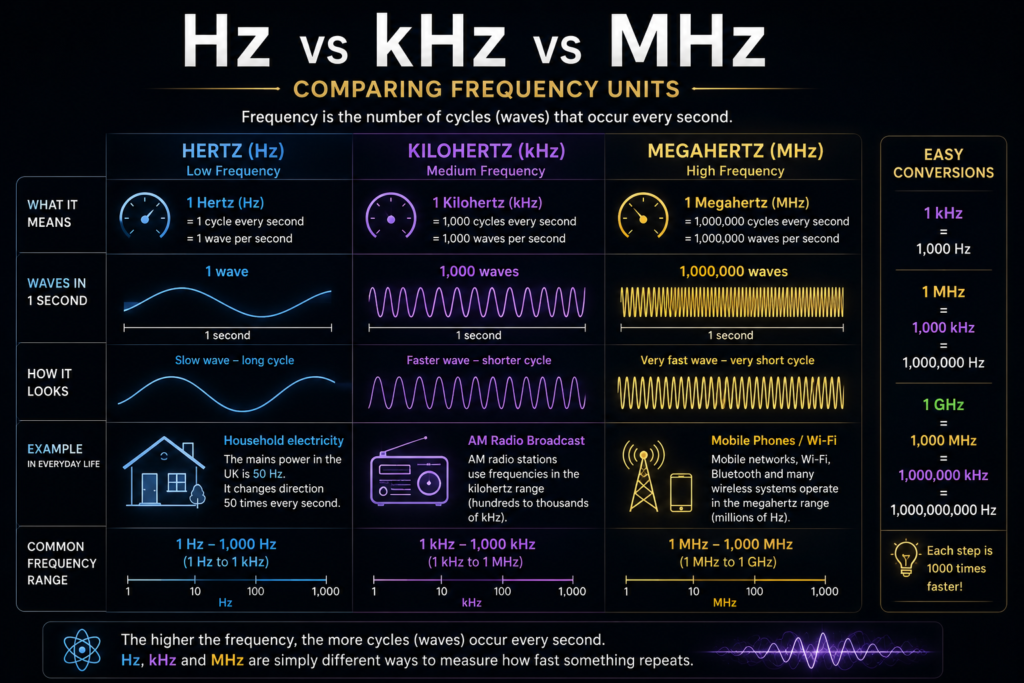
Here’s how they compare:
1 Hertz (Hz) = 1 cycle every second
One Kilohertz (kHz) = 1,000 cycles every second
1 Megahertz (MHz) = 1,000,000 cycles every second
One Gigahertz (GHz) = 1,000,000,000 cycles every second
Each step simply represents a much faster repeating wave.
This system is used throughout electronics, communications and science.
Why Higher Frequencies Matter
Imagine two people jumping on trampolines.
One person jumps slowly.
The other jumps extremely quickly.
Both are moving up and down, but one is repeating the movement much faster.
Electrical waves behave in exactly the same way.
A higher frequency simply means the electrical wave repeats more times every second.
The amount of energy in a system depends on many factors, not frequency alone, but changing it changes how rapidly the electrical field alternates.
This is one reason it is such an important concept in electrical engineering.
Frequency in Everyday Life
Most people don’t realise just how often they encounter it every day.
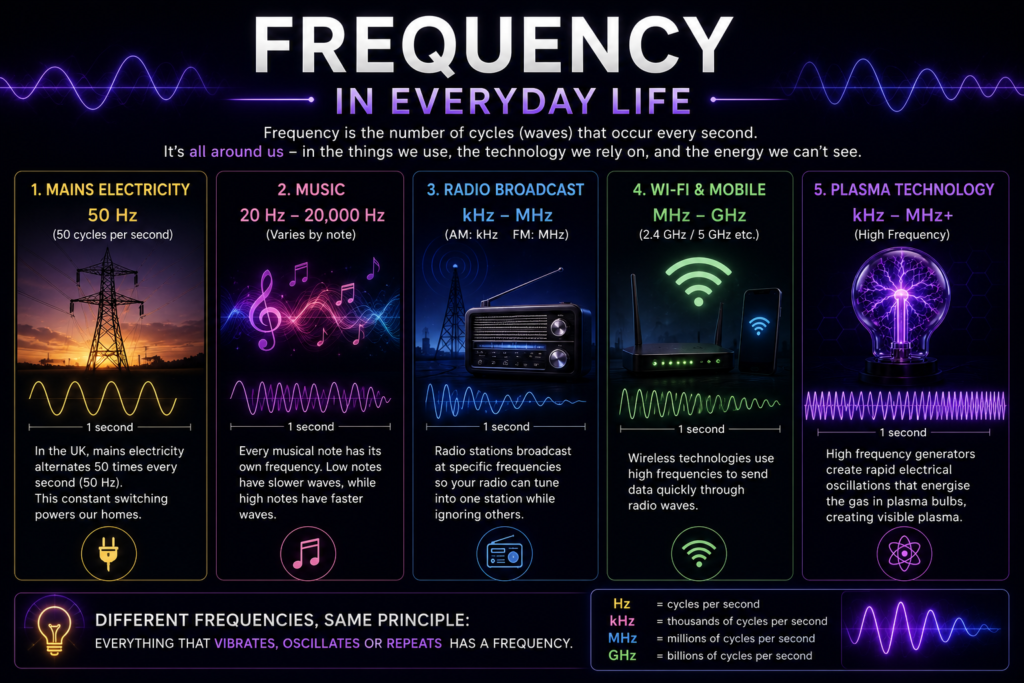
Here are some familiar examples:
Household Electricity
In the United Kingdom, the mains electricity supplied to homes alternates at 50 Hz, meaning it changes direction fifty times every second.
Musical Notes
Every musical note has its own frequency.
A piano, guitar or violin produces sound because strings vibrate at specific frequencies.
Higher notes vibrate faster than lower notes.
Radio Broadcasting
Radio stations each broadcast at their own assigned frequency.
This allows your radio to tune into one station while ignoring others.
Wi-Fi and Mobile Phones
Wireless communication also relies on it.
Signals are transmitted using radio waves operating at carefully controlled frequencies.
Plasma Technology
High-frequency plasma generators use rapidly changing electrical fields to energise the plasma bulbs and create visible plasma.
Why Frequency Is Important In Plasma Technology
One of the reasons Nikola Tesla became fascinated by high-frequency electricity was that changing the frequency changes how electrical energy behaves.
Traditional mains electricity supplied to our homes operates at a relatively low frequency.
High-frequency generators are designed to create electrical oscillations that repeat much more rapidly.
Inside a traditional spark-gap plasma generator, electrical energy is transformed into rapidly oscillating high-frequency energy before travelling to the plasma bulbs, where it energises the low-pressure gas to produce visible plasma.
Understanding it helps explain why different electrical systems can behave so differently even when they all rely on electricity.
Common Misconceptions About It
Myth 1 – A Higher Frequency Always Means More Power
Not necessarily.
Frequency describes how often something repeats.
Power describes how much energy is being transferred.
These are different concepts.
Myth 2 – Frequency Only Applies to Electricity
Frequency is found throughout nature.
It describes anything that repeats, including:
- Sound waves
- Ocean waves
- Vibrations
- Light waves
- Radio waves
- Mechanical motion
Myth 3 – Frequency Is Difficult to Understand
It may sound technical at first, but the idea is actually very simple.
Frequency is simply the number of times something repeats every second.
Once you understand that, terms like Hz, kHz and MHz become much easier to interpret.
Frequently Asked Questions
What Is Frequency?
Frequency is a measurement of how many times something repeats in one second.
What Does Hertz Mean?
One Hertz means one complete cycle every second.
What’s the Difference Between Hz and kHz?
One kilohertz equals one thousand Hertz.
In other words:
1 kHz = 1,000 cycles every second.
What Does MHz Mean?
One megahertz equals one million cycles every second.
Why Is Frequency Important?
It helps describe how quickly repeating events occur.
It is used throughout science, engineering, electronics, communications and physics.
Summary
It is one of the most important measurements used in science and engineering.
Whether you’re listening to music, tuning a radio, connecting to Wi-Fi or exploring plasma technology, frequency plays a fundamental role.
Although the units may seem unfamiliar at first, the concept is surprisingly straightforward.
Frequency simply measures how many times something repeats every second.
Once you understand Hertz, kilohertz and megahertz, many areas of electronics become much easier to understand.
As you continue through the Plasma Learning Centre, this knowledge will help you better understand how electrical systems operate and how plasma generators produce their remarkable glowing plasma.
🧠 Key Takeaways
Frequency measures how many times something repeats each second. ✔
It is measured in Hertz (Hz). ✔
1 kHz equals 1,000 Hz. ✔
1 MHz equals 1,000,000 Hz. ✔
It is found throughout nature and technology. ✔
Understanding it provides the foundation for understanding high-frequency plasma technology. ✔
🔬 Frequency Fact
Did you know?
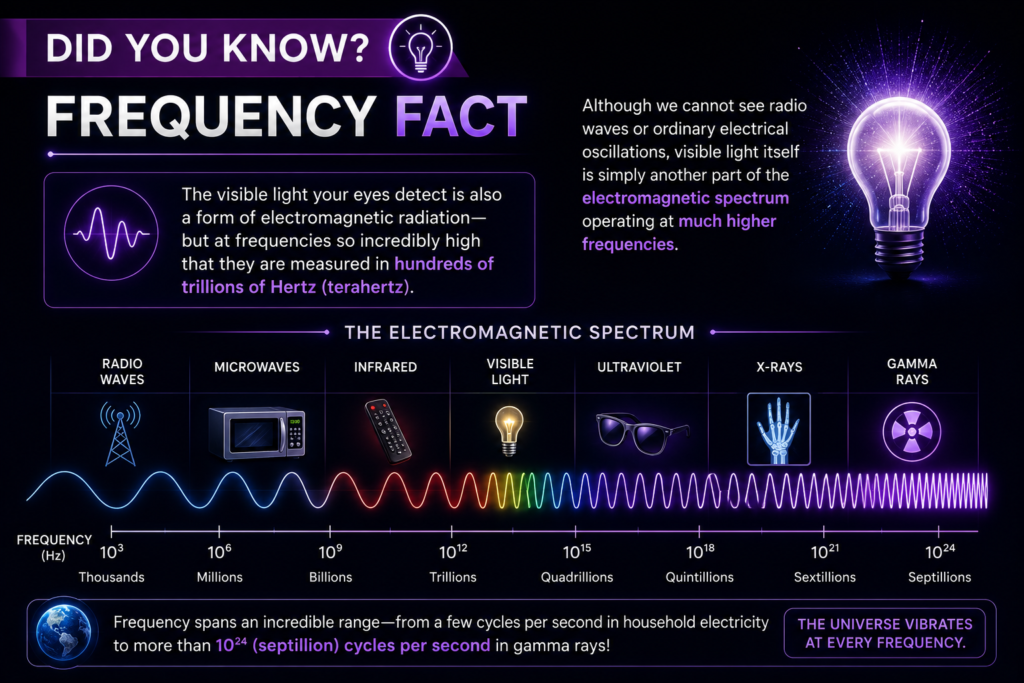
The visible light your eyes detect is also a form of electromagnetic radiation—but at frequencies so incredibly high that they are measured in hundreds of trillions of Hertz (terahertz). Although we cannot see radio waves or ordinary electrical oscillations, visible light itself is simply another part of the electromagnetic spectrum operating at much higher frequencies.
Continue Your Learning Journey
⬅ Previous Lesson
What Is High Frequency Electricity?
Learn how high-frequency electrical energy differs from ordinary household electricity and why Nikola Tesla devoted so much of his work to studying rapidly oscillating electrical currents.
➡ Next Lesson
What Is Resonance?
Discover how resonance occurs throughout nature and engineering, and why it became one of Nikola Tesla’s favourite scientific principles.
Disclaimer
The information contained within the High Frequency Plasma Learning Centre is provided for educational purposes to explain the science, history and engineering of plasma technology.
The High Frequency Plasma Generator is intended for educational, experimental, research, meditation, relaxation and general wellness purposes only.
It is not a medical device and is not intended to diagnose, treat, cure, mitigate or prevent any disease or medical condition.
Always seek advice from a suitably qualified healthcare professional regarding medical concerns.
🎉 Lesson Complete
Congratulations!
You have now completed:
📘 Lesson 8 of 24
What Is Frequency? (Hz, kHz & MHz Explained)
You now understand what it is, how it is measured, what Hertz, kilohertz and megahertz mean, and why it is such a fundamental concept in both everyday technology and high-frequency plasma systems.