
Spark gap plasma technology is a fascinating combination of high voltage, electrical discharge, rapid oscillation and plasma generation. Although modern electronics often rely on semiconductors and digitally controlled switching, spark gaps represent one of the oldest and most visually dramatic methods of rapidly releasing stored electrical energy.

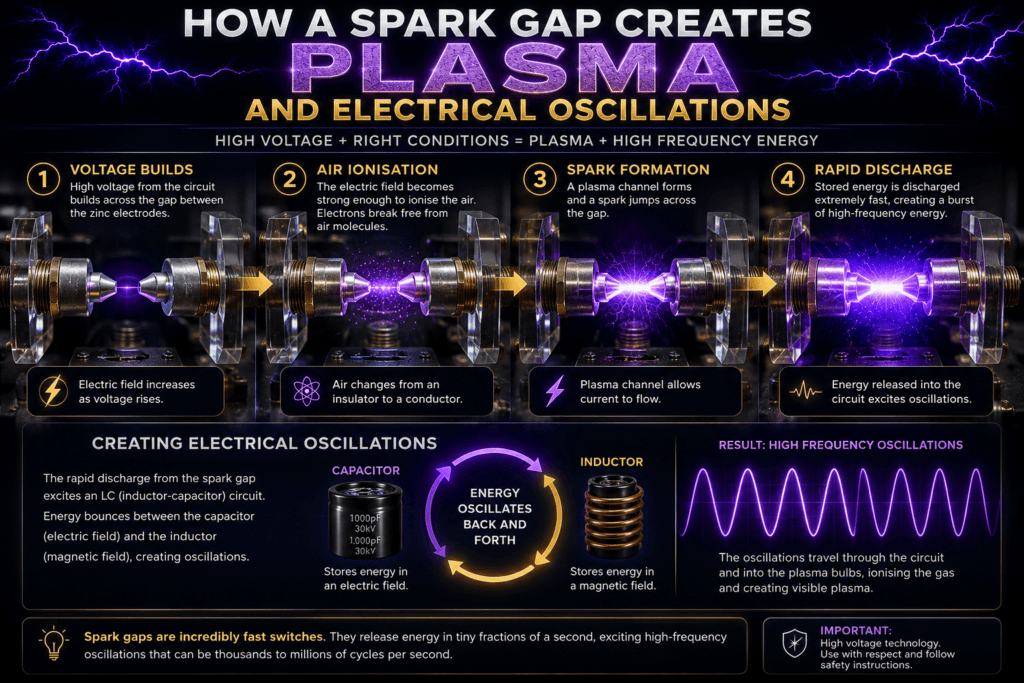
At its simplest, a spark gap consists of two conductive electrodes separated by a small air gap. As voltage builds across those electrodes, the electric field eventually becomes strong enough to ionise the air between them. The normally insulating air suddenly becomes electrically conductive, allowing a spark or arc to jump across the gap.
This rapid electrical discharge can create a powerful burst of electromagnetic activity and, when incorporated into a carefully designed resonant circuit, can contribute to the production of high-frequency electrical oscillations.
The same fundamental principles appeared in many early high-voltage experiments, including spark-gap radio transmitters, Tesla coils, induction apparatus and various electrotherapy devices developed during the late nineteenth and early twentieth centuries.
Today, spark gap plasma technology continues to attract interest from researchers, experimenters, engineers and enthusiasts who are fascinated by high-frequency electricity, plasma phenomena and the pioneering electrical work associated with Nikola Tesla.
Modern systems can combine a high-voltage source, capacitors, a spark gap and gas-filled plasma bulbs to transform ordinary electrical power into a striking display of ionised gas and high-frequency electrical activity.
How Does Spark Gap Plasma Technology Work?
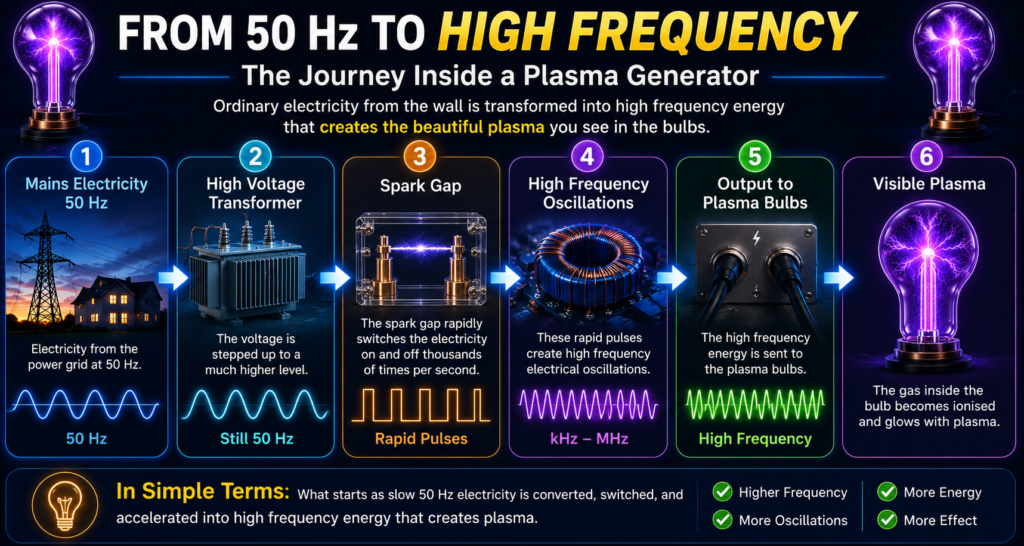
To understand spark gap plasma technology, it helps to follow the journey of electricity through a typical system.
The exact design varies from one device to another, but a spark-gap plasma generator may contain several important stages:
- A power source supplies electrical energy to the system.
- A high-frequency driver or oscillator switches electrical current rapidly.
- A high-voltage transformer dramatically increases the voltage.
- Capacitors temporarily store electrical charge.
- The voltage builds until the spark gap breaks down.
- A spark jumps between the electrodes, rapidly discharging stored energy.
- Electrical oscillations are produced within the surrounding circuit.
- High-voltage, high-frequency energy reaches gas-filled bulbs or another suitable discharge component.
- The gas becomes ionised and produces visible plasma.
The spark gap is therefore much more than a dramatic visual effect. In a suitable circuit, it acts as an extremely fast electrical switch.

Unlike a mechanical switch, which physically opens and closes, the spark gap switches automatically according to voltage. Once the voltage across the electrodes becomes sufficiently high, the air breaks down and conducts. After the energy is discharged and the voltage falls, the conductive channel collapses, allowing the cycle to begin again.
This repeated process can occur extremely rapidly.
The result is a sequence of sharp electrical discharge events that can excite oscillations within a resonant electrical system.
The Science Behind the Spark Gap
Air is normally an electrical insulator. This is why electricity does not simply flow freely through the atmosphere around us.
However, when the electric field between two electrodes becomes sufficiently intense, electrons can be accelerated through the air. These electrons collide with gas molecules and knock additional electrons free.
This creates a chain reaction known as an electron avalanche.
As more molecules become ionised, the air changes from an insulating state into a conductive plasma channel. Electrical current can then cross the gap as a visible spark or arc.
The sequence can be simplified as:
Voltage builds → electric field increases → air ionises → conductive plasma channel forms → spark occurs → stored energy discharges.
This is one of the fundamental processes at the heart of spark gap plasma technology.
The exact breakdown voltage depends on several variables, including:
- The distance between the electrodes
- Electrode shape and surface condition
- Air pressure
- Humidity
- Gas composition
- Applied voltage
- Circuit characteristics
A narrower gap generally requires less voltage to initiate breakdown, while a wider gap generally requires a greater voltage.
This is why adjustable spark gaps can provide a useful method of altering the operating characteristics of a high-voltage plasma system.
Why Spark Gaps Can Produce High-Frequency Oscillations
One common misunderstanding is that the spark itself has one simple, fixed frequency.
In reality, the behaviour is more complicated.
A spark gap may repeat at a particular rate, but the actual electrical discharge can contain extremely fast transitions and excite oscillations determined by the capacitance, inductance, resistance, coupling and geometry of the complete circuit.
In a resonant LC circuit, electrical energy repeatedly exchanges between two components:
- A capacitor stores energy in an electric field.
- An inductor stores energy in a magnetic field.
When the capacitor discharges through an inductive path, energy can oscillate between these two forms.
The approximate resonant frequency is described by:
f = 1 / (2π√LC)
Where:
- f = resonant frequency
- L = inductance
- C = capacitance
In a real spark-gap device, the output may be far more complex than a clean laboratory sine wave. It may contain a fundamental resonance, harmonics, broadband impulses, transient ringing and multiple peaks caused by different resonant structures within the complete system.
This complex electrical behaviour is one reason spark gap plasma technology remains so interesting to people exploring Tesla-inspired electrical systems.
Spark Gap Plasma Technology and Nikola Tesla
No discussion of high-frequency spark-gap systems would be complete without mentioning Nikola Tesla.
During the late nineteenth century, Tesla conducted groundbreaking experiments involving alternating current, resonance, transformers, high voltage, electrical discharges and wireless energy transmission.
His famous Tesla coil circuits used resonant electrical principles to generate extremely high voltages and high-frequency electrical oscillations. Early versions relied on capacitors and spark gaps to rapidly excite resonant transformer systems.
The basic process involved charging a capacitor until a spark gap fired. The capacitor then discharged through the primary coil, creating oscillating current. Through resonant coupling, energy was transferred to a secondary circuit capable of producing spectacular high-voltage electrical discharges.
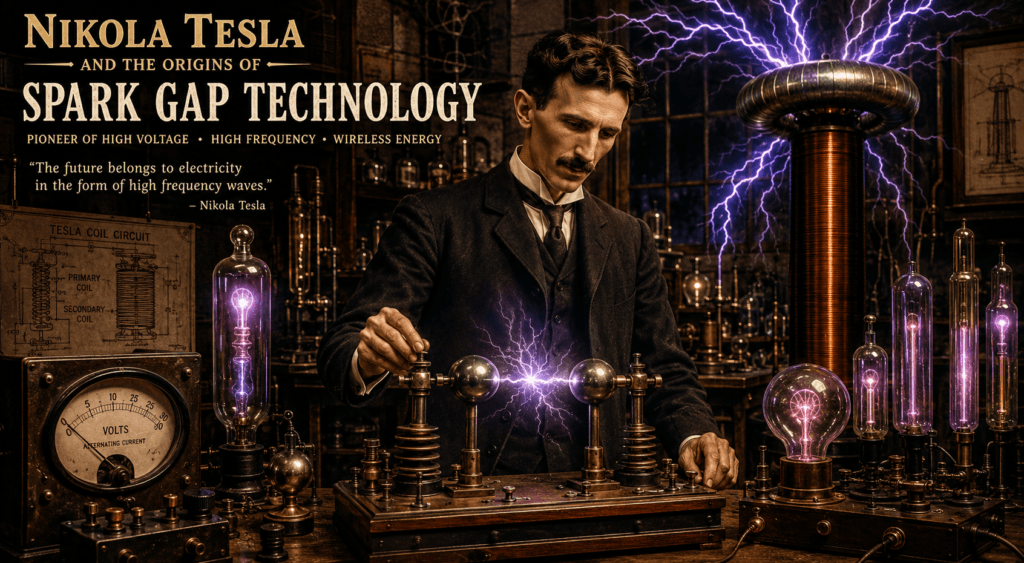
Tesla’s demonstrations showed that high-frequency electricity could behave in ways that seemed extraordinary to contemporary audiences. He illuminated lamps without conventional wired connections, produced enormous electrical discharges and explored the interaction between high-frequency currents, gases and evacuated tubes.
Modern spark gap plasma technology should not automatically be described as identical to Tesla’s original apparatus. However, many modern experimental plasma devices draw inspiration from the same broad electrical principles: high voltage, capacitance, rapid discharge, resonance, oscillation and gas ionisation.
From Early Electrical Experiments to Modern Plasma Devices
The decades around 1900 were an extraordinary period of electrical experimentation.
Researchers and inventors worked with:
- Tesla coils
- Ruhmkorff induction coils
- Spark-gap transmitters
- Oudin coils
- Violet ray apparatus
- Vacuum tubes
- Geissler tubes
- Crookes tubes
- High-frequency oscillators
- Early electrotherapy equipment
These devices varied enormously in their design and purpose, but many shared an interest in high voltage, electrical discharge and the behaviour of gases under electrical excitation.
As semiconductor technology developed, spark gaps largely disappeared from mainstream electronic switching applications. Transistors, MOSFETs and other solid-state components offered quieter, more efficient and precisely controlled switching.
Yet spark gaps retain some unusual characteristics.
They can withstand high voltages, switch extremely rapidly during breakdown and produce sharp impulsive discharges. For experimental high-voltage systems, they also provide a direct and highly visible demonstration of electrical breakdown.
This makes spark gap plasma technology particularly appealing to people interested in historically inspired electrical systems.
What Is Plasma?
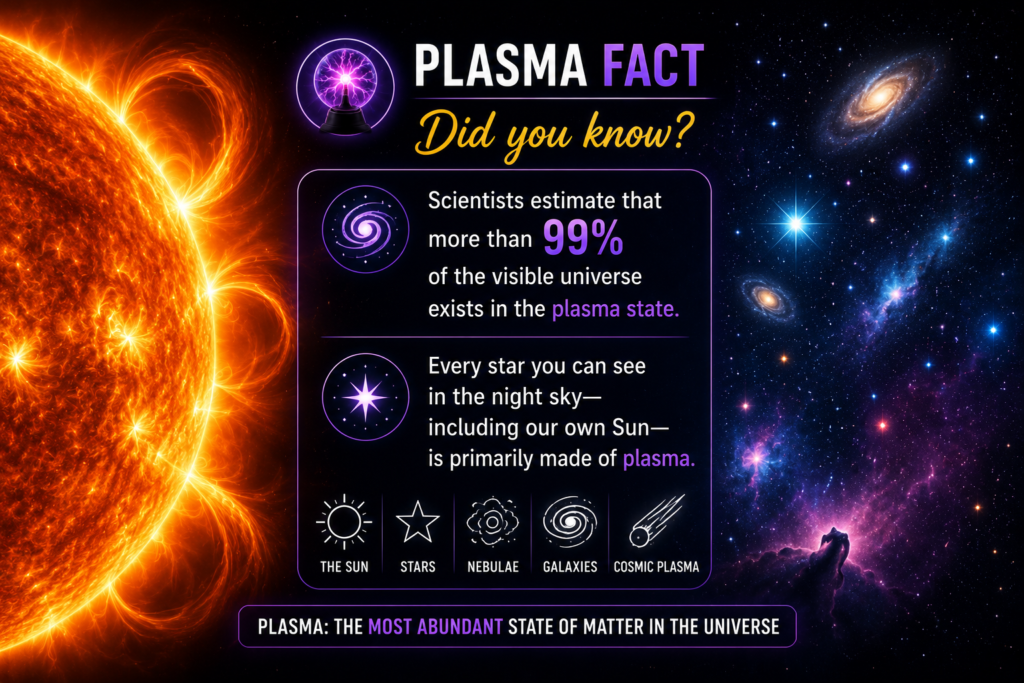
Plasma is often called the fourth state of matter.
The three commonly known states are:
Solid → Liquid → Gas
When enough energy is added to a gas, electrons can become separated from atoms or molecules. The resulting mixture of free electrons, ions and neutral particles is called plasma.
Plasma occurs naturally throughout the universe.
Examples include:
- The Sun and other stars
- Lightning
- Auroras
- The solar wind
Artificial plasma can also be created in:
- Neon signs
- Fluorescent lamps
- Plasma globes
- Laboratory plasma chambers
- Electric arcs
- Gas-discharge tubes
In a gas-filled plasma bulb, a sufficiently strong electrical field energises the gas. Electrons accelerate and collide with gas atoms. These interactions can excite and ionise the gas.
As excited particles return to lower-energy states, they release energy as light.
This is what creates the characteristic glow of a plasma discharge.
How Plasma Bulbs Work with a Spark Gap Generator
A modern high-frequency plasma system can combine several electrical stages before the final energy reaches its plasma bulbs.
The journey may be represented as:
Electrical input → high-frequency switching → high voltage → capacitive energy storage → spark-gap discharge → oscillations → gas ionisation → visible plasma.
The plasma bulbs provide a visible indication that electrical energy is interacting with the gas inside them.
Different gases and gas mixtures can produce different colours because each element has characteristic energy levels and emission spectra.
For example, neon is famously associated with an orange-red glow, while other gases and mixtures can produce blue, violet, pink or other colours.
The appearance of the plasma can also be influenced by pressure, bulb geometry, electrode configuration, voltage, frequency and waveform.
Why Use a Spark Gap Instead of Only Solid-State Electronics?
Modern solid-state electronics offer many advantages, including precision, efficiency, quiet operation and electronic control.
So why would anyone still be interested in a spark gap?
The answer is that spark gaps create a very different type of electrical event.
When breakdown occurs, stored energy can be released extremely rapidly. This produces sharp impulses and can excite a broad range of resonant behaviour within a suitable circuit.
Potential characteristics of a spark-gap system include:
- Extremely rapid electrical switching during breakdown
- High-voltage operation
- Sharp transient impulses
- Excitation of resonant oscillations
- Harmonic-rich electrical behaviour
- Broadband electromagnetic emissions
- A direct visual indication of electrical discharge
These characteristics do not automatically make a spark gap superior to solid-state switching for every application. The best technology depends entirely on the intended purpose.
However, for enthusiasts specifically interested in historical Tesla-inspired electrical systems and visible plasma generation, a genuine spark gap offers an experience that purely digital equipment cannot completely reproduce.
My Approach to Modern Spark Gap Plasma Technology
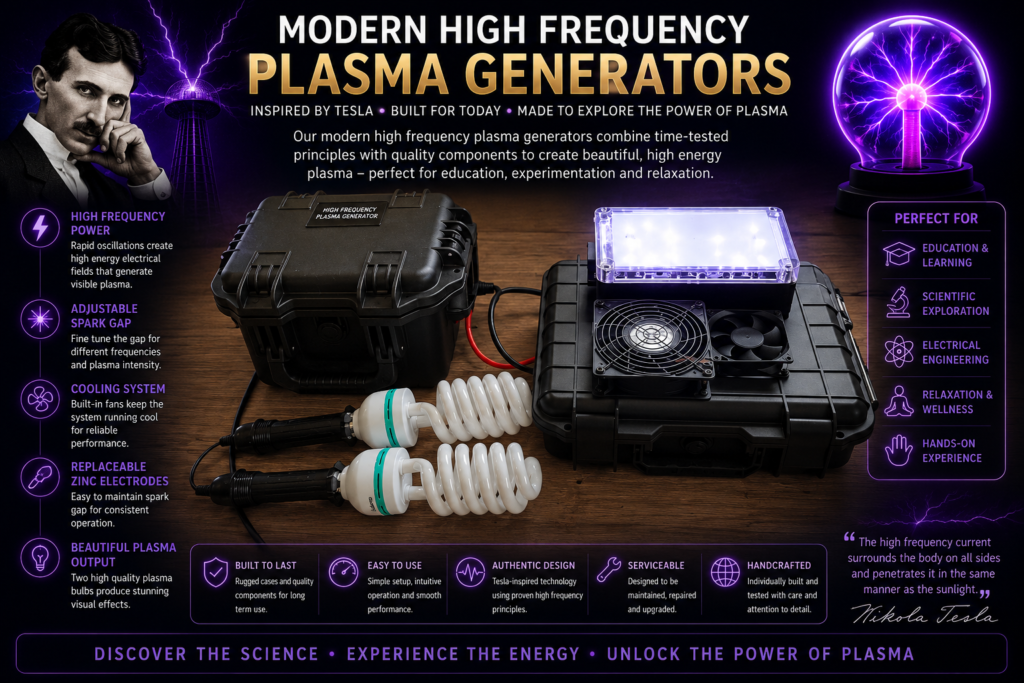
My own High Frequency Plasma Device was developed for people who want to experience a modern, purpose-built system based around high voltage, high-frequency electricity, spark-gap discharge and visible plasma generation.
Rather than requiring the user to construct a complex experimental apparatus from individual components, the system is designed as a complete device.
The main system combines a high-frequency producer, high-voltage generation, capacitors, a genuine adjustable spark gap and handheld gas-filled plasma bulbs.
The goal is to provide a practical and accessible way to experience this fascinating form of electrical technology without requiring the owner to design an entire high-voltage circuit from scratch.
My device is not presented as medical equipment and is not intended to diagnose, treat, cure or prevent disease. It is designed for people interested in high-frequency plasma technology, Tesla-inspired electrical principles and personal wellness practices.

Advantages of My High Frequency Plasma Device
One of the biggest advantages of my High Frequency Plasma Device is that it is supplied as a complete, integrated system.
Many people who become interested in spark gap plasma technology quickly discover that constructing a complete system can be complicated. It may require sourcing transformers, high-voltage capacitors, suitable wiring, electrodes, cooling systems, enclosures, connectors and gas-filled bulbs.
There are also important questions concerning electrical insulation, heat management, component compatibility and spark-gap maintenance.
My device brings these elements together in one purpose-built system.
A Genuine Adjustable Spark Gap
At the heart of the system is a real physical spark gap.
The electrodes can be adjusted, allowing the gap distance to be set and maintained appropriately. This is an important practical feature because electrode surfaces naturally change over time as repeated electrical arcs occur.
A serviceable spark gap gives the owner the ability to inspect and maintain this central part of the device.
Replaceable Zinc Electrodes
My spark-gap generator uses replaceable zinc rods.
Repeated electrical arcing gradually affects any spark-gap electrode. Rather than treating the entire spark-gap assembly as a sealed, disposable component, my design allows the rods to be maintained and replaced when necessary.
This helps make the device practical for long-term ownership.
Two Handheld Plasma Bulbs
The system includes two gas-filled handheld plasma bulbs.
When operating, the gas inside the bulbs becomes electrically excited and produces visible plasma. This creates an immediate visual demonstration of the high-frequency electrical activity within the system.
The two-bulb arrangement also makes the experience simple and intuitive for the user.
Plug-and-Play Operation
One of the strongest advantages is simplicity.
The device is designed to arrive as a complete system rather than a collection of experimental components requiring complex construction.
For many people, this is a major benefit. They may be deeply interested in Tesla-inspired technology and spark-gap plasma generation but have neither the time nor specialist experience required to build a high-voltage system from the ground up.
Purpose-Built Cooling
High-frequency electrical equipment generates heat, particularly during extended operation.
My system incorporates cooling fans to help manage internal temperatures and protect the electronic components during normal recommended operation.
Direct Customer Support
When purchasing specialist technology, support can be just as important as the hardware itself.
Because I personally build these devices, customers can receive guidance on operation, basic maintenance and general ownership.
This provides a more personal experience than purchasing an anonymous electronic product with little or no meaningful after-sales support.
Community Access

Owners can also gain access to a community where experiences, ideas and information can be shared.
For people exploring unusual technologies such as high-frequency plasma generation, having access to others with similar interests can be extremely valuable.
12-Month Warranty
The device is supplied with a 12-month warranty, giving customers additional reassurance when purchasing a specialist handmade electrical system.
What Is Included with the High Frequency Plasma Device?
The complete package includes:
- Two handheld plasma bulbs
- One high-frequency producer
- One spark-gap generator
- Replaceable zinc spark-gap rods
- Built-in cooling
- Simple plug-and-play instructions
- Customer support
- Community access
- A 12-month warranty
The purpose is to provide a complete route into spark gap plasma technology without requiring the customer to source and assemble numerous high-voltage components independently.
Spark Gap Plasma Technology vs Conventional Frequency Generators
Conventional electronic frequency generators and spark-gap plasma systems operate very differently.
A digital frequency generator is generally designed to produce a controlled waveform at a selected frequency. Depending on the equipment, it may generate sine, square, triangular or other waveforms with relatively precise frequency control.
A spark-gap system is much more dynamic.
The discharge event is impulsive, nonlinear and potentially rich in harmonics and transient oscillations. Its behaviour depends on the entire electrical system, including capacitance, inductance, spark-gap spacing, wiring geometry, electrode condition and load.
Therefore, it is misleading to think of a spark-gap plasma generator as simply another digital frequency generator.
It is better understood as an oscillatory high-voltage discharge system in which rapid spark events can excite complex electrical behaviour.
For some enthusiasts, this complexity is precisely what makes spark gap plasma technology so fascinating.
Can Spark Gap Plasma Technology Produce Multiple Frequencies?
Yes, a spark-gap system can produce complex frequency content rather than one perfectly isolated frequency.
Depending on the design, measurements may reveal:
- A primary resonant peak
- Harmonics
- Subharmonics
- Broadband noise
- Transient ringing
- Multiple resonances
- Radio-frequency emissions
The measured result can also depend heavily on the measuring equipment and method used.
A spectrum analyser with a pickup loop, for example, may detect different signals depending on:
- Distance from the device
- Pickup-loop orientation
- Loop dimensions
- Start and stop frequency settings
- Resolution bandwidth
- Detector settings
- Max-hold duration
- Nearby electronic interference
For this reason, meaningful measurement requires careful methodology.
The frequency content detected near a device should also not automatically be interpreted as the exact energy delivered at every location or as evidence of a biological effect.
The Importance of Resonance
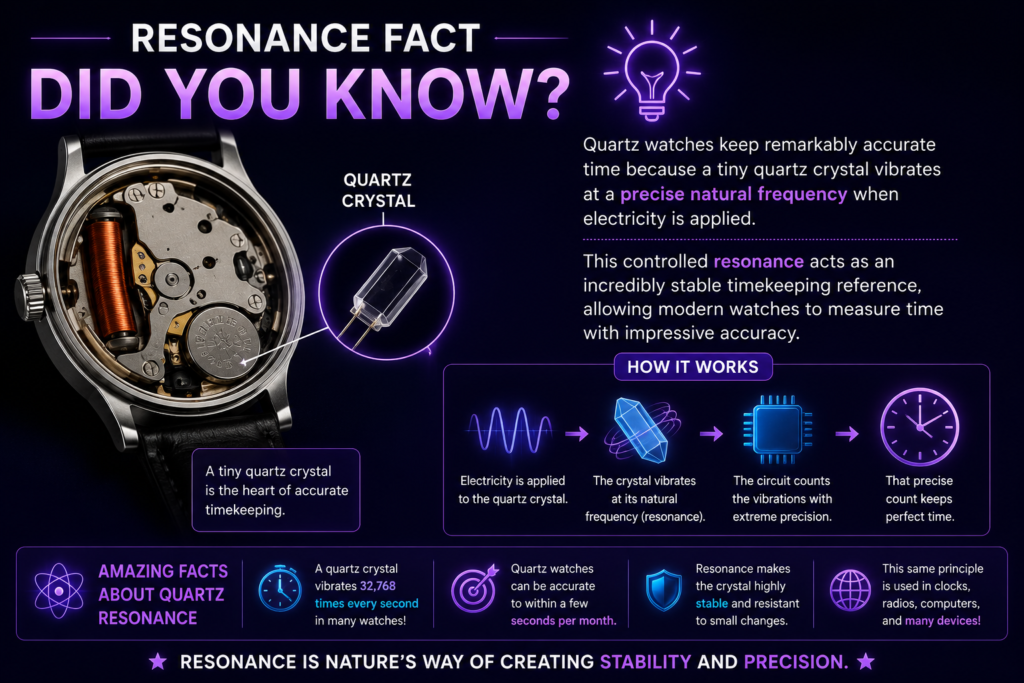
Resonance is central to many high-frequency electrical systems.
Every suitable combination of inductance and capacitance has a natural resonant frequency. When energy is supplied near that frequency, oscillations can build efficiently.
A familiar analogy is pushing someone on a swing.
If you push randomly, the movement may remain small. But if each push arrives at the correct moment, energy accumulates and the swing travels higher.
Electrical resonance follows a similar principle.
In Tesla coils and related circuits, resonance allows energy to oscillate between electric and magnetic fields. When primary and secondary systems are properly designed and coupled, substantial voltages can develop.
In modern spark gap plasma technology, the spark can act as the initiating event that releases stored energy into an oscillatory circuit.
Is Spark Gap Plasma Technology the Same as a Tesla Coil?
Not necessarily.
A traditional Tesla coil generally contains a resonant primary circuit and a resonant secondary coil, with energy transferred between them through electromagnetic coupling.
A spark-gap plasma device may use some related principles without being a conventional Tesla coil.
Both technologies can involve:
- High voltage
- High frequency
- Capacitance
- Inductance
- Electrical resonance
- Spark-gap switching
- Gas ionisation
However, their exact circuits, outputs and purposes may be substantially different.
It is more accurate to say that many modern spark-gap plasma devices are Tesla-inspired rather than claiming that every such device is a Tesla coil.
Who Is Interested in Spark Gap Plasma Technology?
Interest comes from many different communities, including:
- Tesla technology enthusiasts
- High-voltage experimenters
- Plasma enthusiasts
- Alternative technology researchers
- Electronics hobbyists
- People interested in historical electrical apparatus
- Wellness enthusiasts exploring non-medical technologies
- People fascinated by resonance and frequency
For some, the appeal is purely scientific and technical. For others, it is the history of Tesla and early electrical experimentation. Some are attracted by the visual beauty of plasma, while others incorporate these devices into broader personal wellness routines.
Whatever the motivation, it is important to distinguish established scientific principles—such as electrical breakdown, ionisation and resonance—from health claims that require specific clinical evidence.
Is a High Frequency Plasma Device Right for You?
If you are researching spark gap plasma technology, you may be deciding between building a system yourself and purchasing a complete device.
Building your own apparatus can be highly rewarding for experienced high-voltage enthusiasts, but it requires considerable knowledge and respect for the risks involved. High-voltage capacitors may retain dangerous electrical charge even after power is disconnected, and high-frequency systems can create electromagnetic interference and other hazards.
For people who want a complete system rather than a long-term construction project, my High Frequency Plasma Device provides an alternative.
It combines a genuine spark gap, replaceable zinc rods, high-frequency electrical generation, two handheld plasma bulbs, cooling, instructions and direct support in one integrated package.
The device is handmade and intended for people who appreciate specialist Tesla-inspired technology and want something more personal than a mass-produced electronic frequency generator.
Safety and Responsible Use
High-voltage plasma technology should always be treated with respect.
Users should follow the manufacturer’s operating instructions and should never open, modify or work on energised high-voltage equipment.
My High Frequency Plasma Device is not medical equipment and is not intended to diagnose, treat, cure or prevent any disease.
It should not be used during pregnancy or by people with pacemakers or other implanted electronic medical devices. Anyone with health concerns should seek advice from an appropriately qualified healthcare professional.
The recommended operating guidance supplied with the device should always be followed.
The Future of Spark Gap Plasma Technology
Although the spark gap is one of the oldest electrical switching technologies, it continues to fascinate new generations of experimenters.
Modern measurement equipment now allows enthusiasts to examine these systems in ways that Tesla and his contemporaries could only have imagined. Spectrum analysers, oscilloscopes, electromagnetic field meters and thermal cameras can reveal different aspects of device behaviour.
At the same time, growing interest in Tesla’s work has introduced many people to concepts such as resonance, high-frequency electricity, gas discharge and wireless energy.
The future of spark gap plasma technology may therefore lie not in replacing conventional electronics, but in preserving, studying and developing a remarkable branch of electrical science that remains visually spectacular and technically fascinating.
Final Thoughts: Exploring Spark Gap Plasma Technology
Spark gap plasma technology brings together some of the most captivating phenomena in electrical science: high voltage, electrical breakdown, rapid discharge, resonance, oscillations and glowing plasma.
Its history reaches back to the pioneering age of electrical experimentation, when Nikola Tesla and other researchers were discovering entirely new ways of generating and controlling electricity.
Today, modern plasma devices can bring these principles together in a more practical and accessible form.
My High Frequency Plasma Device was created for people who want to explore this fascinating technology through a complete, purpose-built system. It combines a high-frequency producer, genuine adjustable spark gap, replaceable zinc electrodes, two handheld plasma bulbs, cooling, direct customer support and a 12-month warranty.
Rather than simply selling a mass-produced electronic box, my aim is to offer a carefully built device and ongoing support for people who share an interest in high-frequency plasma, Tesla-inspired technology and personal wellness practices.
If you have been researching spark gap plasma technology and want to experience a genuine spark-gap plasma system without constructing a high-voltage device from individual components, the High Frequency Plasma Device offers a practical route into this fascinating world.
Important disclaimer: The High Frequency Plasma Device is not medical equipment and is not intended to diagnose, treat, cure or prevent disease. Do not use during pregnancy or if you have a pacemaker or other implanted electronic medical device. Always follow the supplied safety and operating instructions.
Frequently Asked Questions About Spark Gap Plasma Technology
What is spark gap plasma technology?
Spark gap plasma technology uses high voltage to create an electrical discharge across a gap between two electrodes. When the voltage becomes sufficiently high, the air between the electrodes ionises and becomes temporarily conductive, allowing a spark to form. In suitable circuits, this rapid discharge can excite high-frequency electrical oscillations and contribute to the generation of visible plasma in gas-filled bulbs.
How does a spark gap generate high-frequency energy?
A spark gap acts as an extremely fast electrical switch. Energy builds in the circuit until the voltage becomes high enough to break down the air between the electrodes. The resulting discharge can release stored energy rapidly into a resonant circuit, producing electrical oscillations determined by factors such as capacitance, inductance, resistance and circuit geometry.
Did Nikola Tesla use spark gaps?
Yes. Nikola Tesla used spark gaps extensively in many of his early high-voltage and high-frequency experiments. Spark gaps were an important component in early Tesla coil circuits, where they helped rapidly discharge capacitors into resonant primary circuits.
What is the purpose of the spark gap in a plasma device?
In a spark-gap plasma device, the spark gap can act as a rapid high-voltage switching mechanism. As voltage builds, the gap suddenly becomes conductive and releases stored electrical energy. This discharge can excite oscillations within the electrical system and contribute to the high-frequency conditions used to energise gas-filled plasma bulbs.
Why does a spark gap create multiple frequencies?
A spark-gap discharge is not necessarily a single, clean frequency. The rapid electrical transition can excite a complex range of resonances, harmonics and transient oscillations. The exact frequency spectrum depends on the capacitance, inductance, wiring, spark-gap spacing, electrode condition and overall geometry of the system.
What are the advantages of an adjustable spark gap?
An adjustable spark gap allows the distance between the electrodes to be changed and maintained. Because electrode surfaces can gradually change through repeated arcing, an adjustable design makes inspection and maintenance easier. Gap distance can also influence the voltage required for electrical breakdown and therefore affect the operating characteristics of the system.
Why does the High Frequency Plasma Device use replaceable zinc rods?
Repeated electrical arcing gradually affects spark-gap electrodes. The High Frequency Plasma Device uses replaceable zinc rods so that this important part of the system can be inspected, maintained and replaced when required. This helps make the spark-gap assembly practical for long-term ownership.
What makes the High Frequency Plasma Device different from a conventional frequency generator?
A conventional digital frequency generator is generally designed to produce controlled waveforms at selected frequencies. A spark-gap plasma device operates differently, using high voltage, rapid electrical breakdown, impulsive discharge and oscillatory circuit behaviour. This can create a more complex frequency spectrum containing resonances, harmonics and transient signals.
Does the High Frequency Plasma Device produce real plasma?
Yes. The gas inside the handheld bulbs becomes electrically excited and ionised, producing visible plasma. The appearance and colour of the plasma depend on factors including the gas composition, pressure, bulb design and electrical conditions.
Is the High Frequency Plasma Device a medical device?
No. The High Frequency Plasma Device is not medical equipment and is not intended to diagnose, treat, cure or prevent disease. It is a specialist high-frequency plasma device intended for people interested in Tesla-inspired electrical technology, plasma phenomena and personal wellness practices.
Who should not use a High Frequency Plasma Device?
The device should not be used during pregnancy or by anyone with a pacemaker or other implanted electronic medical device. Users should always follow the supplied operating and safety instructions. Anyone with health concerns should consult an appropriately qualified healthcare professional.
Where can I learn more about spark gap plasma technology?
The High Frequency Plasma Learning Centre contains detailed educational articles covering plasma, plasma generators, spark gaps, electrode materials, resonance and other aspects of high-frequency electrical technology. These resources are designed to help beginners understand the principles behind modern spark-gap plasma systems.