So, what is ionisation? Ionisation is the process by which an atom or molecule gains or loses one or more electrons and therefore acquires an electrical charge. In a gas discharge, energetic electrons can collide with neutral gas atoms and knock additional electrons free. This creates positively charged ions and more free electrons—the charged particles needed for plasma to form and conduct electricity.
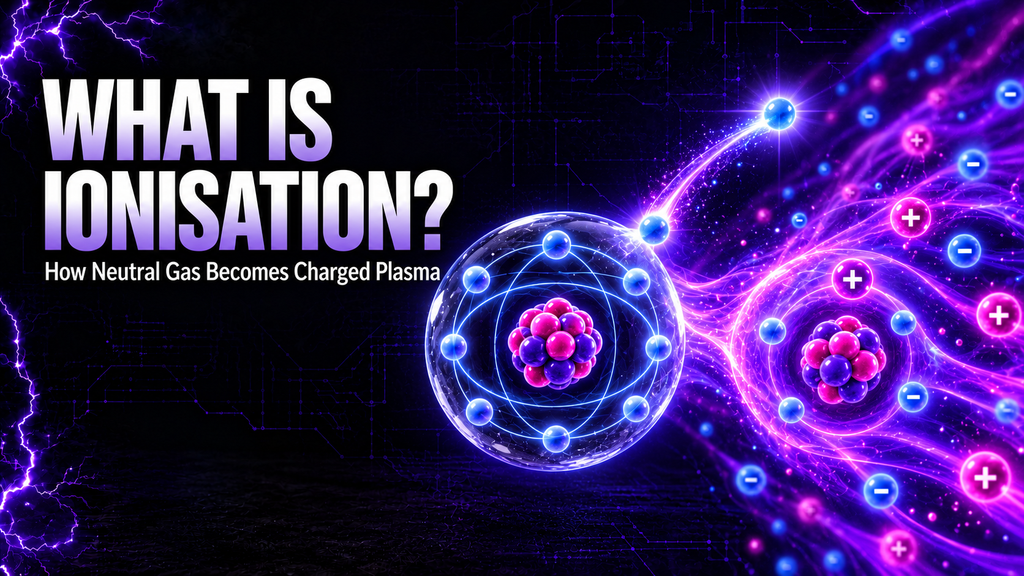
Ionisation is one of the most important ideas in plasma science. It explains how insulating air can suddenly become a conducting spark, how low-pressure gas inside a bulb becomes luminous plasma and why electrical streamers can develop inside a plasma ball.
📚 High Frequency Plasma Learning Centre
📘 Lesson 13 of 24 — What Is Ionisation?
Previous lesson: Lesson 12 — How Does a Plasma Ball Work?
Next lesson: Lesson 14 — What Is an Electric Field? (Coming Soon)
Estimated reading time: 15 minutes
Difficulty: 🟢 Beginner
What You’ll Learn
By the end of this lesson, you will understand:
- What ionisation means. ✔
- How a neutral atom becomes a positive or negative ion. ✔
- The difference between ionisation and excitation. ✔
- What ionisation energy means. ✔
- How electric fields accelerate free electrons. ✔
- How collisions can create an electron avalanche. ✔
- Why ionised gas can conduct electricity. ✔
- Why most practical plasmas are only partially ionised. ✔
- How ionisation produces sparks, glow discharges and streamers. ✔
- Where ionisation occurs in a spark-gap plasma generator. ✔
- Why ionisation is not the same as ionising radiation. ✔
The Short Answer: What Is Ionisation?
Ordinary atoms contain positively charged protons in the nucleus and negatively charged electrons surrounding that nucleus.
When an atom contains equal numbers of protons and electrons, its total electrical charge is neutral.
Ionisation changes that balance:
- If an atom loses an electron, it becomes a positively charged ion.
- If an atom gains an electron, it becomes a negatively charged ion.
- If a molecule gains or loses electrons, it becomes a molecular ion.
The free electron and the newly formed ion can respond to an electric field. When enough charged particles are present, a gas that was previously a good insulator can begin to carry electrical current.
The US Department of Energy’s explanation of plasma describes plasma as an ionised state containing positively charged ions and negatively charged electrons.
What Is an Atom?
To understand what ionisation is, it helps to begin with the structure of an atom.
An atom has a small central nucleus containing:
- Positively charged protons
- Electrically neutral neutrons
The nucleus is surrounded by negatively charged electrons. These electrons occupy allowed energy states rather than moving at any arbitrary energy.
The positive and negative charges balance in a neutral atom. For example, an atom with ten protons and ten electrons has no overall electrical charge.
The outer electrons are generally less tightly bound to the nucleus than the inner electrons. If sufficient energy is supplied, one of these outer electrons can be removed.
That removal is ionisation.
How Does a Neutral Atom Become a Positive Ion?
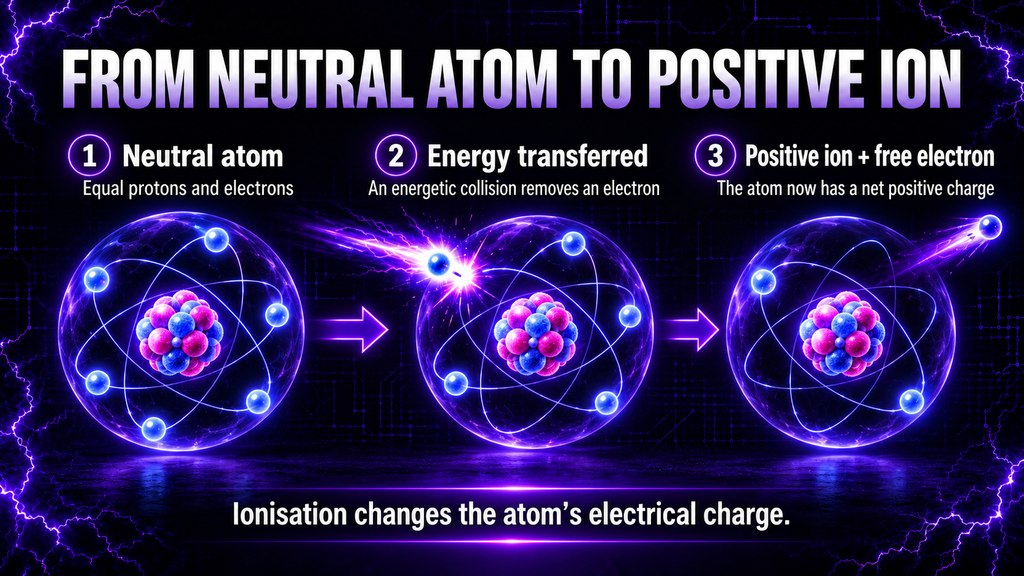
Imagine a neutral gas atom containing the same number of protons and electrons.
An energetic free electron approaches and collides with it. If the incoming electron transfers enough energy, it can remove one of the atom’s bound electrons.
The result is:
Neutral atom + energy → Positive ion + free electron
If electron impact caused the process, there are now two free electrons:
- The original electron that caused the collision
- The electron that was removed from the atom
The atom is left with one more proton than electrons, so it has a net positive charge.
The National Institute of Standards and Technology maintains an electron-impact ionisation and excitation database because these collision processes are fundamental to modelling plasmas, fluorescent lamps and other gas-discharge systems.
Can an Atom Become a Negative Ion?
Yes. An atom or molecule can sometimes capture an additional electron.
It then has more electrons than protons and becomes a negatively charged ion, or anion.
Whether attachment occurs depends on the species involved, the electron’s energy and the surrounding conditions. Some gases are much more likely than others to capture free electrons.
In many introductory descriptions of noble-gas plasma, attention is placed mainly on positive ions and free electrons. However, real gas discharges can also contain negative ions, excited atoms, molecular fragments and many other short-lived species.
Plasma is therefore not one single substance. It is an electrically active mixture whose composition depends on the gas, pressure, temperature, electric field and energy source.
What Is Ionisation Energy?
Electrons are bound to atoms. Removing one requires energy.
The first ionisation energy is the minimum energy required to remove the most loosely bound electron from a neutral gaseous atom in its ground state.
Different elements have different ionisation energies because their electrons are held with different strengths.
The OpenStax explanation of ionisation energy describes it as the energy required to remove the most loosely bound electron from a gaseous atom.
If one electron has already been removed, taking away a second electron normally requires additional energy. This is called the second ionisation energy.
In a plasma bulb or spark gap, energy is not delivered to every atom equally. Some electron collisions are too weak to produce ionisation. Others cause excitation, elastic scattering or different forms of energy transfer.
Only collisions with suitable energy and geometry produce an ionising event.
Ionisation and Excitation Are Not the Same
Ionisation and excitation are closely connected, but they describe different outcomes.
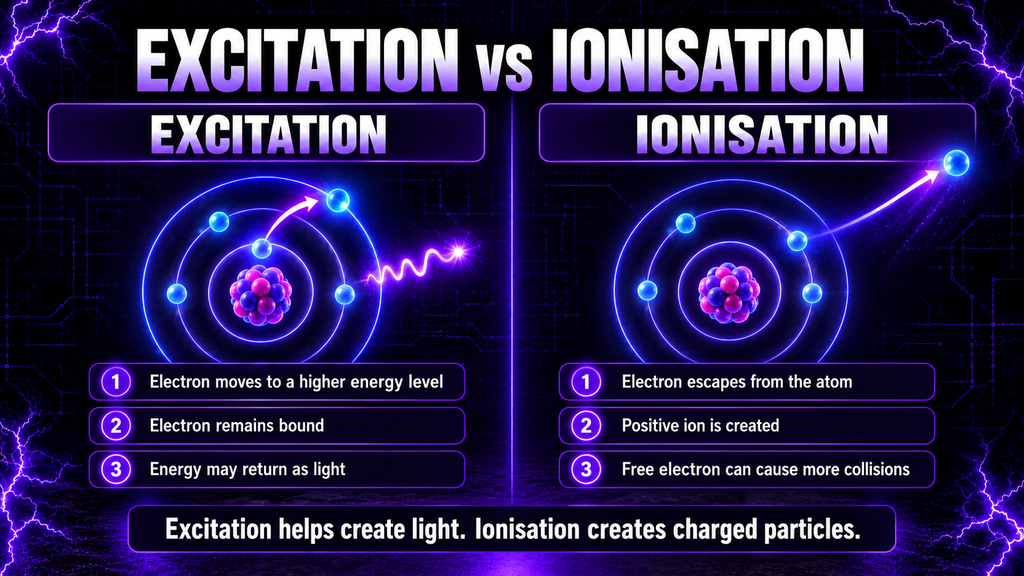
Excitation
During excitation, an electron inside an atom absorbs energy and moves to a higher allowed energy state. It remains bound to the atom.
The excited state is normally temporary. When the electron returns to a lower energy state, the atom can release energy as a photon.
This light-emission process helps produce the colour seen in plasma bulbs, neon signs and other gas-discharge lamps.
Ionisation
During ionisation, enough energy is transferred to remove an electron completely from the atom or molecule.
The result is a positive ion and a free electron.
The difference can be summarised as follows:
| Process | What happens to the electron? | Main result |
|---|---|---|
| Excitation | Moves to a higher bound energy state | Excited atom that may emit light |
| Ionisation | Escapes from the atom or molecule | Ion plus free electron |
OpenStax distinguishes these processes in its explanation of how spectral lines form: collisions can excite an atom, while a sufficiently energetic collision can ionise it.
A glowing plasma normally involves both processes. Ionisation provides charged particles and electrical conductivity, while excitation and relaxation are major contributors to the visible light.
Where Does the First Free Electron Come From?
If free electrons cause further ionisation, it is reasonable to ask where the first free electron originates.
Even apparently neutral gas is not perfectly free of charged particles. A small number can be produced by:
- Natural background radiation
- Ultraviolet light
- Cosmic rays
- Previous electrical discharges
- Heat
- Field emission from an electrode
- Collisions at surfaces
These initial charges are sometimes called seed electrons.
Most disappear quickly under ordinary conditions. However, when a sufficiently strong electric field is present, a seed electron can be accelerated before it recombines or becomes attached to another particle.
That first accelerated electron can begin a much larger multiplication process.
How Does an Electric Field Cause Ionisation?
An electric field exerts a force on charged particles.
Electrons have negative charge, so they accelerate in the direction opposite to the conventional electric-field direction. Positive ions accelerate the other way, although their greater mass means they normally respond more slowly.
As a free electron travels through a gas, it gains kinetic energy from the field. Eventually it collides with an atom or molecule.
Several outcomes are possible:
- The electron changes direction but transfers little energy.
- It excites the atom.
- It ionises the atom.
- It becomes attached to a molecule.
- It transfers energy through another collision process.
If the electron gains enough energy between collisions, an ionising collision becomes possible.
This is why voltage alone does not provide the complete explanation. The result depends on the electric-field strength, the distance available for acceleration, gas pressure, gas composition and electrode geometry.
Lesson 14 will examine electric fields in greater detail.
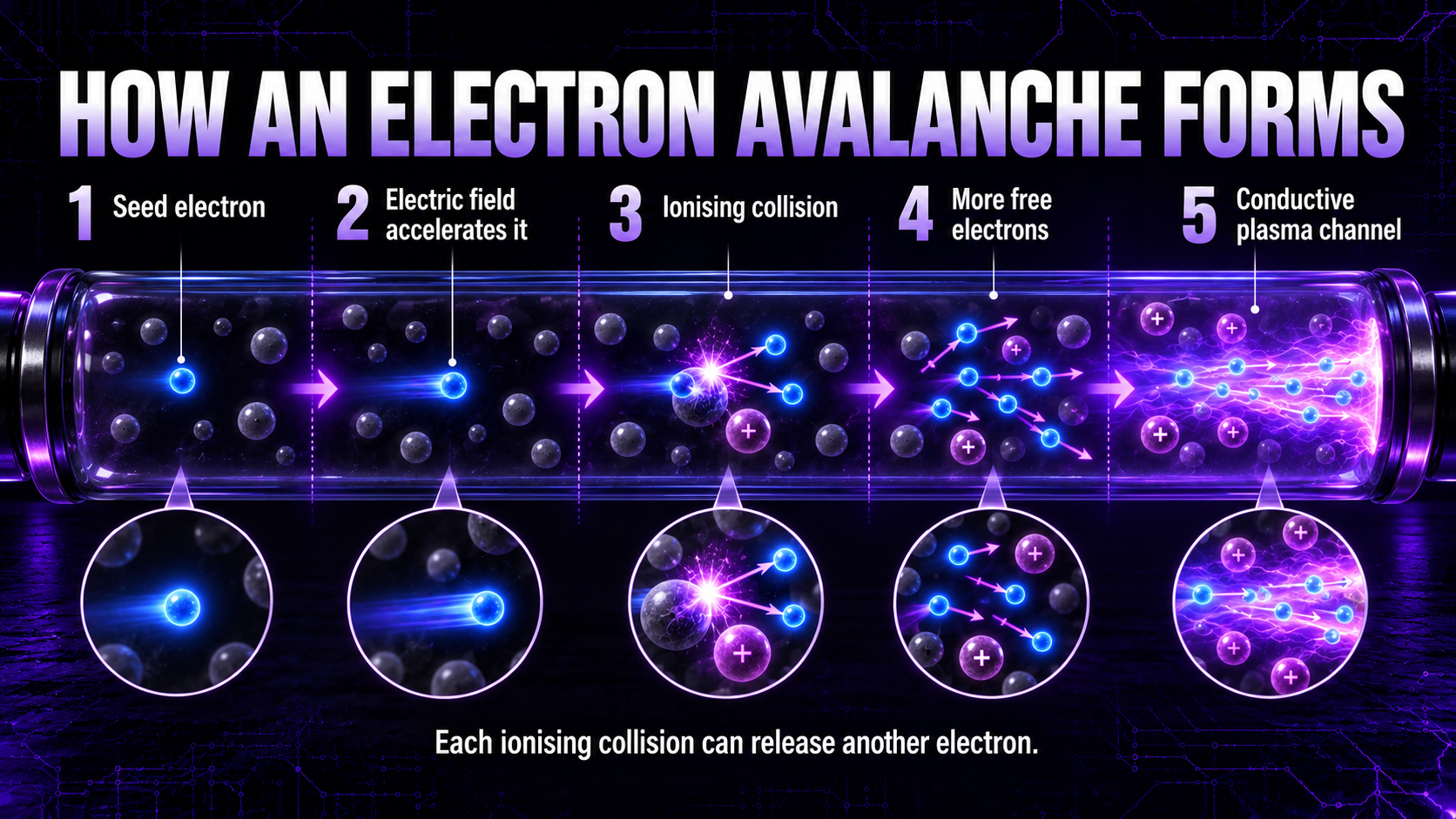
What Is an Electron Avalanche?
One ionising collision can release an additional free electron. Both electrons can then accelerate and collide with more atoms.
If conditions are suitable, the number of free electrons grows rapidly:
- A seed electron accelerates through the gas.
- It strikes a neutral atom with sufficient energy.
- The atom loses an electron and becomes a positive ion.
- Two free electrons are now available.
- Both electrons accelerate and cause further collisions.
- Four electrons may become eight, then sixteen and more.
This multiplication is called an electron avalanche or Townsend avalanche.
The process does not continue indefinitely without energy. Collisions, recombination, attachment, diffusion and circuit limitations remove particles and energy. However, an avalanche can create enough charged particles for the gas to break down electrically and form a discharge.
The University of California, Santa Barbara’s glow-discharge demonstration explains that electrons accelerated by a high voltage can ionise gas molecules, releasing more electrons that then ionise additional molecules.
What Is Electrical Breakdown?
Under ordinary conditions, air and many other gases are good electrical insulators.
As an electric field becomes stronger, ionisation can multiply faster than charged particles are lost. A conductive path begins to develop.
The gas has undergone electrical breakdown.
Breakdown can appear in several forms:
- A spark
- An electrical arc
- A corona discharge
- A glow discharge
- A streamer
The exact form depends on voltage, available current, gas pressure, gap distance, frequency, electrode shape and the surrounding circuit.
Electrical breakdown does not mean that every gas atom has become ionised. A relatively small population of charged particles can dramatically increase conductivity and produce a visible discharge.
Why Do Gas Pressure and Distance Matter?
An electron must gain enough energy from the electric field between collisions.
If the gas pressure is high, particles are close together and collisions occur frequently. An electron may have little distance in which to accelerate.
If the pressure is extremely low, electrons can travel farther, but there may be too few gas particles available to sustain a bright discharge.
The distance between electrodes also matters. Too little distance may limit the energy an electron gains, while a larger gap generally requires the discharge to develop across a longer path.
The relationship between gas pressure, electrode spacing and breakdown voltage is commonly described by Paschen’s law under suitable conditions.
The important beginner’s point is:
Gas breakdown depends on the combination of pressure, distance, gas type, electrode shape and electric field—not on one factor alone.
This is why low-pressure plasma bulbs can produce visible discharges under different conditions from a spark gap operating in ordinary air.
Why Does Ionised Gas Conduct Electricity?
A neutral gas contains very few mobile charged particles. It therefore resists the movement of electrical current.
Ionisation creates free electrons and ions that can move in response to an electric field.
- Electrons move rapidly because they have very little mass.
- Positive ions move more slowly in the opposite direction.
- Negative ions, when present, move according to their charge.
This organised movement of charged particles constitutes electrical current.
As conductivity increases, more current can flow through the ionised channel. That current may produce additional collisions, heat and ionisation, helping sustain the discharge.
The surrounding circuit remains important. It determines how much energy and current are available. Ionising a gas does not create energy; it changes the gas’s electrical behaviour so supplied energy can move through it more readily.
Does All the Gas Become Ionised?
Usually not.
Most laboratory and commercial gas discharges are partially ionised plasmas. Neutral atoms or molecules may greatly outnumber ions and free electrons.
Nevertheless, the charged particles can dominate important electrical behaviour because they respond strongly to electric and magnetic fields.
This is why a plasma ball, fluorescent lamp or low-pressure plasma bulb can operate without every atom losing an electron.
The degree of ionisation depends on factors including:
- Electric-field strength
- Electron energy
- Gas type
- Gas pressure
- Temperature
- Available power
- Collision rates
- Recombination and attachment rates
Plasma should therefore not be imagined as a container filled only with bare nuclei and electrons. That description applies only to much more highly ionised conditions. A visible low-temperature discharge contains neutral gas alongside charged and excited particles.
How Does Ionisation Create Visible Light?
Ionisation itself creates charged particles, but the visible glow involves several related processes.
Energetic electrons collide with gas atoms and excite them. When those atoms return to lower energy states, they emit photons.
Ions and electrons can also recombine. Energy released during recombination may appear through photons or other collisions, depending on the process.
Different gases emit different characteristic colours because their allowed energy levels are different:
- Neon commonly produces orange-red light.
- Argon often contributes violet or blue tones.
- Krypton can produce pale whitish light.
- Xenon can contribute blue, violet or white-blue tones.
The visible colour also depends on pressure, electron-energy distribution, gas mixture and any phosphor coating inside the bulb.
Ionisation makes the gas electrically active. Excitation and relaxation make much of that activity visible.
What Is Recombination?
Recombination is the process by which a free electron becomes bound to a positive ion, returning it towards a neutral state.
It acts in the opposite direction to ionisation:
Positive ion + free electron → Neutral atom or molecule + released energy
In an operating plasma, ionisation and recombination can occur at the same time.
- Ionisation produces charged particles.
- Recombination removes charged particles.
- Attachment can create negative ions.
- Diffusion carries particles away from active regions.
If the power source supplies energy quickly enough, ionisation can replace the charged particles being lost and the discharge continues.
When the power is removed, free electrons and ions recombine, attach or reach surfaces. The visible plasma fades because the energy source maintaining it has disappeared.
Ionisation in a Spark Gap
A spark gap contains conductive electrodes separated by a gas—usually air in an open or ventilated assembly.
At first, the air is insulating. As voltage builds, the electric field between the electrode surfaces becomes stronger.
Seed electrons accelerate and collide with air molecules. When ionising collisions multiply rapidly enough, a conductive channel forms across the gap.
The sequence is:
Voltage builds → Electric field strengthens → Electron avalanche develops → Air breaks down → Arc forms
The arc allows stored electrical energy to discharge through the circuit. As discussed in Lesson 10 — What Are Electrical Oscillations?, that rapid discharge can excite high-frequency electrical oscillations.
When the available energy falls and the current becomes insufficient to sustain the path, the arc extinguishes. The gas cools and loses charged particles until the voltage builds enough for the next firing event.
Learn more in Lesson 4 — What Is a Spark Gap?.
Ionisation Inside a Plasma Bulb
The sealed bulbs used with my High Frequency Plasma Generator contain gas at reduced pressure.
When rapidly changing high-voltage electrical energy reaches a bulb, the electric field accelerates free electrons through the gas. Collisions excite and ionise some atoms, producing a luminous, partially ionised discharge.
The bulb and spark gap therefore both involve gas ionisation, but their operating conditions differ:
| Spark gap | Plasma bulb |
|---|---|
| Usually operates in air near atmospheric pressure | Contains a selected gas or vapour at reduced pressure |
| Produces a concentrated arc between electrodes | Produces a distributed glow or filamentary discharge |
| Acts as rapid electrical switching element | Acts as a visible plasma output and electrical load |
| Arc is exposed within its protective enclosure | Gas discharge remains sealed inside glass |
The spark-gap ionisation initiates rapid discharge events. The bulb ionisation creates the visible plasma output.
Read Lesson 6 — Why Are Plasma Bulbs Used? for more about the bulb stage.
Ionisation Inside a Plasma Ball
A plasma ball uses a central high-voltage electrode and low-pressure gas sealed inside a glass globe.
The alternating electric field accelerates electrons, initiating excitation and ionisation. Conductive streamers form through the gas and reach the inner surface of the globe.
When a hand touches the outside, capacitive coupling changes the local field and concentrates streamers beneath the fingertips. The hand does not directly touch the ionised gas; the glass remains between the user and the plasma.
This provides a clear visual example of how ionisation transforms the electrical behaviour of a gas.
Review the full explanation in Lesson 12 — How Does a Plasma Ball Work?.
Ionisation Is Not the Same as Ionising Radiation
The similar wording often causes confusion.
Ionisation is any process that creates ions by adding or removing electrons.
Ionising radiation is radiation energetic enough to ionise atoms or molecules as it passes through matter. Examples include X-rays, gamma rays and sufficiently energetic ultraviolet radiation.
Electrical discharges can produce ionisation through electron collisions without being an X-ray or gamma-ray source.
At the same time, high-voltage equipment can present other hazards, including shock, burns, heat, ultraviolet emission near arcs, electromagnetic interference and stored electrical charge.
The word “ionised” should therefore not be used to claim that something is radioactive, and the word “plasma” does not automatically mean that ionising radiation is present.
Does High Frequency Cause Ionisation?
Frequency can influence how a discharge behaves, but it is not accurate to say that frequency alone ionises the gas.
Ionisation requires energy to be transferred to atoms or molecules. In an electrical discharge, important factors include:
- Electric-field strength
- Voltage
- Gas pressure and composition
- Distance and geometry
- Electron energy between collisions
- Available current and power
- Frequency and waveform
A rapidly alternating field can repeatedly accelerate electrons and help sustain a discharge. However, a high frequency with insufficient field strength or available energy may not create ionisation.
Similarly, a strong direct electric field can ionise a gas even though it is not alternating at high frequency.
Frequency is therefore one part of the complete operating conditions—not a substitute for voltage, field strength or energy.
Common Myths About Ionisation
Myth 1 — Every atom in a plasma is ionised
Most visible low-temperature plasmas are only partially ionised and still contain many neutral atoms or molecules.
Myth 2 — Ionisation and excitation mean the same thing
Excitation leaves the electron bound to the atom. Ionisation removes or adds an electron and changes the atom’s net charge.
Myth 3 — The visible light is the ion itself
The glow consists of photons released by excited particles and related discharge processes. Individual ions and electrons are too small to see directly.
Myth 4 — High voltage always creates plasma
Gas type, pressure, distance, geometry, available energy and electric-field strength all influence whether a discharge forms.
Myth 5 — Ionised gas is automatically radioactive
Ionisation does not make a gas radioactive. Radioactivity involves unstable atomic nuclei, which is a different phenomenon.
Myth 6 — Ionisation creates free energy
It does not. The energy involved comes from the electrical supply or another external source.
Frequently Asked Questions
What Is the Simplest Definition of Ionisation?
Ionisation is the process of creating an electrically charged atom or molecule by adding or removing electrons.
What Is an Ion?
An ion is an atom or molecule with an unequal number of protons and electrons, giving it a net electrical charge.
What Is a Free Electron?
A free electron is no longer bound to one particular atom or molecule and can move through the material or gas under the influence of an electric field.
Does Ionisation Always Remove an Electron?
Not always. Losing an electron creates a positive ion, while gaining an electron creates a negative ion. In gas-discharge discussions, “ionisation” often refers specifically to electron removal.
Why Does Ionisation Make Gas Conductive?
It supplies mobile charged particles. Free electrons and ions move in response to an electric field and carry electrical current.
Is a Spark Made From Plasma?
A spark contains a rapidly formed channel of ionised and excited gas. The channel can conduct current and emit visible light, so it displays plasma behaviour.
Is Flame a Plasma?
Some flames contain ions and free electrons, but the degree of ionisation may be very low. Whether a particular flame is usefully described as plasma depends on its temperature, composition and collective electrical behaviour.
Why Does Ionised Gas Stop Glowing?
When the energy supply is removed, fewer particles are excited and ionised. Electrons and ions recombine, attach or reach surfaces, so the discharge and its light fade.
Can Ionisation Be Measured?
Yes. Researchers can measure electrical current, voltage, emission spectra, electron density, ion density and other plasma properties. No single instrument measures every aspect of ionisation.
Does Visible Brightness Show the Degree of Ionisation?
Not by itself. Brightness also depends on excitation, gas type, pressure, current, viewing conditions, phosphor coatings and the spectrum produced. A brighter glow does not automatically prove a larger ionised fraction.
Does Ionisation Demonstrate a Health Benefit?
No. Observing gas ionisation shows that a plasma discharge exists; it does not establish a biological or therapeutic effect. Health claims require suitable clinical evidence for the specific device and intended use.
What Have We Learned?
So, what is ionisation?
It is the process that changes a neutral atom or molecule into a charged particle by removing or adding electrons.
In an electrical gas discharge:
- A seed electron is present in the gas.
- An electric field accelerates it.
- The electron collides with a neutral atom or molecule.
- A sufficiently energetic collision removes another electron.
- A positive ion and an additional free electron are created.
- The free electrons cause further collisions.
- An electron avalanche can develop.
- The gas becomes more electrically conductive.
- A spark, arc, streamer or glow discharge may form.
- Excited particles release photons and make the discharge visible.
Ionisation is the bridge between an ordinary neutral gas and electrically active plasma.
🧠 Key Takeaways
- Ionisation creates charged atoms or molecules. ✔
- Losing an electron produces a positive ion. ✔
- Gaining an electron produces a negative ion. ✔
- Ionisation requires sufficient energy. ✔
- Excitation raises an electron’s energy without removing it. ✔
- Electric fields accelerate free electrons through a gas. ✔
- Ionising collisions can multiply into an electron avalanche. ✔
- Ionised gas conducts because it contains mobile charged particles. ✔
- Most practical gas-discharge plasmas are only partially ionised. ✔
- Spark gaps, plasma bulbs and plasma balls all use ionisation under different conditions. ✔
- Ionisation is not automatically ionising radiation or radioactivity. ✔
🔬 Ionisation Fact
Did you know?
A visible plasma does not require every gas atom to be ionised. Even when neutral particles greatly outnumber charged particles, electrons and ions can respond strongly to electric and magnetic fields and dominate the gas’s electrical behaviour.
Continue Your Learning Journey
⬅ Previous Lesson
📘 Lesson 12 of 24 — How Does a Plasma Ball Work?
Discover how a high-voltage, high-frequency electric field energises low-pressure gas and creates luminous streamers inside a sealed glass globe.
➡ Next Lesson
📘 Lesson 14 of 24 — What Is an Electric Field? (Coming Soon)
Discover how charged objects create an influence through space, how electric fields are represented and why field strength is essential to sparks, ionisation and plasma formation.
Learn More About High-Frequency Plasma
If you would like to see how these principles relate to my enclosed spark-gap system, visit the High Frequency Plasma Generator.
You can also join the High Frequency Plasma Community on Telegram to ask Alan questions directly, discuss the technology and read owners’ personal experiences. Individual experiences are anecdotal and should not be treated as medical evidence.
Disclaimer
The information in the High Frequency Plasma Learning Centre is provided for general educational purposes to explain the science, history and engineering of plasma and high-frequency electrical technology.
Gas-discharge and plasma equipment can contain dangerous high voltage, stored electrical charge, hot components and rapidly changing electromagnetic fields. This lesson explains scientific principles; it is not a construction, modification or servicing guide.
The High Frequency Plasma Generator is intended for educational, experimental, research, meditation, relaxation and general wellness purposes only. It is not a medical device and is not intended to diagnose, treat, cure, mitigate or prevent any disease or medical condition.
Always seek advice from a suitably qualified healthcare professional regarding medical concerns.
🎉 Lesson Complete
Congratulations!
You have now completed:
📘 Lesson 13 of 24
What Is Ionisation? How Neutral Gas Becomes Charged Plasma
You now understand how electrons are removed or added to atoms, how charged particles multiply through collisions and why ionisation allows gases to form conducting, luminous plasma.