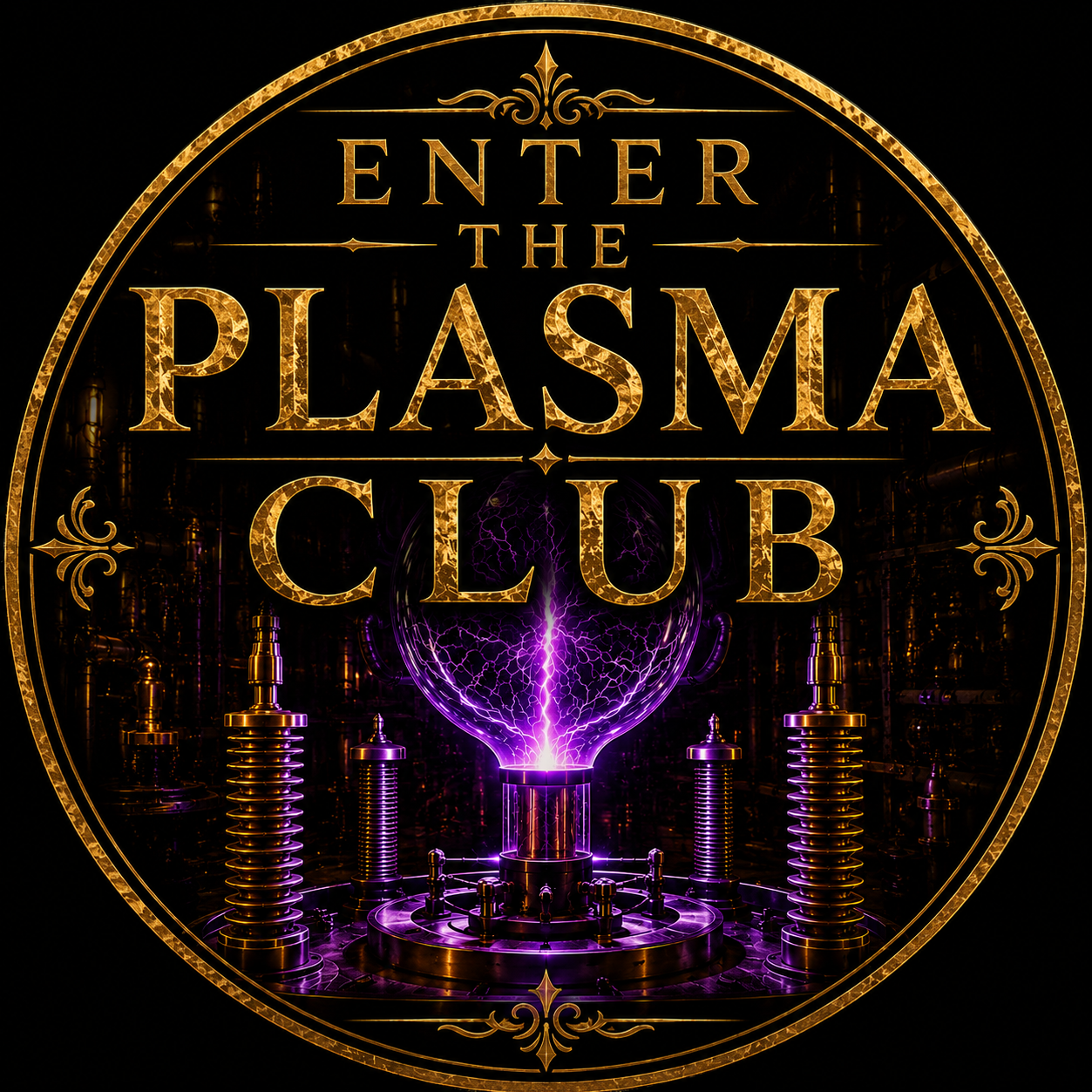
Magnetic resonance therapy is a non-invasive procedure that uses carefully coordinated magnetic fields and radiofrequency signals. It is most commonly associated with MBST, also called molecular biophysical stimulation therapy or therapeutic nuclear magnetic resonance. Commercial systems are promoted mainly for osteoarthritis, bone and musculoskeletal conditions.
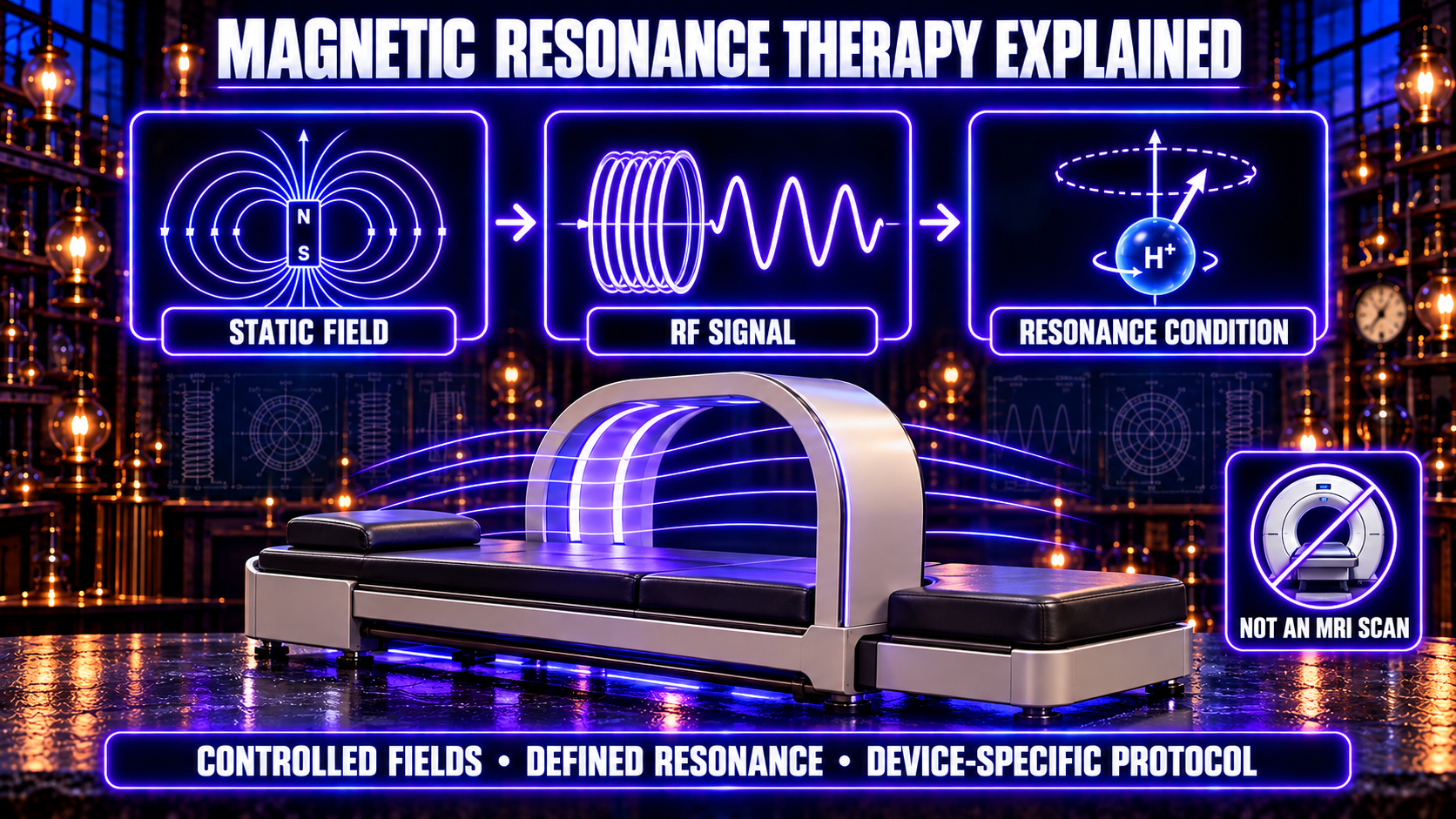
The name resembles magnetic resonance imaging because both refer to nuclear magnetic resonance. Their purposes differ. MRI uses strong magnets, gradient coils and radiofrequency pulses to create diagnostic images; a therapeutic system applies a lower-field programmed sequence without producing pictures.
It must also be distinguished from PEMF, static magnets, transcranial magnetic stimulation and high-frequency plasma. Shared words such as frequency and resonance do not make their outputs or evidence interchangeable.
My High Frequency Plasma Generator is a different type of machine. It uses a Tesla-inspired high-voltage circuit, capacitor bank, adjustable spark gap and resonant output to energise gas inside two bulbs. The repeated discharges create a complex spectrum containing many frequency components rather than one digitally selected therapeutic frequency.
This article explains what the therapy is, what current research says and why the broad output of a spark-gap plasma generator should be understood as fascinating electrical behaviour—not as proof of a medical result.
What Is Magnetic Resonance Therapy?
The term usually refers to therapeutic nuclear magnetic resonance, abbreviated MRT, NMRT or MBST. A person sits or lies within an applicator while coils establish magnetic and radiofrequency fields. Commercial courses often use one-hour sessions on several consecutive days, although protocols vary.
The physical idea begins with hydrogen nuclei, abundant because the body contains water and fat. In a static magnetic field, their magnetic orientation undergoes a motion called precession.
The rate of that precession is related to magnetic-field strength. It is commonly described by the Larmor relationship:
Resonance frequency = gyromagnetic ratio × magnetic-field strength
An alternating field can transfer energy when its frequency and orientation satisfy resonance conditions. MRI uses this behaviour to construct images; therapeutic machines attempt to use related low-field principles without imaging.
Manufacturers describe sequences intended for tissues such as cartilage or bone. That proposed mechanism is not clinical proof. Any result depends on the exact device, fields, coil geometry, waveform, exposure and target tissue.
Is It the Same as an MRI Scan?
No. An MRI scan is a diagnostic procedure producing detailed internal images. Its large magnet, gradient fields and radiofrequency systems are designed for imaging.
Magnetic resonance therapy is an intervention, usually using weaker fields without generating an anatomical picture. It cannot substitute for a requested MRI scan, and imaging is not itself treatment.
Shared physics does not make the machines equivalent. Equipment must be evaluated by its design and intended purpose.
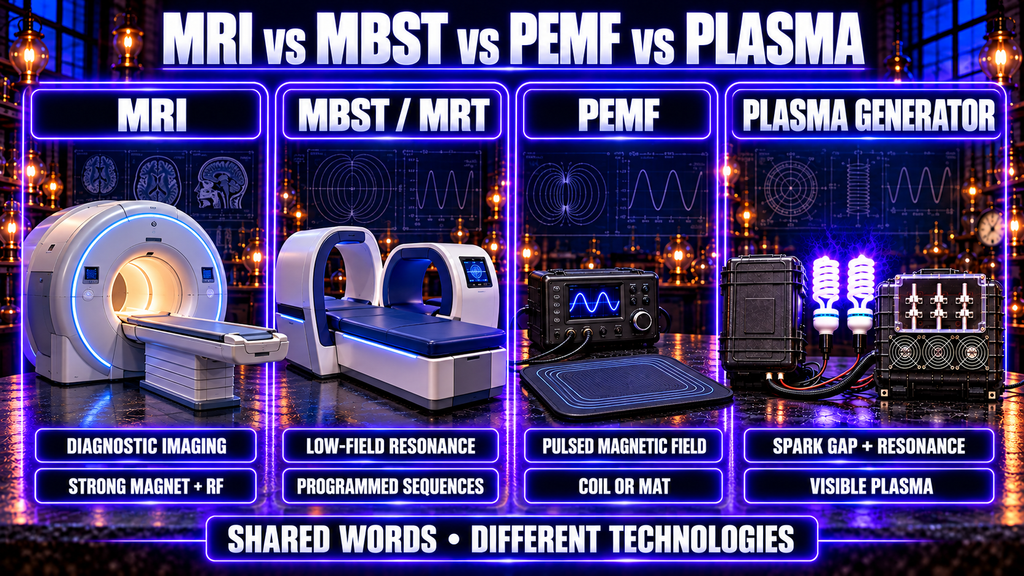
MRT, MBST, PEMF and TMS: Important Differences
Frequency-related terminology can make very different systems sound alike.
| Technology | Main purpose | Typical output arrangement | Key distinction |
|---|---|---|---|
| MRI | Diagnostic imaging | Strong magnet, gradient coils and RF coils | Produces medical images |
| MRT, NMRT or MBST | Proposed musculoskeletal intervention | Low-field coil system with coordinated RF sequences | Attempts to establish therapeutic resonance conditions |
| PEMF | Pulsed electromagnetic field exposure | Timed current pulses through a mat, pad or local coil | Often offers selectable pulse rates and intensities |
| TMS | Clinical brain stimulation | Powerful magnetic pulses from a coil near the head | Used under defined clinical protocols for specific indications |
| High-frequency plasma generator | Plasma generation and electrical experimentation | High voltage, resonant circuitry, spark gap and gas-filled bulbs | Creates visible plasma and complex oscillations |
A magnetic or electric field does not automatically make equipment medical. Nor does hertz identify the form of energy: ten hertz of sound and ten hertz of magnetic pulses are different exposures.
For a direct engineering comparison between coil-based equipment and plasma, see High Frequency Plasma vs PEMF.
What Does the Research Say?
Research into magnetic resonance therapy includes laboratory work, observational studies and a smaller number of controlled clinical trials. Findings should be read with attention to study quality and the exact system tested.
A 2016 randomised, double-blind, placebo-controlled trial studied a ten-day course in people with mild to moderate knee osteoarthritis. Ninety-seven participants completed the trial. Both the active and placebo groups improved, but there were no significant between-group differences in the reported clinical outcomes or imaging results. The researchers concluded that the treatment was not superior to placebo under that protocol.
A 2021 scoping review examined seven osteoarthritis studies and found reports suggesting improvements. However, six relied on subjective outcomes; the authors highlighted small samples, missing control groups and confounding factors, and called for stronger research.
For British readers, NICE guidance on magnetic resonance therapy for knee osteoarthritis says safety evidence raises no major concern, but efficacy evidence is inadequate and shows no benefit over placebo. NICE limits the procedure to research and recommends appropriately powered placebo-controlled trials.
This does not test every possible protocol. It means routine clinical benefit has not been established to NICE’s standard. Testimonials and laboratory mechanisms cannot replace good human trials.
Why Frequency Alone Does Not Define a Therapy
People searching for magnetic frequency therapy often focus on a list of hertz values. Frequency matters, but it is only one part of an exposure.
Proper description may also require:
- magnetic flux density, expressed in tesla, millitesla, microtesla or gauss;
- waveform and pulse shape;
- pulse duration and rise time;
- repetition rate and duty cycle;
- coil size, orientation and distance;
- radiofrequency amplitude and modulation;
- exposure time, schedule and target tissue.
In nuclear magnetic resonance, resonance is not a synonym for “beneficial vibration.” It is a defined relationship between a nucleus and applied fields.
That precision is very different from saying that a machine producing many frequencies must automatically find the “right” frequency for every cell. A larger spectrum is an engineering characteristic. Whether any component produces a biological effect is a separate question requiring dosimetry and controlled research.
How My High Frequency Plasma Generator Works
My generator is based on traditional high-voltage, spark-gap and resonant principles associated with Tesla-era electrical experimentation. Its simplified energy pathway is:
12-volt power supply → ZVS driver → flyback transformer → capacitor bank → adjustable spark gap → resonant output → plasma bulbs
The driver operates the flyback transformer, raising the voltage. Capacitors store energy until the zinc spark gap conducts, rapidly releasing energy into the output circuit.
This repeated discharge produces electrical oscillation. The output energises low-pressure gas inside the bulbs, creating the visible plasma glow and moving filaments.
The plasma bulbs are not magnetic resonance applicators. There is no static treatment magnet, tissue-specific therapy card or programmed MBST sequence. The machine is designed for education, experimentation, research, meditation, relaxation and general wellness rather than diagnosis or treatment.
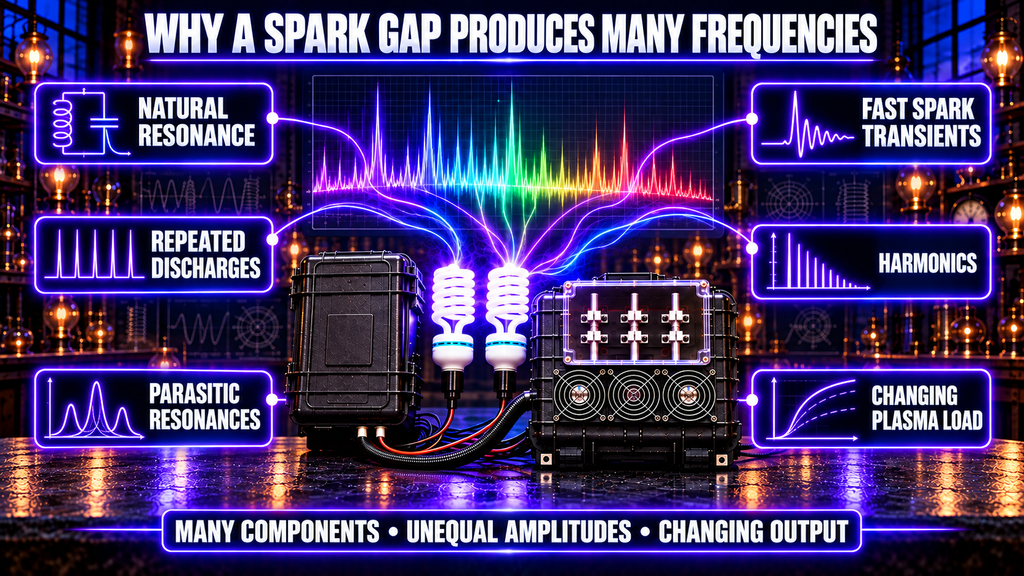
Why the Plasma Generator Produces Many Frequencies
A sine-wave generator may produce one dominant frequency. A spark-gap circuit behaves differently, creating many components through connected processes.
1. The resonant circuit has a natural frequency
Capacitance and inductance store electrical energy in different forms. When the spark gap conducts, energy moves between the circuit’s electric and magnetic fields. An idealised resonant frequency can be written as:
f₀ = 1 ÷ (2π√LC)
Here, L is inductance and C is capacitance. Resistance, losses and stray capacitance make real behaviour more complicated.
2. Each spark is a fast transient
A spark changes voltage and current very quickly. In frequency analysis, a steep pulse corresponds to energy spread across a broad range. Measurements describe small-gap discharges as very wide-band electromagnetic noise sources.
3. Repeated discharges create a pulse train
Repeated firing introduces another pattern and related spectral spacing. Electrode distance, surface condition, voltage, charging and airflow affect the behaviour.
4. Harmonics appear
Non-linear switching generates harmonics at multiples of dominant oscillations, varying with circuit and load.
5. Every conductor adds electrical properties
The flyback, leads, connectors, bulbs and nearby objects add parasitic inductance and capacitance, creating more resonances. Lead layout and a hand near the glass alter loading and the plasma pattern.
6. Plasma itself is a changing load
Ionised gas is non-linear. Its conductivity changes as the discharge forms and moves. That dynamic load can influence waveform shape and spectral content.
The result is a rich, broadband pattern containing a dominant region, harmonics, transient energy and smaller peaks. In ordinary language, it is fair to say the generator produces a vast amount of different frequencies. Technically, it is more accurate to say it produces many frequency components with unequal, changing amplitudes.
What “Many Frequencies” Does and Does Not Mean
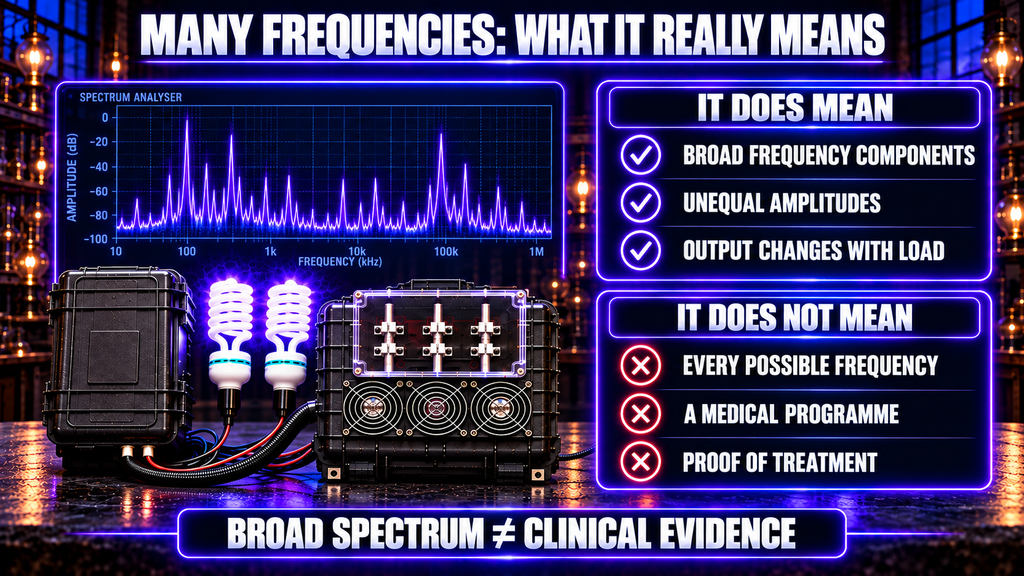
The broad spectrum helps explain why early spark transmitters caused radio interference and why a plasma generator must be kept away from sensitive electronics.
It does not mean that:
- every possible frequency is present;
- all frequencies have equal power;
- the entire spectrum reaches a person in the same way;
- the output stays identical under every load;
- a listed frequency proves a cellular effect; or
- broadband output is automatically therapeutic.
A spectrum analyser can reveal peaks only within its probe and bandwidth limits. A pickup loop, electric-field probe and conducted measurement see different aspects; amplitude also changes with distance, orientation and calibration.
For that reason, I do not describe my machine as selecting individual condition-specific frequencies. The spark gap and resonant network generate the spectrum naturally. The generator offers a direct experience of high-frequency plasma and resonance, not a menu of medical programmes.
Can a broad spectrum create resonance?
A broadband source can contain components that overlap with electrical resonances in the equipment or its surroundings. A resonant system tends to respond more strongly near its own natural frequencies, with the response depending on coupling, losses and bandwidth. This helps explain why bulb behaviour can change when circuit conditions or nearby objects change.
However, accidental spectral overlap is not the same as delivering a calibrated magnetic-resonance protocol. MBST equipment attempts to coordinate field strength, frequency, coil geometry and exposure. To establish what energy from any device reaches a biological target would require calibrated field measurements, dosimetry and testing under defined conditions. A peak on a nearby spectrum analyser identifies detected electromagnetic activity; by itself, it does not show absorption by tissue or a therapeutic interaction.
Magnetic Resonance Therapy vs High-Frequency Plasma
| Feature | Magnetic resonance therapy | My plasma generator |
|---|---|---|
| Central mechanism | Coordinated low magnetic and RF fields | High-voltage spark-gap oscillation and plasma |
| Frequency approach | Controlled sequences intended to meet resonance conditions | Broad, complex spectrum arising from discharge and resonance |
| Main applicator | Magnetic coil or treatment bed | Two handheld gas-filled bulbs |
| Visible plasma | No | Yes |
| Selectable therapy programme | Device-dependent, often programmed | No medical programme selection |
| Intended status | Model- and jurisdiction-dependent medical technology | Non-medical educational and wellness equipment |
| Evidence | Must be evaluated for the exact clinical protocol | No claim to diagnose or treat disease |
The technologies meet different interests. Anyone seeking a musculoskeletal intervention should discuss evidence-based options with a clinician. Someone fascinated by Tesla-inspired circuits, plasma and wideband oscillation may prefer the generator experience.
A Real Tesla-Inspired System for Home Exploration
I hand-build and test every High Frequency Plasma Generator in the UK. The complete system is currently priced at £3,333 and includes:
- two handheld plasma bulbs;
- one high-frequency producer;
- one separate spark-gap and resonant enclosure;
- adjustable, replaceable 100% zinc electrodes;
- built-in three-fan cooling;
- connecting leads, power and operating instructions;
- shipping under the current published terms;
- direct customer support and private community access; and
- a 12-month parts-and-labour warranty on the main machine, excluding the glass bulbs.
Owners can see the bulbs illuminate and observe the covered spark-gap section. Once disconnected and made safe, the zinc rods are accessible for permitted inspection, cleaning and replacement.
Some owners enjoy the light and movement while relaxing or meditating. These experiences are subjective: calm is not evidence of disease treatment, and a plasma pattern is not a biological scan.
Safety and Responsible Use
High voltage demands respect. Read the complete Owner’s Guide before operating the generator. Use it only on a stable, dry surface with ventilation openings clear. Keep it away from water, flammable materials, televisions, computers, storage devices and other sensitive electronics.
Never open an enclosure, remove the spark-gap cover or adjust an electrode while the system is connected to power. Do not use damaged bulbs, wiring or connectors.
Do not use it during pregnancy or with a pacemaker, implanted defibrillator, neurostimulator, insulin pump, cochlear implant or other implanted electronic device. Never delay medical care because of a frequency or wellness machine.
Frequently Asked Questions
Is magnetic resonance therapy scientifically proven?
Some studies report positive outcomes, but evidence quality is mixed. A controlled knee-osteoarthritis trial found no superiority over placebo, and NICE recommends use for that condition only within research. Conclusions should remain device- and condition-specific.
Does your plasma generator produce one frequency?
No. Spark switching and resonant circuitry produce a complex spectrum containing a dominant region, harmonics and broadband transients. The exact measured pattern depends on the circuit, load, electrode condition, environment and measurement method.
Does producing more frequencies make it more therapeutic?
That conclusion cannot be made. Spectrum width is an electrical property, not clinical evidence. A medical claim would require a defined exposure, a specific intended condition and appropriate controlled trials of the exact machine.
Is your generator a magnetic resonance therapy device?
No. It does not use an MBST treatment coil or programmed tissue-specific sequences. It is a Tesla-inspired high-frequency plasma generator for education, experimentation, research, meditation, relaxation and general wellness.
Can it replace medical treatment?
No. The generator is not intended to diagnose, treat, cure, mitigate or prevent disease. Seek professional medical assessment and continue agreed treatment.
Final Thoughts
Magnetic resonance therapy coordinates magnetic and radiofrequency fields. Its language comes from genuine physics, but clinical evidence still requires careful evaluation. For knee osteoarthritis, NICE considers efficacy evidence insufficient outside research.
My generator instead uses high voltage, capacitance, inductance, a spark gap and a changing plasma load to generate visible plasma and a broad family of oscillations. That complex spectrum is authentic and fascinating, but it should not become an unsupported promise.
If your interest is in Tesla-inspired technology, visible plasma and the natural production of many frequency components, explore the High Frequency Plasma Generator or learn more through What Is Frequency? and What Is Resonance?.
Medical disclaimer: This article is for general education. The High Frequency Plasma Generator is not medical equipment and is not intended to diagnose, treat, cure, mitigate or prevent any disease. Research concerning MBST, MRI, PEMF or other electromagnetic devices is not evidence of benefit from this generator. Always consult a suitably qualified healthcare professional about symptoms and treatment.