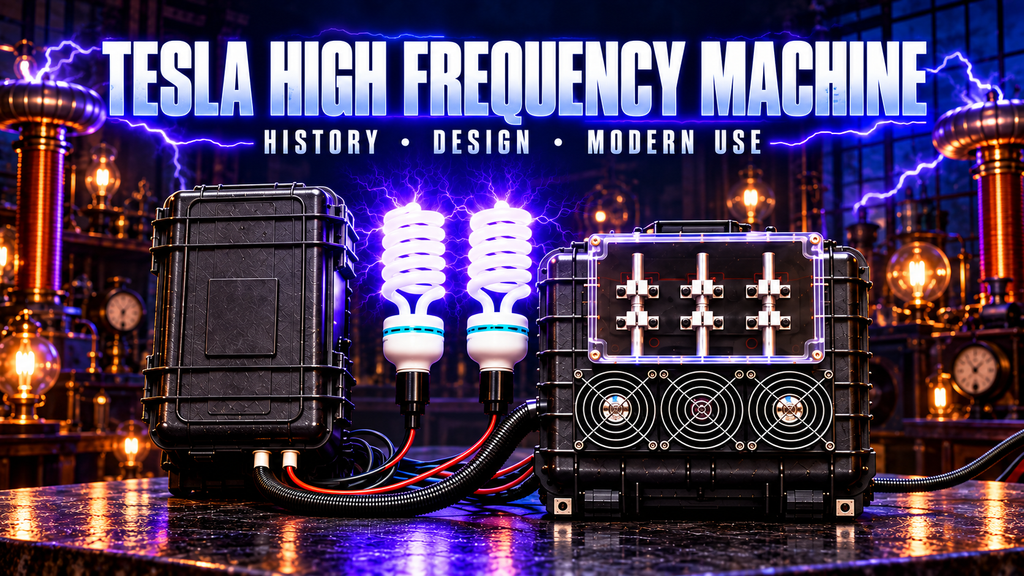
A Tesla high frequency machine uses rapidly changing electrical energy, resonant circuits and high voltage to create effects associated with Nikola Tesla’s experiments. Depending on the design, these may include a visible spark gap and illuminated gas-filled bulbs.
Online, the name can describe anything from a violet-ray wand to a laboratory Tesla coil or full-sized plasma generator. These are not interchangeable: their circuitry, output and intended use differ.
This guide explains what the phrase means, how a traditional spark-gap system operates and what to look for when choosing a machine. It also introduces the handcrafted system I build in the UK.
What Is a Tesla High Frequency Machine?
There is no single official product category called a Tesla high frequency machine. It is a modern search term for equipment inspired by Tesla’s work with high-potential, high-frequency alternating currents.
In a traditional system, electrical energy is transformed, stored briefly in capacitors and released in rapid oscillations through a resonant circuit. A spark gap acts as a fast switch: when its voltage becomes high enough, the air between the electrodes conducts and the stored energy oscillates through the coil-and-capacitor circuit.
A suitable output stage can excite low-pressure gas inside a sealed glass bulb. The moving electrical field transfers energy to the gas, producing the luminous filaments people recognise as plasma. The plasma remains inside the bulb; it is not being pumped or injected into the body.
The essential ideas are:
- high voltage;
- rapid electrical oscillation;
- capacitance and inductance;
- resonance;
- controlled electrical discharge; and
- visible ionisation inside a gas-filled bulb.
These principles have a genuine historical connection to Tesla, but modern machines vary considerably. The name alone says little about a device’s quality, power or intended purpose.
Nikola Tesla and High-Frequency Electricity
During the 1890s, Nikola Tesla gave public demonstrations involving high-frequency currents, resonant coils, luminous tubes and single-terminal lamps. His 1892 lecture collection, Experiments with Alternate Currents of High Potential and High Frequency, records many of these experiments.
Tesla also patented practical ways of generating high-frequency and high-potential currents. His 1896 US Patent 568,176 describes a condenser discharging through a transformer primary, with inductance and capacitance influencing the discharge frequency. Related US Patent 568,179 also describes charging and rapidly discharging condensers.
These documents establish the engineering lineage. Tesla investigated power conversion, lighting, vacuum tubes and resonance; he did not invent one standard wellness product bearing today’s search term.
Other researchers took the technology in different directions. Jacques-Arsène d’Arsonval explored alternating currents, while Paul Oudin developed resonant-coil arrangements. Their names now overlap with terms such as violet ray and plasma generator.
How Does a Traditional Spark-Gap Machine Work?
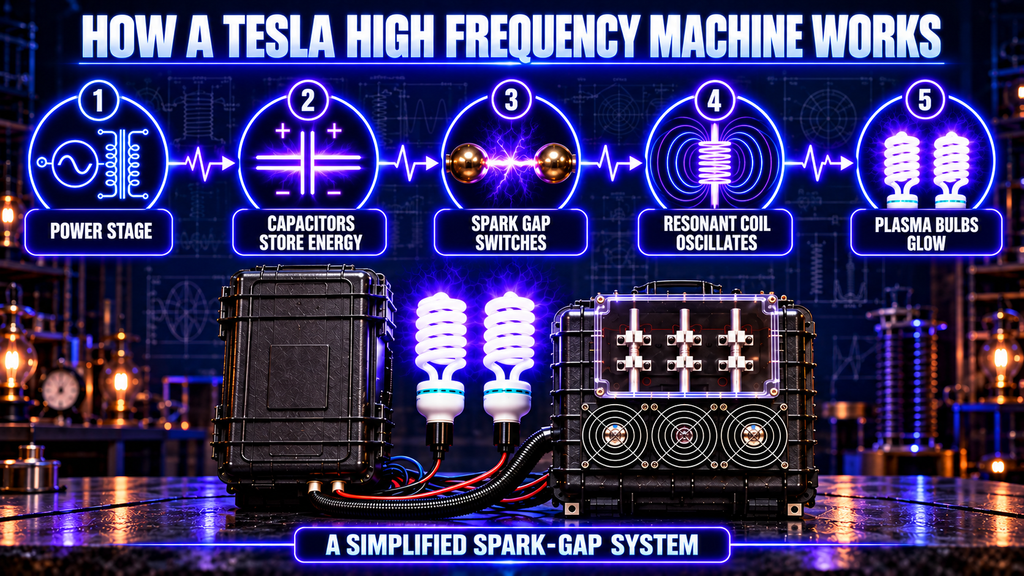
A traditional spark-gap Tesla frequency machine can be understood as five functional stages.
1. The power stage
The electrical supply is converted into the form the machine requires. Suitable insulation, protection and cooling matter because this stage handles real electrical energy—not a purely digital “frequency”.
2. The capacitor stage
Capacitors store charge and release energy into the resonant circuit. Their capacitance helps determine the circuit’s natural frequency.
3. The spark gap
In the spark gap, air normally insulates separated electrodes. When the electric field becomes strong enough, the air ionises, a discharge crosses the gap and the capacitors discharge rapidly.
An exposed-electrode spark gap is a working component. Repeated arcing produces heat, surface marks and deposits, so inspection, cleaning, alignment and eventual electrode replacement are normal parts of ownership. An adjustable, accessible design is therefore a practical advantage.
For a deeper explanation, see What Is a Spark Gap?.
4. The resonant coil
The capacitor and coil form an oscillating circuit. Coil geometry, inductance, capacitance, wiring and electrical load all influence its output.
“Resonance” does not mean that a machine automatically finds a special frequency for a person or health condition. It is first an electrical-engineering description of how an oscillating circuit behaves.
5. The plasma bulbs
At the output, the high-frequency field excites low-pressure gas sealed inside the bulbs. The resulting ionisation and light emission produce branching plasma filaments and a visible sign that the output is active.
Tesla Coil, Violet Ray and Plasma Generator: The Difference
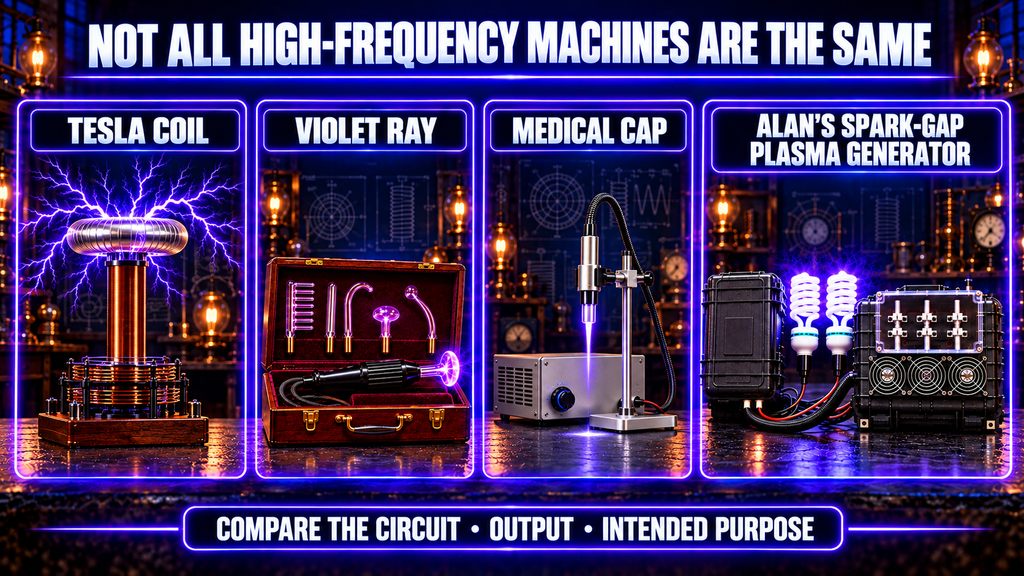
Products carrying Tesla’s name are often grouped together despite important differences.
| Device | Typical form | Output or interface | Main point to understand |
|---|---|---|---|
| Demonstration Tesla coil | Exposed resonant coil, terminal or toroid | Long visible streamers through air | Built mainly for electrical demonstrations; not a handheld wellness device |
| Violet-ray wand | Compact control unit with a gas-filled glass electrode | Local glow or discharge at an electrode near the skin | Historical beauty/electromedical format with a much smaller treatment area |
| Modern medical CAP device | Characterised plasma jet or dielectric-barrier-discharge system | Controlled local plasma exposure | Purpose-built, measured and studied for particular clinical or research settings |
| Two-bulb spark-gap plasma generator | Separate power/resonant stages and handheld sealed bulbs | High-frequency excitation of visible plasma in both bulbs | Intended here for education, experimentation, relaxation and general wellness |
A stage Tesla coil is not automatically suitable for home sessions, and a violet ray is not a miniature version of every plasma generator. A medical cold-plasma system is also not equivalent to a general-wellness machine merely because both create ionised gas.
If you are comparing products, begin with the circuit, output method and manufacturer’s stated purpose rather than the name used in an advert.
Why Are People Interested in These Machines Today?
Interest in Tesla-inspired high-frequency equipment comes from several directions.
Some owners want to experience a modern interpretation of spark-gap and resonant-coil technology. Others appreciate the moving plasma, rhythmic sound and ritual of sitting quietly with the bulbs. A session can become time for meditation, breathing, reading or stepping away from screens.
Owners may describe warmth, tingling, calmness or relaxation. These subjective experiences vary and are not proof that a machine treats disease.
This kind of equipment offers:
- a visible encounter with high-frequency electrical principles;
- a route into Tesla history, resonance and plasma physics;
- a structured setting for relaxation or meditation;
- a distinctive piece of working electrical apparatus; and
- a community of people interested in frequency and alternative technologies.
What Do Historical and Modern Studies Tell Us?
High-frequency electrical tools have a long history, but old claims require care. Terms such as d’Arsonvalisation, effluvia, violet ray and diathermy described techniques with different coupling, electrodes and intensity.
A useful modern historical paper is Napp and colleagues’ 2015 study, “On the history of plasma treatment and comparison of microbiostatic efficacy of a historical high-frequency plasma device with two modern devices”. The researchers compared a historical violet wand with two modern plasma sources against bacterial isolates grown on agar and found antimicrobial activity in the treated areas.
The result is historically interesting, but it came from an in-vitro experiment on cultured microorganisms. It was not a human trial, did not test my generator and does not show that holding sealed bulbs can treat a health condition.
Modern cold atmospheric plasma is a genuine research field, but CAP devices are characterised by gas composition, temperature, reactive species, power, distance and exposure time. Findings from one plasma jet or dielectric-barrier-discharge device cannot be transferred to every “Tesla” or “high frequency” machine.
What Should You Look for Before Buying?
If you are considering a Tesla high frequency machine for home use, compare practical details instead of dramatic claims.
Clear construction
Can the maker explain the stages in plain language? Genuine photographs, a protected visible spark gap and an understandable layout are more useful than mysterious terminology.
An adjustable, replaceable spark gap
Spark-gap electrodes wear. Ask whether they can be inspected, aligned, cleaned and replaced. A sealed or awkward assembly can make routine service difficult.
Cooling and ventilation
Power components and repeated discharges generate heat. Look for deliberate cooling and clear ventilation instructions.
Complete, compatible components
Check which bulbs, cables, connectors and power components are included. A low headline price can mislead if essential parts cost extra.
Testing, instructions and warranty
Ask whether every machine is tested, whether instructions are supplied and exactly what the warranty covers. Bulbs and consumable parts may be treated differently from the main unit.
Access to real support
Direct access to someone who understands the construction is valuable when questions arise about setup, spark-gap wear or replacement parts.
Careful claims
A trustworthy seller distinguishes experience from evidence and general wellness from medical treatment. Disease lists and guaranteed outcomes are warning signs.
My Handcrafted High Frequency Plasma Generator
I build my updated High Frequency Plasma Generator in the UK for people who want to explore Tesla-inspired technology without buying a loose collection of experimental parts.
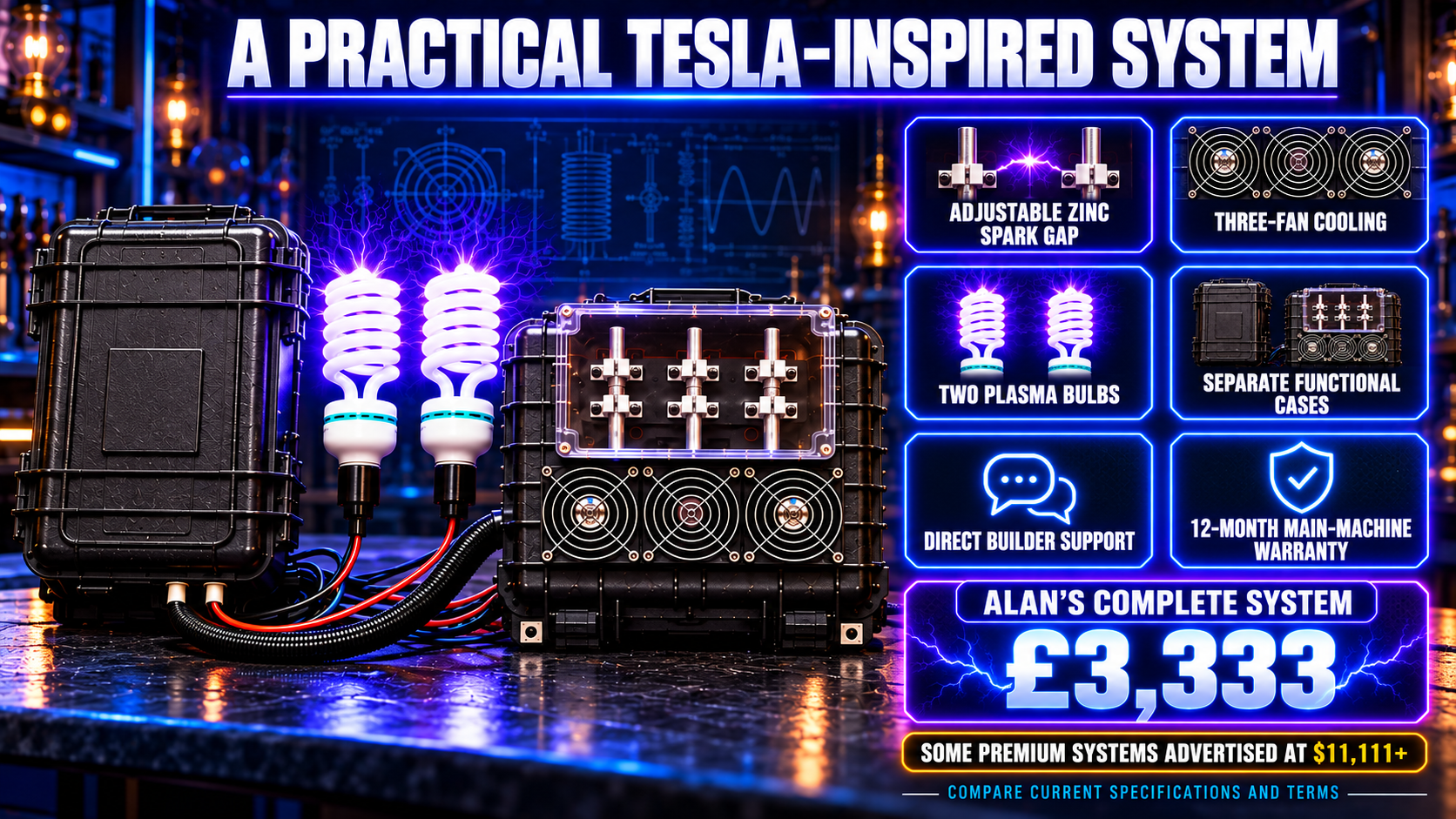
The design uses two rugged enclosures. One contains the high-frequency producer; the other houses the resonant coil and protected spark-gap section. This creates a clear functional layout, provides room for cooling and maintenance, and reduces the close interaction that can occur when every component is crowded into one case. It does not eliminate all electromagnetic interference.
The protected, visible spark gap uses adjustable and replaceable 100% zinc rods in dedicated holders. The rods can be advanced and aligned as their working surfaces wear. Maintenance is performed only with the machine disconnected and as instructed.
The current design also includes three-fan cooling and two handheld spiral plasma bulbs. Each completed unit is tested before dispatch. For operation and routine care, owners receive clear guidance in the Owner’s Guide.
The package currently includes:
- the handcrafted high-frequency producer;
- the separate spark-gap and resonant-coil enclosure;
- two compatible plasma output bulbs;
- adjustable, replaceable zinc electrodes;
- three-fan cooling;
- power supply and connecting leads;
- individual testing before dispatch;
- operating and maintenance information;
- direct customer support;
- access to the private owner community; and
- a 12-month warranty on manufacturing defects and workmanship in the main machine, subject to the published terms (plasma bulbs are excluded).
This is a plug-and-use system in the practical sense that the matched components are supplied together. It is still high-voltage equipment and must be positioned, operated and maintained exactly as instructed.
Price and Long-Term Value
My complete system currently costs £3,333. Some premium Tesla-inspired packages have been advertised at approximately $11,111 or more. Specifications, currencies and inclusions vary, so this is not a like-for-like technical comparison; always check each supplier’s current written offer.
Even so, the difference in headline cost is substantial. My aim is to make a maintainable spark-gap system available at a more accessible price while retaining the parts that matter for long-term ownership: two bulbs, separate functional enclosures, cooling, replaceable electrodes, guidance and direct contact with the builder.
Value also includes replaceable wearing parts, help after the sale and a machine that can be understood rather than discarded when it needs attention.
You can examine the construction in more detail in my guide to Tesla plasma machine design, maintenance and value.
Safety: High Frequency Does Not Mean Risk-Free
A Tesla high frequency machine contains high voltage, produces electrical arcing and may create electromagnetic interference. Treat it as serious electrical equipment.
Always follow the instructions supplied with the exact machine. General precautions include:
- use the equipment only in a dry, stable, well-ventilated location;
- keep it away from water, flammable vapours, aerosols and oxygen-rich environments;
- never cover the cooling fans;
- keep sensitive electronics at a suitable distance;
- inspect bulbs, cables and connectors before use;
- never open, adjust or clean the spark gap while the machine is connected;
- allow the unit to discharge as instructed before maintenance;
- do not modify internal wiring or substitute unapproved parts;
- stop using the machine if it is damaged, abnormally hot or behaving unusually; and
- keep children, pets and untrained people away while it is operating.
Do not use this equipment during pregnancy or if you have a pacemaker, implanted defibrillator, neurostimulator, insulin pump, cochlear implant or another implanted or body-worn electronic medical device unless the relevant device manufacturer and a qualified healthcare professional have specifically confirmed that it is safe in your circumstances.
Frequently Asked Questions
Is a Tesla high frequency machine the same as a Tesla coil?
Not necessarily. A Tesla coil is a resonant transformer, but the search phrase covers several types of apparatus. A two-bulb generator can use related principles with a different layout and output from a demonstration coil.
Is it the same as a violet-ray machine?
No. A violet ray normally uses one small glass electrode for a local glow or discharge. A two-bulb spark-gap system has different circuitry, scale and interface, so violet-wand research cannot automatically be applied to it.
Why does the spark gap make a buzzing sound?
The sound comes from rapid discharges across the electrodes. Sound, light and gradual surface wear are normal, but changes from the machine’s usual behaviour should be checked against the guidance.
Why do the bulbs glow?
High-frequency electrical energy excites the low-pressure gas sealed inside each bulb. The resulting ionisation and light emission create the visible plasma filaments. The glow is a physical effect and a useful indication that the output stage is active.
Is a stronger output always better?
No. Greater intensity does not automatically mean higher quality or a better personal experience. Good design aims for controlled, repeatable operation, adequate cooling and a manageable interface. Comfort and the maker’s operating limits matter more than pursuing the harshest sensation.
Does the machine treat health conditions?
My generator is not a medical device and is not offered to diagnose, treat, cure, mitigate or prevent disease. It is intended for education, personal experimentation, meditation, relaxation and general wellness. Historical reports and research involving other high-frequency or plasma devices do not establish medical efficacy for this product.
Where can I learn more before deciding?
Start with the product page for the current package and terms. You can also read What Is a Tesla Healing Machine? for a fuller discussion of terminology and research, then contact me if you have a question about construction, ownership or support.
Final Thoughts
The Tesla high frequency machine brings together electrical history, resonant circuits, visible plasma and a hands-on experience far removed from an app-controlled gadget.
Informed ownership requires more than fascination. Evidence from one device cannot be borrowed for another, and high voltage demands respect. Examine construction, maintenance, cooling, instructions and support—not just price or promises.
My updated generator is designed around those practical priorities. It combines a separate high-frequency producer and resonant section, a protected adjustable zinc spark gap, three-fan cooling and two plasma bulbs in a complete handcrafted package. At £3,333, it offers a more accessible route into this technology than some premium systems while giving owners direct support from the person who builds it.
For those drawn to Tesla’s experiments, plasma displays or meditation, it offers an understandable, serviceable interpretation of a remarkable electrical tradition.
Important disclaimer: This article is for general educational information and is not medical advice. The High Frequency Plasma Generator is not a medical device and is not intended to diagnose, treat, cure, mitigate or prevent any disease or medical condition. Do not delay or replace professional medical care because of information about frequency or plasma equipment. Always follow the supplied safety instruct