By the end of this lesson you’ll understand: What Is Plasma and why scientists call it the fourth state of matter. ✔
How it is formed. ✔
Why it behaves differently from solids, liquids and gases. ✔
Where it exists naturally throughout the universe. ✔
Why it glows. ✔
How high frequency plasma generators create visible plasma. ✔
📚 High Frequency Plasma Learning Centre
📘 Lesson 3 of 24
Estimated Reading Time: 12–15 Minutes
Difficulty: 🟢 Foundation
What Is Plasma?
If you’ve been exploring Tesla-inspired technology or high frequency generators, one of the first questions you’ll probably ask is:
Although many people have heard the word plasma, surprisingly few understand exactly what it is.
Plasma is often called the fourth state of matter, yet it is actually the most common visible form of matter in the universe. Every star in the night sky, including our own Sun, is made primarily of plasma. Lightning, the aurora borealis and even the glowing gas inside neon signs all demonstrate plasma in different forms.
Understanding What Is Plasma is essential if you want to understand how high frequency plasma generators work.
Fortunately, the science behind plasma is both fascinating and surprisingly easy to understand.
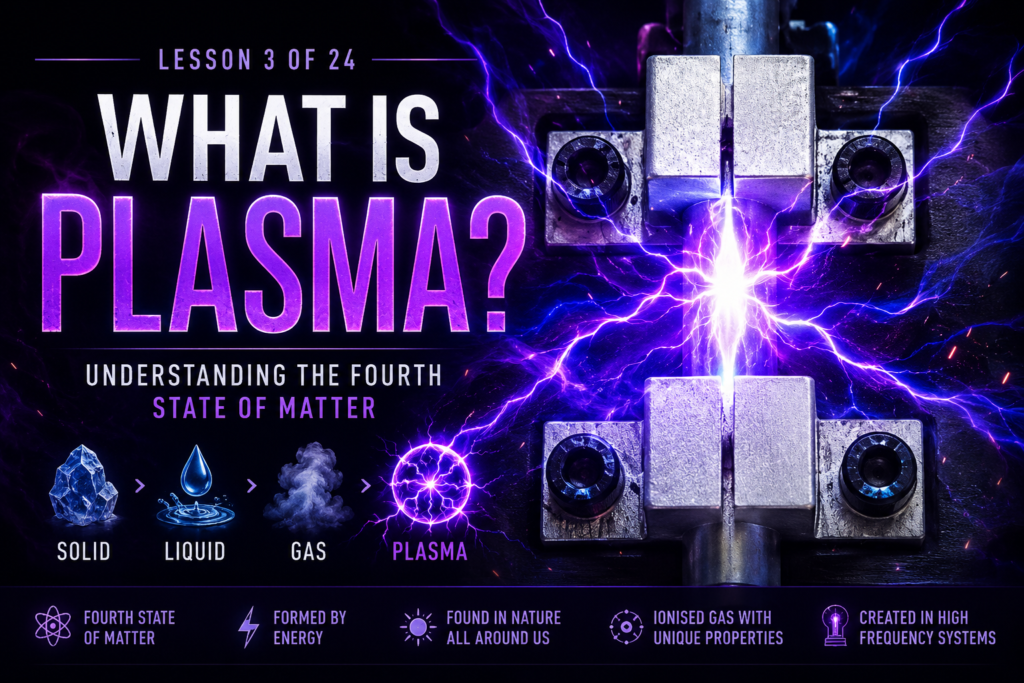
The Four States of Matter
Most of us learn in school that matter exists in three forms:
- Solid
- Liquid
- Gas
However, there is actually a fourth state.
That fourth state is plasma.
Each state behaves differently because the particles inside them contain different amounts of energy.
Solids
In solids, atoms are tightly packed together.
They can vibrate slightly but cannot move around freely.
Examples include:
- Copper
- Steel
- Wood
- Glass
- Stone
Liquids
When additional energy is added, solids can melt into liquids.
The atoms remain close together but can now move around each other.
Examples include:
- Water
- Oil
- Alcohol
Gases
Adding even more energy causes liquids to become gases.
Gas particles move freely and spread out to fill the available space.
Examples include:
- Oxygen
- Nitrogen
- Helium
Plasma
When enough energy is added to a gas, something remarkable happens.
Some electrons are stripped away from the atoms.
The gas becomes electrically charged.
At this point it is no longer an ordinary gas.
It has become plasma.
This is why scientists refer to plasma as the fourth state of matter.

How Is Plasma Formed?
Understanding What Is Plasma becomes much easier once you understand how it forms.
Imagine heating a gas.
As more and more energy is added, the atoms begin moving faster.
Eventually the energy becomes so great that electrons break free from some of the atoms.
The result is a mixture containing:
- Positive ions
- Free electrons
- Neutral atoms
This electrically charged mixture is called plasma.
The process of removing electrons from atoms is known as ionisation.
Ionisation is one of the most important concepts in plasma physics and forms the basis of many natural and man-made plasma phenomena.
Why Is Plasma Different From Gas?
At first glance plasma may appear similar to a gas.
However, plasma behaves very differently.
Unlike an ordinary gas, plasma contains charged particles.
Because of these charged particles it can:
- Conduct electricity
- Respond to electric fields
- Respond to magnetic fields
- Produce visible light
- Form complex patterns
These unique properties make it unlike any other state of matter.
This is one of the reasons why scientists continue researching about it today.
Where Can it Be Found in Nature?
One of the most surprising facts about plasma is how common it actually is.
Although we don’t often encounter it in everyday life, it exists throughout the universe.
Examples include:
The Sun
Our Sun is an enormous sphere of it
The tremendous temperatures inside the Sun cause atoms to become ionised, creating vast amounts of plasma.
Other Stars
Every visible star in the night sky is primarily composed of it.
In fact, astronomers estimate that most visible matter in the universe exists in this state.
Lightning
Lightning is another spectacular example of it naturally.
When electrical energy passes through the atmosphere, the surrounding air becomes ionised, creating an intense plasma channel that glows brilliantly.
Aurora Borealis
The beautiful Northern Lights are produced when charged particles from the Sun interact with gases in Earth’s atmosphere.
These interactions create glowing plasma high above our planet.
Space
Much of the space between planets and stars contains ionised gases that exist as plasmatic state.
This means it is actually the dominant visible form of matter throughout the universe.
Plasma Around Us
Although most plasma exists naturally, humans have learned to create it for many different purposes.
Examples include:
- Neon signs
- Plasma globes
- Fluorescent lamps
- Scientific research equipment
- Welding arcs
- Industrial cutting systems
Each application takes advantage of plasma’s unique electrical properties.
Although the equipment may look very different, the underlying principle is the same.
Energy is added to a gas until ionisation occurs, producing it.
Why Does It Glow?
One of the most beautiful characteristics of plasma is that it emits light.
But why?
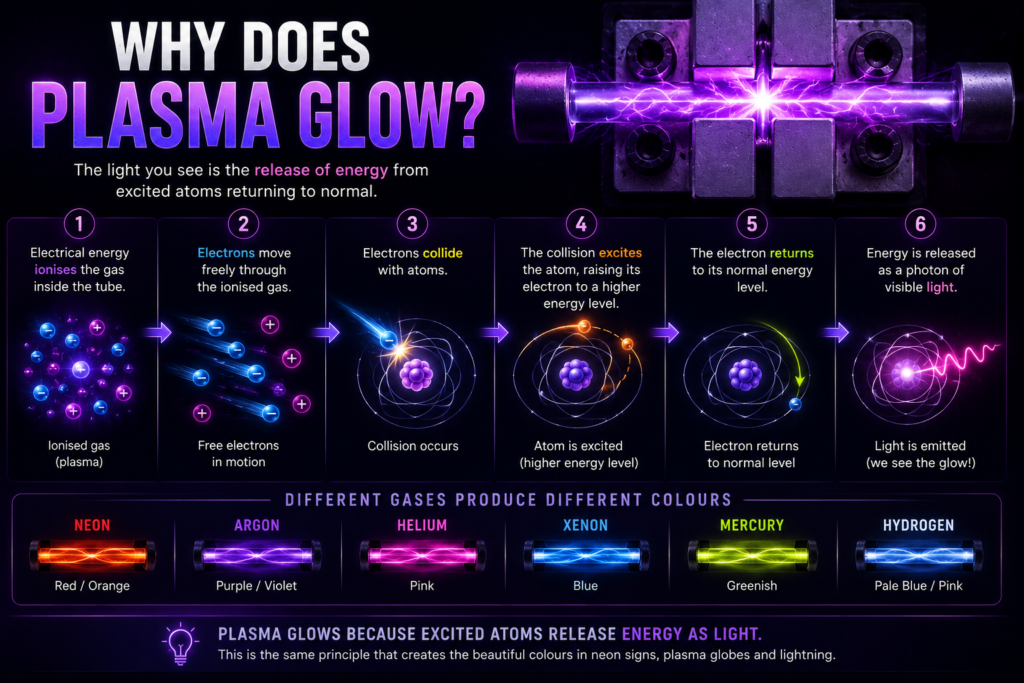
As electrons move through the ionised gas, they collide with atoms.
These collisions excite the atoms.
When the atoms return to their normal energy levels, they release energy as visible light.
Different gases produce different colours.
For example:
- Neon produces orange-red light.
- Argon often produces purple or blue tones.
- Other gases create different colours depending on their atomic structure.
This explains why plasma globes, scientific discharge tubes and plasma bulbs can display such spectacular colours.
What Is High Frequency Plasma?
Now that we’ve answered the question What It is, we can look at how its produced inside a high frequency generator.
Unlike the naturally occurring versions of it, such as lightning or the Sun, high frequency generators create it inside specially designed glass bulbs.
The process is carefully controlled and uses high-frequency electrical energy rather than the extreme temperatures found inside stars.
Understanding What It Is helps explain why these machines work.
A generator doesn’t “make light.” Instead, it provides enough electrical energy to ionise the gas inside the bulb.
Once the gas becomes ionised, visible plasma is produced.
This is one of the reasons generators are so fascinating—they allow us to observe the fourth state of matter safely inside a sealed glass bulb.
How Its Produced Inside My Generator
Although every builder has their own design philosophy, the operating principles remain broadly similar.
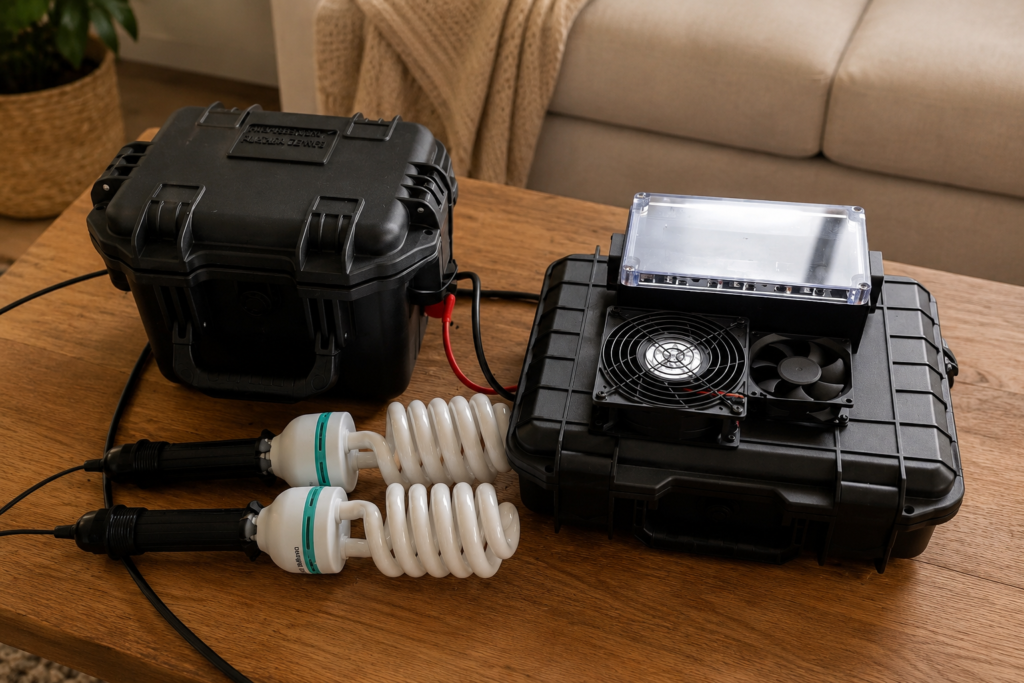
My High Frequency Plasma Generator produces it in six stages.
Step 1 – Electrical Power
Electrical power enters the machine.
Step 2 – High Frequency Producer
The incoming electrical energy is converted into rapidly oscillating high-frequency electrical energy.
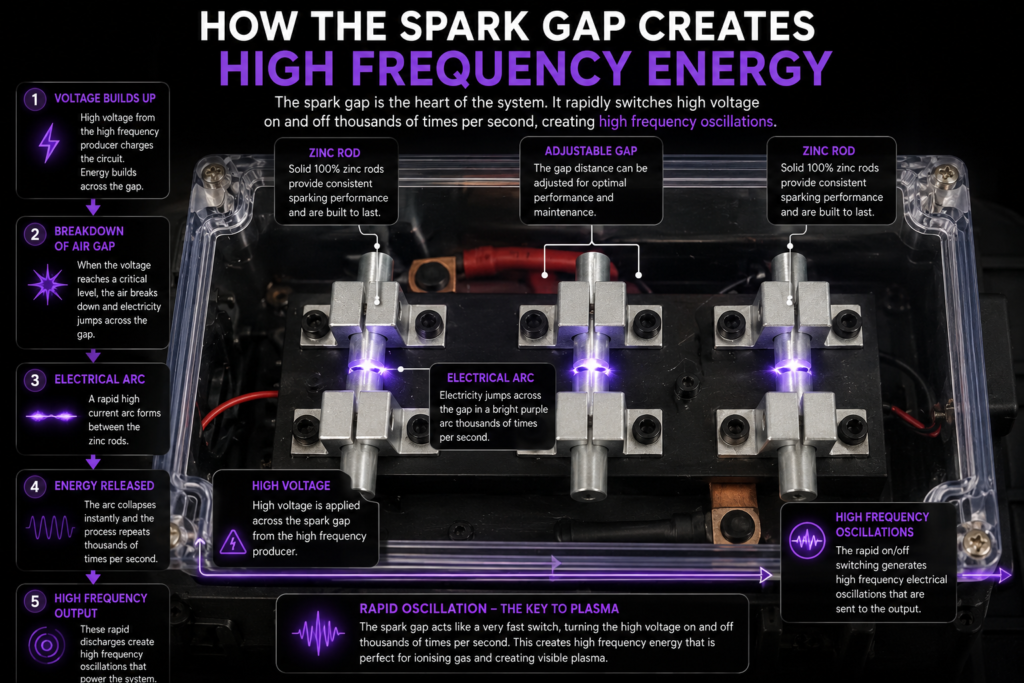
Step 3 – Spark Gap
The spark gap rapidly discharges between two adjustable zinc rods.
These rapid discharges create high-frequency electrical oscillations.
Step 4 – Plasma Bulbs
The electrical energy travels through the output cables into the bulbs.
Step 5 – Ionisation
The gas sealed inside the bulbs becomes ionised.
Electrons separate from some of the atoms, transforming the gas into it.
Step 6 – Visible Versions
The ionised gas emits visible light.
The beautiful glowing streams inside the bulbs are the plasma itself.
Although the process takes place in fractions of a second, it demonstrates many of the same electrical principles that fascinated Nikola Tesla during his high-frequency experiments.
Plasma vs Ordinary Electricity
Many people assume that a these generator simply produces ordinary electricity.
In reality, the electrical behaviour is very different.
Household electricity is designed to power appliances such as televisions, kettles and lights.
A high frequency generator, however, is designed to create rapidly oscillating electrical fields that ionise gas inside a sealed bulb.
This difference is one of the reasons why these generators produce such striking visual effects.
The electricity is not the end result.
The electricity is simply the means by which plasma is created.
Common Misconceptions About This Amazing Substance
Because it is less familiar than solids, liquids or gases, several misconceptions are common.
IT Is Not Fire
Although flames can contain ionised particles under certain conditions, it and fire are not the same thing.
It is an electrically charged state of matter.
Fire is a chemical reaction involving combustion.
It Is Not Simply Hot Gas
A gas becomes plasma only when enough energy is added for ionisation to occur.
This is what distinguishes it from an ordinary gas.
It Is Found Throughout the Universe
Many people believe plasma is rare.
The opposite is true.
Astronomers estimate that the vast majority of visible matter in the universe exists in the plasma state.
Why Learning About Plasma Matters
Understanding What it Is provides the foundation for understanding many areas of science and engineering.
It plays an important role in:
- Space science
- Astrophysics
- Electrical engineering
- Fusion research
- Industrial manufacturing
- Lighting technology
- High-frequency electrical systems
For enthusiasts interested in Tesla-inspired plasma technology, learning about it also makes it much easier to understand how these generators operate.
Frequently Asked Questions
What Is Plasma?
It is the fourth state of matter.
It forms when enough energy is added to a gas for some of its atoms to become ionised.
Is It Hot?
Natural versions, such as the Sun or lightning, can reach extremely high temperatures.
However, different forms of it exist under different conditions, and temperature alone does not define it.
Is Lightning Plasma?
Yes.
Lightning is one of the best-known natural examples of it.
The intense electrical discharge ionises the surrounding air, creating a glowing plasma channel.
Is the Sun Made of It?
Yes.
The Sun is primarily composed of it.
Its enormous temperatures keep atoms in a continuously ionised state.
Why Does It Glow?
When excited atoms return to lower energy states, they release energy in the form of light.
Different gases produce different colours.
Is It a Gas?
It begins as a gas, but once ionisation occurs it becomes a separate state of matter with its own unique electrical properties.
Summary
By now you should have a clear understanding of What It is and why scientists describe it as the fourth state of matter.
Unlike solids, liquids and gases, it contains electrically charged particles that allow it to respond to electric and magnetic fields while producing visible light.
Although it exists naturally in stars, lightning and the aurora borealis, it can also be created in controlled environments using high-frequency electrical systems.
Understanding What Is it is an important step towards understanding Tesla-inspired plasma technology and the operation of modern generators.
In the next lesson we’ll explore one of the most important components inside these machines—the spark gap.
🧠 Key Takeaways
It is the fourth state of matter.
forms when a gas becomes ionised.
contains free electrons and positive ions.
It is the most common visible form of matter in the universe.
Lightning, the Sun and the Northern Lights are natural examples of it.
High-frequency plasma generators create it by ionising gas inside sealed bulbs.
Understanding What Is Plasma makes it much easier to understand how generators work.
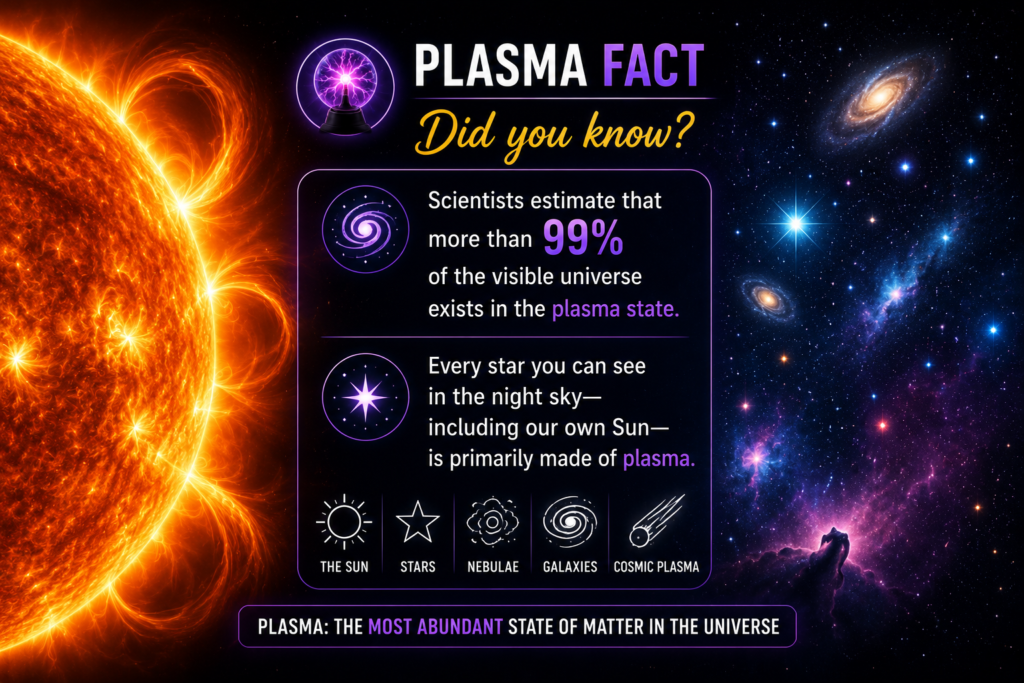
🔬 Plasma Fact
Did you know?
Scientists estimate that more than 99% of the visible universe exists in this state.
Every star you can see in the night sky—including our own Sun—is primarily made of it.
Continue Your Learning Journey
⬅ Previous Lesson
📘 Lesson 2 of 24
How Does a Plasma Generator Work?
Learn how electrical energy is transformed into visible plasma using high-frequency oscillations, spark gaps and bulbs.
➡ Next Lesson
What Is a Spark Gap?
Discover why the spark gap is one of the most important components in a traditional high frequency generator and how it produces high-frequency electrical oscillations.
Related Lessons
You may also enjoy:
- What Is High Frequency Plasma?
- How Does a Generator Work?
- What Is a Spark Gap?
- Why Does My Machine Use Zinc Rods?
- Why Are these Bulbs Used?
- Tesla’s High Frequency Experiments Explained
Disclaimer
The information contained within the High Frequency Learning Centre is provided for educational purposes to explain the history, science and engineering of this technology.
The High Frequency Plasma Generator is intended for educational, experimental, research, meditation, relaxation and personal wellness purposes only.
It is not a medical device and is not intended to diagnose, treat, cure, mitigate or prevent any disease or medical condition.
Always seek advice from a suitably qualified healthcare professional regarding any medical concerns.
🎉 Lesson Complete
Congratulations!
You have now completed:
📘 Lesson 3 of 24
What Is Plasma?
You now understand what it is, how it forms, where it exists in nature and why it is one of the most fascinating states of matter studied by scientists and engineers.
In the next lesson, we’ll examine the spark gap—the component that has played a central role in high-frequency electrical systems since the pioneering experiments of Nikola Tesla.