
So, what is an electric field? An electric field is a region in which an electrically charged particle would experience a force. Electric charges produce electric fields around themselves, and those fields can push or pull other charges without the objects having to touch.
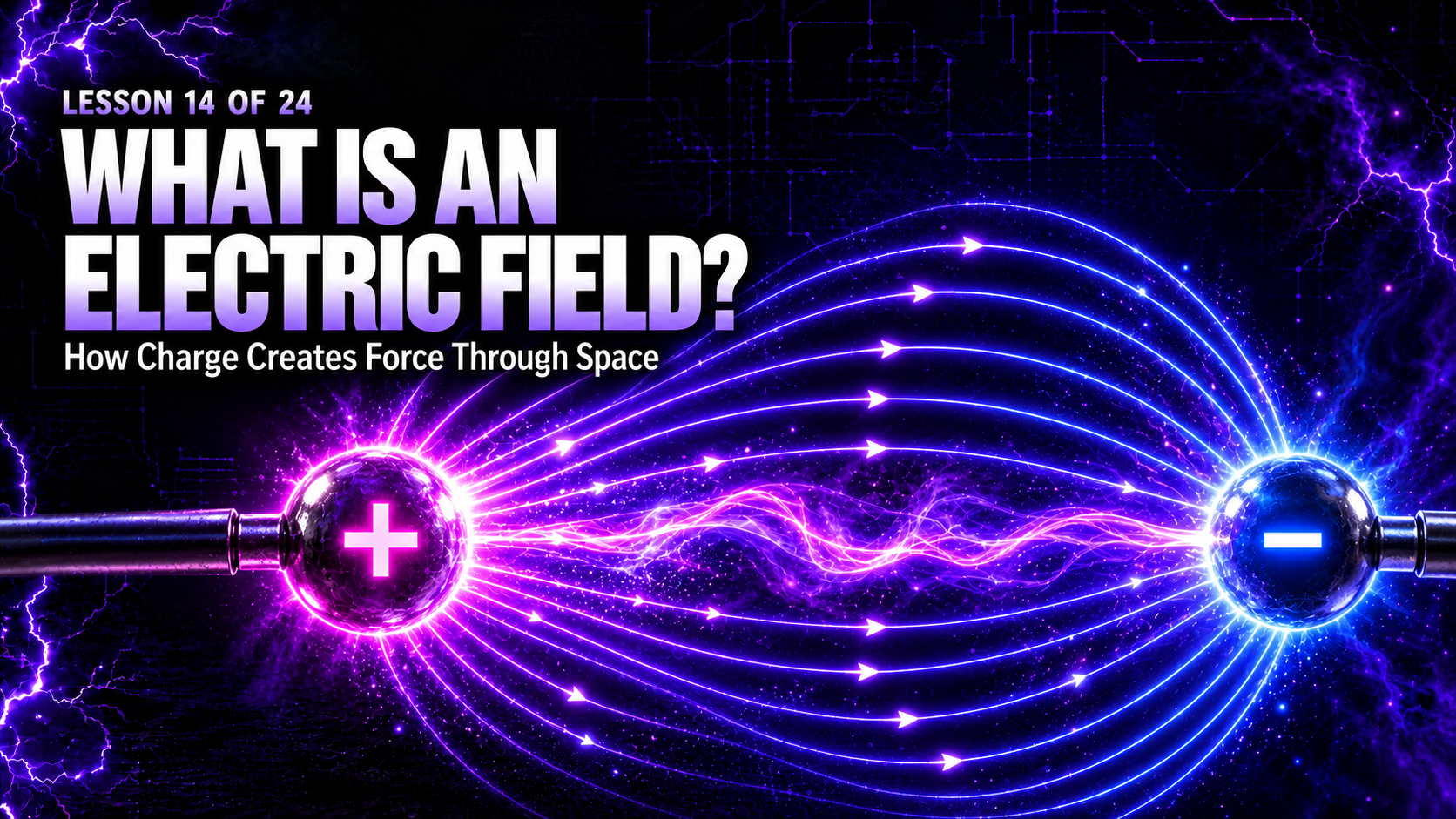
Electric fields are central to the operation of capacitors, spark gaps, plasma balls, plasma bulbs, transformers and high-frequency electrical systems. A sufficiently strong field can accelerate free electrons through a gas, help initiate ionisation and contribute to the formation of a spark, streamer or glow discharge.
📚 High Frequency Plasma Learning Centre
📘 Lesson 14 of 24 — What Is an Electric Field?
Previous lesson: Lesson 13 — What Is Ionisation?
Next lesson: Lesson 15 — What Is a Magnetic Field? (Coming Soon)
Estimated reading time: 15–20 minutes
Difficulty: 🟢 Beginner
What You’ll Learn
By the end of this lesson, you will understand:
- What an electric field is. ✔
- How electric charge creates a field. ✔
- Why an electric field has both strength and direction. ✔
- What electric field lines represent. ✔
- How positive and negative charges respond differently. ✔
- How electric field, force and voltage are related. ✔
- Why a smaller gap can produce a stronger field for the same voltage. ✔
- How capacitors store energy in an electric field. ✔
- How an electric field can act through glass and other insulators. ✔
- How changing electric fields differ from static fields. ✔
- Why strong fields help initiate ionisation and plasma. ✔
- Where electric fields occur in a spark-gap plasma generator. ✔
The Short Answer: What Is an Electric Field?
An electric field describes the electrical influence present at each point in space around charged objects.
If another charge enters that region, the field can exert a force on it.
The field exists even when there is no second charge present to reveal it. A small test charge is used as a conceptual tool to describe what the force would be at a particular location.
The OpenStax introduction to electric fields defines an electric field as the force per unit charge at locations around a charge distribution.
In equation form:\[ \vec{E}=\frac{\vec{F}}{q} \]
Here:
- \(\vec{E}\) is the electric field.
- \(\vec{F}\) is the electrical force on the test charge.
- \(q\) is the value of that test charge.
The arrows above \(E\) and \(F\) indicate that they are vectors: they have direction as well as magnitude.
What Creates an Electric Field?
Electric charge creates an electric field.
There are two types of electric charge:
- Positive charge
- Negative charge
Charges with the same sign repel each other, while charges with opposite signs attract.
A positively charged object produces a field directed away from it. A negatively charged object produces a field directed towards it.
The field becomes weaker with increasing distance from an isolated point charge. In an idealised situation, its magnitude is:\[ E=k\frac{|Q|}{r^2} \]
Where:
- \(E\) is the electric-field strength.
- \(Q\) is the source charge.
- \(r\) is the distance from that charge.
- \(k\) is Coulomb’s constant.
The equation shows two important relationships:
- A larger source charge produces a stronger field.
- Increasing the distance rapidly reduces the field strength.
Real devices rarely contain one perfect point charge. Electrodes, wires, capacitor plates, glass bulbs and nearby objects create more complicated three-dimensional field patterns.
Why Is Field Direction Defined Using a Positive Test Charge?
Scientists needed a consistent convention for describing direction.
Electric-field direction is defined as the direction in which a small positive test charge would be pushed.
This means:
- The field points away from a positive source charge.
- The field points towards a negative source charge.
- A positive charge accelerates in the field direction.
- A negative charge accelerates in the opposite direction.
Electrons are negatively charged. Therefore, the force on an electron points opposite to the electric-field arrow.
This distinction is particularly important in plasma physics. Diagrams may show the electric field pointing in one direction while free electrons accelerate in the other.
What Are Electric Field Lines?
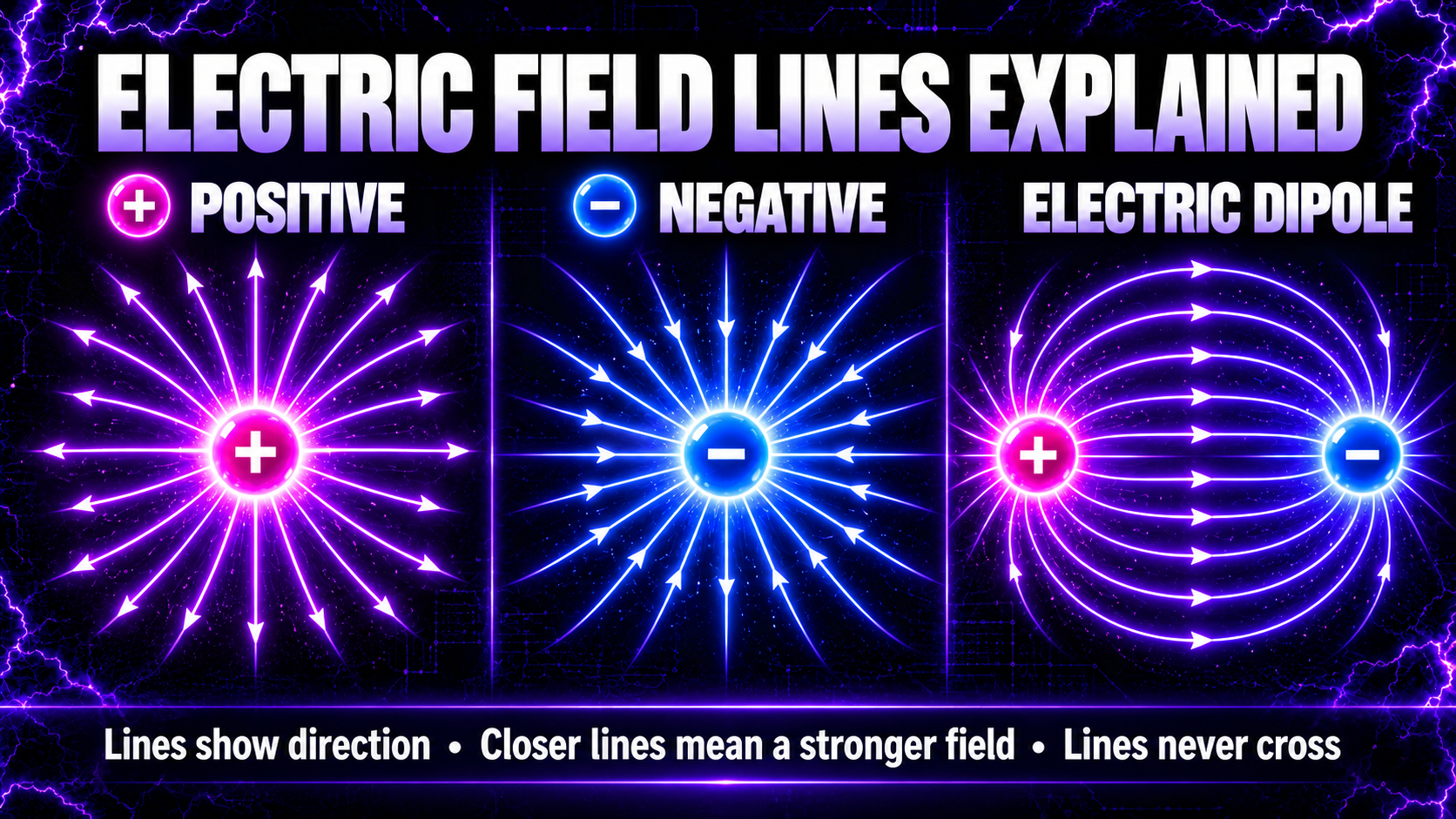
Electric field lines are a visual model used to represent the direction and relative strength of an electric field.
They are not physical threads, wires or streams of material. They help us picture an invisible field.
Field-line diagrams follow several rules:
- Lines begin on positive charges and end on negative charges, or extend to or from infinity.
- The arrow shows the direction a positive test charge would move.
- Closely spaced lines represent a stronger field.
- Widely spaced lines represent a weaker field.
- Electric field lines do not cross, because a field cannot point in two different directions at the same location.
- Lines meet the surface of a conductor at right angles under electrostatic equilibrium.
A positive isolated charge is normally drawn with lines radiating outwards. A negative isolated charge is drawn with lines converging inwards.
For two opposite charges, many lines curve from the positive charge to the negative charge. This pattern is called an electric dipole field.
What Does Electric Field Strength Mean?
Electric-field strength describes how much force the field would exert per unit of charge.
Its common units are:
- Newtons per coulomb, written N/C
- Volts per metre, written V/m
These units are equivalent ways of describing the same physical quantity.
The OpenStax electric-field summary gives N/C as the unit of electric field, while its discussion of electric potential shows why electric field may also be expressed in volts per metre.
A stronger field means that the same test charge would experience a greater force.
However, field strength should not be confused with:
- Frequency
- Electrical current
- Power
- Energy
- Magnetic-field strength
These quantities can influence one another in a working circuit, but they are not interchangeable measurements.
Electric Field and Force
Once the field at a point is known, the force on a charge placed there can be calculated:\[ \vec{F}=q\vec{E} \]
This equation tells us:
- A larger charge experiences a larger force in the same field.
- A positive charge is pushed in the field direction.
- A negative charge is pushed in the opposite direction.
The OpenStax explanation of electric field and force presents this relationship as \(\vec{F}=q\vec{E}\).
It is important to remember that force is not the same as field.
The field describes the electrical conditions at a location. The force depends both on that field and on the charge placed within it.
Electric Field and Voltage Are Related—but Not Identical
Voltage is electric potential difference. It describes the change in electrical potential energy per unit charge between two points.
An electric field describes how that potential changes through space and what force a charge would experience at a location.
A useful comparison is height on a hill:
- Voltage is similar to the difference in height between two places.
- Electric field is similar to the steepness and direction of the slope.
The same height difference spread across a long gentle slope produces a smaller gradient than the same height difference across a short steep slope.
In a simple uniform field between parallel plates:\[ E\approx\frac{\Delta V}{d} \]
Where:
- \(E\) is electric-field strength.
- \(\Delta V\) is the voltage difference.
- \(d\) is the distance between the plates.
This approximation shows why gap distance matters. If the voltage remains the same but the distance becomes smaller, the average field strength becomes larger.
Real spark gaps are not perfect parallel plates, so the field is not completely uniform. Electrode shape and edge effects can create regions that are much stronger than the simple average.

Electric Field, Voltage, Current, Frequency and Power
These five terms describe different aspects of an electrical system.
| Quantity | What it describes | Common unit |
|---|---|---|
| Electric field | Force per unit charge at a location | V/m or N/C |
| Voltage | Potential difference between two points | Volt |
| Current | Rate of electric-charge flow | Ampere |
| Frequency | Number of cycles per second | Hertz |
| Power | Rate of energy transfer | Watt |
A system can have high voltage but very limited current. It can have a high frequency without producing a particularly strong field at a distant location. A strong local electric field does not by itself tell us the total energy or power available.
This separation is essential when discussing high-frequency plasma equipment accurately.
How Do Several Charges Combine Their Fields?
Every charge contributes to the total electric field.
At any location, the individual field vectors are added together. This is called the principle of superposition.
Because fields have direction, they cannot always be added as ordinary numbers.
For example:
- Two equal fields pointing in the same direction reinforce one another.
- Two equal fields pointing in opposite directions cancel at that point.
- Fields pointing at angles combine to create a new direction and strength.
This explains why physical layout matters in high-voltage equipment. Moving an electrode, wire, bulb, metal object or measuring probe changes the geometry and can alter the combined field.
Nearby conductors can also redistribute their surface charge in response to the field, changing the pattern again.
What Is a Uniform Electric Field?
A uniform electric field has approximately the same strength and direction throughout a region.
The field between two large, flat, oppositely charged parallel plates is a common approximation. Away from the plate edges, the field lines are nearly straight, parallel and evenly spaced.
Near the edges, they bend outwards. This is called fringing.
No real field is perfectly uniform across an unlimited region, but the parallel-plate model is extremely useful for understanding capacitors and the relationship between voltage, separation and field strength.
What Is a Non-Uniform Electric Field?
In a non-uniform field, the strength or direction changes from one position to another.
Fields around points, spheres, sharp electrodes, wires and irregular conductors are non-uniform.
A sharp point or small-radius edge can concentrate charge into a small surface region. This can produce a much stronger local field than the average field elsewhere on the conductor.
Strong local fields can encourage:
- Corona discharge
- Electron emission
- Gas ionisation
- Electrical tracking
- Unwanted arcing
This is why high-voltage terminals are often made smooth and rounded when designers want to reduce corona and premature breakdown.
Conversely, pointed electrodes may be used deliberately when field concentration is required.
How Does an Electric Field Exist Between Capacitor Plates?
A capacitor contains two conductive regions separated by an insulating material or gap.
When charge is moved from one plate to the other:
- One plate develops positive charge.
- The other develops negative charge.
- An electric field forms between them.
- Energy is stored in that field.
The field points from the positive plate towards the negative plate.
When the capacitor is connected to a suitable discharge path, the field can collapse as charge moves through the circuit. In an LC circuit, energy can then transfer between the capacitor’s electric field and the magnetic field associated with current.
This is the energy exchange explored in Lesson 10 — What Are Electrical Oscillations?.
OpenStax illustrates the field between opposite capacitor plates in its guide to capacitors and capacitance.
What Is a Dielectric?
A dielectric is an insulating material that can become electrically polarised.
Examples include:
- Glass
- Ceramic
- Plastic
- Mica
- Air under normal conditions
- Special insulating oils
When a dielectric is placed in an electric field, its positive and negative charges shift slightly in opposite directions. The charges remain bound within the material, but their small displacement changes the internal field.
This is not the same as current flowing freely through a conductor.
Dielectrics are important because they:
- Separate capacitor plates
- Affect capacitance
- Store electrical energy through polarisation
- Insulate high-voltage components
- Allow capacitive coupling across a barrier
OpenStax explains that a dielectric is polarised by an electric field and changes the field within a capacitor: Molecular Model of a Dielectric.
Can an Electric Field Pass Through Glass?
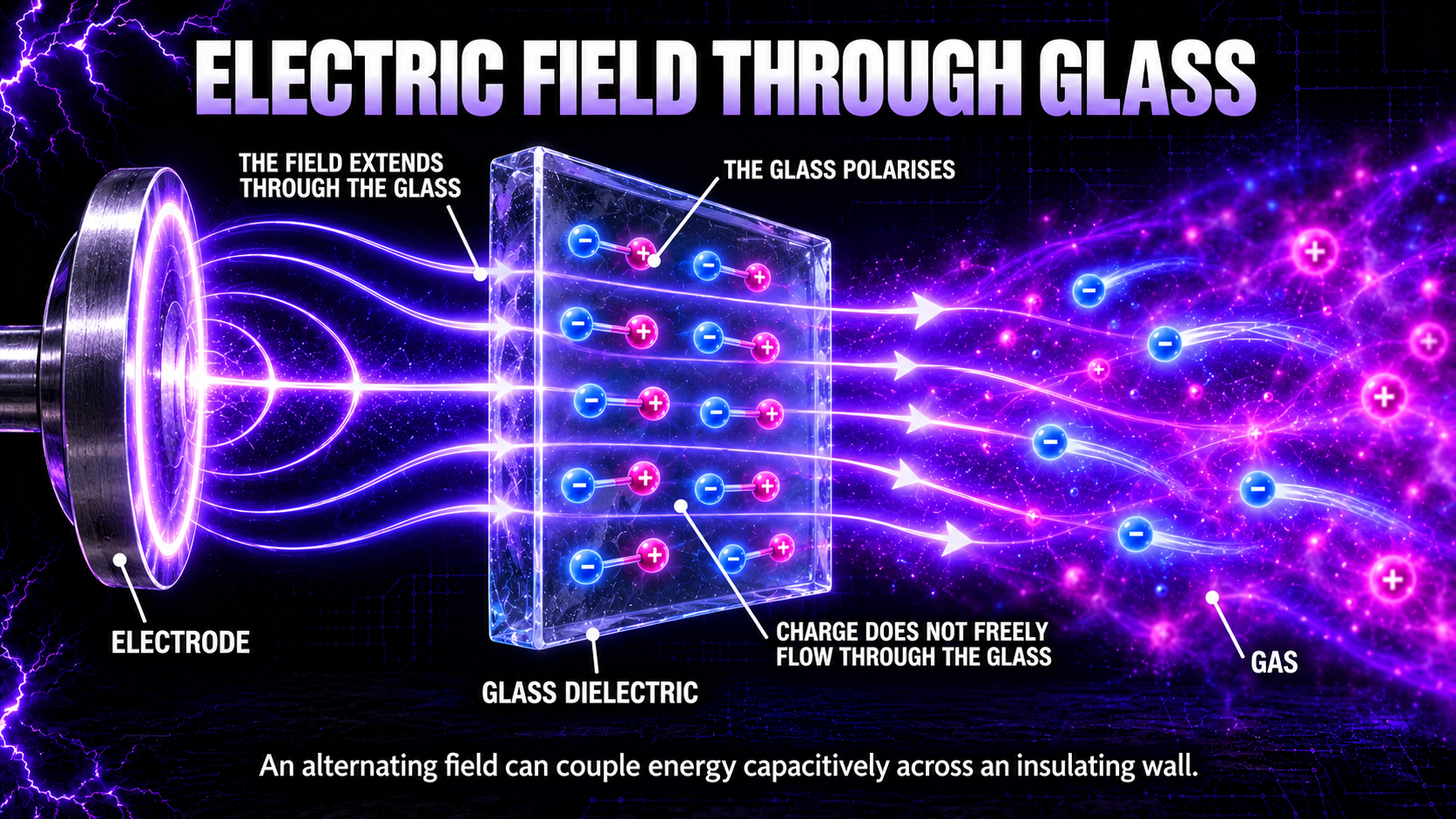
An electric field can exist within and across glass even though glass is an electrical insulator.
The field polarises the material. Bound positive and negative charges shift slightly, creating an opposing contribution to the internal field.
This helps explain the behaviour of a plasma ball. When a hand touches the outside of the globe:
- The plasma remains inside.
- The glass continues to act as an insulating barrier.
- The hand changes the capacitance and surrounding electric-field pattern.
- Streamers concentrate beneath the point of contact.
No normal conductive wire passes through the glass. The interaction occurs through a changing field and capacitive coupling.
Review this process in Lesson 12 — How Does a Plasma Ball Work?.
Static and Changing Electric Fields
A static electric field is produced by charges whose distribution is not changing with time.
Static electricity on a rubbed balloon is a familiar example. The field may remain until the charge leaks away or discharges.
A changing electric field varies in strength or direction over time.
Alternating voltage produces an alternating electric field. If the voltage changes polarity, the field direction reverses.
In high-frequency equipment, this reversal can occur thousands or many more times per second. Charged particles in a gas respond to these changing conditions.
A changing field can also be associated with magnetic effects and electromagnetic radiation. Lesson 15 will explain magnetic fields and their relationship with current and time-varying electric fields.
How Does an Electric Field Accelerate Electrons?
Free electrons are negatively charged, so an electric field exerts a force on them opposite to the field direction.
As an electron accelerates through a gas, it gains kinetic energy. It eventually collides with an atom or molecule.
The collision may:
- Change the electron’s direction
- Transfer heat
- Excite an atom
- Ionise an atom
- Cause electron attachment
If the field is strong enough and the electron travels a suitable distance between collisions, it may gain enough energy to remove another electron from a gas atom.
This creates a positive ion and another free electron. Repeated multiplication can develop into the electron avalanche described in Lesson 13 — What Is Ionisation?.
How Does an Electric Field Create a Spark?
Air normally acts as an insulator because it contains relatively few free charged particles.
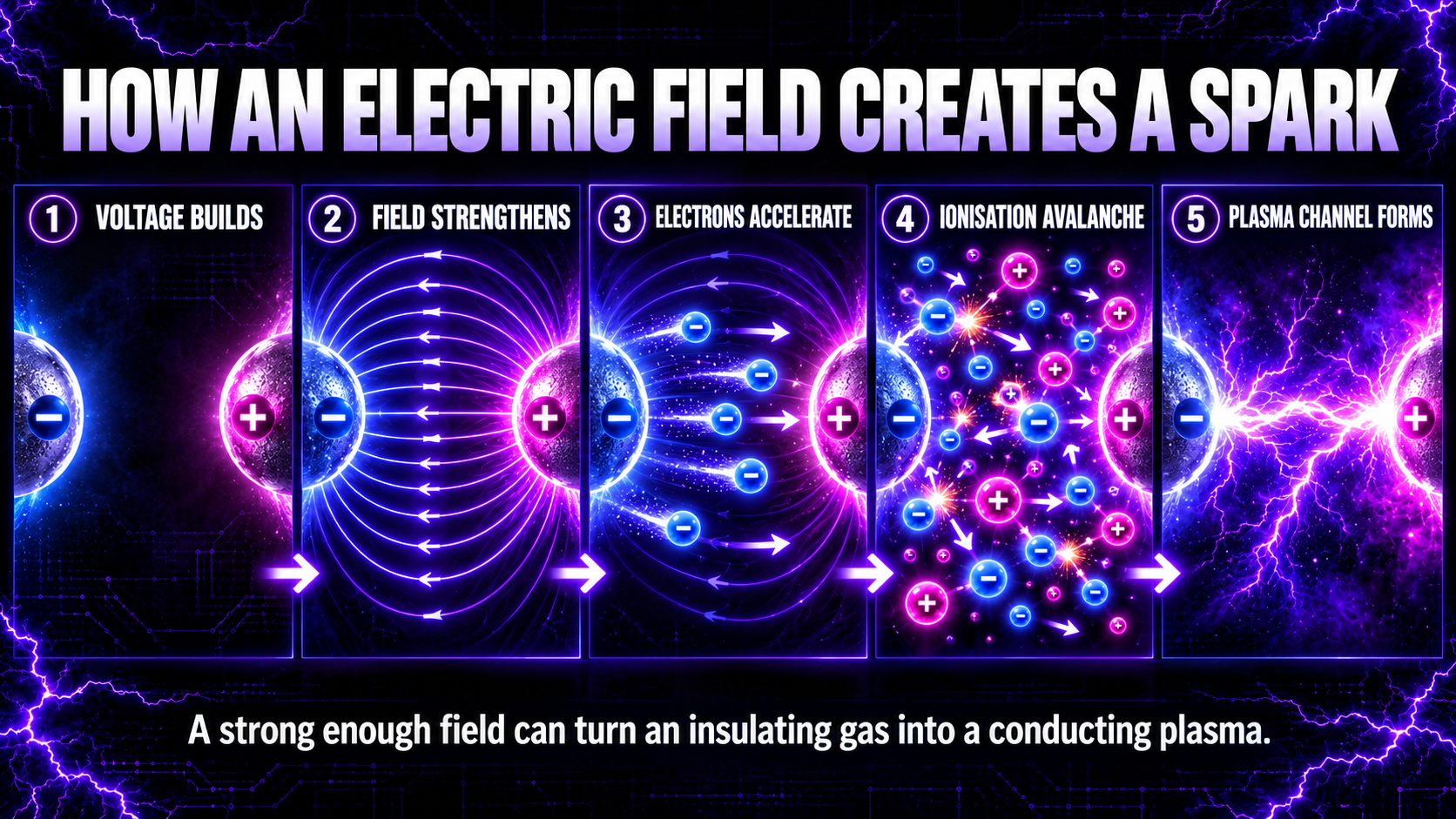
As voltage builds across a gap, the electric field grows stronger. Seed electrons accelerate through the air and collide with molecules.
If ionising collisions multiply fast enough:
- Charged-particle density increases.
- The gas becomes more conductive.
- A narrow ionised channel develops.
- Current rises through that channel.
- A visible spark or arc forms.
The University of California, Santa Barbara’s glow-discharge demonstration explains how electrons accelerated by an electric field can ionise gas molecules and initiate breakdown.
The breakdown point depends on more than voltage. Gas type, pressure, electrode separation, electrode condition, shape, available energy and circuit behaviour all matter.
Electric Fields in a Spark Gap
A spark gap contains opposing conductive electrodes separated by air or another gas.
As the capacitor network charges, a voltage difference develops between the electrodes. This produces an electric field within the gap.
The field is normally strongest where the electrode surfaces are closest or most sharply curved. When the local field becomes sufficient to initiate self-sustaining gas breakdown, an arc bridges the gap.
The simplified sequence is:
Voltage builds → Electric field strengthens → Electrons accelerate → Air ionises → Conductive arc forms
Adjusting the gap changes the distance across which the voltage acts. It also changes the breakdown conditions and the voltage normally required before firing.
However, the gap is not a precise frequency-control dial. It affects firing behaviour, while the oscillation frequency depends mainly on the complete circuit’s effective inductance and capacitance.
Learn more in Lesson 4 — What Is a Spark Gap?.
Electric Fields Inside Plasma Bulbs
The sealed plasma bulbs contain gas and vapour at reduced pressure.
Rapidly changing high-voltage electrical conditions create an electric field through the gas. Free electrons accelerate, collide with atoms and produce excitation and ionisation.
The resulting discharge can contain:
- Free electrons
- Positive ions
- Neutral atoms and molecules
- Excited particles
- Visible and non-visible photons
The field need not be perfectly uniform. Bulb geometry, internal components, wiring, gas pressure and nearby objects all influence the distribution.
The visible glow confirms that energy is reaching the gas-discharge stage, but brightness does not by itself reveal the precise field strength, voltage, current, frequency or total power.
Read Lesson 6 — Why Are Plasma Bulbs Used? for more about the bulbs.
Electric Fields in the High Frequency Plasma Generator
My High Frequency Plasma Generator contains several regions where electric fields are important:
Inside the Capacitor Network
Energy is stored in electric fields within the capacitors’ dielectric material.
Around High-Voltage Wiring and Connections
Voltage differences create fields around conductors. Insulation, spacing and enclosure design help control those fields.
Across the Spark Gaps
The field grows until the air breaks down and conductive arcs form.
Around the Plasma-Bulb Outputs
Rapidly changing electrical conditions help energise and ionise the low-pressure gas inside the bulbs.
Around the Operating Equipment
Time-varying electric and magnetic fields can be detected near the device. Their measured values depend strongly on location, orientation, instrument type and operating conditions.
The complete generator must therefore be understood as one interacting electrical system rather than as a source of one uniform field everywhere around it.
Explore the architecture in Lesson 2 — How Does a Plasma Generator Work?.
Electric Fields and Magnetic Fields Are Different
Electric and magnetic fields are related, but they are not the same.
An electric field is produced by electric charge and by changing magnetic fields.
A magnetic field is produced by moving charge—electric current—and by changing electric fields.
In high-frequency circuits, voltage and current change rapidly, so electric and magnetic fields often exist together as parts of an electromagnetic system.
Nevertheless, a measurement of one does not automatically give the other. Electric fields are commonly expressed in V/m, while magnetic flux density may be expressed in tesla or gauss.
Lesson 15 will examine magnetic fields in detail.
How Can an Electric Field Be Measured?
Electric fields can be measured using instruments designed for the expected frequency and field strength.
Examples include:
- Electrostatic field meters
- Electric-field probes
- Near-field probes
- Calibrated broadband EMF instruments
- Specialised high-voltage measurement systems
The result depends on:
- Distance from the source
- Probe orientation
- Frequency range
- Calibration
- Nearby conductors
- Grounding
- Field uniformity
- Instrument loading
A TinySA with a pickup coil is primarily detecting radio-frequency energy coupled into that coil. It does not directly display the electric field in V/m and does not measure every internal voltage or current in the generator.
Never connect a general-purpose spectrum analyser, multimeter or oscilloscope probe directly to a high-voltage output unless the entire measurement system is correctly rated and the operator understands the grounding and transient hazards.
Common Myths About Electric Fields
Myth 1 — Electric field lines are physical objects
They are a diagramming tool used to represent field direction and relative strength.
Myth 2 — Voltage and electric field are the same
Voltage is a potential difference between points. Electric field describes how potential changes through space and the force per unit charge at a location.
Myth 3 — A strong field always means a large current
Current also depends on conductivity and the complete circuit. A strong field can exist across an insulating gap before breakdown with very little current flowing.
Myth 4 — Electric fields cannot act through glass
An electric field can polarise and act through a dielectric even though the material blocks ordinary conduction.
Myth 5 — High frequency automatically means a stronger field
Frequency describes how rapidly a signal repeats. Field strength depends on voltage, geometry, distance, materials and other circuit conditions.
Myth 6 — Detecting an electric field proves a health effect
It does not. Field detection demonstrates an electrical condition. Biological or therapeutic claims require separate, suitable evidence for the specific exposure and outcome.
Frequently Asked Questions
Can You See an Electric Field?
Not directly. Its effects can be observed through forces, sparks, movement of charged particles and the behaviour of plasma, but the field itself is represented using models such as arrows and field lines.
Does an Electric Field Require Current?
No. A static charge can produce an electric field even when no continuous current is flowing.
Can an Electric Field Exist in a Vacuum?
Yes. Electric fields do not require air or another material medium.
Does an Electric Field Travel Through Insulation?
An electric field can exist in an insulator. The material becomes polarised and changes the field, even though charges are not free to conduct as they are in a metal.
Why Do Electrons Move Opposite to Field Arrows?
Field direction is defined using a positive test charge. Electrons have negative charge, so the force on them points the opposite way.
Why Do Sharp Points Produce Corona?
Charge can become concentrated around a small-radius point or edge, producing a strong local field that can ionise the surrounding gas.
Does Reducing a Spark Gap Strengthen the Field?
For the same voltage, reducing the separation increases the average field represented by \(E\approx V/d\). In practice, the firing voltage and complete circuit behaviour also change, so the result is not controlled by distance alone.
Is the Field Inside a Capacitor Uniform?
Between large parallel plates and away from their edges, it can be approximately uniform. Near the edges and in real component geometries, fringing and material effects make it non-uniform.
Can an Electric Field Store Energy?
Yes. Capacitors store electrical energy in the electric field established between their conductive regions.
Is an Electric Field the Same as an Electromagnetic Wave?
No. A static electric field is not an electromagnetic wave. A self-propagating electromagnetic wave contains linked changing electric and magnetic fields.
Can a TinySA Measure Electric-Field Strength?
Not directly in V/m with an ordinary pickup coil. It can show frequency components coupled into the probe. Calibrated field-strength measurement requires an appropriate probe and measurement method.
Does a Brighter Plasma Bulb Mean a Stronger Electric Field?
Not necessarily. Brightness also depends on gas mixture, pressure, excitation, current, bulb construction, coupling, viewing conditions and other factors.
What Have We Learned?
So, what is an electric field?
It is the electrical influence created by charge and described as force per unit charge.
The key sequence in a gas-discharge system is:
- A voltage difference creates an electric field.
- The field exerts forces on charged particles.
- Free electrons accelerate opposite to the field direction.
- Electron collisions excite and ionise gas atoms.
- Charged-particle multiplication increases conductivity.
- A spark, streamer or glow discharge can form.
Electric fields also store energy in capacitors, act across dielectric materials and change rapidly in high-frequency circuits.
Understanding the field connects voltage, capacitance, ionisation, spark-gap breakdown and plasma formation into one coherent electrical process.
🧠 Key Takeaways
- Electric charge creates an electric field. ✔
- Electric field is force per unit charge. ✔
- It has both strength and direction. ✔
- Field direction is defined using a positive test charge. ✔
- Electrons accelerate opposite to the field direction. ✔
- Field lines are a visual model, not physical threads. ✔
- Electric field may be measured in N/C or V/m. ✔
- Voltage and distance influence the average field between electrodes. ✔
- Capacitors store energy in an electric field. ✔
- Dielectrics can be polarised by fields without freely conducting current. ✔
- Strong local fields can initiate gas ionisation and electrical breakdown. ✔
- Electric and magnetic fields are related but remain different quantities. ✔
🔬 Electric Field Fact
Did you know?
The same voltage can produce very different electric-field strengths depending on geometry. Spreading the potential difference over a larger distance produces a smaller average gradient, while concentrating it across a narrow gap or sharp edge can create a much stronger local field.
Continue Your Learning Journey
⬅ Previous Lesson
📘 Lesson 13 of 24 — What Is Ionisation?
Discover how atoms gain or lose electrons, how electron avalanches begin and why ionised gas becomes electrically conductive.
➡ Next Lesson
📘 Lesson 15 of 24 — What Is a Magnetic Field? (Coming Soon)
Discover how moving electric charges create magnetic fields, how current produces magnetism and why rapidly changing electric and magnetic fields are closely connected.
Learn More About High-Frequency Plasma
If you would like to see how electric fields, spark gaps and gas discharge combine in my enclosed system, visit the High Frequency Plasma Generator.
You can also join the High Frequency Plasma Community on Telegram to ask Alan questions directly, discuss the technology and read owners’ personal experiences. Individual experiences are anecdotal and should not be treated as medical evidence.
Disclaimer
The information in the High Frequency Plasma Learning Centre is provided for general educational purposes to explain the science, history and engineering of plasma and high-frequency electrical technology.
High-voltage and plasma equipment can cause serious electrical shock, burns, fire, electromagnetic interference and equipment damage. Capacitors may retain dangerous stored energy after power has been disconnected. This lesson explains scientific principles; it is not a construction, modification, measurement or servicing guide.
The High Frequency Plasma Generator is intended for educational, experimental, research, meditation, relaxation and general wellness purposes only. It is not a medical device and is not intended to diagnose, treat, cure, mitigate or prevent any disease or medical condition.
Always seek advice from a suitably qualified healthcare professional regarding medical concerns.
🎉 Lesson Complete
Congratulations!
You have now completed:
📘 Lesson 14 of 24
What Is an Electric Field? Charge, Voltage, Force and Plasma Explained
You now understand how electric charge creates a field, how that field exerts force through space and why strong electric fields are essential to capacitors, ionisation, spark-gap breakdown and plasma formation.