
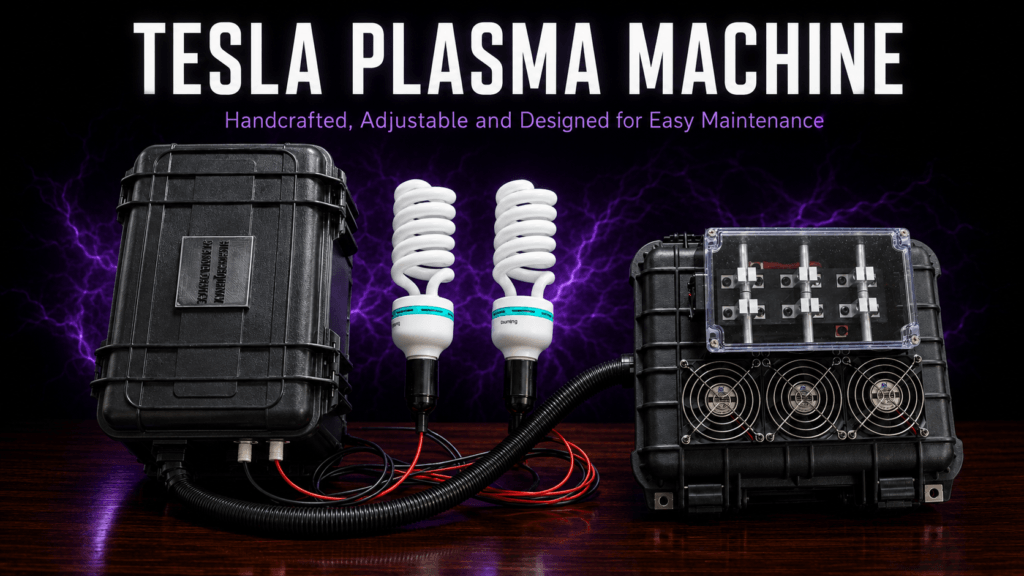
A Tesla plasma machine is a fascinating combination of electrical oscillation, resonance, high voltage and visible plasma. Although these machines may appear similar from the outside, their internal construction, spark-gap arrangement, coil design, ease of maintenance and overall price can differ considerably.
These differences matter because a Tesla plasma machine is not simply a sealed electronic product that is switched on and forgotten. Traditional spark-gap technology contains working parts that require inspection, cleaning and occasional adjustment. The arrangement of the internal components can also influence cooling, unwanted electrical interaction and how easily the machine can be maintained.
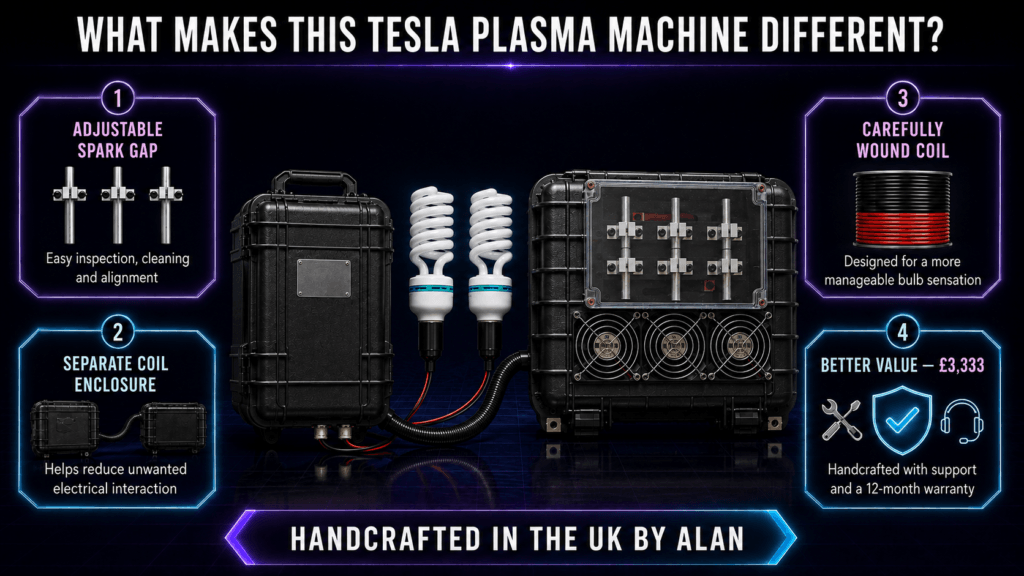
I designed my handcrafted High Frequency Plasma Generator with these practical considerations in mind. It has an accessible and fully adjustable spark gap, replaceable zinc rods, a separate enclosure for the Oudin/d’Arsonval coil and a carefully wound output coil intended to create a more manageable sensation at the plasma bulbs.
It is also available at a considerably lower price than some premium plasma systems.
This guide explains how a Tesla plasma machine works, what buyers should examine and why serviceability may be more important than impressive marketing language.
The generator discussed here is intended for education, electrical experimentation, meditation, relaxation and general personal wellness. It is not a medical device and no claim is made that it can diagnose, treat, cure or prevent any health condition.
What Is a Tesla Plasma Machine?
The term Tesla plasma machine is commonly used to describe a high-frequency generator inspired by the electrical experiments of Nikola Tesla and other early researchers, including Jacques-Arsène d’Arsonval and Paul Marie Oudin.
It is not one standardised product category. Different manufacturers may use the term for machines with different circuits, power levels, electrodes and output arrangements.
A traditional system normally contains several important stages:
- A power supply
- A high-frequency producer
- A high-voltage transformer
- Capacitors that temporarily store electrical energy
- A spark gap that repeatedly releases that energy
- An Oudin, d’Arsonval or related resonant coil
- Cables carrying the output
- Gas-filled bulbs that make the electrical effect visible
The sealed bulbs contain gas at relatively low pressure. When the changing electric field becomes strong enough, electrons are separated from some of the gas atoms. The gas becomes partly ionised, creating the glowing plasma visible inside the bulbs.
The colour and movement of the plasma depend on the gas, pressure, bulb construction, voltage, frequency, waveform and surrounding electrical conditions.
Where Did Tesla-Inspired Plasma Technology Begin?
In 1891, Nikola Tesla developed the high-frequency oscillator that became known as the Tesla coil or resonant transformer. The Nikola Tesla Museum describes it as an apparatus for producing high-voltage, high-frequency currents.
Tesla used resonant circuits, capacitors and spark gaps to create extremely rapid electrical oscillations. His demonstrations included illuminated gas-filled tubes, brush discharges and wireless lighting effects that appeared extraordinary to nineteenth-century audiences.
At approximately the same time, French physician and biophysicist Jacques-Arsène d’Arsonval was investigating high-frequency currents. Paul Marie Oudin later modified d’Arsonval’s arrangement by adding a resonator coil capable of producing higher voltage at lower current.
The Smithsonian National Museum of American History records the historical interest of Tesla and d’Arsonval in high-frequency electrical currents. However, historical medical experimentation should not be confused with modern clinical evidence or regulatory approval.
A modern Tesla plasma machine may use principles associated with all three pioneers. This is why terms such as Tesla coil, Oudin coil and d’Arsonval coil are sometimes used together, even though the original historical circuits were not identical.
How Does a Tesla Plasma Machine Work?
Although individual designs vary, the operating process can be explained in plain language.
Electrical power first enters the main generator enclosure. The internal electronics transform the incoming electricity and raise it to a much higher voltage.
The capacitors then store electrical charge. As the voltage across the spark gap rises, it eventually becomes strong enough to cross the air space between the electrodes.
At that moment, the spark gap fires.
The stored energy is released very rapidly through the circuit, producing electrical oscillations. The process then resets, the capacitors charge again and the spark gap fires repeatedly.
These rapid bursts excite the Oudin/d’Arsonval coil. The coil and its associated capacitance form a resonant system that shapes and increases the high-frequency output.
The output travels through the connecting cables to the bulbs. Inside each bulb, the changing electric field energises the low-pressure gas. Charged particles collide with gas atoms, and light is released as those atoms return to a lower-energy state.
This creates the moving coloured plasma that the user can see.
When someone holds a bulb, the person’s body changes the electrical conditions around the glass. The visible plasma may become brighter or concentrate towards the hand because the body provides additional capacitive coupling to the surrounding environment.
The plasma itself remains inside the sealed bulb. It is primarily a changing electric field and a small capacitive current that couple through the glass—not the glowing gas escaping into the body.
For a more detailed introduction, read How Does a Plasma Generator Work?.
Why the Physical Design of a Tesla Plasma Machine Matters
Two machines can be based on similar electrical principles while offering very different ownership experiences.
A buyer should therefore look beyond the strength of the plasma display. Important practical questions include:
- Can the spark gap be inspected easily?
- Can the electrode gap be measured and adjusted accurately?
- Are the electrodes replaceable?
- Is there adequate cooling?
- Is the resonator positioned away from switching electronics?
- Can individual parts be serviced without dismantling the entire machine?
- Are instructions and replacement parts available?
- Is support provided by someone who understands the construction?
A Tesla plasma machine that is difficult to clean or adjust may become frustrating to own, regardless of its purchase price.
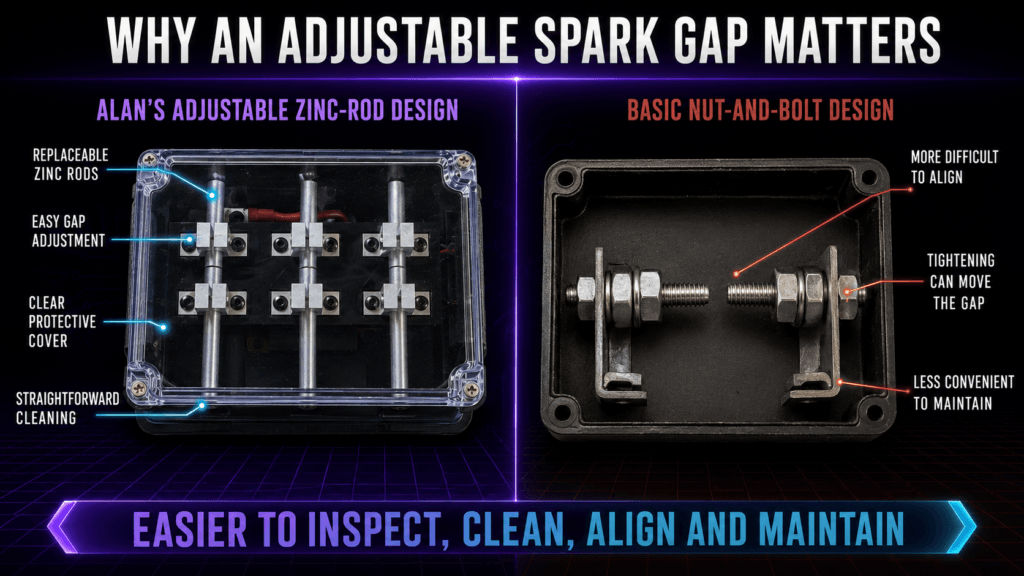
The Advantage of a Fully Adjustable Spark Gap
The adjustable spark gap is one of the most important features of my High Frequency Plasma Generator.
Every time the spark gap operates, a discharge crosses the space between the electrodes. This produces heat, light, sound and gradual surface erosion. Deposits can develop, and the ends of the rods can become uneven after extended use.
This is a normal characteristic of exposed spark-gap technology. It means the electrodes eventually require cleaning, repositioning or replacement.
Some plasma machines use ordinary bolts, threaded contacts or nut-and-bolt arrangements as their spark-gap electrodes. These designs can operate, but adjustment may be less convenient.
Loosening a nut can allow the electrode to move in more than one direction. Tightening it again may alter the gap that has just been set. The facing surfaces can also become misaligned, making it harder to establish a consistent spacing.
Dedicated Adjustable Holders
My Tesla plasma machine uses solid rods secured in dedicated adjustable holders. The rods can be moved forwards or backwards, aligned and locked into position. The clear enclosure allows the owner to see the spark-gap assembly without exposing it during operation.
This offers several practical advantages:
- The gap is easier to inspect.
- Electrode faces can be aligned more accurately.
- A feeler gauge can be used when the machine is disconnected.
- Cleaning is straightforward.
- Worn rods can be advanced to expose a fresh surface.
- Replacement does not require redesigning the assembly.
- The owner can understand what is happening instead of treating it as a sealed mystery.
The system currently uses replaceable solid zinc rods. Zinc was chosen as a practical electrode material that can be sourced and replaced without requiring a specialist sealed component.
All adjustment and cleaning must be carried out only after the generator has been switched off, disconnected and allowed to discharge fully. The spark gap must never be touched or adjusted while the machine is operating.
Why Easier Maintenance Can Mean Better Long-Term Value
Purchase price is only one part of the cost of owning a Tesla plasma machine.
A machine that costs more is not automatically easier to service. If an electrode is hidden behind a complicated arrangement or made from a proprietary component, even routine maintenance may require assistance from the manufacturer.
An accessible spark gap gives the owner more control over normal maintenance. It also makes it easier to identify whether declining performance is caused by dirty electrodes, an enlarged gap or another visible issue.
This does not remove the need for sensible safety precautions or technical support. It simply means that a normal consumable part has been designed to remain accessible.
For owners who expect to use their machine for years, replaceable electrodes and straightforward adjustment may be more valuable than decorative features.
You can learn more about this part of the circuit in What Is a Spark Gap?.
Why My Oudin/d’Arsonval Coil Is Housed Separately

Another important difference is the location of the Oudin/d’Arsonval coil.
In my design, the main power electronics are housed in one enclosure, while the resonant coil and spark-gap section are housed in a separate enclosure. The two sections are connected through protected cabling.
The purpose of this arrangement is to create physical separation between different stages of the machine.
The main enclosure contains components that switch and transform electrical power. These components can generate heat, rapidly changing currents and electromagnetic fields.
The Oudin/d’Arsonval coil is a resonant part of the output system. Its behaviour is affected by its inductance, winding geometry, surrounding objects, connecting cables and stray capacitance.
Placing everything very close together may allow unwanted electrical or magnetic coupling between different parts of the circuit. Physical separation can help reduce this interaction, although it would be inaccurate to say that separation completely eliminates all interference.
Electromagnetic interference can travel through wiring as well as through radiated electric and magnetic fields. Enclosure material, grounding, cable routing and component placement also matter. The general importance of designing electronic systems to tolerate electromagnetic disturbances is explained in this NIST electromagnetic-compatibility paper.
The separate-box arrangement offers several possible engineering and practical advantages:
- Greater physical distance from switching components
- Reduced direct coupling between the resonator and main electronics
- Less heat from the power stage surrounding the coil
- More freedom to position and cool the spark-gap assembly
- Easier access for inspection and maintenance
- Simpler fault finding because the stages are physically organised
- A clearer separation between power production and resonant output
This layout is one of the features that distinguishes my Tesla plasma machine from compact designs that place every component inside one enclosure.
Does a Separate Coil Produce More Stable Harmonics?
A spark-gap system does not produce a single perfectly clean sine wave. Each rapid discharge can generate a fundamental oscillation together with multiple harmonics and transient components.
The exact spectrum depends on the capacitor values, inductance, spark gap, wiring, electrode condition, load and coil geometry.
Keeping the resonant coil away from other electrical components is intended to reduce unwanted interaction and support more repeatable operation. If the resonator’s surroundings change less, its effective inductance and stray capacitance may also remain more consistent.
This gives the separate enclosure a sensible engineering purpose.
However, claims about “more stable harmonics” should ultimately be supported by repeatable measurements. A spectrum analyser, suitable high-voltage probes and a controlled load would be needed to compare two designs properly.
It is therefore safest to say that the separate-box design is intended to reduce unwanted coupling and promote a more consistent output. It should not be claimed that enclosure separation alone proves a particular biological benefit.
A stable and manageable output may improve the user experience at the bulbs, but it does not establish that the harmonics treat the body or produce a guaranteed health result.
Why the Way the Coil Is Wound Matters
The Oudin/d’Arsonval coil is not simply a length of wire placed inside a box. The way it is wound can influence how the Tesla plasma machine behaves.
Relevant factors include:
- The number of turns
- Coil diameter
- Wire thickness
- Spacing between turns
- Winding length
- Insulation
- Coupling to the rest of the circuit
- Inductance and stray capacitance
- Distance from conductive objects
- The electrical load presented by the bulbs and user
Changing one of these factors may alter the resonant behaviour, output voltage, current distribution or frequency spectrum.
My coil is wound with the aim of creating a strong visible plasma effect while keeping the bulbs reasonably comfortable to hold.
People sometimes describe an excessively sharp bulb output as feeling “spicy.” This can mean a prickling, biting or concentrated sensation at the hand, especially around individual points of contact.
More aggressive does not necessarily mean better. A bulb that feels uncomfortably sharp may be difficult to hold for the intended session, even if its visual plasma effect appears impressive.
The objective of my coil design is balance: enough output to produce an active plasma display without deliberately chasing the harshest possible sensation.
Individual sensitivity varies, so no machine can guarantee that every person will experience the bulbs in exactly the same way. Users should always begin cautiously and stop immediately if the sensation becomes painful or uncomfortable.
A Lower-Priced Alternative to Premium Plasma Machines
Cost is another major advantage.
Some premium Tesla-inspired systems have been marketed at prices around $11,000 or more. My handcrafted High Frequency Plasma Generator is currently offered for £3,333, with the package and current terms described on the official product page.
These figures use different currencies and packages can differ, so buyers should compare current prices and inclusions directly. Nevertheless, the difference in headline cost is substantial.
The lower price does not mean removing the parts that make long-term ownership practical. The package currently includes:
- The handcrafted high-frequency generator
- Separate spark-gap and coil enclosure
- Two plasma output bulbs
- Adjustable zinc electrodes
- Three-fan cooling system
- Instructions
- Testing before dispatch
- Direct customer support
- Owner-community access
- A 12-month warranty
- Shipping under the published terms
My aim is to make Tesla-inspired technology more accessible without creating a sealed product that owners cannot understand or maintain.
Tesla Plasma Machine Comparison
| Feature | Alan’s High Frequency Plasma Generator | Some higher-priced designs |
|---|---|---|
| Spark-gap adjustment | Rods move in dedicated holders | May use bolts, nuts or fixed contacts |
| Electrode access | Visible and accessible after disconnection | May require more dismantling |
| Electrode replacement | Replaceable solid zinc rods | May depend on proprietary parts |
| Coil location | Separate resonator and spark-gap enclosure | Components may share one enclosure |
| Cooling | Three external cooling fans | Varies by model |
| Bulb sensation | Coil wound for a more manageable output | Some outputs may feel sharper |
| Builder contact | Direct access to Alan | Support arrangements vary |
| Current price | £3,333 | Some systems are substantially more expensive |
This is not a claim that every competing Tesla plasma machine uses the same construction. Buyers should inspect the specifications and maintenance arrangements of the particular machine they are considering.
What Should You Ask Before Buying?
Before investing in any Tesla plasma machine, ask the seller practical questions:
- Can I see genuine photographs of the complete machine?
- What type of spark gap does it use?
- How is the gap measured and adjusted?
- Are the electrodes replaceable?
- What maintenance is expected?
- Where is the resonant coil positioned?
- How is the machine cooled?
- What happens if a bulb or electrode needs replacing?
- Is the unit individually tested?
- Are operating and maintenance instructions included?
- Is there a written warranty?
- Can I speak directly to someone who understands the construction?
- What is the machine legally and practically intended to do?
Clear answers are more valuable than dramatic promises.
Is a Tesla Plasma Machine a Medical Device?
Not automatically.
“Tesla plasma machine” is a popular search phrase, not a recognised medical classification. A home spark-gap generator should not be confused with a regulated clinical cold-atmospheric-plasma system.
The UK MHRA explains that medical-device classification depends on a product’s intended purpose and mode of action. Its current borderline-products guidance should be considered before making medical claims.
My High Frequency Plasma Generator is intended for education, experimentation, meditation, relaxation and general personal wellness. It is not intended to diagnose, treat, cure, mitigate or prevent disease.
Customer experiences may be shared as personal accounts, but they should not be presented as clinical proof or a promise that another person will experience the same result.
Tesla Plasma Machine Safety
High-frequency generators involve high voltage, electrical arcing and electromagnetic fields. They must be treated as serious electrical equipment.
Always follow the supplied instructions and observe these precautions:
- Keep the equipment dry.
- Operate it on a stable, non-flammable surface.
- Keep flammable vapours and aerosols away from the spark gap.
- Never open or adjust the machine during operation.
- Disconnect it before cleaning or maintenance.
- Keep airflow around the fans unobstructed.
- Inspect cables, bulbs and connectors before every session.
- Keep sensitive electronics at a suitable distance.
- Stop immediately if the machine becomes damaged, unusually hot or abnormal.
- Do not use it around pacemakers, implanted defibrillators, neurostimulators, insulin pumps or other implanted or body-worn electronic medical equipment.
- Do not use during pregnancy without appropriate professional guidance.
- Keep children, pets and untrained people away from the operating equipment.
Frequently Asked Questions
What is the biggest advantage of the adjustable spark gap?
It makes inspection, cleaning, alignment and replacement easier. Dedicated rod holders also allow the gap to be set without relying entirely on threaded bolts and locking nuts.
Why does the spark gap need cleaning?
Repeated electrical discharges gradually mark and erode the electrode surfaces. Deposits or uneven surfaces can affect the way the gap fires.
Why put the Oudin/d’Arsonval coil in a separate box?
Physical separation is intended to reduce unwanted interaction with the power electronics, simplify cooling and make the resonant section easier to access. It does not eliminate every possible form of interference, but it is a deliberate engineering choice.
Does a separate coil guarantee better harmonics?
No single construction feature can guarantee this. Coil design, capacitors, wiring, spark-gap condition and electrical loading all affect the spectrum. Proper comparative measurements would be needed to prove a specific harmonic improvement.
Why do some plasma bulbs feel “spicy”?
The term usually describes a sharp or prickling sensation. Coil tuning, output level, bulb design, contact area and the user’s sensitivity can all influence the sensation.
Is stronger always better?
No. An extremely sharp output may be uncomfortable and difficult to use. A well-designed Tesla plasma machine should aim for controllable, repeatable operation rather than pursuing the harshest possible output.
Is a more expensive machine automatically superior?
No. Price should be considered alongside construction, maintenance, cooling, warranty, support and the parts included.
Is This Tesla Plasma Machine Right for You?
My High Frequency Plasma Generator may suit people interested in Nikola Tesla, resonance, high-frequency electricity, visible plasma, historical electrical technology, meditation or personal experimentation.
Its principal advantages are practical:
- A visible, adjustable spark gap
- Replaceable zinc electrodes
- Easier cleaning and maintenance
- A separate Oudin/d’Arsonval coil enclosure
- Reduced proximity between the resonator and main electronics
- A coil designed for a more manageable bulb sensation
- Built-in cooling
- Direct access to the builder
- A substantially lower price than some premium alternatives
These features do not turn the generator into a medical device or guarantee a health result. They make it a more serviceable, understandable and accessible Tesla-inspired system.
To examine the complete package, visit the High Frequency Plasma Generator page. You can also join the High Frequency Plasma Community on Telegram to ask questions directly before deciding.
A good Tesla plasma machine should not depend on mystery. Its design, maintenance requirements, intended use and price should all be explained clearly. That transparency is at the heart of the machine I build.