So, how does a Tesla coil work? In simple terms, a traditional Tesla coil stores electrical energy in a capacitor, releases it rapidly through a primary coil and uses resonance to transfer that energy into a secondary coil. This develops a high-frequency, high-voltage output that can ionise the surrounding air and create visible electrical streamers.
📚 High Frequency Plasma Learning Centre
📘 Lesson 11 of 24 — How Does a Tesla Coil Work?
Previous lesson: Lesson 10 — What Are Electrical Oscillations?
Next lesson: Lesson 12 — How Does a Plasma Ball Work? (Coming Soon)
Estimated reading time: 15 minutes
Difficulty: 🟢 Beginner
What You’ll Learn
By the end of this lesson, you will understand:
- What a Tesla coil is. ✔
- Who invented the Tesla coil and why. ✔
- The main components in a traditional spark-gap Tesla coil. ✔
- How capacitors, spark gaps and coils work together. ✔
- Why resonance allows a Tesla coil to develop a very high voltage. ✔
- Why the electrical discharge appears as lightning-like streamers. ✔
- How a Tesla coil can illuminate certain lamps without a direct wire connection. ✔
- What Tesla coils share with spark-gap plasma generators—and how the devices differ. ✔
- Why Tesla coils must be treated as hazardous high-voltage equipment. ✔
- How does a Tesla coil work
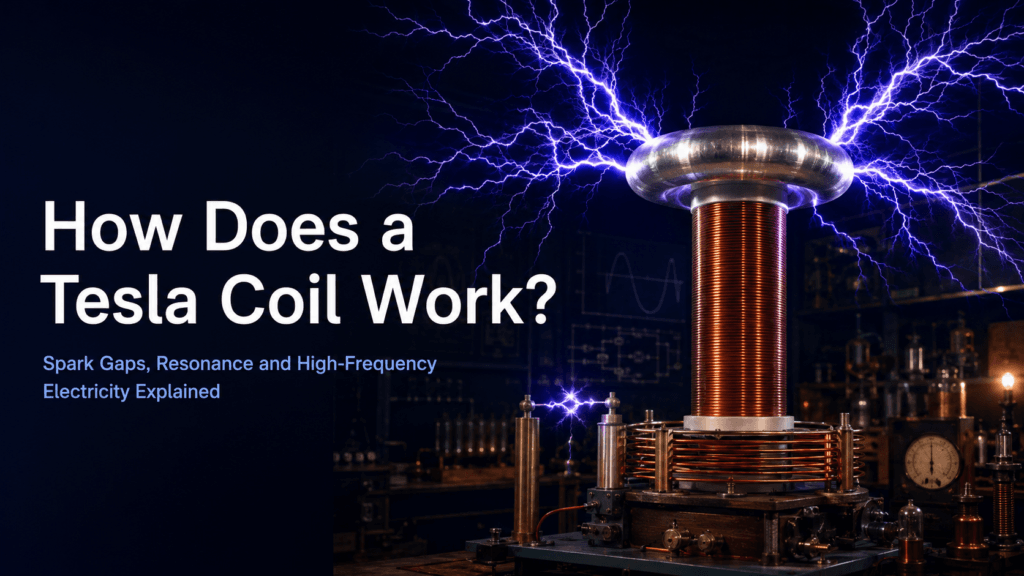
If you have ever seen a machine produce long, branching electrical streamers, you may have been watching a Tesla coil. The display looks dramatic, but behind it is an elegant combination of capacitance, inductance, electrical oscillation and resonance.
So, how does a Tesla coil work? In simple terms, a traditional Tesla coil stores electrical energy in a capacitor, releases it rapidly through a primary coil and uses resonance to transfer that energy into a secondary coil. This develops a high-frequency, high-voltage output that can ionise the surrounding air and create visible electrical streamers.
That one-sentence explanation contains several ideas covered earlier in the High Frequency Plasma Learning Centre. We have already explored frequency, resonance, spark gaps and electrical oscillations. In this lesson, those pieces come together in one of Nikola Tesla’s most recognisable inventions.
What Is a Tesla Coil?
A Tesla coil is an air-core resonant transformer designed to produce alternating electricity at a high voltage and high frequency.
The word transformer tells us that electrical energy is transferred between coils. The term air-core means that the coils are not wound around the solid iron core found in an ordinary mains transformer. The word resonant means that the electrical circuits are tuned so that energy oscillates strongly at particular natural frequencies.
A traditional spark-gap Tesla coil normally contains two electrically tuned sections:
- A primary circuit containing a capacitor and primary coil.
- A secondary circuit containing a secondary coil and its effective capacitance, often including a metal top load.
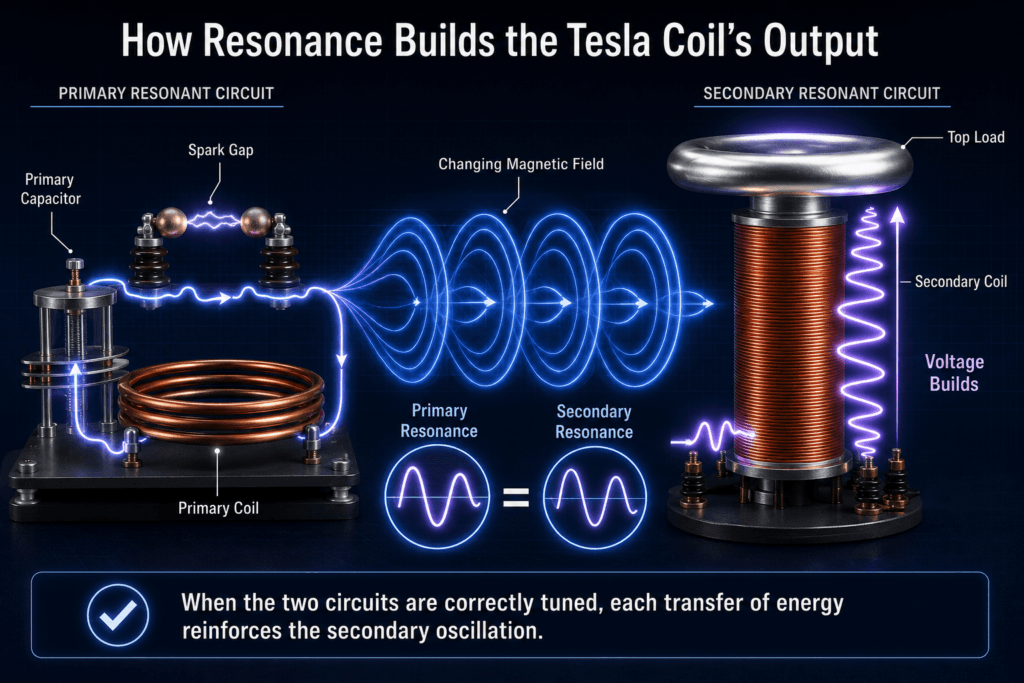
The two circuits are positioned close enough for their changing magnetic fields to couple energy between them, but they are not normally connected by an ordinary conducting wire. When both circuits are tuned to compatible resonant frequencies, energy can move efficiently from the primary system into the secondary system.
The result is a large alternating voltage at the top of the secondary coil. If the surrounding electric field becomes strong enough, the air breaks down electrically and produces streamers or sparks.
For anyone asking how does a Tesla coil work, the most important starting point is that the machine does not rely on one component alone. Its dramatic output is created by a precisely timed interaction between energy storage, rapid switching, magnetic coupling and resonance.
Who Invented the Tesla Coil?
Nikola Tesla developed the apparatus that became known as the Tesla coil in 1891. It was also described as Tesla’s resonant transformer, Tesla’s oscillator or a generator of high-frequency currents.
Tesla was investigating how alternating electricity behaved at higher frequencies than the ordinary power systems of his time. His experiments involved electrical resonance, lighting, gas-discharge tubes, insulation, wireless signalling and the transfer of energy through electric and magnetic fields.
The Nikola Tesla Museum describes the 1891 apparatus as a high-frequency converter without an iron core and with a spark gap, used to generate high-voltage, high-frequency currents. The National MagLab’s Magnet Academy likewise identifies it as a high-frequency transformer capable of producing very high voltage.
Tesla made many versions rather than one permanent design. Later experimenters also modified the circuit, so the expression “Tesla coil” now describes a family of resonant high-voltage devices rather than one exact machine.
The Six Main Parts of a Traditional Tesla Coil
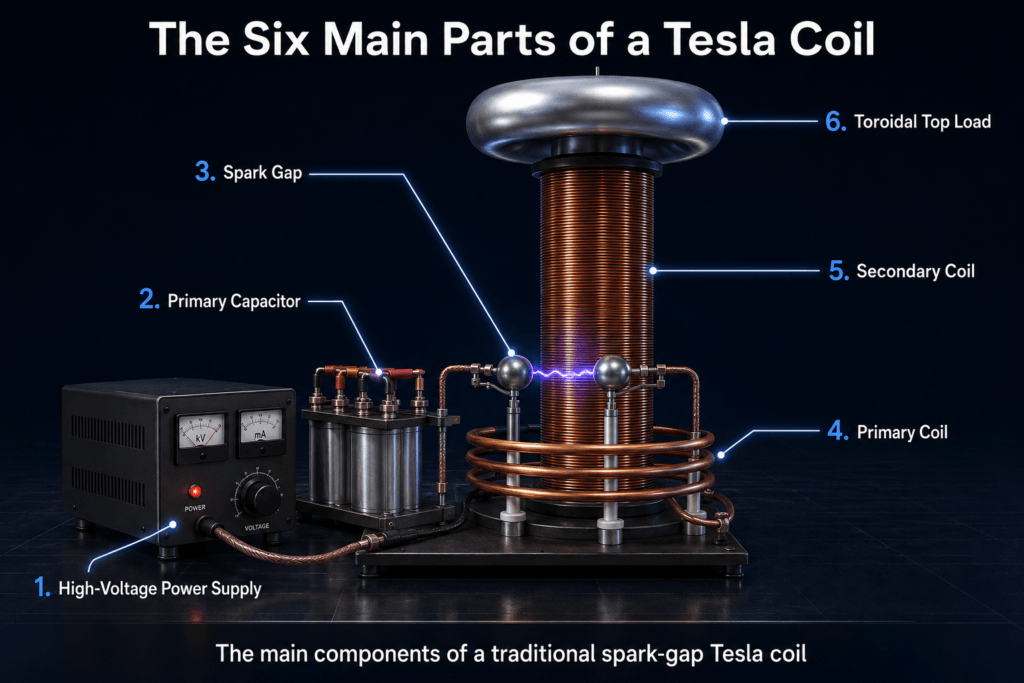
To understand “how does a Tesla coil work”, it helps to identify the principal parts of a classic spark-gap design.
The question how does a Tesla coil work becomes much easier to answer once each of these components is understood separately.
1. High-voltage power supply
The power supply raises the incoming voltage to a level capable of charging the primary capacitor. This is the energy source for each operating cycle; it is not normally the stage that produces the final high-frequency output.
2. Primary capacitor
The capacitor stores separated electric charge and energy in an electric field. As the power supply operates, the voltage across the capacitor increases. When the spark gap fires, the capacitor can release its stored energy very rapidly.
3. Spark gap
The spark gap consists of two or more conductive electrodes separated by air. At first, the air acts as an insulator. When the voltage becomes high enough, the air ionises, an arc forms and the gap suddenly becomes conductive. In this way, the spark gap behaves like an extremely fast, automatic high-voltage switch.
Primary Coil
4. Primary coil
The primary coil usually consists of a relatively small number of turns made from a substantial conductor. Together with the primary capacitor, it forms an LC—or inductance-capacitance—resonant circuit. When the spark gap conducts, energy begins oscillating between the capacitor’s electric field and the magnetic field associated with current in the primary coil.
5. Secondary coil
The secondary normally contains many more turns of finer wire. It has its own inductance and capacitance and therefore its own natural resonant frequency. The changing magnetic field from the primary coil induces an alternating voltage in the secondary.
6. Top load or output terminal
The secondary is commonly topped by a smooth metal sphere or toroid—the familiar doughnut-shaped terminal. The top load adds capacitance, affects the secondary’s resonant frequency and helps control the electric field around the output. When the field becomes strong enough, streamers can extend into the surrounding air.
Grounding, insulation, protective controls and the physical spacing of the components are also essential to a working system. These should never be treated as optional details.
How Does a Tesla Coil Work Step by Step?
The complete process occurs extremely quickly and repeats many times while a traditional spark-gap Tesla coil is operating.
Step 1 — The primary capacitor charges
The high-voltage supply delivers energy to the capacitor. As charge accumulates, the voltage across the capacitor—and usually across the spark gap—rises.
Step 2 — The spark gap breaks down
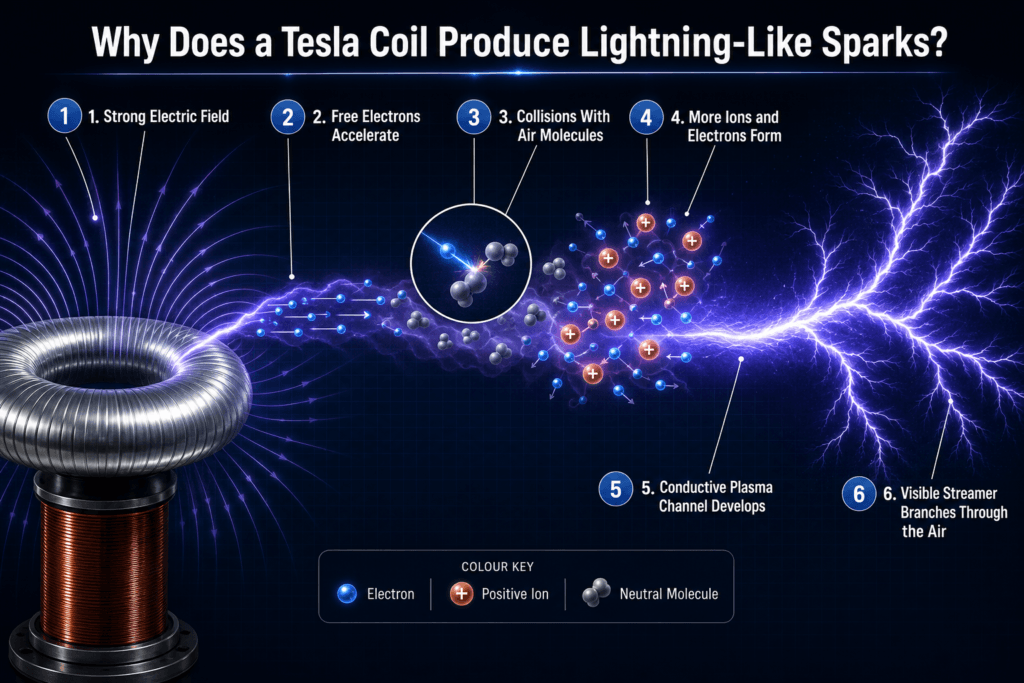
Air normally resists electrical current. As the voltage across the gap rises, however, the electric field becomes increasingly strong. At the breakdown point, free electrons accelerate and collide with air molecules. More charged particles are produced, a conductive channel forms and a visible arc bridges the gap.
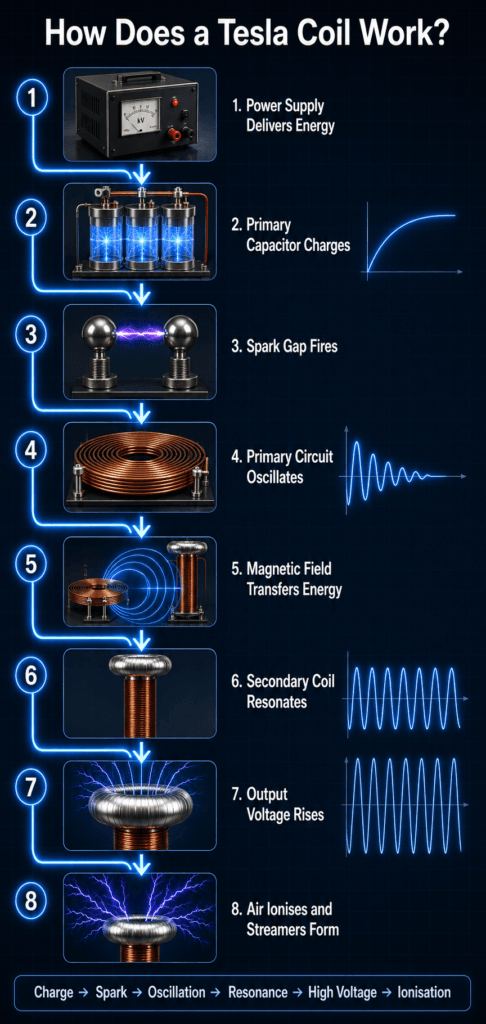
Step 3 — The primary circuit begins to oscillate
The conducting spark gap connects the charged capacitor to the primary coil. The capacitor discharges through the coil, creating a rapidly changing current and magnetic field.
The magnetic field then begins to collapse. Its changing flux induces a voltage that helps keep the current moving and recharges the capacitor with the opposite polarity. Energy therefore moves backwards and forwards between the capacitor and the primary coil.
This produces a short burst of high-frequency, damped electrical oscillations—the “ringing” discussed in Lesson 10.
Step 4 — The primary transfers energy to the secondary
The changing current in the primary produces a changing magnetic field around it. Because the secondary coil sits within part of this field, electromagnetic induction creates a voltage in the secondary.
This is transformer action, but a Tesla coil does more than simply rely on the ratio between the numbers of turns. It also relies on both electrical sections being resonant.
Step 5 — Resonance builds the secondary response
If the primary and secondary circuits are suitably tuned, successive transfers of energy arrive with helpful timing. Each oscillation reinforces the developing secondary oscillation rather than working against it.
This resembles pushing a playground swing at the correct point in every cycle. A single push creates a small movement, but correctly timed pushes allow a much larger motion to develop. In a Tesla coil, electrical energy—not a physical swing—is oscillating.
Step 6 — A high voltage develops at the output terminal
The secondary contains many turns, and the resonant exchange allows a large alternating electrical potential to form near its top. The top load stores charge and shapes the electric field around the output.
Step 7 — The surrounding air becomes ionised
When the electric field exceeds the ability of the surrounding air to remain insulating, the air begins to break down. Charged particles form branching conductive paths. These luminous paths appear as streamers, corona or sparks, depending on the operating conditions.
Step 8 — The burst decays and the cycle starts again
Real circuits lose energy through resistance, heat, sound, the spark gap, electromagnetic radiation and the visible discharge. The oscillation therefore becomes weaker. The primary arc eventually extinguishes, the capacitor begins charging again and the process repeats.
The simplified sequence is:
Power supply → Capacitor charges → Spark gap fires → Primary circuit oscillates → Magnetic coupling transfers energy → Secondary resonates → Voltage rises → Air ionises → Streamers form → Cycle repeats
Why Is Resonance So Important?
Resonance is the feature that distinguishes a Tesla coil from a basic step-up transformer.
Any complete answer to how does a Tesla coil work must therefore explain resonance, because transformer action and the number of coil turns do not tell the whole story.
Every oscillating electrical circuit has a natural frequency determined mainly by its inductance and capacitance. For an ideal LC circuit, this is expressed as:
[
f_0=\frac{1}{2\pi\sqrt{LC}}
]
In this equation:
- (f_0) is the resonant frequency in hertz.
- (L) is inductance in henries.
- (C) is capacitance in farads.
The primary coil and its capacitor form one resonant system. The secondary coil, its top load and its distributed capacitance form another. Designers adjust physical dimensions, numbers of turns, capacitance and connection points so the two sections respond at compatible frequencies.
When the tuning is close, energy supplied by the primary reinforces the secondary oscillation. When the tuning is poor, less energy reaches the secondary and the output normally becomes weaker or less efficient.
The simple LC equation is an excellent starting point, but a real Tesla coil is more complicated. Coil geometry, coupling, resistance, stray capacitance, spark-gap behaviour, the top load and nearby objects can all change its operation.
How Does the Voltage Become So High?
It is tempting to explain a Tesla coil only by saying that the secondary has more turns than the primary. The turns ratio does contribute, but it is not the whole explanation.
A conventional transformer is normally described largely through its primary-to-secondary turns ratio. A Tesla coil is a loosely coupled, double-tuned resonant system. Energy transfers over several rapid oscillations, and the resonant rise in the secondary contributes significantly to the final voltage.
Several features therefore work together:
- The power supply charges the primary capacitor to a high voltage.
- The capacitor releases energy quickly.
- The primary LC circuit creates a strong oscillating current.
- Magnetic coupling moves energy into the secondary.
- The secondary contains many turns.
- Resonance allows the secondary response to build.
- The top load and coil capacitance store alternating charge.
This combination can create an output far above the original input voltage. The precise output is not determined by one component and should never be estimated simply from spark length.
Why Does a Tesla Coil Produce Lightning-Like Sparks?
Ordinary air is mainly an electrical insulator, but no insulator can withstand an unlimited electric field.
People searching how does a Tesla coil work are often most curious about these lightning-like discharges. They are the visible result of the intense electric field around the output ionising the surrounding air.
Near the Tesla coil’s top terminal, the alternating voltage creates a powerful, rapidly changing electric field. If the local field becomes sufficiently intense, it accelerates free electrons already present in the air. These electrons collide with molecules and can knock additional electrons free.
The process creates positively and negatively charged particles and forms a partially ionised gas. That conductive channel permits further current to flow, creating a luminous streamer.
The streamer branches because the electric field is not perfectly uniform. Tiny differences in humidity, air pressure, nearby surfaces and existing charged particles influence the path. The result resembles miniature lightning, although its scale, available energy and surrounding conditions differ greatly from a thunderstorm.
The discharge is also a form of gas ionisation. This creates an important connection with plasma: electrical energy creates free charges and excited particles within the gas, and some of the energy is released as visible light.
How Can a Tesla Coil Light a Lamp Without Wires?
Tesla coils are often demonstrated beside fluorescent or other gas-discharge tubes that glow without a normal wired connection to the output.
The alternating voltage produces changing electric and magnetic fields around the apparatus. A nearby lamp can couple with part of this field through electromagnetic induction and capacitive effects. If sufficient energy is coupled into the lamp, the gas inside can become excited and emit light.
This does not mean that energy has appeared from nowhere. The lamp receives energy from the field generated by the powered coil. Distance, orientation, lamp construction, field strength and nearby objects all affect the result.
Tesla investigated this behaviour as part of his research into high-frequency lighting and wireless energy. These historic demonstrations helped show that rapidly alternating electrical fields could energise gas-discharge tubes without the familiar two-wire arrangement used by ordinary lamps.
Why Does a Tesla Coil Use an Air Core?
Ordinary low-frequency transformers often use iron or ferrite cores to guide magnetic flux efficiently. A traditional Tesla coil commonly uses air between the primary and secondary instead.
At the operating frequencies and voltages involved, a large conventional iron core would introduce problems such as heating and energy loss. The air-core arrangement also allows the primary and secondary to be loosely coupled, which suits the transfer of energy between the two resonant circuits.
“Air core” does not mean that air produces the energy. It simply describes the absence of a ferromagnetic core linking the two windings.
Do All Tesla Coils Use a Spark Gap?
No. The original and traditional designs commonly used spark gaps, but modern Tesla coils may use other switching technologies.
Common categories include:
- Spark-gap Tesla coil: A physical air gap switches the primary capacitor into the resonant circuit.
- Vacuum-tube Tesla coil: Electronic valves create and sustain the high-frequency oscillation.
- Solid-state Tesla coil: Semiconductor switches drive the primary circuit.
- Dual-resonant solid-state Tesla coil: Both primary and secondary resonant systems are used with precisely controlled electronic switching.
All belong to the wider Tesla-coil family, but their waveforms, switching systems, power levels and operating behaviour can differ considerably. A modern electronic design may produce a more controlled waveform than the broad, noisy bursts generated by a traditional spark gap.
Tesla Coil vs Ordinary Transformer
Both devices transfer electrical energy through changing magnetic fields, but they are designed for different operating conditions.
An ordinary mains transformer usually:
- Uses an iron or ferrite core.
- Operates at the supply frequency or a controlled electronic switching frequency.
- Has relatively tight magnetic coupling.
- Is designed to deliver power to a connected electrical load.
- Often produces a continuous output while energised.
A traditional Tesla coil usually:
- Uses an air core.
- Contains two tuned resonant systems.
- Has relatively loose coupling between its coils.
- Operates at a much higher frequency than the mains supply.
- Develops very high alternating voltage at its secondary terminal.
- May produce repeated bursts rather than one continuous clean waveform.
- Can create corona, streamers and sparks in the surrounding air.
Calling a Tesla coil simply a “high-voltage transformer” is therefore not wrong, but it leaves out the essential role of resonance.
Tesla Coil vs High-Frequency Plasma Generator
Tesla coils and spark-gap plasma generators can share several scientific principles, but they should not automatically be described as identical machines.
Shared principles can include:
- High-voltage electrical behaviour.
- High-frequency oscillations.
- Capacitance and inductance.
- Electrical resonance.
- Spark-gap switching in traditional designs.
- Rapidly changing electric and magnetic fields.
- Ionisation of gas and visible plasma effects.
A classic Tesla coil, however, is specifically a resonant transformer with primary and secondary coils tuned to exchange energy. Its recognisable output usually appears at a metal top load and may form open streamers in the surrounding air.
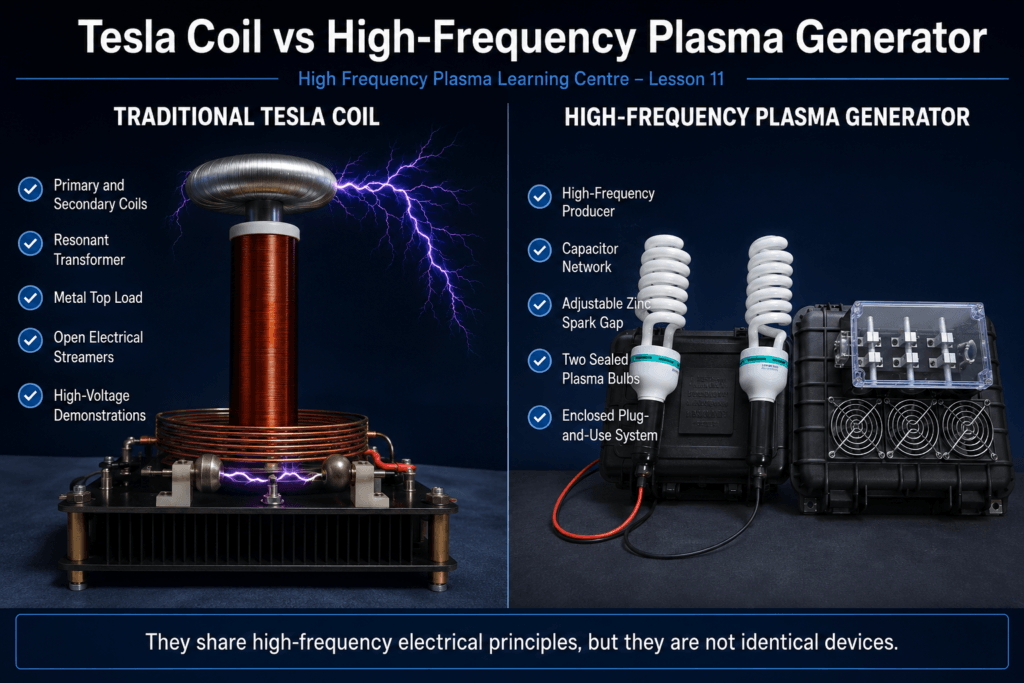
My High Frequency Plasma Generator uses its own enclosed architecture: a high-frequency producer, capacitor network, adjustable spark gap and two sealed spiral plasma bulbs. The bulbs provide controlled, visible gas-discharge outputs rather than the exposed top-load streamers associated with a demonstration Tesla coil.
It is therefore most accurate to say that the device draws on high-frequency, spark-gap and plasma principles associated with Tesla-era electrical research. It should not be assumed to be a conventional two-coil Tesla transformer unless its complete circuit topology meets that definition.
You can explore the device architecture in How Does a Plasma Generator Work? or view the High Frequency Plasma Generator.
Common Myths About “How Does a Tesla coil work”
Myth 1 — High frequency makes a Tesla coil safe to touch
This is false and potentially dangerous. Tesla-coil currents can cause electrical shock, deep radio-frequency burns, nerve or muscle effects and secondary injuries. Different designs and operating conditions create different hazards. Never use the historic “skin effect” demonstration as evidence that a coil is safe.
Myth 2 — A Tesla coil creates free energy
It does not. Energy delivered by the output ultimately comes from the electrical supply. Resonance can allow voltage or current to build within a tuned system, but it does not create energy. Every real coil also loses energy as heat, sound, light, electromagnetic radiation and electrical resistance.
Myth 3 — The spark-gap firing rate is the Tesla coil’s only frequency
The audible spark repetition rate and the much faster electrical oscillation are different measurements. One gap firing can initiate a train of many high-frequency oscillations. The output may also contain harmonics and transient components.
Myth 4 — Longer sparks always mean a better Tesla coil
Spark length depends on many variables and does not provide a complete measurement of voltage, current, energy, efficiency or safety. A dramatic display is not automatically an electrically well-designed one.
Myth 5 — Any machine containing a spark gap is a Tesla coil
A spark gap is used in many kinds of electrical equipment. A classic Tesla coil is defined by its resonant transformer arrangement, not by the presence of a spark alone.
Tesla Coil Safety
Tesla coils are not beginner toys. Even relatively small systems can contain hazardous voltages and capacitors capable of retaining charge after the power has been disconnected.
Potential hazards include:
- Electric shock and radio-frequency burns.
- Stored charge remaining in capacitors after switch-off.
- Fire or ignition of nearby materials.
- Hot electrodes, wiring and components.
- Ultraviolet light and irritating gases around electrical arcs.
- Hearing damage from loud discharges.
- Electromagnetic interference with phones, computers, televisions and communications equipment.
- Interference with pacemakers, implanted electronics and other medical equipment.
- Unexpected arcing to nearby conductive objects.
Never touch an operating Tesla coil or its discharge. Do not build, modify, open or service high-voltage equipment without the appropriate engineering knowledge, test equipment and safe working procedures. Proper enclosures, interlocks, grounding, clearances and controlled discharge arrangements are essential.
The U.S. Department of Energy’s Electrical Safety Handbook emphasises suitable enclosures, conductor clearances, insulation, grounding and safe access for high-voltage power-electronics systems. Tesla-coil demonstrations should be conducted only by competent operators in controlled environments.
Frequently Asked Questions
How does a Tesla coil work in simple terms?
A traditional Tesla coil charges a capacitor, releases the energy through a primary coil and uses resonance to transfer the energy into a secondary coil. A very high alternating voltage develops at the secondary output and can ionise the surrounding air.
Is a Tesla coil AC or DC?
The characteristic output is high-frequency alternating electricity. Some modern coils may begin with a DC supply internally, but switching electronics convert that input into rapidly alternating or pulsed energy before it drives the resonant coil.
Why does a Tesla coil need two coils?
The primary coil creates the oscillating magnetic field. The secondary receives energy from that field and develops a much higher voltage through transformer action and resonance.
Why does a Tesla coil need a capacitor?
In a traditional spark-gap design, the primary capacitor stores energy and works with the primary coil to form a resonant LC circuit. Its rapid discharge helps create the oscillating current that energises the secondary.
What does the spark gap do?
The gap acts as a fast high-voltage switch. It remains non-conductive while voltage builds, then ionises and becomes conductive, allowing the stored capacitor energy to enter the primary resonant circuit.
Does a Tesla coil create plasma?
The visible streamers involve ionised gas containing free electrons, ions and excited particles. They can therefore display plasma behaviour. The electrical arc across a traditional spark gap is also an ionised gas discharge.
Can a Tesla coil light a bulb wirelessly?
Certain gas-discharge lamps can glow near an operating Tesla coil because changing electromagnetic fields couple energy into the lamp. The energy still comes from the powered coil; it is not free energy.
Is a Plasma Ball a Small Tesla coil?
Some plasma globes use a small high-frequency, high-voltage transformer or oscillator that may be loosely described as Tesla-coil-like. However, their construction and output are not necessarily the same as a classic two-circuit Tesla coil. We will explore this in Lesson 12.
Is a Tesla coil the same as a high-frequency plasma generator?
No. They may share principles such as resonance, spark-gap switching and gas ionisation, but the circuit architecture and output arrangement can be different.
Are Tesla coils medically proven healing machines?
No reliable conclusion about treating or curing disease should be drawn merely from a device using high frequency, high voltage, plasma or Tesla-inspired principles. Historic electrical demonstrations and medical advertising are not substitutes for modern clinical evidence.
Summary
A Tesla coil is an air-core, resonant transformer developed by Nikola Tesla during his investigations into high-frequency electricity.
The simplest answer to how does a Tesla coil work is that stored electrical energy is released into one resonant circuit, transferred through a changing magnetic field and built up as a much higher alternating voltage in a second resonant circuit.
In a traditional spark-gap design, a power supply charges a primary capacitor. When the voltage becomes high enough, the spark gap conducts and releases the stored energy through the primary coil. The capacitor and primary coil create rapidly damped electrical oscillations.
The primary’s changing magnetic field transfers energy into the secondary coil. When the two resonant systems are suitably tuned, the secondary response builds and a very high alternating voltage develops at its top terminal. If the electric field becomes strong enough, the surrounding air ionises and produces visible streamers.
The Tesla coil brings together the major ideas covered in earlier lessons: frequency, capacitance, inductance, spark gaps, electrical oscillations, resonance and plasma. Understanding this process also makes it easier to compare a classic Tesla coil with other high-frequency and plasma-producing devices without incorrectly treating every device as the same machine.
🧠 Key Takeaways
- Nikola Tesla introduced the Tesla coil in 1891. ✔
- A Tesla coil is an air-core resonant transformer. ✔
- A traditional design contains primary and secondary resonant circuits. ✔
- The primary capacitor stores electrical energy. ✔
- The spark gap acts as a rapid high-voltage switch. ✔
- The primary circuit produces high-frequency electrical oscillations. ✔
- Magnetic coupling transfers energy into the secondary. ✔
- Resonance helps a very high alternating voltage develop at the output. ✔
- Visible streamers form when the surrounding air becomes ionised. ✔
- A Tesla coil and a plasma generator can share principles without being identical devices. ✔
- High frequency does not make high-voltage equipment safe to touch. ✔
🔬 Tesla Coil Fact
Did you know?
Nikola Tesla did not build just one Tesla coil. He developed numerous versions while investigating lighting, insulation, resonance, electrical discharge and wireless signalling. The name now covers several related designs, including traditional spark-gap coils, valve-driven coils and modern solid-state Tesla coils.
Continue Your Learning Journey
⬅ Previous Lesson
📘 Lesson 10 of 24 — What Are Electrical Oscillations?
Discover how voltage, current and charge can repeatedly change within a circuit, and how a spark-gap discharge can initiate bursts of high-frequency electrical oscillations.
➡ Next Lesson
📘 Lesson 12 of 24 — How Does a Plasma Ball Work? (Coming Soon)
Discover how a high-frequency electric field energises low-pressure gas, why glowing filaments appear inside the globe and why they move towards your hand when you touch the glass.
Learn More About High-Frequency Plasma
If you would like to see how the principles in the Learning Centre relate to my enclosed spark-gap plasma system, visit the High Frequency Plasma Generator.
You can also join the High Frequency Plasma Community on Telegram to ask Alan questions directly, discuss the technology and read owners’ personal experiences. Individual experiences are anecdotal and should not be treated as medical evidence.
Disclaimer
The information contained within the High Frequency Plasma Learning Centre is provided for educational purposes to explain the science, history and engineering of plasma and high-frequency electrical technology.
The High Frequency Plasma Generator is intended for educational, experimental, research, meditation, relaxation and general wellness purposes only. It is not a medical device and is not intended to diagnose, treat, cure, mitigate or prevent any disease or medical condition.
Tesla coils and other high-voltage devices can cause serious injury, fire, electromagnetic interference and damage to equipment. This lesson is an explanation of operating principles, not construction or operating instructions. Do not build, modify or operate high-voltage equipment unless you are appropriately trained and able to follow recognised electrical-safety procedures.
Always seek advice from a suitably qualified healthcare professional regarding medical concerns.
🎉 Lesson Complete
Congratulations!
You have now completed:
📘 Lesson 11 of 24
How Does a Tesla Coil Work? Spark Gaps, Resonance and High-Frequency Electricity Explained
You now understand how a traditional Tesla coil stores electrical energy, creates high-frequency oscillations, transfers energy between two resonant circuits and develops the high voltage responsible for its lightning-like display.