
So, what is a magnetic field? A magnetic field is a region in which moving electric charges, electric currents and magnetic materials can experience a magnetic force. Magnetic fields surround permanent magnets, current-carrying wires, coils, transformers, electric motors, the Earth and even moving charged particles inside plasma.
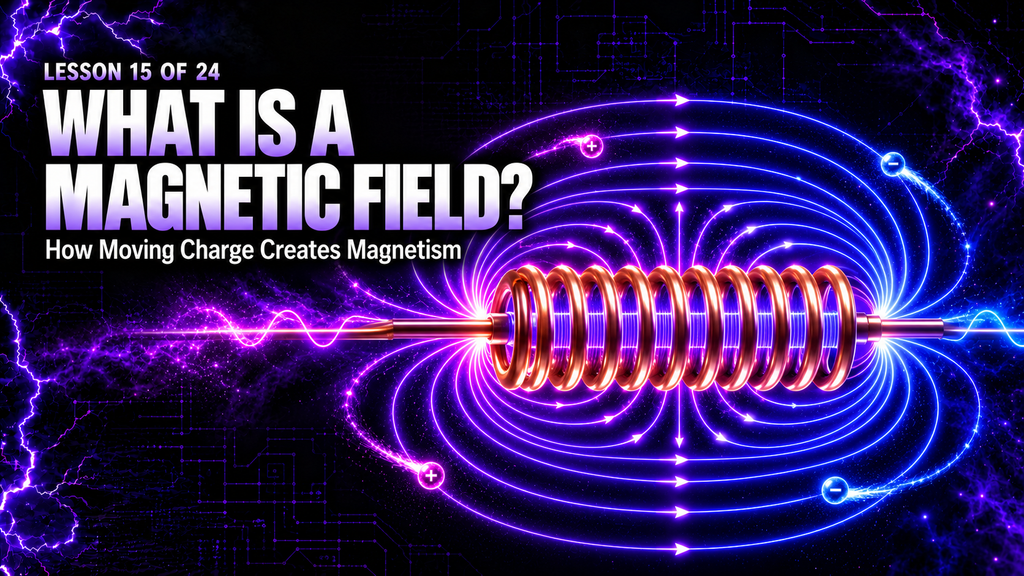
Magnetic fields are invisible, but their effects can be observed with a compass, iron filings, a Hall-effect sensor or a calibrated gaussmeter. They are also an essential part of high-frequency electrical systems because every changing current produces a changing magnetic field.
📚 High Frequency Plasma Learning Centre
📘 Lesson 15 of 24 — What Is a Magnetic Field?
Previous lesson: Lesson 14 — What Is an Electric Field?
Next lesson: Lesson 16 — What Is Electromagnetic Induction? (Coming Soon)
Estimated reading time: 15–20 minutes
Difficulty: 🟢 Beginner
What You’ll Learn
By the end of this lesson, you will understand:
- What a magnetic field is. ✔
- What creates magnetic fields. ✔
- Why moving charge and electric current are central to magnetism. ✔
- How magnetic field lines show direction and relative strength. ✔
- Why magnetic field lines always form closed loops. ✔
- How the right-hand grip rule works. ✔
- What tesla and gauss measure. ✔
- How current, coils and distance affect field strength. ✔
- How a magnetic field acts on moving charged particles. ✔
- How magnetic fields can influence plasma. ✔
- Where magnetic fields appear inside a high-frequency plasma generator. ✔
- How magnetic fields differ from electric fields. ✔
- How magnetic fields are measured safely. ✔
The Short Answer: What Is a Magnetic Field?
A magnetic field is a vector field: it has both a strength and a direction at every point in space.
Physicists normally represent magnetic field with the symbol:
B
Its SI unit is the tesla, written T.
A magnetic field can be created by:
- A permanent magnet.
- Moving electric charge.
- Electric current in a wire.
- Current flowing around a loop or through a coil.
- Changing electric fields.
- Magnetic materials that have become magnetised.
A stationary electric charge creates an electric field, but it does not experience the magnetic part of the Lorentz force. When charge moves, magnetism becomes part of the story.
This gives us a useful beginner’s distinction:
Electric charge creates an electric field. Moving electric charge creates a magnetic field as well.
In a conductor, the organised movement of charge is electric current. Therefore, wherever current flows, a magnetic field forms around the current path.
What Creates a Magnetic Field?
At the most fundamental level, magnetic fields are associated with moving electric charges and the intrinsic magnetic properties of particles.
In everyday electrical equipment, the most obvious source is electric current. A current-carrying wire produces a magnetic field around itself. If the current becomes larger, the field usually becomes stronger. If the observation point moves farther away from the wire, the field becomes weaker.
Permanent magnets are slightly more subtle. A bar magnet does not need wires or an external power supply, yet it produces a persistent field. This behaviour arises mainly from the magnetic moments of electrons and the way many of those moments align inside regions called magnetic domains.
In most ordinary materials, the microscopic magnetic effects point in many different directions and largely cancel. In a ferromagnetic material such as iron, cobalt or nickel, many domains can align strongly enough to create a noticeable external field.
What Are Magnetic Poles?
A familiar magnet has two poles:
- North pole
- South pole
Opposite poles attract, while like poles repel.
However, poles should not be imagined as isolated magnetic charges equivalent to positive and negative electric charges. If a bar magnet is cut in half, it does not produce a separate north-only magnet and south-only magnet. It produces two smaller magnets, each with its own north and south poles.
No isolated magnetic monopole has been confirmed in ordinary laboratory observations. For practical beginner-level diagrams, magnetic field lines therefore form continuous loops rather than beginning or ending on a single pole.
What Are Magnetic Field Lines?
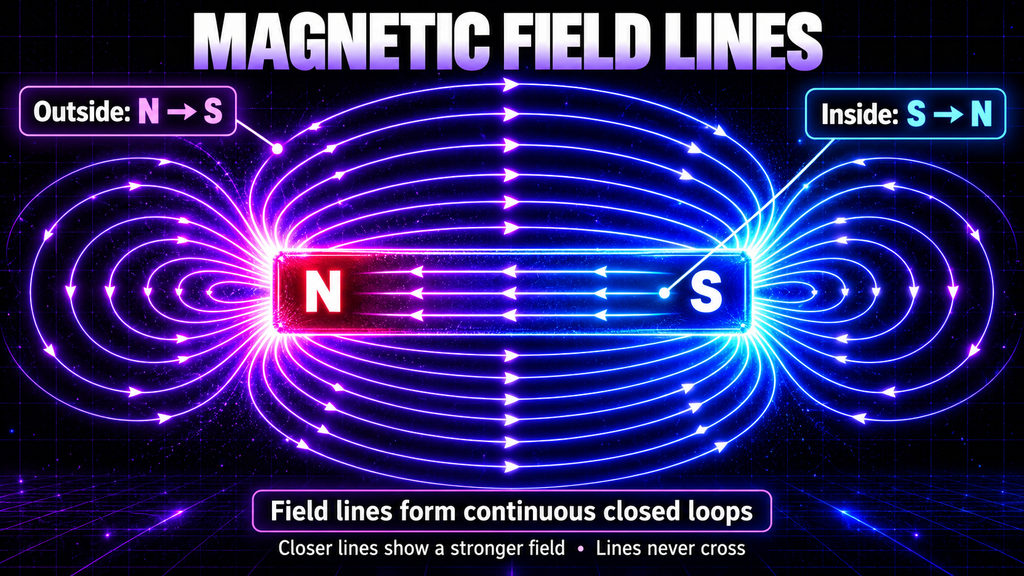
Magnetic field lines are a visual model. They help us see an invisible field, but they are not physical threads or tubes floating in space.
For a bar magnet:
- Outside the magnet, the lines travel from the north pole to the south pole.
- Inside the magnet, they continue from south back to north.
- Together, they form closed loops.
The diagrams follow four important rules:
- The direction of the field is tangent to the line at each point.
- Closely spaced lines represent a stronger field.
- Widely spaced lines represent a weaker field.
- Field lines never cross because the field cannot point in two different directions at the same location.
A small compass placed in the field turns until its needle aligns with the local field direction.
How Does the Right-Hand Grip Rule Work?
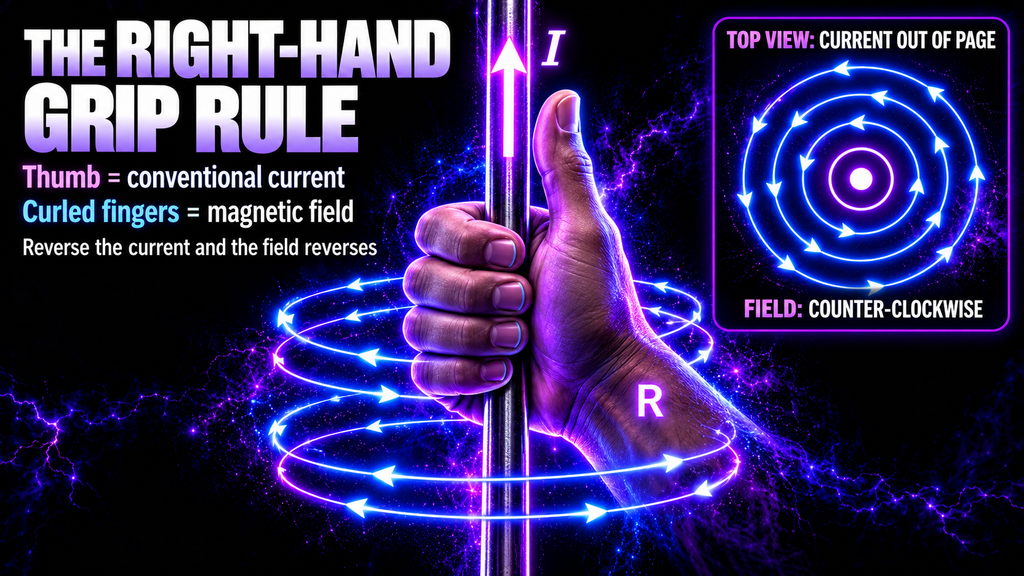
The magnetic field around a straight current-carrying wire forms concentric circles.
To find the direction of those circles, use the right-hand grip rule:
- Imagine gripping the wire with your right hand.
- Point your thumb in the direction of conventional current.
- Your curled fingers show the direction of the magnetic field around the wire.
If the current reverses, the magnetic field direction reverses.
Conventional current is defined as the direction in which positive charge would move. In a metal wire, electrons actually drift in the opposite direction. This is why diagrams must state whether an arrow represents conventional current or electron motion.
How Strong Is a Magnetic Field?
Magnetic flux density B is measured in tesla:
1 tesla = 1 T
The tesla is a large unit for many everyday measurements, so smaller units are often used:
- 1 millitesla (mT) = 0.001 T
- 1 microtesla (µT) = 0.000001 T
- 1 gauss (G) = 0.0001 T
- 1 T = 10,000 G
The terms magnetic field strength and magnetic flux density are sometimes used casually as though they mean exactly the same thing. In precise engineering, B is magnetic flux density, measured in tesla, while H is magnetic field strength, measured in amperes per metre. The two are related through the magnetic properties of the material.
For this introductory lesson, we mainly use B, because it describes the field responsible for magnetic force on moving charge.
Magnetic Field Around a Straight Wire
For an ideal, very long straight wire, the field magnitude at distance r is:
B = μ₀I / 2πr
Where:
- B is magnetic flux density in tesla.
- μ₀ is the permeability of free space.
- I is current in amperes.
- r is the distance from the centre of the wire in metres.
The equation reveals two important relationships:
- Increasing current increases the field.
- Increasing distance reduces the field.
For example, doubling the current doubles the ideal field at the same distance. Doubling the distance halves it.
Real equipment has finite wire lengths, bends, nearby conductors and magnetic materials, so the actual field pattern can be more complicated than the ideal formula suggests.
Why Does a Coil Create a Stronger and More Useful Field?
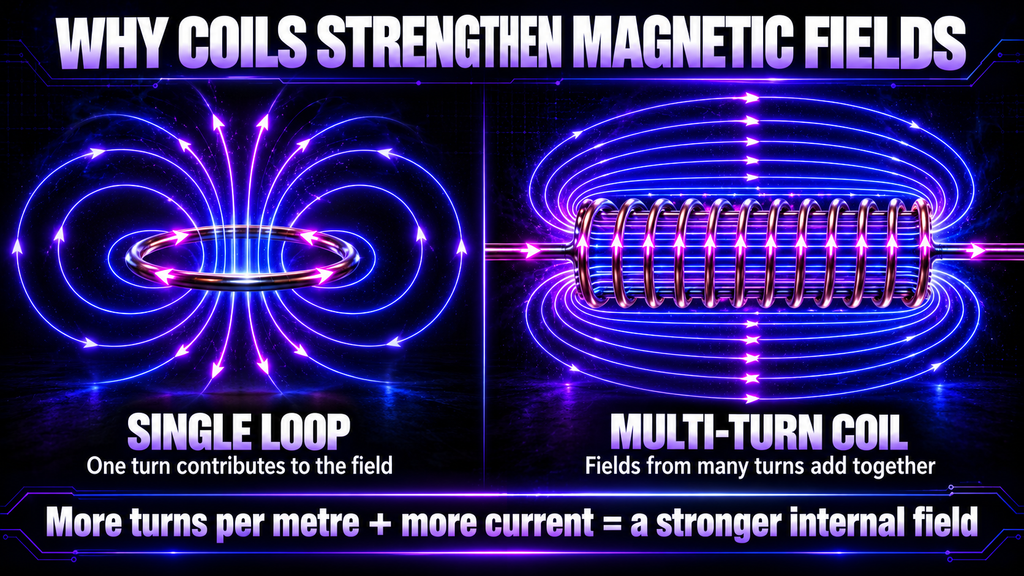
When wire is formed into a loop, the magnetic fields produced by different parts of the loop combine. Near the centre, many contributions point in the same direction.
Adding more turns creates a coil. In a long solenoid, the field inside is approximately:
B = μ₀nI
Where:
- n is the number of turns per metre.
- I is the current.
This means the field can be increased by:
- Increasing the current.
- Increasing the number of turns per unit length.
- Adding a suitable magnetic core.
The field pattern of a current-carrying coil resembles the pattern around a bar magnet. One end behaves like a north pole and the other behaves like a south pole. Reversing the current reverses the poles.
Coils are therefore central to electromagnets, relays, motors, loudspeakers, transformers, inductors, flyback transformers and many other devices.
Permanent Magnet Versus Electromagnet
| Feature | Permanent magnet | Electromagnet |
|---|---|---|
| Main source | Aligned magnetic domains | Electric current through a wire or coil |
| Needs continuous electrical power | No | Usually yes |
| Can be switched off easily | No | Yes |
| Can reverse polarity easily | Usually no | Yes, by reversing current |
| Field strength adjustment | Limited | Can be changed with current, turns and core |
| Common examples | Fridge magnet, compass | Relay, solenoid, transformer, lifting magnet |
Both produce magnetic fields, but an electromagnet offers much greater control.
How Does a Magnetic Field Act on a Moving Charge?
A magnetic field can exert force on a charged particle only when the particle is moving with a component of velocity across the field.
The magnitude of the magnetic force is:
F = |q|vB sin θ
Where:
- F is force.
- q is electric charge.
- v is particle speed.
- B is magnetic flux density.
- θ is the angle between the velocity and magnetic field.
The force is greatest when the particle moves perpendicular to the field. It is zero when the particle is stationary or moving exactly parallel to the field.
The magnetic force is perpendicular to both the field and the particle’s direction of motion. It can therefore bend the particle’s path without directly increasing its kinetic energy. A uniform magnetic field can make a charged particle travel in a circle or helix.
For a positive charge, a right-hand rule gives the force direction. For an electron, which is negatively charged, the force points in the opposite direction.

Can a Magnetic Field Affect Plasma?
Yes. Plasma contains mobile electrons and ions, so magnetic fields can influence their paths.
When a charged particle moves across a magnetic field, the magnetic force bends its trajectory. Depending on its velocity, charge, mass and the field strength, the particle may follow a circular or helical path around a field line.
Electrons are much lighter than positive ions, so their paths are usually curved more strongly under the same conditions. In powerful or carefully controlled fields, this behaviour can be used to guide or confine plasma.
Examples include:
- Fusion research devices.
- Magnetrons.
- Plasma processing equipment.
- Particle accelerators.
- Space plasmas interacting with planetary magnetic fields.
However, it is important not to overstate this effect in a small atmospheric-pressure plasma system. In many compact plasma bulbs and spark gaps, the electric field is the main field that accelerates electrons and initiates ionisation. Magnetic fields are present because charges are moving, but they do not automatically dominate the discharge.
Electric Field and Magnetic Field: What Is the Difference?
Electric and magnetic fields are related, but they are not interchangeable.
| Question | Electric field | Magnetic field |
|---|---|---|
| Main symbol | E | B |
| Common SI unit | volts per metre (V/m) or newtons per coulomb (N/C) | tesla (T) |
| Produced by | Electric charge and changing magnetic fields | Moving charge, current and changing electric fields |
| Acts on stationary charge | Yes | No magnetic force on a stationary charge |
| Acts on moving charge | Yes | Yes, depending on direction of motion |
| Force direction | Along or opposite the field | Perpendicular to velocity and field |
| Field-line pattern | Can begin on positive charge and end on negative charge | Always forms closed loops |
In a high-frequency system, electric and magnetic fields change rapidly and are linked by Maxwell’s equations. Close to the circuit, their shapes depend strongly on the conductors, coils, capacitors and return paths. Farther away, changing electric and magnetic fields can propagate together as electromagnetic radiation.
Static and Changing Magnetic Fields
A permanent magnet produces an approximately static field: its direction and strength remain fairly steady over time.
A direct current that remains constant also produces a steady magnetic field around its conductor.
Alternating or pulsed current produces a changing magnetic field. The field grows, collapses and reverses as the current changes.
This distinction matters because a changing magnetic field can induce an electromotive force in a nearby conductor. That phenomenon is called electromagnetic induction, and it is the subject of Lesson 16 — What Is Electromagnetic Induction?
The rate of change matters. A rapidly changing current can produce rapid changes in magnetic flux, which is fundamental to transformers, inductors, ignition coils and flyback transformers.
Magnetic Fields in a Transformer
A transformer uses changing magnetic flux to transfer electrical energy between windings.
In simplified terms:
- Alternating current flows through the primary winding.
- That current produces a changing magnetic field.
- A magnetic core helps guide the changing flux.
- The changing flux passes through the secondary winding.
- A voltage is induced in the secondary.
A transformer requires changing magnetic flux. A steady direct current, once settled, does not continuously induce a secondary voltage. Electronic circuits can switch DC on and off rapidly so that it behaves as a changing current at the transformer primary.
This principle is central to the flyback transformer used in many high-voltage circuits.
Magnetic Fields in the High Frequency Plasma Generator
The High Frequency Plasma Generator contains magnetic fields at several stages. They are produced wherever current flows and change whenever the current changes.
1. DC supply wiring
Current from the 12-volt supply produces circular magnetic fields around the supply and return conductors. Keeping the outgoing and return paths close together helps their external fields partly cancel.
2. ZVS driver
The switching circuit converts the DC input into rapidly alternating current for the transformer primary. Rapid current changes create rapidly changing magnetic fields.
3. Flyback transformer windings
Current in the primary winding creates changing magnetic flux in the core. This changing flux couples to the secondary winding and contributes to the production of high voltage.
4. Capacitor and spark-gap circuit
When stored charge discharges through the spark gap, a brief high-current pulse can occur. A current pulse produces a short-lived magnetic field pulse around the discharge path.
5. Output conductors and bulbs
High-frequency current in the output path creates a changing magnetic field around the wiring. Moving charges within the ionised gas also contribute microscopic magnetic fields.
The system therefore produces a complex mixture of electric fields, magnetic fields and conducted or radiated electromagnetic signals. The exact spectrum and field levels depend on circuit layout, current, voltage, switching behaviour, spark-gap operation, wiring geometry, distance and the measuring instrument.
The generator should not be described as a calibrated PEMF device unless its magnetic pulse waveform, field strength, repetition rate and spatial distribution have been properly measured and documented. Producing a magnetic field is not the same as delivering a known therapeutic magnetic exposure.
Why Do Current Paths and Wiring Layout Matter?
Magnetic fields depend on the complete current loop, not just a single visible wire.
Current travels out through one conductor and returns through another. If these paths are close together and carry equal current in opposite directions, their external magnetic fields partly cancel. If the loop area is large, the system can couple more strongly to nearby circuits and radiate more interference.
Practical high-frequency construction often aims to:
- Keep high-current loops short.
- Keep supply and return conductors close together.
- Avoid unnecessary loop area.
- Separate sensitive signal wiring from switching and spark paths.
- Use suitable shielding, grounding and enclosure practices.
These are engineering principles, not construction instructions. High-voltage and spark-gap systems should only be assessed or modified by a suitably competent person.
What Is Magnetic Flux?
Magnetic flux describes how much magnetic field passes through a surface.
It is represented by the Greek letter:
Φ — phi
For a uniform field passing straight through a flat area:
Φ = BA
When the field meets the surface at an angle, the perpendicular component must be considered.
Magnetic flux is measured in webers, written Wb.
Flux can change if:
- The magnetic field strength changes.
- The area of a loop changes.
- The angle between the field and loop changes.
- A magnet and coil move relative to one another.
A changing magnetic flux through a circuit can induce voltage. We will explore that relationship in Lesson 16.
How Do Materials Respond to Magnetic Fields?
Materials do not all respond in the same way.
Diamagnetic materials
These develop a very weak magnetic response that opposes an applied field. The effect is normally subtle.
Paramagnetic materials
These are weakly attracted to an applied field because some atomic magnetic moments partly align with it.
Ferromagnetic materials
These can respond very strongly. Their magnetic domains can align, and some materials retain substantial magnetisation after the external field is removed.
Iron, nickel and cobalt are familiar ferromagnetic elements. Many practical cores and permanent magnets use carefully engineered alloys or ceramic compounds rather than pure metals.
The material around a coil can therefore dramatically change the magnetic flux pattern and inductance.
Is the Earth Surrounded by a Magnetic Field?
Yes. Earth has a large-scale magnetic field generated mainly by motion of electrically conducting molten material in its outer core.
A compass aligns with the local direction of this field. The field extends far into space and forms the magnetosphere, which interacts with charged particles arriving from the Sun.
Near Earth’s surface, the field is commonly of the order of tens of microtesla, although its strength and direction vary with location. This is much weaker than the field near many permanent magnets, but it extends over an enormous region.
Auroras are connected to energetic charged particles interacting with Earth’s magnetic environment and upper atmosphere.
How Can a Magnetic Field Be Measured?
The correct instrument depends on the field being measured.
Compass
A compass shows the direction of a relatively steady local field. It is simple but does not provide a precise strength measurement.
Hall-effect sensor
A Hall sensor produces an electrical response to magnetic flux density. Hall probes are widely used in gaussmeters and teslameters.
Gaussmeter or teslameter
These instruments display field strength in gauss, tesla or a smaller unit. The probe orientation, frequency response, range and calibration all matter.
Search coil or induction probe
A coil can detect a changing magnetic field because changing flux induces a voltage. Its output depends on the number of turns, coil area, orientation and rate of field change.
Spectrum analyser with a near-field probe
A magnetic near-field loop connected to suitable radio-frequency test equipment can help locate frequencies and emissions. It does not automatically provide an accurate field strength in tesla unless the complete probe-and-instrument system has been calibrated for that measurement.
A TinySA with an antenna or pickup loop is useful for observing parts of a frequency spectrum, but it should not be treated as a direct replacement for a calibrated gaussmeter.
Why Can Magnetic Readings Be Misleading?
A single number without measurement conditions tells us very little.
A useful record should include:
- The instrument and probe model.
- Whether the reading is DC, AC, peak or RMS.
- The instrument’s frequency range.
- The measurement distance.
- The probe orientation.
- The operating state of the equipment.
- Background readings with the equipment switched off.
- Whether the value is stable or pulsed.
A meter designed for low-frequency power systems may not accurately capture fast spark pulses. A radio-frequency probe may show spectral activity without providing a trustworthy gauss value. Probe position can also change the result dramatically because fields normally weaken with distance.
Common Myths About Magnetic Fields
Myth 1: Only permanent magnets produce magnetic fields
False. Electric current, moving charge and changing electric fields also produce magnetic fields.
Myth 2: Magnetic field lines physically exist as glowing strands
False. Field lines are a visual model used to show direction and relative strength.
Myth 3: A magnetic field pushes every charged particle
False. The magnetic part of the force requires motion, and it depends on the angle between velocity and field.
Myth 4: A stronger voltage automatically means a stronger magnetic field
Not necessarily. Magnetic field is closely related to current, geometry and rate of change. High voltage with very little current can produce a different magnetic field from low voltage with high current.
Myth 5: Any pulsed electrical machine is automatically a PEMF therapy device
False. A calibrated PEMF system is characterised by measured magnetic flux density, waveform, pulse duration, repetition rate, spatial distribution and intended operating conditions.
Myth 6: Magnetic fields and electric fields are the same thing
False. They are connected parts of electromagnetism, but their sources, units, field lines and forces are different.
Frequently Asked Questions
What is a magnetic field in simple words?
It is the region around a magnet, moving charge or electric current where magnetic forces can act.
Can we see a magnetic field?
Not directly. We can visualise its pattern using iron filings, compasses, simulations or sensor measurements.
What unit measures a magnetic field?
Magnetic flux density is measured in tesla. Gauss is also commonly used, with 10,000 gauss equal to one tesla.
Does a wire have a magnetic field when no current flows?
An ordinary unmagnetised wire does not produce the circular current-generated field if no current is flowing. Nearby magnets, Earth’s field or residual magnetisation may still be present.
Does direct current produce a magnetic field?
Yes. Steady DC produces a steady magnetic field. Changing or alternating current produces a changing field.
Does higher frequency always mean a stronger magnetic field?
No. Frequency describes how rapidly a waveform repeats. Magnetic field strength also depends on current amplitude, circuit geometry, distance, materials and waveform.
Why does a coil strengthen a magnetic field?
The fields from many turns add together, particularly inside the coil.
Can glass block a magnetic field?
Ordinary glass has little effect on most low-level static magnetic fields. Magnetic shielding generally requires materials with particular magnetic properties or conductive structures designed for the relevant frequency.
Can a magnetic field create plasma?
A magnetic field can influence moving charged particles in plasma, but electric fields usually supply the energy that accelerates electrons and initiates ionisation in common discharge systems.
Does the High Frequency Plasma Generator produce a magnetic field?
Yes. Any current produces a magnetic field, and the device contains steady, switching, pulsed and high-frequency currents. The exact field at a particular location must be measured with suitable equipment.
Is a TinySA a gaussmeter?
No. A TinySA is a compact spectrum analyser. With a suitable pickup probe it can show frequency-domain signals, but it does not directly replace a calibrated magnetic field meter.
Why do magnetic field lines form closed loops?
Unlike electric field lines, they do not begin on isolated positive magnetic charge and end on isolated negative magnetic charge. The field continues through and around the magnet or current system.
What Have We Learned?
A magnetic field is a region with a measurable magnitude and direction in which moving charges, currents and magnetic materials can experience magnetic effects.
Magnetic fields are produced by moving electric charge, current, permanent magnets and changing electric fields. Around a straight wire, the field forms circular loops. Around a coil, the contributions from each turn combine to create a stronger, more concentrated field.
Magnetic force acts perpendicular to the motion of a charged particle and to the field. It can curve the path of electrons and ions, which is why magnetic fields are important in plasma science. In common spark gaps and plasma bulbs, however, the electric field remains central to initiating ionisation.
Inside a high-frequency plasma generator, current in the supply wiring, switching circuit, transformer, discharge path and output conductors creates magnetic fields. Because many of those currents change rapidly, the fields change rapidly too.
That changing magnetic flux leads directly to the subject of our next lesson: electromagnetic induction.
🧠 Key Takeaways
- A magnetic field has both strength and direction.
- Moving charge and electric current produce magnetic fields.
- Magnetic field lines form continuous closed loops.
- The right-hand grip rule gives the field direction around a wire.
- Magnetic flux density is measured in tesla or gauss.
- More current generally produces a stronger field.
- A greater distance from a wire generally means a weaker field.
- Coils combine the magnetic effects of many wire turns.
- Magnetic force acts on moving charge and can bend a particle’s path.
- Electric and magnetic fields are connected but are not identical.
- A changing magnetic field can induce voltage in a nearby circuit.
- Correct instruments and documented test conditions are essential for meaningful measurements.
🔬 Magnetic Field Fact
If a charged particle moves exactly parallel to a magnetic field, the magnetic force on it is zero. If it moves perpendicular to the field, the magnetic force is at its maximum for that speed and field strength.
Continue Your Learning Journey
Previous: Lesson 14 — What Is an Electric Field?
Next: Lesson 16 — What Is Electromagnetic Induction? (Coming Soon)
In Lesson 16, we will explore how changing magnetic flux can induce voltage, why transformers require changing current and how induction connects coils without a direct electrical connection.
Further Reading
- OpenStax: Magnetic Fields, Field Lines and Force
- OpenStax: Magnetic Fields and Lines
- OpenStax: Motion of a Charged Particle in a Magnetic Field
- OpenStax: Magnetism in Matter
- NIST Guide to SI Units
- NASA: Earth’s Magnetosphere
Learn More About High-Frequency Plasma
Explore the High Frequency Plasma Learning Centre for more beginner-friendly lessons about plasma, spark gaps, frequency, resonance, ionisation, electric fields and high-voltage technology.
For product information, visit the High Frequency Plasma Generator website.
To ask questions and meet other people interested in plasma technology, join the free High Frequency Plasma Community Group on Telegram.
Disclaimer
The information in the High Frequency Plasma Learning Centre is provided for general educational purposes to explain the science, history and engineering of plasma and high-frequency electrical technology.
High-voltage and plasma equipment can cause serious electrical shock, burns, fire, electromagnetic interference and equipment damage. Capacitors may retain dangerous stored energy after power has been disconnected. This lesson explains scientific principles; it is not a construction, modification, measurement or servicing guide.
Magnetic fields can interfere with pacemakers, implanted electronic devices, magnetic storage media and sensitive equipment. People who are pregnant or who use a pacemaker or other implanted electronic device should not operate or remain close to this equipment. Follow the manufacturer’s safety instructions and obtain appropriate professional advice.
The High Frequency Plasma Generator is intended for educational, experimental, research, meditation, relaxation and general wellness purposes only. It is not a medical device and is not intended to diagnose, treat, cure, mitigate or prevent any disease or medical condition.
Always seek advice from a suitably qualified healthcare professional regarding medical concerns.
🎉 Lesson Complete
Congratulations!
You have now completed:
📘 Lesson 15 of 24
What Is a Magnetic Field? Magnets, Current, Coils and Plasma Explained
You now understand what creates magnetic fields, how they act on moving charges and why changing magnetic fields are essential inside transformers and high-frequency electrical systems.