
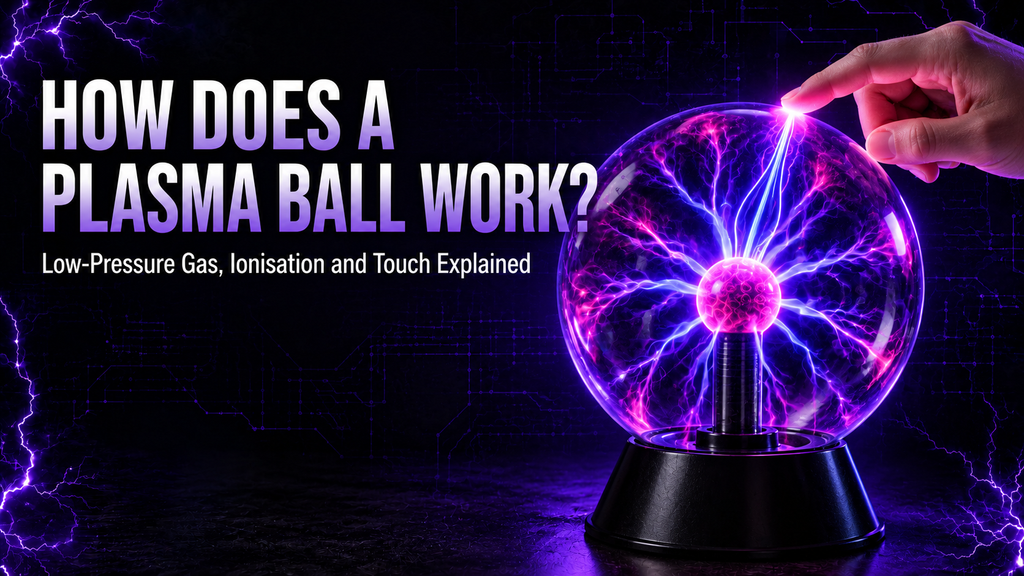
So, how does a plasma ball work? In simple terms, a plasma ball uses a high-voltage, high-frequency electrical supply to energise low-pressure gas inside a sealed glass globe. The electric field accelerates free electrons, which collide with gas atoms and create glowing, partially ionised channels called streamers. When you place a hand on the glass, your body changes the electric field and provides stronger capacitive coupling to the surroundings, causing the streamers to gather beneath your fingers.
📚 High Frequency Plasma Learning Centre
📘 Lesson 12 of 24 — How Does a Plasma Ball Work?
Previous lesson: Lesson 11 — How Does a Tesla Coil Work?
Next lesson: Lesson 13 — Coming Soon
Estimated reading time: 15 minutes
Difficulty: 🟢 Beginner
What You’ll Learn
By the end of this lesson, you will understand:
- What a plasma ball is. ✔
- The main parts hidden inside the globe and its base. ✔
- Why the globe contains gas at reduced pressure. ✔
- How a rapidly alternating high voltage turns part of the gas into plasma. ✔
- Why the plasma forms moving filaments or streamers. ✔
- Why the streamers move towards your hand when you touch the glass. ✔
- Why different gases produce different colours. ✔
- How a plasma ball can illuminate a nearby fluorescent tube. ✔
- What a plasma ball shares with a Tesla coil. ✔
- How a plasma ball differs from my High Frequency Plasma Generator. ✔
- The main safety precautions when using a plasma ball. ✔
What Is a Plasma Ball?
A plasma ball—also called a plasma globe, plasma sphere or plasma lamp—is a sealed glass container containing gas at reduced pressure and a high-voltage electrode near its centre.
When the device is switched on, an electronic circuit in the base applies a rapidly alternating high voltage to the central electrode. The resulting electric field transfers energy to charged particles in the gas. Collisions then excite and ionise some of the gas atoms, producing the colourful, branching filaments visible inside the globe.
The word “plasma” does not mean that every atom inside the ball has become ionised. The gas is normally only partially ionised. It contains a mixture of:
- Neutral atoms or molecules
- Free electrons
- Positively charged ions
- Excited atoms
- Photons of emitted light
The US Department of Energy’s introduction to plasma explains that a plasma contains positively charged ions and negatively charged electrons. A plasma ball provides a small, visible example of this state of matter.
The Short Answer: How Does a Plasma Ball Work?
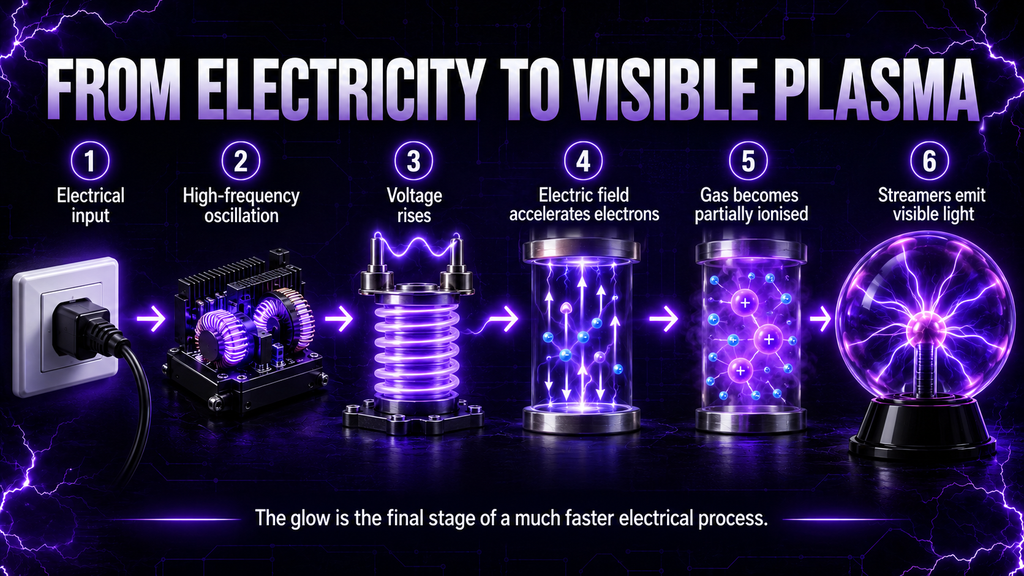
The complete process can be summarised in eight stages:
- Electrical energy enters the circuit in the base.
- An oscillator converts it into rapidly alternating electricity.
- A transformer raises the voltage while limiting the available current.
- The alternating voltage is applied to the central electrode.
- A changing electric field forms throughout the low-pressure gas.
- Free electrons accelerate and collide with gas atoms.
- Some atoms become excited or ionised, creating conductive plasma channels.
- Excited particles release photons, making the channels glow.
The visible display is therefore the final stage of a chain involving voltage transformation, high-frequency oscillation, electric fields, gas collisions, ionisation and light emission.
This is the central answer to how does a plasma ball work, but each stage becomes much clearer when we examine the parts of the device.
The Five Main Parts of a Plasma Ball
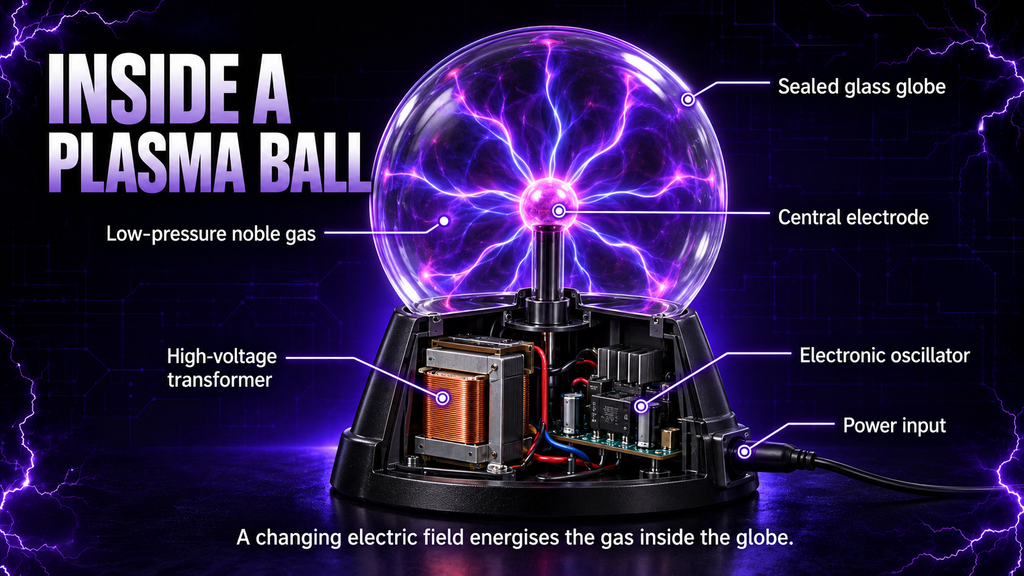
Although designs vary, a typical decorative plasma ball contains five main sections.
1. The Glass Globe
The outer globe is made from sealed glass. It keeps the special gas mixture inside while separating the user from the central high-voltage electrode.
Glass is an electrical insulator, also called a dielectric. Charge does not pass through it in the same way that direct current flows through a metal wire. However, a changing electric field can act across the glass, allowing capacitive coupling between the inside of the globe and objects outside it.
This is why your hand can influence the discharge even though it never touches the plasma directly.
2. Low-Pressure Gas
The globe contains gas at a pressure below normal atmospheric pressure. Noble gases such as neon, argon, krypton and xenon may be used alone or in mixtures. The exact composition differs between manufacturers and helps determine the appearance and colour of the display.
Arizona State University’s plasma-globe demonstration describes a globe containing low-pressure noble gases with a high-voltage, high-frequency electrode at the centre.
3. The Central Electrode
At the centre is usually a conductive electrode enclosed in a smaller glass form. It is connected to the high-voltage circuit hidden in the base.
The electrode is not simply sending continuous direct current outwards. Its voltage changes rapidly, creating an alternating electric field through the surrounding gas.
4. The Electronic Oscillator
The input electricity must be converted into a rapidly alternating signal. An oscillator or inverter circuit switches the current on and off or reverses it many thousands of times per second.
The precise operating frequency is not the same for every plasma ball. For example, Arizona State University describes one demonstration globe operating in the vicinity of 35 kHz, but other designs may operate at different frequencies.
5. The High-Voltage Transformer
A transformer raises the oscillator’s voltage to the level required to create a strong electric field and initiate gas discharge.
The voltage can reach several thousand volts, but a small commercial globe is designed with limited available current. High voltage and high current are not the same thing, and the transformer and surrounding circuit must be considered together.
The base may also contain protective components, a mode switch, sound-response electronics and a low-voltage power input, depending on the model.
Why Is the Gas at Low Pressure?
Gas pressure strongly affects how easily a discharge can form.
At normal atmospheric pressure, gas molecules are closely packed. An electron accelerated by an electric field travels only a short distance before colliding with another particle. Under the conditions inside a plasma ball, reducing the pressure increases the average distance between collisions, known as the mean free path.
This gives an electron more opportunity to gain energy from the electric field before its next collision. If it gains sufficient energy, that collision can excite a gas atom or knock an electron away from it.
The pressure must still be within a suitable range:
- If it is too high, the applied field may not ionise the gas effectively.
- If it is too low, there may be too few particles to create bright, stable streamers.
- At a suitable pressure, branching discharge channels can form visibly across the globe.
The relationship between gas pressure, electrode spacing and breakdown voltage is more complicated than “lower pressure always means easier ionisation.” Plasma-ball designers select the gas mixture, pressure, voltage, frequency and globe dimensions to work together.
How Does the Gas Become Plasma?
There are usually already a small number of free charged particles in the gas due to natural background radiation and other processes. When the plasma ball is powered, the central electrode creates a rapidly changing electric field.
Free electrons respond much more quickly than the heavier ions. They accelerate through the gas and collide with atoms.
These collisions can produce two important results.
Excitation
An electron can transfer part of its energy to an atom without removing one of the atom’s electrons. The atom enters an excited state. When it returns to a lower-energy state, it releases energy as a photon.
Some of those photons fall within the visible part of the spectrum, creating the coloured glow.
Ionisation
If a collision transfers sufficient energy, it can remove an electron from an atom. The result is a free electron and a positively charged ion.
Those additional electrons can also be accelerated and cause further collisions. This multiplication of charged particles helps a conductive discharge channel develop through the gas.
Ionisation creates charged particles; excitation and relaxation produce much of the visible light. Both processes occur within the luminous streamers.
Why Does a Plasma Ball Produce Filaments?
If the central electrode produces an electric field in every direction, why does the entire globe not glow evenly?
The answer is that electrical discharge does not always spread uniformly through a gas. Small variations in charge density, temperature, gas composition and electric-field strength allow certain paths to become more conductive than the gas around them.
Once a path begins to ionise, it can carry more current. Additional energy is then concentrated along that path, increasing excitation and ionisation. The discharge becomes a narrow, luminous channel called a streamer or filament.
The process reinforces itself for a short time:
- A small region becomes slightly more conductive.
- More electrical energy follows that path.
- More atoms are excited and ionised.
- The channel glows more brightly.
- Heat, charge distribution and the changing field alter the path.
- The streamer moves, branches, fades or reforms elsewhere.
The filaments can drift partly because warmer gas is less dense and rises. They also move because the electric field, surface charge and distribution of ionised gas are constantly changing.
The streamers are not permanent wires, and the glowing pattern is not a direct map of electrons travelling in one straight line. It is a dynamic gas-discharge structure that is continually forming and decaying.

Why Do Plasma Streamers Touch the Glass?
The electrical circuit does not end at the central electrode. An alternating system also needs a return path, although at high frequency that path may be provided through capacitance rather than an ordinary second wire.
The central electrode, surrounding gas, glass globe, nearby objects, the user and the wider environment form a network of small capacitances. As the voltage alternates, charge can shift on opposite sides of insulating materials.
Streamers extend from the central region towards the inner surface because that is where the electric field and capacitive relationship with the surroundings allow the discharge to develop.
The glass stops the ionised gas from leaving the globe and prevents direct contact with the high-voltage electrode. The luminous channel reaches the inside surface; it does not travel through the glass as a normal spark and touch the skin.
Why Do the Streamers Follow Your Hand?
This is the most familiar part of how a plasma ball works.
Your body contains water and dissolved ions, making it much more electrically responsive than the surrounding air. When you place your hand on the glass, your body becomes capacitively coupled to the powered globe and to the wider environment, including the floor and nearby objects.
The glass remains between your hand and the plasma, but the electric field polarises the glass and redistributes charge across its surfaces. Your hand increases the effective capacitance at the point of contact and changes the local electric field.
That point now provides a more favourable alternating return path than the surrounding untouched glass. More of the discharge concentrates beneath your fingers, so several faint filaments may merge into one or two brighter channels.
The University of Illinois Physics Van explains this response in terms of capacitive coupling between the inner and outer surfaces of the glass, with the hand supplying mobile charge on the outside.
The effect is not mainly caused by the warmth of your hand. It is an electrical-field and capacitance effect.
What Happens When You Use Several Fingers?
Each fingertip changes the local electrical conditions. The discharge may divide between several points or jump between them as their relative coupling changes.
If one finger makes firmer contact, has a larger contact area or is better coupled to the surroundings, it may attract a brighter streamer. Moisture on the skin, footwear, the surface beneath the globe and nearby conductive objects can all influence the display.
Why Are Plasma Balls Different Colours?
Different atoms have different allowed electron-energy levels. When an excited atom returns to a lower-energy state, it emits photons with particular energies—and therefore particular wavelengths and colours.
Typical colours include:
- Neon: orange, red or pink tones
- Argon: lavender, blue or purple tones
- Krypton: pale or whitish tones
- Xenon: blue, violet or white-blue tones
Manufacturers can combine gases to create multicoloured effects. The colour may also vary along a single streamer because electric-field strength, electron energies, temperature and the relative excitation of each gas are not identical at every point.
The American Chemical Society’s overview of plasma globes shows how different noble gases and mixtures produce distinctly coloured streamers.
This is similar to the principle used in gas-discharge signs and spectral lamps: the emitted colour contains information about the atoms that released the light.
Is a Plasma Ball a Miniature Tesla Coil?
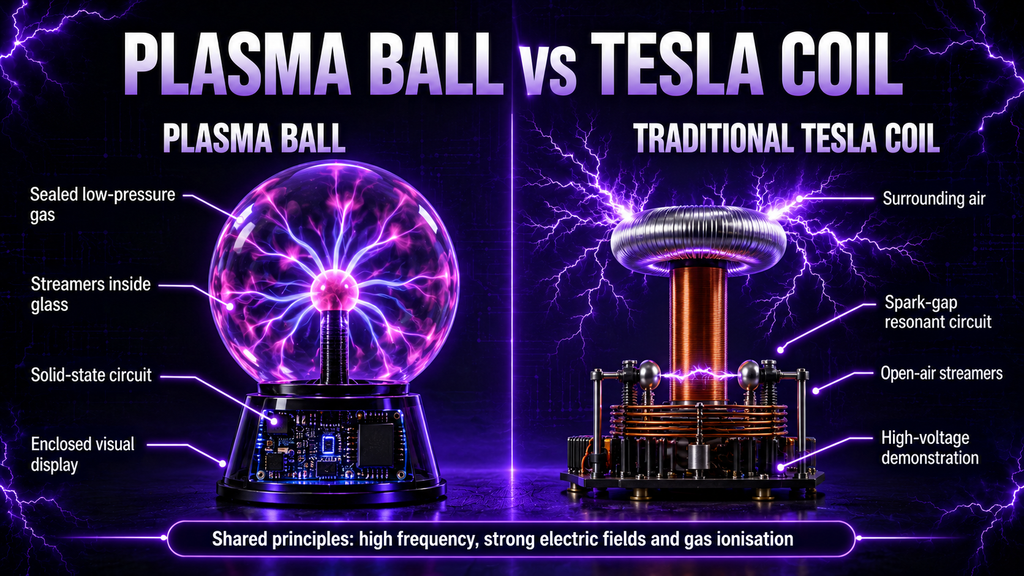
Plasma balls are frequently described as miniature Tesla coils, and there is a genuine connection. Both devices can use rapidly alternating high voltage to create strong electric fields and gas discharge.
However, the description needs care.
A classic spark-gap Tesla coil contains two tuned resonant circuits: a primary LC circuit and a secondary resonant coil. Many modern decorative plasma balls instead use a compact solid-state oscillator and high-voltage transformer hidden inside the base. The circuit may be Tesla-coil-like without reproducing every component of a traditional spark-gap Tesla coil.
| Feature | Traditional spark-gap Tesla coil | Decorative plasma ball |
|---|---|---|
| Main display | Streamers through open air | Streamers inside a sealed globe |
| Gas | Surrounding atmospheric air | Selected gas mixture at reduced pressure |
| Switching | Usually a spark gap | Usually solid-state electronics |
| Resonant circuits | Tuned primary and secondary systems | Design varies; often a compact high-frequency transformer circuit |
| User access | Exposed discharge is hazardous | Glass separates the user from the discharge |
| Purpose | High-voltage demonstration and experimentation | Enclosed visual display and education |
You can learn about the classic design in Lesson 11 — How Does a Tesla Coil Work?.
How Can a Plasma Ball Light a Fluorescent Tube Without Wires?
Bring a suitable fluorescent tube close to some plasma balls and it may glow even though it is not plugged into a socket.
The plasma ball’s rapidly alternating voltage produces an electric field outside the glass. That field can couple energy into the tube. Free electrons inside the tube accelerate, collide with the gas and help initiate a discharge. Ultraviolet light created by the discharge then excites the phosphor coating, which produces visible light.
Energy has not appeared from nowhere. It comes from the powered plasma ball and is transferred through the surrounding field and capacitive coupling.
Brightness depends on:
- Distance from the globe
- Orientation of the tube
- Plasma-ball output
- Operating frequency
- Tube construction
- Whether the person holding it is coupled to ground
- Other nearby objects
A paper in the American Chemical Society’s Journal of Chemical Education describes using a plasma globe to illuminate gas-discharge tubes and explains that the effect relies on high-frequency excitation and capacitive coupling: A Safe and Interactive Method of Illuminating Discharge Tubes for Studying Emission Spectra.
Plasma Ball vs High Frequency Plasma Generator
A small decorative plasma ball and my High Frequency Plasma Generator both make electrical energy visible through gas discharge, but they are different devices.
| Feature | Decorative plasma ball | High Frequency Plasma Generator |
|---|---|---|
| Gas enclosure | One spherical glass globe | Two removable sealed spiral plasma bulbs |
| Electrode arrangement | Central electrode inside the globe | Energy supplied to two external bulb outputs |
| Electrical source | Usually a compact solid-state oscillator | High-frequency producer, capacitor network and adjustable spark-gap assembly |
| Spark gap | Normally absent from modern novelty balls | Visible adjustable spark gaps |
| User interaction | Fingers touch the outer glass | Bulbs are held as described in the Owner’s Guide |
| Primary purpose | Decorative and educational display | Educational, experimental, research, meditation, relaxation and general wellness use |
The shared principles can include high voltage, high-frequency electrical activity, changing fields, gas excitation, ionisation and visible plasma. The architecture, energy delivery and intended use are not the same.
For a closer look at my system, read Lesson 2 — How Does a Plasma Generator Work? and Lesson 6 — Why Are Plasma Bulbs Used?.
Does a Plasma Ball Contain Hot Plasma?
The word plasma often brings to mind the Sun, stars or fusion experiments, but not every plasma has the same temperature or energy.
A decorative plasma ball contains a low-temperature, non-equilibrium gas discharge. The electrons can gain enough energy from the electric field to excite and ionise atoms, while the overall gas remains far cooler than stellar plasma.
This does not mean that every part stays at room temperature. Streamer channels and the glass at a point of prolonged contact can warm, and the electronics in the base also produce heat. That is one reason a hand or object should not be left pressed against one place for an extended period.
Does a Plasma Ball Produce One Frequency?
The circuit has an operating or switching frequency, but describing the entire output with one number can be misleading.
The electrical behaviour may also contain:
- Harmonics of the main operating frequency
- Fast transient components
- Radio-frequency interference
- Variations caused by the moving discharge
- Changes caused by touching the globe or moving nearby objects
Instrument readings also depend on probe type, position, orientation, bandwidth and instrument settings. A peak detected near the globe does not automatically describe every electric field, current or discharge process inside it.
The operating frequency should not be confused with brightness, voltage, power or any claimed biological effect. A decorative plasma ball is not a calibrated medical or frequency-therapy device.
For more background, read Lesson 8 — What Is Frequency? and Lesson 10 — What Are Electrical Oscillations?.
Plasma Ball Safety
Commercial plasma balls are normally designed as enclosed, low-current displays, but they still contain high-voltage circuitry and should be used only as the manufacturer directs.
Important precautions include:
- Do not use a globe with cracked glass, a damaged base or a damaged power lead.
- Never open the base or attempt to touch the internal circuitry.
- Keep the unit away from water, damp areas and flammable materials.
- Use only the power supply specified by the manufacturer.
- Do not place the globe on a conductive metal surface unless its instructions explicitly permit it.
- Do not place coins, foil or other metal objects on the glass; they can concentrate the field, become hot or produce a small arc.
- Do not hold one finger or object against one point for a prolonged period.
- Keep it away from sensitive electronic equipment if interference occurs.
- People with pacemakers, implanted defibrillators, cochlear implants or other implanted electronics should follow their device manufacturer’s guidance and avoid close contact unless cleared by an appropriate medical professional.
- Switch the ball off before cleaning or moving it, and allow it to cool if it has been operating for a long period.
- Supervise children and follow the age guidance supplied with the product.
The glass globe is a protective barrier, not permission to modify the device or experiment with conductive materials. Different plasma balls have different power levels, construction and safety instructions, so the manual supplied with the exact model takes priority.
Common Myths About How a Plasma Ball Works
Myth 1 — The glowing filaments are electrons you can see
Individual electrons are far too small to see. The visible light comes mainly from excited atoms and molecules releasing photons. The filament marks a luminous discharge channel containing charged and neutral particles.
Myth 2 — Your hand attracts the streamers because it is warm
Temperature is not the main reason. Your hand changes the electric field and increases capacitive coupling at the point of contact.
Myth 3 — The electricity passes straight through the glass
Glass is an insulator. The effect occurs because a changing electric field can couple across a dielectric and cause charge to redistribute on its surfaces.
Myth 4 — High frequency means the device is automatically harmless
No frequency makes every high-voltage device safe. A properly manufactured plasma ball limits current and encloses the discharge, but damaged, modified or unsuitable equipment can still cause injury, heat or interference.
Myth 5 — A plasma ball produces free energy
It does not. The light, heat, sound and electromagnetic fields all come from the electrical energy supplied to the device.
Myth 6 — Every plasma ball is a classic Tesla coil
The devices share important principles, but many decorative balls use modern solid-state circuitry rather than a traditional two-resonator spark-gap Tesla coil.
Frequently Asked Questions
Is There a Vacuum Inside a Plasma Ball?
The globe is not normally a perfect vacuum. It contains gas at reduced pressure. Enough gas remains to provide atoms that can be excited and ionised.
What Gas Is Inside a Plasma Ball?
There is no universal mixture. Neon, argon, krypton and xenon are commonly mentioned, and different manufacturers use different combinations and pressures. Colour alone may offer clues, but it cannot reliably reveal the complete mixture.
Why Does the Plasma Ball Hum?
The oscillator, transformer, switching electronics and rapidly changing electrical forces can create audible vibration. Some sound-activated models also include a microphone mode that changes the display in response to nearby noise.
Does Touching the Glass Complete the Circuit?
Your hand becomes part of the alternating circuit through capacitive coupling. It provides a more effective return path to the surrounding environment, but this is not the same as connecting a wire directly from the electrode to earth.
Why Does One Streamer Become Brighter Under My Finger?
The hand increases the effective capacitance and changes the local field. More discharge energy becomes concentrated in that region, so one filament can appear thicker and brighter.
Can the Plasma Escape Through the Glass?
Not during normal operation. The ionised gas remains sealed inside. A rapidly changing electric field extends outside the globe, but the internal gas does not pass through intact glass.
Why Does a Nearby Lamp Glow?
The alternating field can transfer enough energy into certain gas-discharge or fluorescent lamps to excite the gas inside them. The effect weakens with distance and depends on the lamp and the plasma ball.
Is a Plasma Ball a Medical Device?
No. A decorative plasma ball is an educational or novelty display. Its visible streamers do not demonstrate a medical benefit, and the device should not be promoted as diagnosing, treating, curing, mitigating or preventing disease.
Can I Measure It With a Spectrum Analyser?
A suitable non-contact pickup probe may detect some radiated frequency components, but the result depends strongly on the measurement setup. Never connect an analyser, oscilloscope or multimeter directly to the central electrode or internal high-voltage circuit.
Can I Leave It Running All Day?
Follow the operating-time limits in the manufacturer’s instructions. Continuous use can heat the base and glass and may shorten the life of the electronics. Never leave it operating unattended.
What Have We Learned?
So, how does a plasma ball work?
- An oscillator in the base creates rapidly alternating electricity.
- A transformer raises the voltage and applies it to the central electrode.
- The electrode creates a changing electric field through the low-pressure gas.
- Free electrons accelerate and collide with gas atoms.
- Some atoms become ionised, creating more charged particles.
- Other atoms become excited and later release energy as photons.
- Conductive, glowing streamer channels form between the centre and the inner glass surface.
- A hand on the glass changes the electric field and strengthens capacitive coupling.
- The streamers gather near the fingers because that region provides a more favourable alternating return path.
The display brings together many ideas from the earlier Learning Centre lessons: plasma, frequency, resonance, electrical oscillations and Tesla-coil principles.
🧠 Key Takeaways
- A plasma ball contains gas at reduced pressure. ✔
- A central electrode is powered by a high-voltage, high-frequency circuit. ✔
- The electric field accelerates electrons through the gas. ✔
- Collisions excite and ionise gas atoms. ✔
- Excited atoms release photons and create visible light. ✔
- Streamers are dynamic channels of partially ionised gas. ✔
- Touching the glass changes the field and increases local capacitive coupling. ✔
- Different gases and energy transitions produce different colours. ✔
- A plasma ball and a Tesla coil share principles but are not always the same circuit. ✔
- The globe is educational or decorative—not a medical device. ✔
🔬 Plasma Ball Fact
Did you know?
The modern interactive plasma globe is generally credited to Bill Parker, who developed the concept while studying at the Massachusetts Institute of Technology in 1971. However, Nikola Tesla had already demonstrated high-voltage, high-frequency discharges in evacuated glass vessels in the late nineteenth century. Today’s plasma ball therefore combines modern display design with principles explored during the earliest years of high-frequency electrical research.
Continue Your Learning Journey
⬅ Previous Lesson
📘 Lesson 11 of 24 — How Does a Tesla Coil Work?
Discover how capacitance, inductance, magnetic coupling and resonance allow a Tesla coil to produce high-frequency, high-voltage electricity.
➡ Next Lesson
📘 Lesson 13 of 24 — Coming Soon
Learn More About High-Frequency Plasma
If you would like to see how gas-discharge principles are used in my enclosed spark-gap system, visit the High Frequency Plasma Generator.
You can also join the High Frequency Plasma Community on Telegram to ask Alan questions directly, discuss the technology and read owners’ personal experiences. Individual experiences are anecdotal and should not be treated as medical evidence.
Disclaimer
The information in the High Frequency Plasma Learning Centre is provided for general educational purposes to explain the science, history and engineering of plasma and high-frequency electrical technology.
Plasma balls and plasma generators contain high-voltage circuitry and can produce rapidly changing electric fields, heat and electromagnetic interference. This lesson explains operating principles; it is not a construction, repair or modification guide. Use electrical products only as their manufacturers direct.
The High Frequency Plasma Generator is intended for educational, experimental, research, meditation, relaxation and general wellness purposes only. It is not a medical device and is not intended to diagnose, treat, cure, mitigate or prevent any disease or medical condition.
Always seek advice from a suitably qualified healthcare professional regarding medical concerns.
🎉 Lesson Complete
Congratulations!
You have now completed:
📘 Lesson 12 of 24
How Does a Plasma Ball Work? Low-Pressure Gas, Ionisation, Streamers and Touch Explained
You now understand how a high-voltage, high-frequency electric field energises low-pressure gas, why luminous plasma streamers form inside the globe, and why those streamers move towards your fingers when you touch the glass.