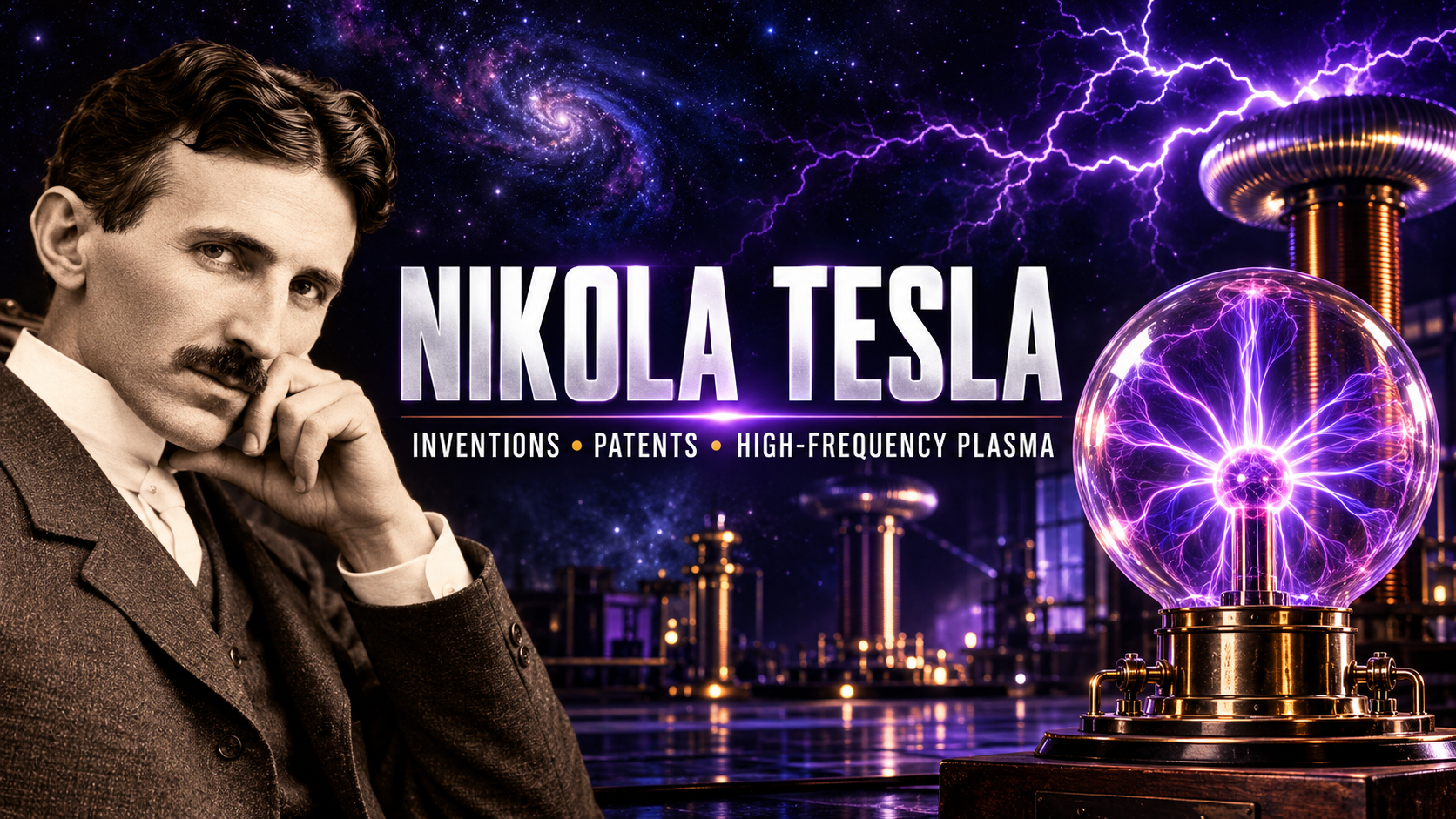
Nikola Tesla is remembered as one of the most inventive electrical engineers of the nineteenth and twentieth centuries. His work helped shape alternating-current power systems, radio-frequency engineering, wireless demonstrations, electric motors and the public imagination around electricity. Among the parts of his career that still attract particular interest are his experiments with high-frequency currents and the patents that described ways to produce them.
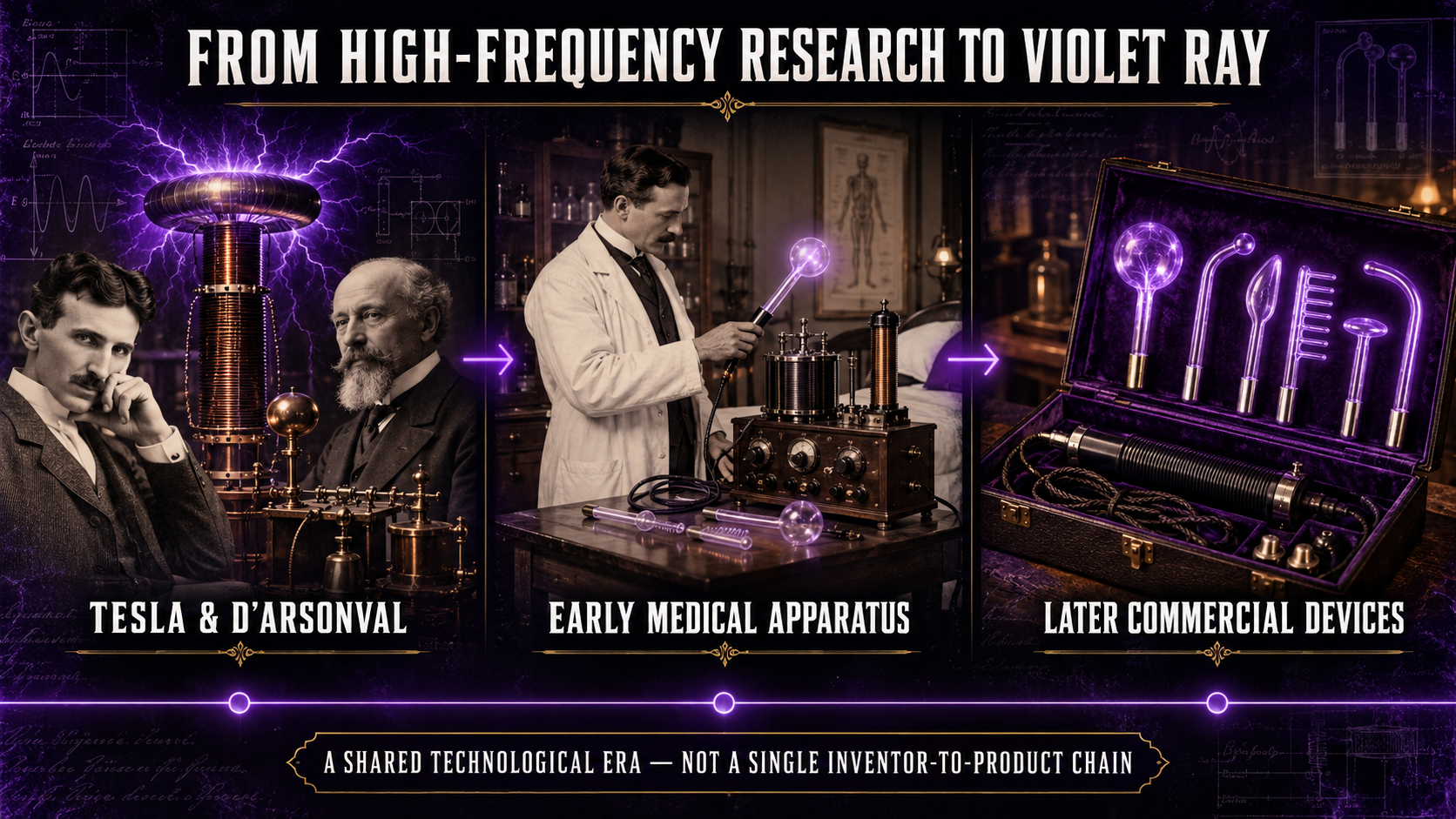
Those experiments also belong to a longer history of electrical treatment. In the late nineteenth and early twentieth centuries, doctors and other practitioners explored high-frequency electrical apparatus in medical offices. Manufacturers later sold violet-ray and similar devices for home use, often with glass electrodes that glowed when energized. These machines were inspired by the wider high-frequency electrical era associated with Tesla and other researchers, including Jacques-Arsène d’Arsonval.
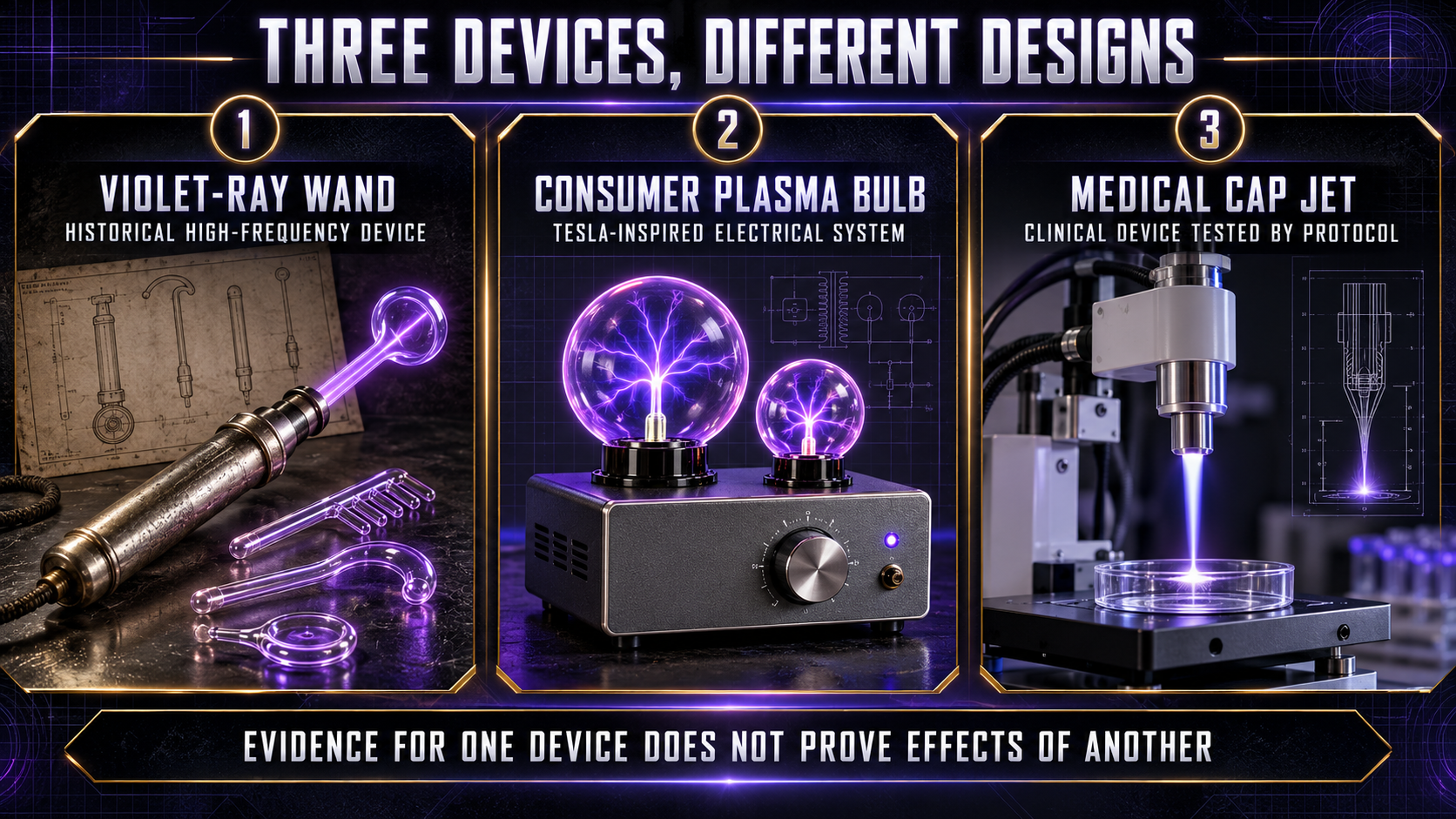
It is useful to tell that story accurately. Nikola Tesla patents were engineering documents, not clinical trials, and they did not establish that electrical treatment could cure disease. Nor is every modern product described as a “plasma device” the same kind of technology. A historical violet-ray machine, a consumer spark-gap generator with glowing bulbs, and a regulated cold-atmospheric-plasma device used in medical research can have important differences in design, output, exposure and intended use.
This guide looks at Tesla’s inventions and patents, how high-frequency apparatus entered medical practice, what current research on cold atmospheric plasma does and does not show, and how to assess updated devices inspired by this history.
Who was Nikola Tesla?
Nikola Tesla was born in 1856 in Smiljan, then part of the Austrian Empire and now in Croatia. He studied engineering, worked in Europe, and moved to the United States in 1884. Tesla became an inventor and electrical engineer whose ideas ranged from practical power equipment to ambitious experiments in wireless transmission and remote control. He died in New York in 1943.
Tesla’s career was broad, and his inventions are sometimes blended together in popular accounts. The most historically consequential part of his work was his contribution to alternating-current (AC) systems. Tesla developed and patented components and arrangements for polyphase AC power, including motors and transmission systems. George Westinghouse’s company licensed Tesla’s patents and used related technology in the expansion of AC power. This helped make it practical to transmit electricity over longer distances and operate AC motors in factories and buildings.
Tesla also worked on high-frequency and high-voltage electricity. He experimented with resonant circuits, transformers, oscillating discharges and wireless transmission. His public lectures and demonstrations showed striking electrical effects, including luminous discharges and the lighting of lamps without conventional wiring. These experiments made Tesla a prominent figure in the popular culture of electricity as well as in engineering.
Other inventions and projects associated with Tesla include the induction motor, the Tesla coil, early radio-frequency apparatus, remote-control demonstrations, and proposals for wireless communication and power. The history of radio involved several inventors and legal disputes, so it is more accurate to say Tesla made important contributions to radio technology than to reduce the entire development of radio to a single inventor.
Nikola Tesla gained a reputation which accumulated stories that go beyond documented evidence. He was a prolific inventor, but not every device later marketed with his name was his invention, and not every claim made in his name is supported by historical records. Separating the patents and contemporary documents from later advertising helps keep his real achievements in view.
What did Nikola Tesla invent?
Alternating-current motors and power systems
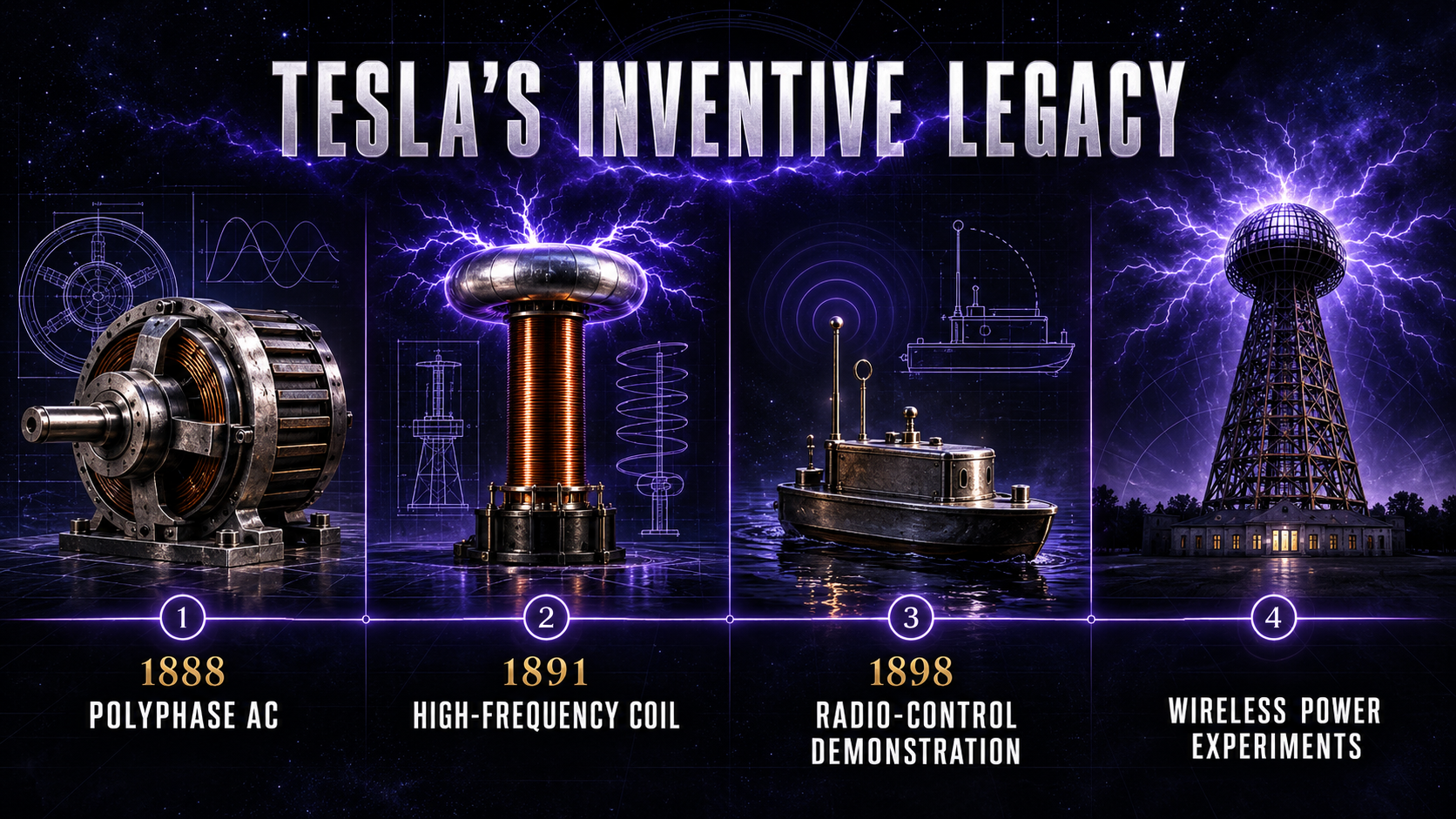
Nikola Tesla invented the polyphase AC system used alternating currents arranged in phases to create a rotating magnetic field. That rotating field could turn an induction motor without a mechanical commutator. Tesla’s patents from 1888 describe important versions of the motor and electrical transmission system. The technology became central to industrial power because AC could be transformed to different voltages and distributed efficiently.
The practical importance of this work is easy to overlook today, when AC outlets and electric motors are ordinary parts of daily life. In Tesla’s time, engineers were still debating how electricity should be generated, transmitted and delivered. His inventions helped make polyphase AC a workable system rather than only a laboratory concept.
The Nikola Tesla coil and high-frequency electricity
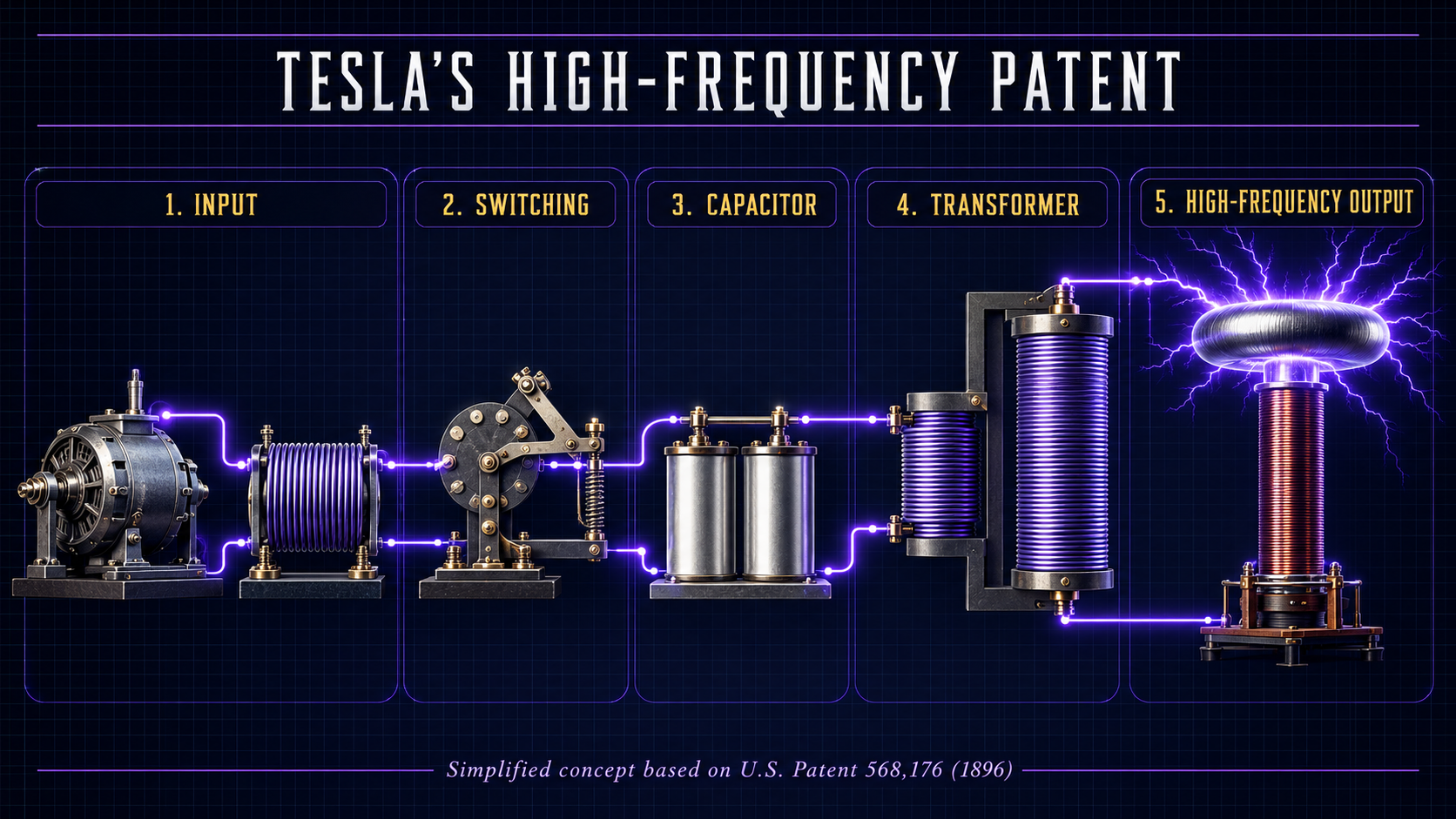
A Tesla coil is a resonant transformer circuit that can produce high-voltage, high-frequency electrical oscillations. Tesla developed and refined apparatus for generating these oscillations during the 1890s. In broad terms, energy is stored and released in a circuit, and a transformer arrangement produces a high-frequency output. The exact circuit design varies across Tesla’s patents and later devices.
The dramatic sparks produced by a Tesla coil made it an effective demonstration instrument. But the visible spark is only one part of the system. The coil, capacitors, switching arrangement, circuit geometry and operating conditions all shape the electrical output. A modern device that uses a spark gap or high-frequency transformer may share broad engineering principles without being a copy of one particular Tesla patent.
Wireless experiments and remote control
Tesla conducted experiments in wireless transmission and proposed systems for transmitting signals and energy. At the 1898 Electrical Exhibition in New York, he publicly demonstrated a radio-controlled boat, an early and striking example of remote control. Tesla’s wireless work is one strand in the wider history of radio and communications engineering, which also involved other inventors, laboratories and patent disputes.
Other projects
Tesla explored turbines, lighting, mechanical oscillators and wireless communication systems. Some ideas were developed into working demonstrations; others remained proposals, prototypes or incomplete projects. The distinction matters: a patent can protect a described invention or method, but a patent by itself does not prove that a device was built at scale, clinically effective, or commercially successful.
Nikola Tesla’s high-frequency patents
Nikola Tesla received patents for apparatus that converted electrical energy into high-frequency currents. One useful example is U.S. Patent 568,176, “Apparatus for Producing Electric Currents of High Frequency and Potential”, granted in 1896. Its specification discusses circuits with inductance and capacitance, interruption of current, transformer windings and oscillating discharges. Tesla describes arrangements intended to produce currents with higher frequency and potential than ordinary generators could readily provide.
Another relevant patent is U.S. Patent 568,179, “Method of and Apparatus for Producing Currents of High Frequency”. It describes charging a condenser and discharging it through a circuit in a way that produces rapid electrical impulses. U.S. Patent 568,180 concerns an apparatus for high-frequency currents using a spark-based circuit controller. These patents are valuable primary sources: readers can inspect Tesla’s original claims, diagrams and explanations rather than relying only on modern summaries.
The patents show Nikola Tesla working through a practical engineering problem: how to produce and control rapid electrical oscillations using the components available at the time. They do not all describe a single fixed “Tesla machine.” Tesla’s drawings and claims cover particular circuit combinations and variations. Later designers adapted high-frequency transformer principles in different ways, using newer components and different power supplies.
When reading an old patent, it helps to focus on the date, the stated problem, the diagram and the specific claims at the end. The descriptive sections explain the inventor’s reasoning, while the claims identify the combinations the patent seeks to protect. A patent may mention possible uses, but that does not mean every suggested use was tested. Nor does a patent document settle who later used the technology in a clinic. Those questions need separate historical records, such as medical textbooks, practitioner reports, manufacturer catalogues and clinical publications.
Tesla’s high-frequency patents are still valuable because they let readers see the engineering language of the period. Terms such as “condenser” and “self-induction” are older names for capacitor and inductance concepts. Following the circuit rather than the period wording makes the underlying ideas easier to understand: store energy, switch or discharge it rapidly, and use transformer coupling to produce an output with the desired characteristics. This electrical lineage is a useful context for later high-frequency instruments, even though each later device needs to be considered on its own merits.
It is also important to separate high-frequency electricity from plasma. Plasma is a partially ionized gas containing charged particles. A spark or glow discharge can ionize gas, but a high-frequency current can exist in circuits without producing a visible gas plasma. When a glass electrode glows, the light is produced by electrical excitation of gas inside or around the electrode. The exact process depends on the lamp construction and electrical conditions.
How did high-frequency electricity enter medical practice?
Tesla was not the only scientist studying high-frequency current. French physician and physicist Jacques-Arsène d’Arsonval investigated the effects of high-frequency currents on the body in the late nineteenth century. Medical practitioners and electrical engineers explored a range of electrical treatments during this period, from galvanic and faradic currents to high-frequency apparatus. The field developed through the work of several people, and the equipment varied widely.
In the late 1800s and early 1900s, some physicians and electrotherapists used high-frequency apparatus in their practices. Later devices often included a high-voltage coil and glass electrodes containing a low-pressure gas. When energized, the tubes could glow in different colours. The practitioner might apply an electrode to or near the skin, depending on the device and the treatment tradition of the time. “Violet ray” became a familiar name for some of these products, although manufacturers and designs differed.
These devices were shaped by the broader technology of high-frequency currents, resonant coils and gas-discharge tubes. It would be too strong to say that doctors simply took Tesla’s patents and invented all violet-ray machines directly from them. Historical medical equipment emerged through a wider chain of engineering, commercial manufacturing and clinical experimentation. Tesla’s patents help explain some electrical principles that later designers found useful; they do not establish a direct one-to-one lineage for every machine.
The therapeutic claims made for early electrical devices were extensive. Period advertising and manuals sometimes promised relief for many unrelated conditions. Such claims should be read as historical evidence of what sellers and practitioners asserted, not as proof that the devices worked for those conditions. Early medical practice had different standards, limited clinical testing and fewer regulatory controls than modern medicine.
That history can still be interesting. It shows how physicians and engineers were trying to understand electricity’s interaction with tissue, and how new laboratory technology moved into clinics and homes. It also offers a reminder that dramatic electrical effects and enthusiastic marketing are not substitutes for controlled evidence.
From violet-ray machines to modern plasma devices
A violet-ray machine typically used high-voltage, high-frequency electrical output and glass applicators. In some designs, gas inside the glass tube produced a visible glow when energized. Depending on the apparatus and technique, the electrode could be placed on the skin or held slightly away from it, producing a discharge. The visible colour and intensity depended on the gas, tube construction and electrical conditions.
A modern consumer device may use a different power supply, switching electronics, electrode design, enclosure and operating method. Some contemporary high-frequency plasma systems use replaceable spark-gap electrodes, bulbs or other gas-discharge attachments. The principle of creating high-frequency electrical output has historical connections with Tesla-era engineering, but the build, measured output and intended purpose are specific to each product.
The term “plasma device” is also used for modern medical equipment that creates cold atmospheric plasma (CAP). CAP devices used in research or clinical settings are engineered to deliver a defined plasma plume or discharge under specified conditions. They may use a gas flow, a controlled electrode geometry and electrical parameters that differ significantly from consumer bulbs or historical violet-ray equipment. Researchers measure factors such as temperature, voltage, current, gas composition, exposure time and reactive species.
For that reason, evidence from a clinical study of one medical CAP device cannot automatically be applied to another device that happens to use the words “plasma,” “Tesla” or “high frequency.” Similar vocabulary does not mean identical technology. A fair comparison requires device-specific testing and a close look at what the study actually evaluated.
What do studies say about high-frequency plasma?
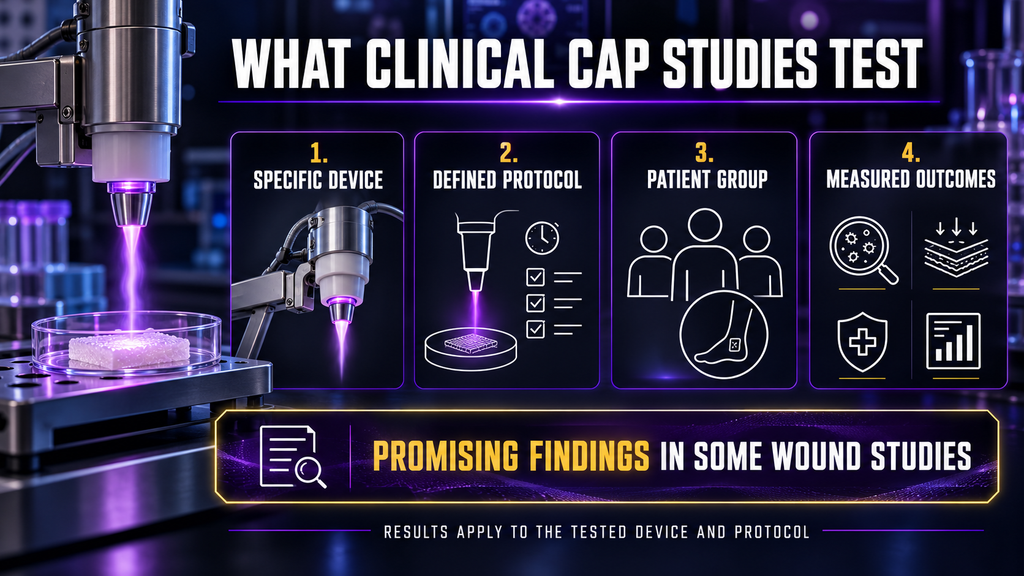
Current research on cold atmospheric plasma is an active area of medical science. Studies have investigated wound care, microbial effects and interactions with cells and tissues. Some clinical trials report promising findings in specific settings, particularly chronic wounds. However, the results apply to the tested devices, patient groups, treatment protocols and outcomes. They do not establish that every plasma-producing product has the same effect, and they do not prove broad claims about general health, energy, pain, immunity or disease treatment.
Here are examples of published research readers can examine:
- In a randomized clinical trial of cold atmospheric plasma for diabetic foot ulcers, researchers studied 62 ulcers in 43 patients. The authors reported improved wound-healing measures with the tested CAP treatment compared with standard therapy plus placebo. The population, device and clinical protocol are specific to this trial.
- A multicentre randomized non-inferiority trial of a cold-plasma jet for chronic wounds compared a medical CAP-jet treatment with best-practice wound dressings. It evaluated wound healing and infection-related outcomes under clinical supervision. The results concern that medical device and protocol, not consumer high-frequency bulbs.
- A separate randomized trial examining inflammatory markers in diabetic foot ulcers reported changes in selected inflammatory markers after CAP treatment. Biomarker changes are research findings; they are not, on their own, proof of a cure or a benefit for unrelated conditions.
- A more recent randomized controlled trial on chronic venous leg ulcers examined direct cold atmospheric plasma used alongside standard care. It illustrates how current work continues to test defined devices and protocols in particular wound populations.
These studies are worth reading because they show the difference between an engineering idea and a clinical claim. They use defined medical devices, treatment schedules, outcome measures and patient groups. Some studies are relatively small, and research findings need replication and ongoing evaluation. A wound-care result does not establish a benefit for a home device used in a different way.
The word “plasma” can refer to different physical systems. Cold atmospheric plasma jets and consumer gas-discharge bulbs do not necessarily create the same mixture of reactive species, exposure pattern, temperature or electrical conditions. A medical study’s results should therefore not be used as proof that a consumer bulb device treats wounds or any other health condition unless that specific product has been independently tested in an appropriate clinical study.
What is the difference between Tesla-inspired devices and medical CAP equipment?
The phrase “Tesla-inspired” usually points to high-frequency electrical engineering principles such as transformer action, oscillating circuits or spark-gap switching. It describes a historical or design influence. It does not mean that Tesla personally designed the modern product, nor does it certify that the device is medically approved or clinically proven.
A medical CAP jet is designed for a particular clinical purpose. The device and treatment protocol are tested and measured, and the product may be subject to medical-device regulation in the jurisdictions where it is sold. A consumer high-frequency system may have a different intended use, construction and evidence base. Bulbs, sparking electrodes and plasma jets are not interchangeable merely because they all involve gas discharge or high voltage.
If a manufacturer cites a study, ask whether it tested the exact model being offered. Check the study’s authors, journal, date, device name, number of participants, comparison group and measured outcome. Look for limitations and whether the study was independently replicated. If the device used in the study is different, the study may explain a research area but cannot verify the consumer product’s performance.
Alan’s updated High Frequency Plasma device
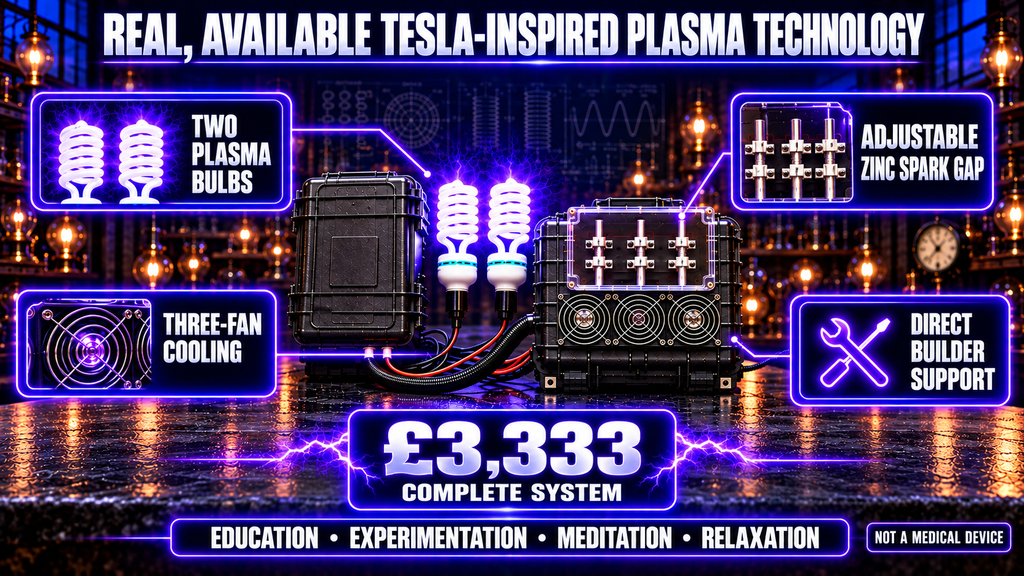
For readers interested in a modern, handcrafted device that draws on the tradition of high-frequency electrical apparatus, Alan’s High Frequency Plasma Generator is presented as a contemporary consumer product inspired by that engineering history. The current product information describes a high-frequency producer, spark-gap generator with adjustable and replaceable 100% zinc rods, and two handheld plasma bulbs. The package also includes simple operating instructions, shipping, direct customer support and a 12-month warranty for the machine; the bulbs are excluded from the warranty.
The device is listed at £3,333. The seller describes it as plug-and-use and provides buyer support through the High Frequency Plasma website and its High Frequency Plasma Community Group on Telegram. Buyers should review the current product page for the latest specifications, package details, terms and safety instructions before ordering.
The appeal of an updated design can include maintainable components, replaceable spark-gap rods, two handheld bulbs and access to support from the maker. Those are product and service features; they should be considered separately from medical efficacy. The product is not a substitute for professional medical care, and it should not be described as diagnosing, treating, curing or preventing disease. It is not the same as a regulated cold-atmospheric-plasma medical device used in the clinical studies cited above.
Anyone considering a high-voltage or high-frequency device should read and follow its instructions, use it only for its stated purpose and observe all warnings. People with pacemakers or other implanted electronic devices, and people who are pregnant, should avoid use unless a qualified clinician and the manufacturer provide specific guidance. Keep electrical equipment away from computers, televisions and other sensitive electronics. Stop using any device if it appears damaged or behaves unexpectedly, and seek qualified help rather than opening or modifying high-voltage equipment.
This article is educational and historical. It is not medical advice. If you have a health concern, speak with a qualified healthcare professional and do not delay evidence-based care because of claims about electrical or plasma devices.
Why Nikola Tesla still matters to plasma-device history
Tesla’s work remains relevant because he helped develop ways to generate and control high-frequency electrical currents. His patents show a technically ambitious engineer documenting circuits that used inductance, capacitance, switching and transformers to create rapid oscillations. Those principles became part of a larger electrical toolkit used by engineers and device makers in later decades.
Doctors and electrotherapists of Tesla’s era were exploring electrical treatment at the same time that these engineering developments were taking place. Later violet-ray devices brought high-frequency apparatus and glowing glass tubes into medical offices and homes. The history is not a simple story of Tesla inventing one medical device that doctors copied. It is a story of overlapping work by inventors, physicists, physicians, manufacturers and practitioners, with claims that changed as scientific standards evolved.
Today, researchers are studying carefully engineered cold atmospheric plasma devices for defined clinical questions, including wound care. That research is promising in some areas, but it remains device-specific and protocol-specific. It should be discussed with care and not used to validate products that have not undergone the same testing.
For anyone searching “Nikola Tesla” because of an interest in high-frequency plasma, the best starting point is both inspiring and grounded: read the patents, understand the engineering, learn the history of early electrotherapy, and distinguish that past from modern clinical evidence. Tesla’s legacy is strong enough without exaggerating what his patents prove. An informed view gives readers a clearer way to compare historical machines, modern consumer devices and regulated medical plasma technology.
Frequently asked questions about Nikola Tesla and plasma devices
Did Nikola Tesla invent the violet-ray machine?
Tesla’s work on high-frequency currents helped shape the wider technological context in which violet-ray devices emerged. However, the familiar consumer violet-ray machines were later products made by different manufacturers. It is more accurate to say they were part of a high-frequency electrical tradition than to attribute every model directly to Tesla.
Did Tesla’s patents prove that high-frequency treatment benefits health?
No. Patents describe inventions and the claims an inventor sought to protect. They are not clinical trials and do not establish medical safety or effectiveness. Any health claim requires evidence from appropriate studies of the specific device and use.
Are violet-ray devices the same as cold atmospheric plasma jets?
No. They can share broad features such as electrical discharges or gas excitation, but their design, output, exposure and intended use can differ. Results from a medical CAP jet study cannot automatically be applied to a violet-ray machine or a consumer plasma-bulb device.
Is Alan’s High Frequency Plasma Generator a medical device?
The product is presented as a consumer high-frequency plasma device, not as a regulated medical CAP jet. Review its current product information and warnings. It should not be relied on to diagnose, treat, cure or prevent any disease.
Where can I read Tesla’s original patents?
Start with U.S. Patent 568,176, U.S. Patent 568,179 and U.S. Patent 568,180. These are historical primary sources that explain specific high-frequency apparatus and methods.
What should I check before buying a high-frequency plasma device?
Check the exact model’s specifications, intended use, operating instructions, warranty, support and safety information. Ask whether clinical studies tested that exact model. Treat comparisons with medical equipment cautiously, and speak with a qualified healthcare professional about health questions.