
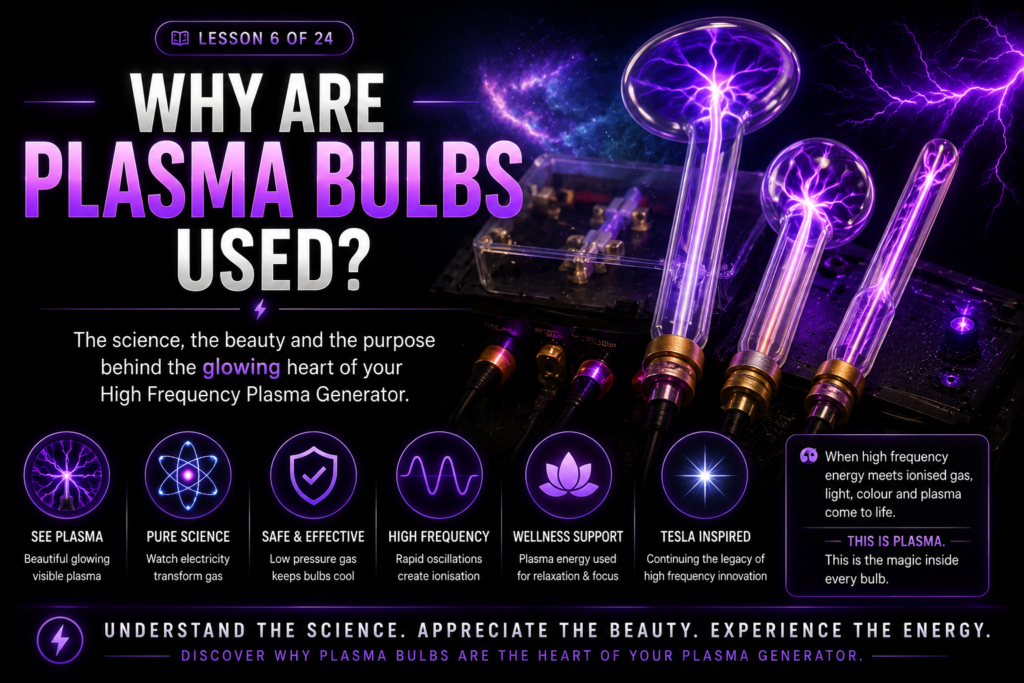
Learn why plasma bulbs are used in high frequency plasma generators, how they work, what gas they contain, and why they produce beautiful glowing plasma.
📚 High Frequency Plasma Learning Centre
📘 Lesson 6 of 24
Why Are Plasma Bulbs Used?
Estimated Reading Time: 12–15 Minutes
Difficulty: 🟢 Foundation
What You’ll Learn
By the end of this lesson you’ll understand:
Why plasma bulbs are used. ✔
What is inside a plasma bulb. ✔
How high frequency electricity creates plasma. ✔
Reason the bulbs stay cool. ✔
Why different gases produce different colours. ✔
Why Are Plasma Bulbs Used?
One of the first things people notice about a high frequency plasma generator is the beautiful glowing bulbs.
They produce brilliant white and purple light while remaining comfortable to hold during normal operation.
But have you ever wondered what is actually happening inside the bulb?
The answer lies in one of the most fascinating areas of physics: gas ionisation.
Unlike an ordinary household light bulb, a plasma bulb is designed to allow high frequency electrical energy to interact with a low-pressure gas sealed inside the glass envelope.
As the gas becomes energised, it enters the plasma state and emits visible light.
This glowing plasma is one of the defining characteristics of traditional Tesla-inspired plasma technology.
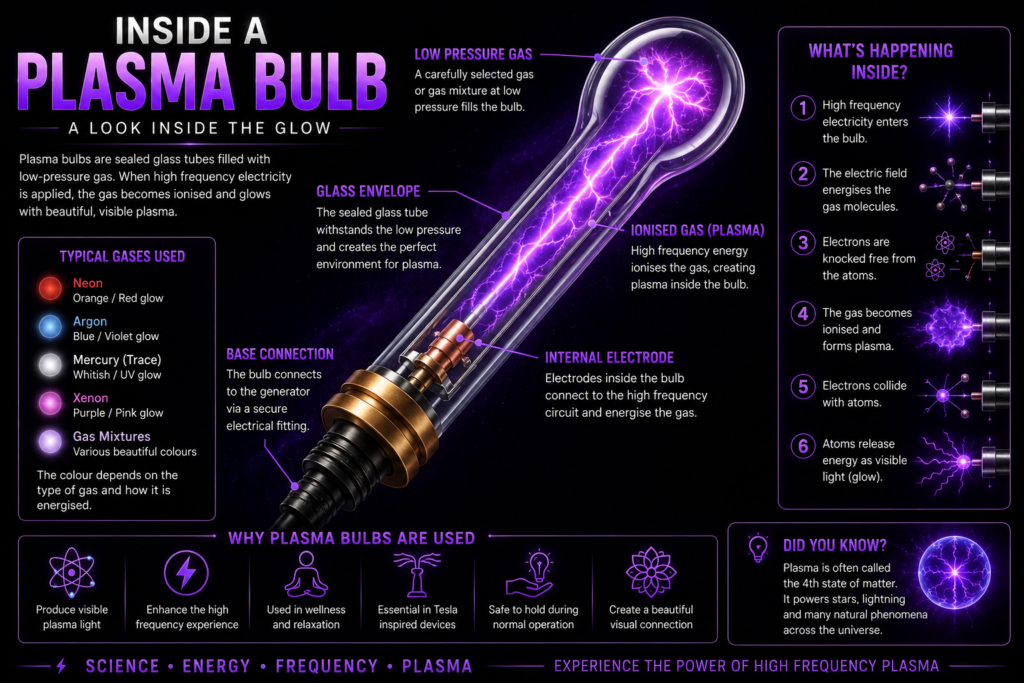
What Is Inside a Plasma Bulb?
At first glance, a plasma bulb appears to be little more than a glass tube.
In reality, it is a carefully constructed gas-discharge device.
Inside the glass is:
- A carefully selected gas or gas mixture
- Low internal pressure
- Internal electrodes connected to the high frequency circuit
- A sealed glass envelope
The low-pressure environment allows the gas to ionise much more easily than ordinary air.
When high-frequency electrical energy is applied, the gas begins to glow.
What Is Ionisation?
Under normal conditions, gas atoms are electrically neutral.
However, when sufficient energy is introduced, electrons can be removed from some of those atoms.
The gas now contains:
- Positively charged ions
- Free electrons
This process is known as ionisation.
Once ionised, the gas can conduct electricity and emit visible light.
This glowing ionised gas is what we recognise as plasma.
Why Do Plasma Bulbs Glow?
One of the most beautiful characteristics of plasma is its ability to emit light.
As high-frequency electrical energy passes through the bulb, electrons move rapidly through the ionised gas.
These energetic electrons collide with gas atoms.
Each collision transfers energy to the atoms.
When the atoms return to their normal energy level, they release that energy as visible light.
This continual cycle of excitation and relaxation creates the beautiful glow seen inside the plasma bulb.

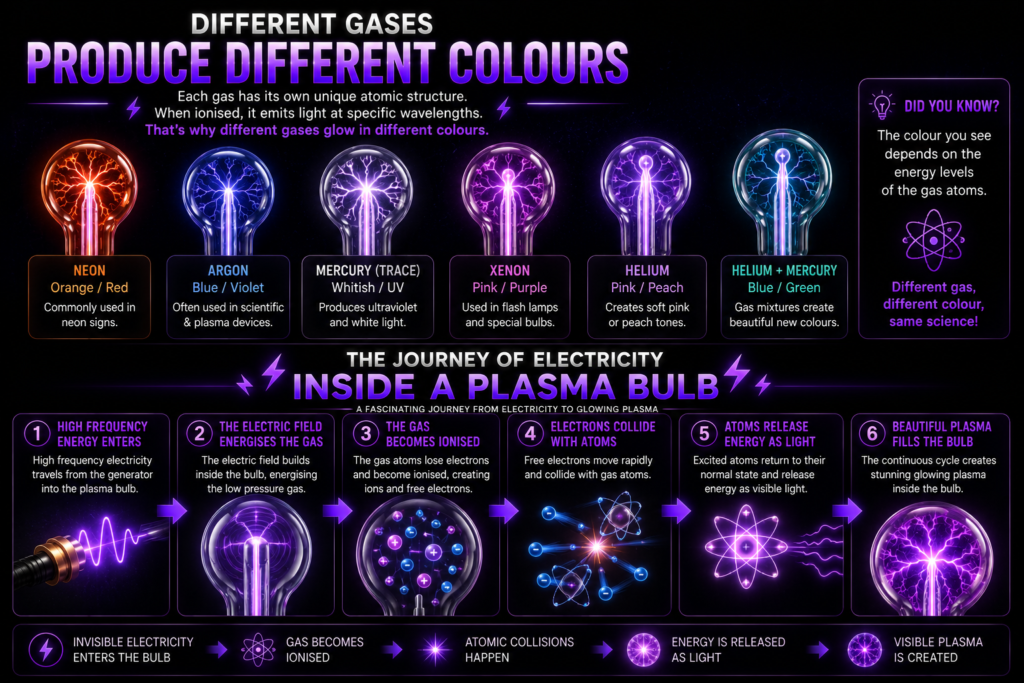
Why Do Different Plasma Bulbs Produce Different Colours?
Not every gas emits the same colour of light.
Each gas has its own unique atomic structure.
As a result, different gases release different wavelengths of visible light when ionised.
For example:
- Neon typically produces an orange-red glow.
- Argon often creates blue or violet colours.
- Other gas mixtures may appear white, pink or lavender.
The colour depends on the gas used and the way it is excited by the high-frequency electrical field.
Why Don’t Plasma Bulbs Get Extremely Hot?
This is another question many people ask.
Although plasma itself can exist at very high temperatures in some environments, the type of plasma produced inside a low-pressure gas-discharge bulb behaves differently.
The energy is distributed through the ionised gas rather than heating the glass in the same way as a traditional incandescent filament.
As a result, the bulbs can often remain much cooler than people expect during normal operation.
The Journey of Electricity Inside the Bulb
The process can be summarised in six simple steps:
- High-frequency electrical energy enters the bulb.
- The electric field energises the low-pressure gas.
- The gas becomes ionised.
- Electrons collide with gas atoms.
- The atoms emit visible light.
- Beautiful glowing plasma fills the bulb.
Although the science is complex, the overall process demonstrates one of the most fascinating interactions between electricity and matter.

Why Are Plasma Bulbs Held in the Hands?
One of the most recognisable features of a traditional high frequency plasma generator is the pair of handheld plasma bulbs.
Rather than being permanently fixed to the machine, these bulbs allow the user to comfortably hold them during operation.
The bulbs serve two important purposes.
Firstly, they contain the low-pressure gas needed to create visible plasma.
Secondly, they provide a safe, insulated glass enclosure that allows the fascinating plasma effect to be observed while keeping the ionised gas sealed inside.
The glowing bulbs also make it possible to appreciate the science taking place inside the device, transforming invisible electrical energy into beautiful visible plasma.
Why Is Glass Used?
Glass is an ideal material for plasma bulbs because it performs several important functions.
It:
- Seals the low-pressure gas inside the bulb.
- Allows the glowing plasma to be clearly seen.
- Electrically insulates the ionised gas from the outside environment.
- Remains chemically stable during normal operation.
Without the sealed glass envelope, the carefully controlled environment required for plasma generation could not exist.
How Do the Bulbs Connect to the Generator?
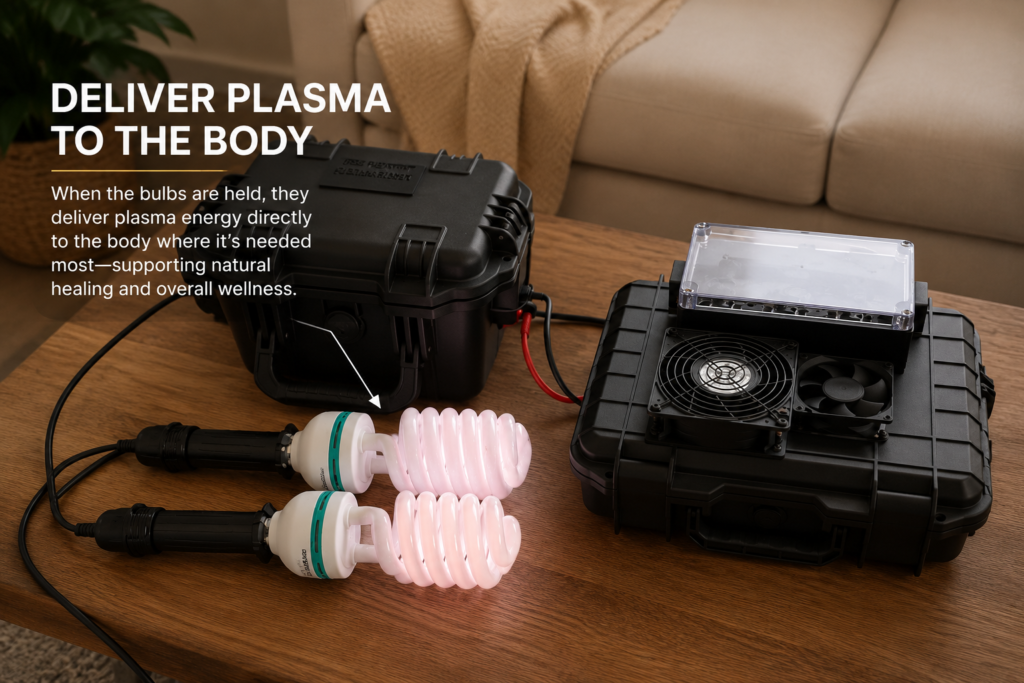
The plasma bulbs connect directly to the high frequency output of the generator.
Inside the machine, the spark gap and high-frequency circuitry create rapidly oscillating electrical energy.
This energy travels through the connecting cables to the electrodes inside each bulb.
As the electric field develops inside the sealed glass tube, the low-pressure gas becomes ionised and begins to glow.
Although the bulb appears simple from the outside, it is the final stage of a fascinating journey that began with mains electricity entering the generator.
Why Are Plasma Bulbs Such an Important Part of the Machine?
Without the plasma bulbs, there would be no visible plasma.
They are where the electrical energy produced by the generator becomes something you can actually see.
The bulbs:
- Convert high-frequency electrical energy into visible plasma.
- Demonstrate the ionisation process.
- Showcase one of the four fundamental states of matter.
- Help users understand how the generator is operating.
For many people, the glowing plasma is one of the most captivating aspects of the entire device.
Common Myths About Plasma Bulbs
Myth 1 – The Bulb Is Just an Ordinary Light Bulb
It isn’t.
A plasma bulb is a specialised gas-discharge device designed to operate with high-frequency electrical energy.
Myth 2 – The Light Comes From a Filament
Unlike a traditional incandescent bulb, there is no glowing filament producing the light.
Instead, the light is emitted by ionised gas inside the sealed glass envelope.
Myth 3 – Plasma Is Fire
No.
Although plasma can appear similar to flames, it is not burning.
Plasma is an ionised gas containing free electrons and positively charged ions.
Frequently Asked Questions
Why Are Plasma Bulbs Used?
Plasma bulbs provide the sealed environment needed for gas ionisation, allowing high-frequency electrical energy to create visible plasma.
What Gas Is Inside a Plasma Bulb?
The exact gas or gas mixture depends on the bulb’s design. Different gases produce different colours when ionised.
Why Do Plasma Bulbs Glow?
Electrons moving through the ionised gas collide with atoms, exciting them. As those atoms return to a lower energy state, they release energy as visible light.
Why Are Plasma Bulbs Made From Glass?
Glass provides a sealed, electrically insulating enclosure that maintains the low-pressure gas environment while allowing the plasma to be seen.
Do Different Gases Produce Different Colours?
Yes. Each gas has its own unique emission spectrum, so different gases glow with different colours when energised.
Summary
Plasma bulbs are much more than attractive glowing tubes.
They are carefully engineered gas-discharge devices that transform invisible high-frequency electrical energy into beautiful visible plasma.
Inside every bulb, electricity, physics and chemistry combine to produce one of nature’s most fascinating phenomena.
Understanding how plasma bulbs work helps explain why they have been used for well over a century in demonstrations of high-frequency electricity and continue to capture people’s imagination today.
🧠 Key Takeaways
Plasma bulbs contain a low-pressure gas. ✔
High-frequency electrical energy ionises the gas. ✔
Ionisation creates plasma. ✔
Excited atoms release visible light. ✔
Different gases produce different colours. ✔
The glass bulb creates the perfect environment for plasma formation. ✔
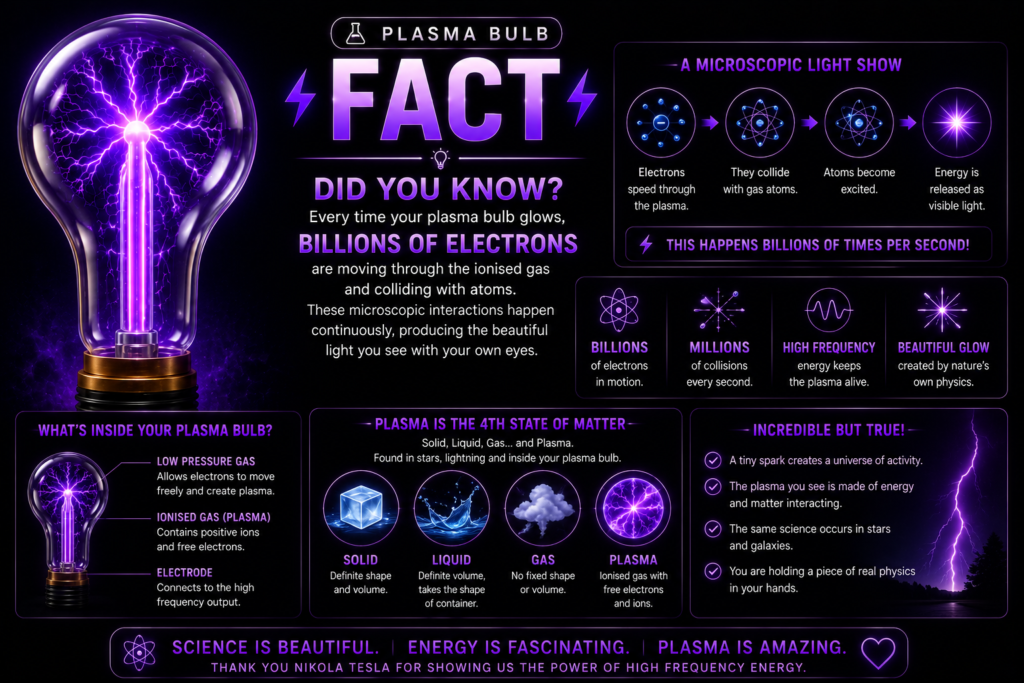
🔬 Plasma Bulb Fact
Did you know?
Every time your plasma bulb glows, billions of electrons are moving through the ionised gas and colliding with atoms. These microscopic interactions happen continuously, producing the beautiful light you see with your own eyes.
Continue Your Learning Journey
⬅ Previous Lesson
Why Does My Machine Use Zinc Rods?
Discover why electrode material matters, how zinc rods work inside the spark gap, and how simple maintenance helps keep your plasma generator operating reliably.
➡ Next Lesson
What Is High Frequency Electricity?
Discover how high-frequency electrical energy differs from ordinary mains electricity, why frequency matters, and how Tesla used high-frequency currents in his pioneering experiments.
Disclaimer
The information contained within the High Frequency Plasma Learning Centre is provided for educational purposes to explain the science, history and engineering of plasma technology.
The High Frequency Plasma Generator is intended for educational, experimental, research, meditation, relaxation and personal wellness purposes only.
It is not a medical device and is not intended to diagnose, treat, cure, mitigate or prevent any disease or medical condition.
Always seek advice from a suitably qualified healthcare professional regarding medical concerns.
🎉 Lesson Complete
Congratulations!
You have now completed:
📘 Lesson 6 of 24
Why Are Plasma Bulbs Used?
You now understand what is inside a plasma bulb, how high-frequency electricity ionises the gas, why plasma emits light, and why these glowing bulbs are such an important part of a traditional high-frequency plasma generator.