
So, what is voltage? Voltage is the electric potential difference between two points. It tells us how much electric potential energy changes for each unit of charge moved between those points.
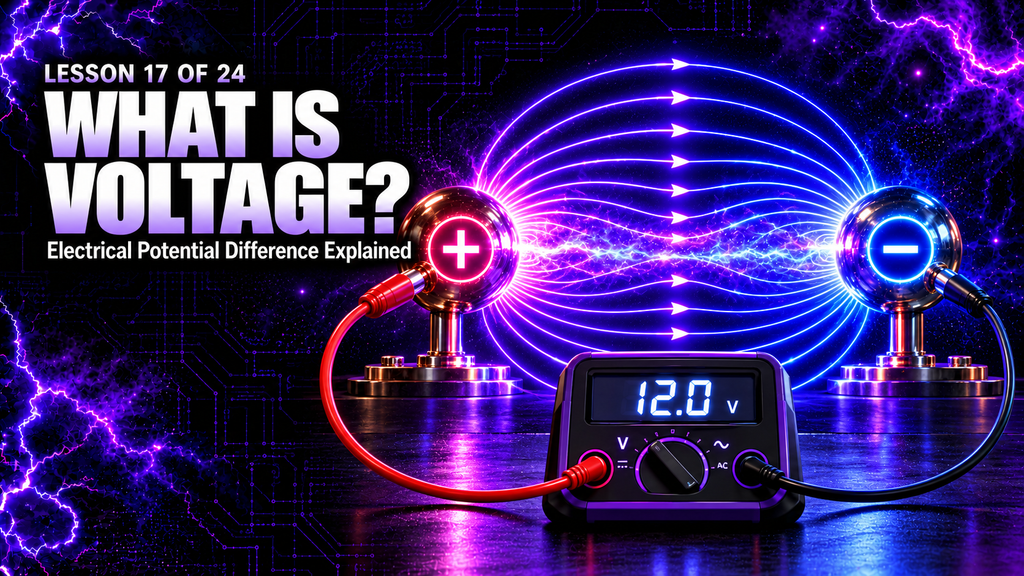
Voltage is one of the most frequently used—and frequently misunderstood—ideas in electricity. It is often described as electrical “pressure,” which can be a useful first analogy, but voltage is more accurately defined as energy per unit charge.
Voltage is essential to batteries, power supplies, transformers, capacitors, spark gaps and plasma bulbs. Inside the High Frequency Plasma Generator, voltage changes form several times: mains alternating voltage is converted to low-voltage DC, switched rapidly by the ZVS driver, transformed to high voltage by the flyback stage, stored across capacitors and finally applied to the spark-gap and output circuit.
📚 High Frequency Plasma Learning Centre
📘 Lesson 17 of 24 — What Is Voltage?
Previous lesson: Lesson 16 — What Is Electromagnetic Induction?
Next lesson: Lesson 18 — What Is Electric Current? (Coming Soon)
Estimated reading time: 18–22 minutes
Difficulty: 🟢 Beginner
What You’ll Learn
By the end of this lesson, you will understand:
- What voltage really measures. ✔
- Why voltage is always measured between two points. ✔
- Why one volt equals one joule per coulomb. ✔
- How voltage differs from current, resistance, power and frequency. ✔
- How voltage relates to an electric field. ✔
- What voltage sources and voltage drops mean. ✔
- How Ohm’s law connects voltage, current and resistance. ✔
- How DC, AC and pulsed voltage differ. ✔
- What peak, peak-to-peak and RMS voltage mean. ✔
- Why high voltage does not automatically tell us the current or power. ✔
- How capacitors store energy at a voltage. ✔
- How voltage changes through the High Frequency Plasma Generator. ✔
- How voltage should be measured safely. ✔
The Short Answer: What Is Voltage?
Voltage is electric potential difference.
Mathematically:
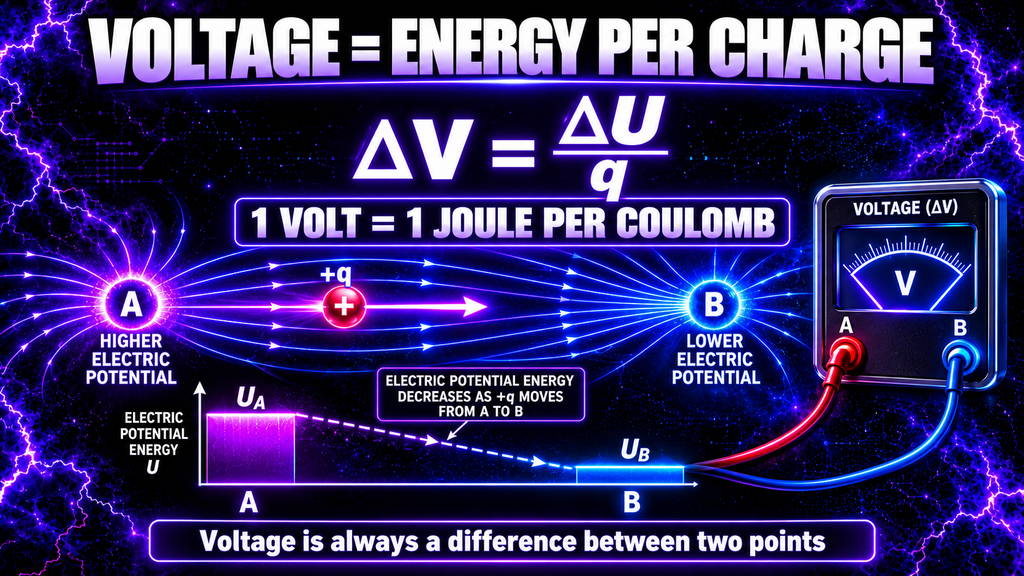
ΔV = ΔU / q
Where:
- ΔV is the voltage or change in electric potential.
- ΔU is the change in electric potential energy.
- q is electric charge.
The unit of voltage is the volt, symbol V.
1 volt = 1 joule per coulomb
Written as an equation:
1 V = 1 J/C
If one coulomb of charge changes its electric potential energy by one joule when moving between two points, the voltage between those points is one volt.
Voltage does not describe how much charge is moving per second. That is current. Voltage describes the energy difference available per unit charge.
Why Is Voltage Always Between Two Points?
Voltage is a difference, not an isolated quantity belonging to one point by itself.
A battery labelled 12 V has approximately 12 volts of potential difference between its positive and negative terminals. A voltmeter measures one point relative to another point.
We often choose a convenient reference and call it:
- 0 V
- Ground
- Common
- Circuit reference
However, zero volts is not automatically the same everywhere. A circuit’s local ground may be isolated from protective earth, connected to it at one location or moving relative to another circuit.
A point described as +12 V therefore means:
This point is 12 volts above the chosen reference point.
A point described as −5 V is five volts below that reference. The negative sign indicates polarity relative to the chosen reference; it does not mean that voltage is “bad” or that electricity is flowing backwards.
Voltage as Energy per Charge
Imagine raising an object against gravity. The object gains gravitational potential energy because of its position.
Electric charge can also possess potential energy because of its position in an electric field. Voltage describes that potential energy per unit charge.
The analogy is useful:
| Gravitational idea | Electrical idea |
|---|---|
| Height difference | Voltage difference |
| Gravitational field | Electric field |
| Mass | Electric charge |
| Potential energy per unit mass | Potential energy per unit charge |
An object can be high above the floor without moving. Similarly, a voltage can exist without current flowing.
If a conducting path is then provided, charge may move—depending on the complete circuit and its impedance.
This is why a disconnected battery can have voltage across its terminals even though no external current flows.
Is Voltage Like Water Pressure?
The water analogy can help beginners:
- Voltage resembles a pressure difference.
- Current resembles water-flow rate.
- Resistance resembles a narrow or restrictive pipe.
Higher pressure difference can drive more flow through the same restriction. Similarly, higher voltage can drive more current through the same resistance.
However, the analogy has limits. Electric fields establish throughout a circuit very differently from water physically travelling through a pipe. AC circuits, capacitors, inductors, transmission lines and electromagnetic waves cannot be understood completely using simple plumbing.
Use the analogy to build intuition, but use the electrical equations for accurate reasoning.
Voltage, Current, Resistance, Power and Frequency
These terms describe different properties.
| Quantity | Meaning | Symbol | Unit |
|---|---|---|---|
| Voltage | Potential-energy difference per unit charge | V | volt (V) |
| Current | Rate of charge flow | I | ampere (A) |
| Resistance | Opposition to DC current in an ohmic element | R | ohm (Ω) |
| Power | Rate of energy transfer | P | watt (W) |
| Frequency | Cycles per second | f | hertz (Hz) |
Voltage can exist without current. Current cannot continue around an ordinary circuit without a closed path. Power requires both voltage and current:
P = VI
Frequency says how quickly a repeating waveform cycles. It does not by itself tell us the voltage, current or power.
How Does Voltage Relate to Current?
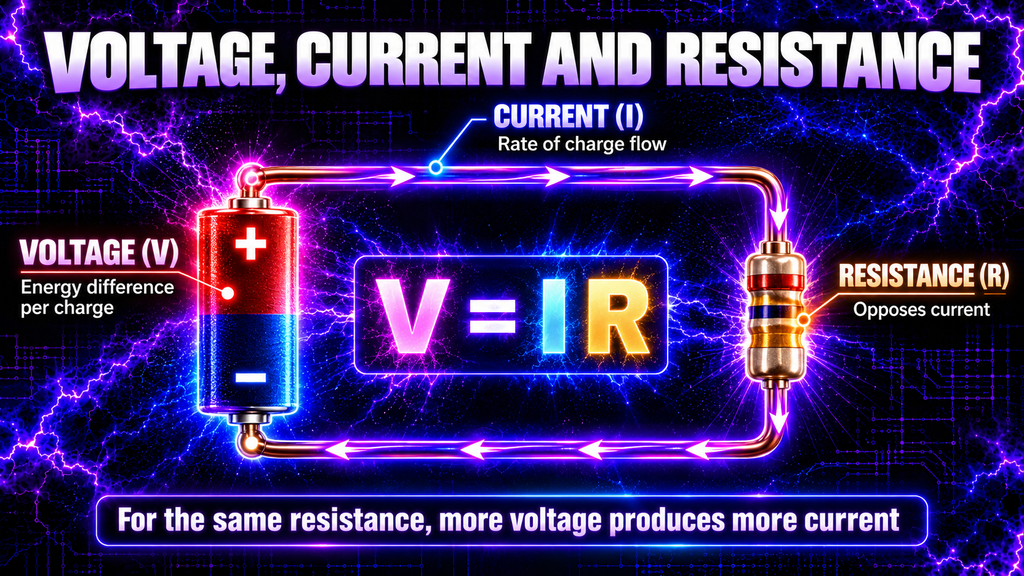
For an ohmic resistor under stable conditions, Ohm’s law states:
V = IR
This can also be written:
I = V / R
For the same resistance:
- Increasing voltage increases current.
- Reducing voltage reduces current.
For the same voltage:
- Increasing resistance reduces current.
- Reducing resistance increases current.
Ohm’s law is extremely useful, but not every component has a constant resistance. Diodes, gas discharges, spark gaps, lamps, capacitors and inductors can have nonlinear or frequency-dependent behaviour.
A spark gap, for example, behaves like a very high impedance before breakdown and a much lower impedance while conducting. A single fixed resistance value cannot fully describe that transition.
What Is a Voltage Source?
A voltage source maintains a potential difference between its terminals.
Common sources include:
- Batteries.
- DC power supplies.
- Alternators and generators.
- Solar cells.
- Transformers and induced-emf sources.
- Charged capacitors.
An ideal voltage source would maintain exactly the same terminal voltage no matter how much current the load demanded. Real sources have limits and internal impedance.
If a heavy load draws current, the terminal voltage may fall. This is called voltage sag or voltage droop.
A source can therefore show the expected voltage with no load but collapse when connected to a demanding circuit. Measuring open-circuit voltage alone does not prove that the source can supply the required current or power.
What Is a Voltage Drop?
As charge moves through circuit components, electric potential can decrease or increase depending on the component and direction considered.
Across a resistor carrying current, the voltage drop is:
V = IR
The electrical energy is commonly converted into heat, light, sound or another form.
Voltage drops occur across:
- Resistors.
- Wiring and connectors.
- Semiconductor devices.
- Motor windings.
- Transformer windings.
- Internal source resistance.
- Conducting arcs and plasma.
Kirchhoff’s voltage law states that the algebraic sum of voltage rises and drops around a closed loop is zero. Energy gained from sources is accounted for by energy transferred or stored in circuit elements.
How Does Voltage Relate to an Electric Field?
Voltage and electric field are closely related but not identical.
Voltage describes a potential difference between two points. Electric field describes the force per unit charge at a particular location.
The general relationship is:
E = −∇V
The electric field points in the direction in which electric potential decreases most rapidly for a positive test charge.
For a simplified uniform field between parallel plates:
E ≈ ΔV / d
Where d is the separation.
This means that the same voltage across a smaller gap can create a stronger average electric field. That relationship is important in capacitors, spark gaps and gas ionisation.
Voltage alone does not define the field everywhere; the geometry, distance, materials and charge distribution also matter.
What Is DC Voltage?
DC means direct current, but the term DC voltage is used for a voltage whose polarity remains the same.
A 12 V DC supply maintains one output terminal positive relative to the other. Its voltage may contain a small amount of ripple or noise, but it does not regularly reverse polarity in normal operation.
Common DC sources include:
- Batteries.
- Regulated power supplies.
- Solar panels.
- Rectified AC supplies.
DC voltage can be constant, slowly changing or pulsed while still retaining the same overall polarity.
What Is AC Voltage?
AC means alternating current. An AC voltage repeatedly changes magnitude and normally reverses polarity.
A sine wave is the familiar example, but AC waveforms can also be square, triangular or irregular.
Important AC voltage measurements include:
- Instantaneous voltage: the value at one moment.
- Peak voltage: the maximum magnitude from zero.
- Peak-to-peak voltage: the difference between the positive and negative peaks.
- RMS voltage: a value related to equivalent heating in a resistive load.
For a pure sine wave:
Vᵣₘₛ = Vₚₑₐₖ / √2
and:
Vₚₑₐₖ₋ₜₒ₋ₚₑₐₖ = 2Vₚₑₐₖ
These relationships apply to a sine wave. Non-sinusoidal pulses require appropriate measurement methods and may have very different peak and RMS values.

What Is Pulsed Voltage?
A pulsed voltage changes rapidly between levels rather than varying smoothly.
Useful descriptions include:
- Pulse amplitude.
- Pulse width.
- Rise time.
- Fall time.
- Repetition rate.
- Duty cycle.
- Overshoot and ringing.
A spark-gap circuit can produce extremely fast transients and damped oscillations. A basic multimeter may show an unstable, averaged or misleading number because it is not designed to capture every peak.
The correct measurement depends on the waveform’s amplitude, frequency content, repetition and source impedance.
Voltage Versus Power
Voltage and power are not the same.
Electrical power is:
P = VI
A source can produce high voltage but very little current, resulting in limited average power. Another source can operate at low voltage while supplying very high current and substantial power.
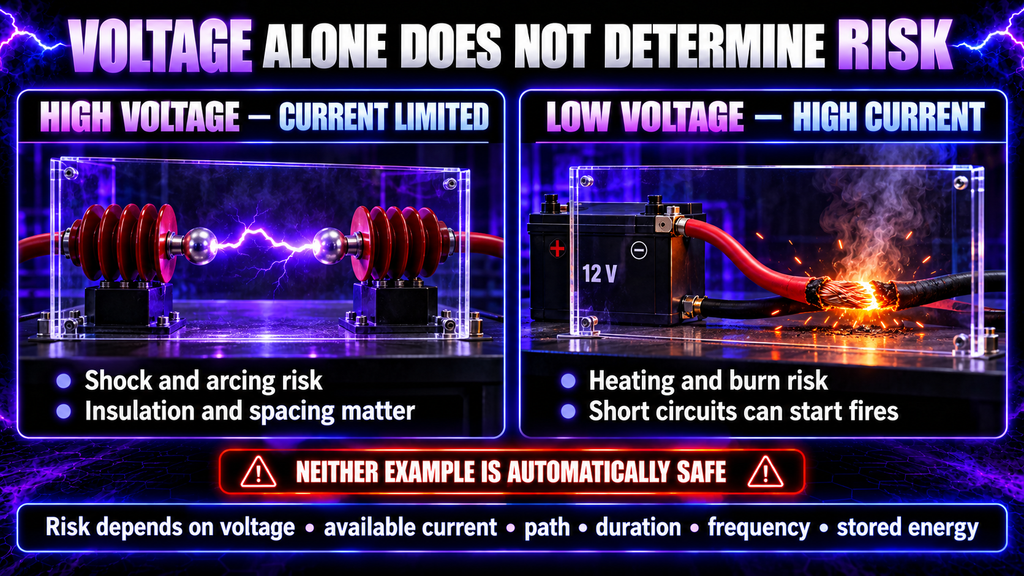
However, “high voltage but low current” must never be used as a general claim that equipment is safe. The current that can pass through a person depends on source impedance, contact, skin condition, path through the body, frequency, duration and voltage. Stored energy and available fault current also matter.
The electrical hazards of a system must be assessed from the complete source and circuit, not from voltage alone.
High Voltage, Low Current Versus Low Voltage, High Current
| Example characteristic | High voltage, current-limited source | Low voltage, high-current source |
|---|---|---|
| Main concern | Shock, arcing, insulation breakdown | Heating, burns, short-circuit fire |
| Possible current | Depends on source impedance and load | Can be extremely large into low resistance |
| Air-gap behaviour | More likely to create corona or sparks | Less likely to bridge the same air gap |
| Cable concern | Insulation and spacing | Conductor cross-section and heating |
| Safe by description alone? | No | No |
A 12 V supply may present relatively low shock risk under dry normal conditions, yet a high-current short circuit can melt wiring, damage components or start a fire.
A high-voltage capacitor bank can retain hazardous energy even after the power supply is disconnected.
How Do Capacitors Store Voltage and Energy?
A capacitor stores separated electric charge. Its capacitance is:
C = Q / V
Rearranged:
Q = CV
The energy stored is:
U = ½CV²
This equation has a crucial implication: for a fixed capacitance, stored energy increases with the square of voltage.
If the voltage doubles, the ideal stored energy becomes four times greater.
Capacitors can remain charged after the supply is switched off. A voltage measurement falling to zero at one point does not guarantee that every capacitor in a complex circuit is discharged.
High-voltage capacitor banks require appropriate bleeder arrangements, discharge procedures, enclosures and verification by a competent person.
Why Does a Spark Gap Need Sufficient Voltage?
Air and other gases normally behave as insulators. If the electric field becomes strong enough, free electrons can accelerate, collide with gas atoms and create additional charged particles.
This process can develop into electrical breakdown and form a conducting plasma channel.
In a simplified uniform gap:
E ≈ V / d
So increasing voltage or reducing distance can increase the average field. Real breakdown also depends on:
- Electrode shape.
- Gas type.
- Gas pressure.
- Surface condition.
- Temperature and humidity.
- Field non-uniformity.
- The waveform and rate of voltage rise.
Sharp points can concentrate the local electric field. Therefore, gap voltage cannot always be predicted reliably from distance alone.
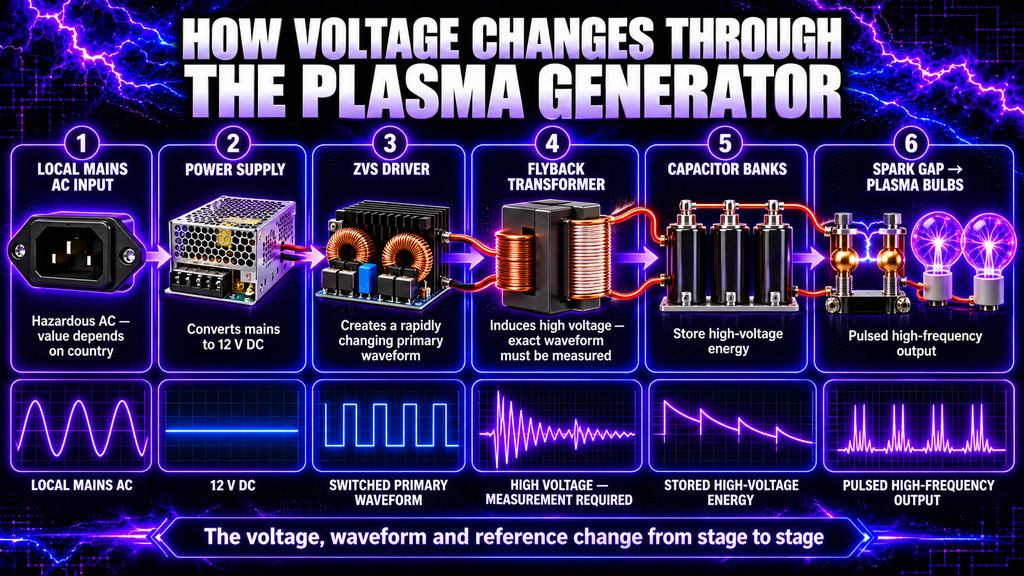
How Voltage Changes Through the High Frequency Plasma Generator
The generator does not contain one single voltage everywhere. Each stage has a different waveform, reference and purpose.
Stage 1: Mains input to the power supply
The enclosed power supply accepts the local mains AC input. Mains voltage is hazardous and should remain isolated behind appropriate covers, wiring practices and protective earthing.
Stage 2: Regulated 12 V DC output
The supply converts mains AC into approximately 12 V DC for the driver. Although this is low voltage, the supply can deliver substantial current, so short circuits, overheating and fire remain important risks.
Stage 3: ZVS switching waveform
The ZVS driver rapidly switches current through the flyback primary winding. The voltage across circuit components is now time-varying rather than simple steady DC.
Stage 4: Flyback secondary high voltage
Changing magnetic flux induces high voltage across the many-turn secondary winding. The exact peak value depends on the transformer, switching waveform, supply, primary turns, resonance, load and measurement method. It should be measured rather than assumed.
Stage 5: Capacitor-bank voltage
The secondary output charges the capacitor banks. Energy accumulates in their electric fields according to U = ½CV².
Stage 6: Spark-gap voltage
Voltage rises across the spark gap until conditions permit breakdown. When the gap conducts, capacitor voltage can collapse rapidly as energy moves into the discharge circuit.
Stage 7: Output and plasma-bulb voltage
The output is pulsed and high frequency, and its voltage depends strongly on load, wiring and coupling to the bulbs. The electric field through the bulb glass helps excite the gas.
It is misleading to quote a precise output voltage without a suitable calibrated high-voltage measurement because the waveform may be fast, pulsed and load-dependent.
Voltage, the Flyback and Turns Ratio
In an ideal conventional transformer:
Vₛ / Vₚ = Nₛ / Nₚ
A secondary with many more turns than the primary can produce a higher voltage.
A flyback system is more complicated than the ideal equation alone. Its output also depends on:
- Switching frequency and waveform.
- Rate of primary-current change.
- Core geometry and material.
- Magnetic coupling.
- Leakage inductance.
- Parasitic capacitance.
- Secondary rectification.
- Output load.
The turns ratio explains part of the voltage transformation, while electromagnetic induction and energy storage describe the complete process more accurately.
Does Higher Frequency Mean Higher Voltage?
Not automatically.
Frequency describes how often a waveform repeats. Voltage describes potential difference.
A circuit can have:
- High frequency and low voltage.
- Low frequency and high voltage.
- High frequency and high voltage.
- Low frequency and low voltage.
In transformers and resonant circuits, changing frequency can alter impedance, losses, coupling and resonance. This may cause voltage to rise or fall, but frequency itself is not voltage.
Measurements must keep the two quantities separate.
What Is Open-Circuit Voltage?
Open-circuit voltage is measured when no external load current is being drawn, apart from the very small current taken by the measuring instrument.
A high-impedance meter may show a significant open-circuit voltage from a source that cannot supply much current. When a load is connected, the voltage may fall substantially.
This can happen because of:
- Internal resistance.
- Leakage.
- Current limiting.
- Transformer regulation.
- Capacitive coupling.
- Measurement pickup from nearby fields.
Open-circuit voltage is useful, but it is not a complete statement of source capability.
What Is a Floating Voltage?
A floating circuit is not intentionally tied to protective earth or another shared reference.
Measuring a floating voltage requires care because attaching an earth-referenced instrument can create a new current path and change the circuit—or cause a dangerous short circuit.
High-voltage transformer secondaries are often floating until connected elsewhere. Their voltage must still be measured between specified points using correctly rated differential or isolated equipment.
Never assume that a floating circuit is safe to touch. Capacitance to earth, stored charge and insulation failure can all create hazards.
How Is Voltage Measured?
Voltage is measured across two points, not inserted in series like a current meter.
Digital multimeter
A multimeter can measure many DC and mains-frequency AC voltages within its category, frequency and voltage ratings.
Oscilloscope
An oscilloscope shows voltage changing over time. It can reveal waveform shape, pulse width, ringing and peak voltage, provided the probe and grounding arrangement are suitable.
High-voltage probe
A properly rated high-voltage probe reduces the measured voltage to a safe level for compatible test equipment. Probe bandwidth, divider ratio, insulation, clearances and maximum ratings must match the source.
Differential or isolated probe
This allows voltage to be measured between two points that are not safely referenced to the oscilloscope’s earth connection.
Non-contact voltage detector
A non-contact detector may indicate the presence of an alternating electric field. It does not provide an accurate voltage measurement and may miss DC or shielded conductors.
A TinySA is a spectrum analyser, not a voltmeter for a high-voltage circuit. It should never be connected directly to the flyback, capacitor banks, spark gap or bulb outputs.
Why High-Frequency Voltage Is Difficult to Measure
High-frequency and pulsed systems challenge ordinary meters because of:
- Limited bandwidth.
- Probe capacitance loading the circuit.
- Fast rise times.
- High peak-to-average ratios.
- Common-mode voltage.
- Radiated pickup.
- Ground-loop errors.
- Insufficient probe insulation or clearance.
The measuring probe becomes part of the circuit. Adding capacitance or a long ground lead can alter resonance and waveform shape.
A displayed number is meaningful only when the instrument, probe, bandwidth, divider ratio, connection method and reference points are documented.
Common Myths About Voltage
Myth 1: Voltage is electricity flowing
False. Voltage is potential difference. Current describes the rate of charge flow.
Myth 2: Voltage exists at only one point
False. A voltage value is always relative to another point or chosen reference.
Myth 3: Zero current means zero voltage
False. An open battery, charged capacitor or disconnected source can have voltage without continuous external current.
Myth 4: High voltage always means high power
False. Power depends on voltage and current. Source impedance and load determine how much current flows.
Myth 5: High voltage with low current is automatically safe
False. Voltage, available current, path, duration, frequency, contact conditions and stored energy all affect risk.
Myth 6: Twelve volts cannot be dangerous in any way
False. Although its shock risk is often lower in dry conditions, a high-current 12 V source can overheat wires, cause burns, create arcs during a short circuit or ignite materials.
Myth 7: A multimeter can measure every voltage
False. Instruments have maximum voltage, measurement-category and frequency limits. Fast high-voltage pulses need specialist equipment.
Myth 8: Frequency and voltage are the same
False. Frequency is cycles per second; voltage is energy difference per unit charge.
Frequently Asked Questions
What is voltage in simple words?
Voltage is the electric potential-energy difference per unit charge between two points.
Why is voltage sometimes called electrical pressure?
The analogy helps show how voltage can drive current through resistance, similar to pressure driving water flow. It is not a complete physical description.
What does one volt mean?
One volt equals one joule of energy per coulomb of charge.
Can voltage exist without current?
Yes. A battery, charged capacitor or open-circuit power supply can maintain voltage even when no external current is flowing.
Can current exist without voltage?
In ordinary resistive circuits, a potential difference is needed to sustain current. Special cases such as persistent current in a superconductor require more advanced explanation.
What is the difference between volts and amps?
Volts measure potential difference. Amps measure how much charge passes a point per second.
What is the difference between volts and watts?
Volts measure potential difference. Watts measure power. Electrical power is voltage multiplied by current.
Does doubling voltage double power?
It depends on the load. For a fixed resistance, P = V²/R, so doubling voltage ideally produces four times the power. Real components may change resistance or fail.
Why is mains voltage quoted as RMS?
RMS expresses the equivalent heating effect of the AC waveform in a resistive load. For a sine wave, peak voltage is √2 times the RMS value.
Does the ZVS driver increase the 12 V supply voltage directly?
The ZVS driver creates rapidly changing primary current. The flyback transformer then uses electromagnetic induction to produce a much higher secondary voltage.
Does the spark gap create the high voltage?
No. The flyback stage generates the high voltage. The capacitors store energy and the spark gap acts as a rapid switch when breakdown occurs.
How much voltage reaches the plasma bulbs?
It should not be guessed from the supply voltage or transformer ratio alone. The output is pulsed and load-dependent and requires correctly rated, calibrated measurement equipment.
Is a non-contact tester an accurate voltage meter?
No. It may indicate an AC electric field, but it cannot reliably state the conductor’s voltage.
Can a capacitor remain dangerous after switch-off?
Yes. A capacitor may retain voltage and stored energy after the input supply has been disconnected.
What Have We Learned?
Voltage is the electric potential difference between two points. It measures how much potential energy changes for each coulomb of charge and is expressed in volts, where one volt equals one joule per coulomb.
Voltage is not current, power or frequency. It can exist without continuous current, while power transfer requires both voltage and current.
Ohm’s law connects voltage, current and resistance for ohmic components. Electric power is P = VI, and capacitors store energy according to U = ½CV².
DC voltage normally maintains one polarity. AC voltage repeatedly changes and reverses polarity. Pulsed voltage requires additional descriptions such as peak amplitude, pulse width, rise time and repetition rate.
In the High Frequency Plasma Generator, the enclosed power supply produces 12 V DC, the ZVS circuit converts that into rapidly changing primary current, and the flyback transformer produces high secondary voltage through induction. The capacitor banks store energy, the spark gap switches it and the output circuit creates the fields that excite the bulbs.
Our next lesson will examine what happens when charge actually moves: electric current.
🧠 Key Takeaways
- Voltage is potential-energy difference per unit charge.
- One volt equals one joule per coulomb.
- Voltage is always measured between two points.
- A chosen ground is a reference, not a universal zero.
- Voltage can exist without continuous current.
- Ohm’s law for an ohmic element is V = IR.
- Electrical power is P = VI.
- DC, AC and pulsed voltage require different descriptions.
- RMS and peak voltage are not the same.
- High voltage does not automatically tell us current or power.
- High-voltage, low-current equipment is not automatically safe.
- Capacitor energy rises with the square of voltage.
- Spark-gap breakdown depends on electric field as well as voltage.
- High-frequency voltage requires correctly rated specialist measurement equipment.
🔬 Voltage Fact
A voltmeter does not measure “how much electricity” is at one probe. It compares the electric potential at one probe with the potential at the other probe.
Continue Your Learning Journey
Previous: Lesson 16 — What Is Electromagnetic Induction?
Next: Lesson 18 — What Is Electric Current? (Coming Soon)
In Lesson 18, we will explore how electric charge moves, what an ampere measures and why current depends on the complete circuit rather than voltage alone.
Further Reading
- OpenStax: Electric Potential and Potential Difference
- OpenStax: Ohm’s Law
- OpenStax: Electrical Energy and Power
- OpenStax: Simple AC Circuits
- OpenStax: Energy Stored in a Capacitor
- NIST: SI Units for Electrical Quantities
- UK Health and Safety Executive: Electrical Safety FAQs
Learn More About High-Frequency Plasma
Explore the High Frequency Plasma Learning Centre for beginner-friendly lessons about plasma, spark gaps, frequency, resonance, ionisation, electric fields, magnetic fields and electromagnetic induction.
For product information, visit the High Frequency Plasma Generator website.
To ask questions and meet other people interested in plasma technology, join the free High Frequency Plasma Community Group on Telegram.
Disclaimer
The information in the High Frequency Plasma Learning Centre is provided for general educational purposes to explain the science, history and engineering of plasma and high-frequency electrical technology.
High-voltage and plasma equipment can cause serious or fatal electrical shock, burns, fire, arcing, electromagnetic interference and equipment damage. Capacitors may retain dangerous voltage and energy after the power has been disconnected. Inductive circuits can produce unexpected voltage transients. This lesson explains scientific principles; it is not a construction, modification, measurement or servicing guide.
Never connect ordinary multimeters, oscilloscopes, spectrum analysers or test leads directly to an unknown high-voltage output. Testing should be performed only by a suitably competent person using equipment correctly rated for the voltage, waveform, frequency and measurement category.
Magnetic and electromagnetic fields can interfere with pacemakers, implanted electronic devices, magnetic storage media and sensitive equipment. People who are pregnant or who use a pacemaker or other implanted electronic device should not operate or remain close to this equipment. Follow the manufacturer’s safety instructions and obtain appropriate professional advice.
The High Frequency Plasma Generator is intended for educational, experimental, research, meditation, relaxation and general wellness purposes only. It is not a medical device and is not intended to diagnose, treat, cure, mitigate or prevent any disease or medical condition.
Always seek advice from a suitably qualified healthcare professional regarding medical concerns.
🎉 Lesson Complete
Congratulations!
You have now completed:
📘 Lesson 17 of 24
What Is Voltage? Potential Difference, Electric Fields and High Voltage Explained
You now understand what voltage measures, how it differs from current and power, and how voltage changes through a high-frequency plasma generator.
Recommended SEO Details
- SEO title: What Is Voltage? Complete Beginner’s Plasma Guide
- Meta description: What is voltage? Learn about volts, potential difference, current, power, AC, DC, capacitors and voltage inside a plasma generator.
- Suggested URL:
/what-is-voltage/ - Focus keyword:
what is voltage - Secondary keywords:
voltage explained,voltage vs current,what is a volt,AC and DC voltage,high voltage explained,voltage in a plasma generator - Suggested hero image: A wide black-and-purple Learning Centre banner showing positive and negative terminals separated by a luminous electric potential landscape, with a voltmeter and violet plasma glow. Main title: “What Is Voltage?” Subtitle: “Electrical Potential Difference Explained.”
Suggested Image Placement and ALT Text
- Hero graphic — place below the title.
ALT: What is voltage lesson showing potential difference between positive and negative terminals. - Energy per charge graphic — place after “Voltage as Energy per Charge.”
ALT: One volt equals one joule of energy per coulomb of electric charge. - Voltage, current and resistance graphic — place after “How Does Voltage Relate to Current?”
ALT: Voltage drives current through resistance according to Ohm’s law. - DC, AC and pulsed voltage graphic — place after “What Is Pulsed Voltage?”
ALT: Comparison of steady DC, alternating AC and pulsed voltage waveforms. - Voltage, current and power safety graphic — place after “High Voltage, Low Current Versus Low Voltage, High Current.”
ALT: Voltage alone does not determine current, power or electrical safety. - Plasma generator voltage stages graphic — place after “How Voltage Changes Through the High Frequency Plasma Generator.”
ALT: Voltage stages from the power supply through the ZVS, flyback, capacitors, spark gap and plasma bulbs.