

Understanding what is high frequency electricity helps explain how traditional plasma generators, Tesla coils and other high-frequency devices operate.
📚 High Frequency Plasma Learning Centre
📘 Lesson 7 of 24
What Is High Frequency Electricity?
Estimated Reading Time: 12–15 Minutes
Difficulty: 🟢 Foundation
🎓 What You’ll Learn
By the end of this lesson you’ll understand:
What frequency means. ✔
How frequency is measured. ✔
The difference between ordinary mains electricity and high frequency electricity. ✔
Why Nikola Tesla became fascinated by high-frequency currents. ✔
How high frequency electricity is produced inside a plasma generator. ✔
Why high frequency electricity plays such an important role in plasma generation. ✔

What Is High Frequency Electricity?
When most people plug an electrical appliance into the wall, they rarely think about the type of electricity powering it. Yet not all electricity behaves in the same way.
One of the most fascinating forms is high frequency electricity, a type of alternating electrical energy that changes direction far more rapidly than the electricity supplied to our homes.
Although the science behind it can seem complex, the basic principles are surprisingly easy to understand.
What Does “Frequency” Mean?
Before learning about high frequency electricity, we first need to understand the meaning of frequency.
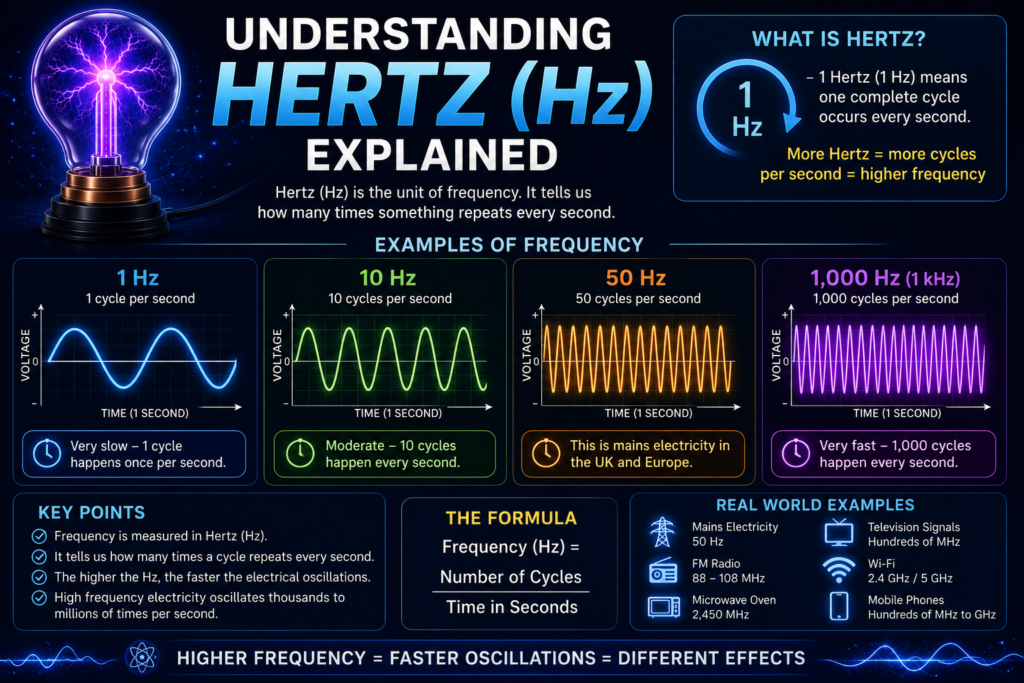
Frequency simply describes how many times something repeats every second.
In electricity, frequency tells us how many times the electrical current changes direction every second.
Frequency is measured in Hertz (Hz).
One Hertz means:
One complete cycle every second.
If something operates at:
- 10 Hz → it changes direction 10 times every second.
- 100 Hz → it changes direction 100 times every second.
- 1,000 Hz (1 kHz) → it changes direction one thousand times every second.
The higher the frequency, the faster the electrical oscillations occur.
The Electricity in Your Home
In the United Kingdom, mains electricity operates at 50 Hertz.
This means the alternating current changes direction 50 times every second.
For everyday appliances such as kettles, televisions, lights and washing machines, this frequency works extremely well.
However, inventors like Nikola Tesla realised that electricity could behave very differently when operated at much higher frequencies.
This discovery led to many fascinating experiments involving electrical discharge, resonance and wireless energy.
What Makes Electricity “High Frequency”?
There is no single frequency at which electricity suddenly becomes “high frequency.”
Instead, the term generally refers to alternating electrical currents that oscillate significantly faster than ordinary mains electricity.
As the frequency increases:
- The electrical waveform repeats more rapidly.
- Oscillations become much faster.
- Different electrical effects become possible.
- New engineering techniques can be used.
Traditional Tesla-inspired spark-gap generators use rapidly oscillating electrical energy to create the conditions needed for plasma generation.
Why Was Nikola Tesla Interested in High Frequency Electricity?
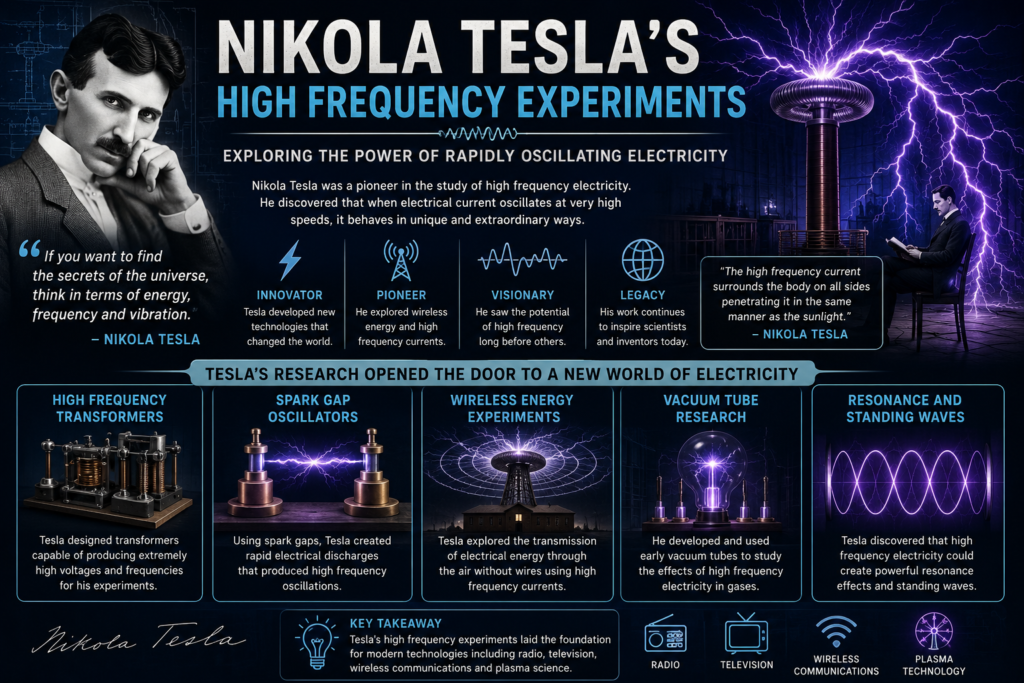
During the late 1800s, Nikola Tesla became one of the world’s leading pioneers in high-frequency electrical research.
Rather than focusing only on power transmission, Tesla investigated how rapidly oscillating electrical currents behaved.
His research included:
- High-frequency transformers.
- Electrical resonance.
- Wireless power transmission.
- Spark-gap oscillators.
- Vacuum tubes.
- Gas discharge experiments.
Many of these ideas continue to inspire educational demonstrations and experimental high-frequency devices today.
High Frequency Electricity Inside a Plasma Generator
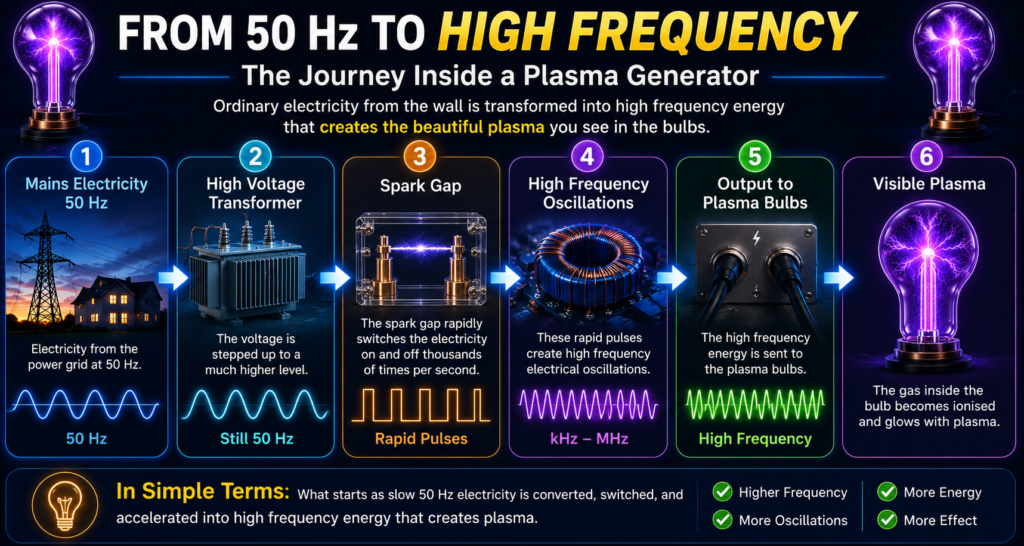
Inside a traditional spark-gap plasma generator, mains electricity is only the starting point.
The electrical energy is transformed through several stages before it reaches the plasma bulbs.
A simplified journey looks like this:
50 Hz Mains Electricity
↓
High Voltage Circuit
↓
Spark Gap
↓
High Frequency Oscillations
↓
Plasma Bulbs
↓
Visible Plasma
Each stage plays an important role in producing the glowing plasma seen inside the bulbs.
Why Does High Frequency Electricity Behave Differently?
One of the most interesting characteristics of high frequency electricity is that it behaves differently from the ordinary electricity used to power our homes.
Although both are forms of alternating current (AC), increasing the frequency changes how the electrical energy behaves within circuits and electrical components.
As the frequency increases:
- The electrical current changes direction much more rapidly.
- Oscillations occur much faster.
- Different electrical effects become possible.
- Electrical energy can interact with specialised components in new ways.
These properties are one of the reasons Nikola Tesla devoted so much of his research to high-frequency electrical currents during the late nineteenth century.
What Are Electrical Oscillations?
Throughout this Learning Centre you’ve probably noticed the word oscillations appearing several times.
But what exactly does it mean?
An oscillation is simply a repeated movement backwards and forwards.
In electricity, an oscillation describes the continual change in the direction of the electrical current.
At 50 Hz, the current changes direction 50 times every second.
At much higher frequencies, those changes occur thousands—or even millions—of times every second.
These incredibly rapid oscillations are a defining characteristic of high frequency electricity.
Understanding Wavelength
Frequency and wavelength are closely related.
A simple way to imagine this is by thinking of waves travelling across the surface of water.
If only a few waves pass each second, each wave is long and widely spaced.
If many waves pass every second, each wave becomes much shorter.
Exactly the same principle applies to electrical waves.
- Lower frequency → longer wavelength.
- Higher frequency → shorter wavelength.
This relationship is fundamental to many areas of science and engineering, including radio communication, wireless technology and plasma generation.
How High Frequency Electricity Creates Plasma
In a traditional spark-gap plasma generator, high frequency electricity performs an important role.
The spark gap rapidly switches electrical energy, creating high-frequency oscillations.
These oscillations travel through the output circuit to the plasma bulbs.
Inside the sealed bulbs, the rapidly changing electrical field energises the low-pressure gas.
As the gas becomes ionised, it enters the plasma state and begins to emit visible light.
This transformation from electrical energy to glowing plasma is one of the most fascinating demonstrations of high-frequency electrical physics.

Common Myths About High Frequency Electricity
Myth 1 – High Frequency Means High Voltage
Not necessarily.
Voltage and frequency are two different electrical properties.
A system can have a high voltage, a high frequency, both, or neither.
Myth 2 – High Frequency Electricity Is a Different Type of Electricity
It isn’t.
High frequency electricity is still alternating current.
The difference lies in how rapidly the current changes direction.
Myth 3 – Frequency Measures Electrical Power
Frequency does not measure power.
It measures how many complete cycles occur every second.
Power depends on several other electrical factors, including voltage and current.
Frequently Asked Questions
What Is High Frequency Electricity?
High frequency electricity is alternating electrical current that changes direction much faster than ordinary household mains electricity.
How Is Frequency Measured?
Frequency is measured in Hertz (Hz).
One Hertz represents one complete electrical cycle every second.
What Is the Frequency of UK Mains Electricity?
In the United Kingdom, standard mains electricity operates at 50 Hz, meaning the current changes direction 50 times every second.
Why Did Nikola Tesla Study High Frequency Electricity?
Tesla believed that rapidly oscillating electrical currents could reveal new scientific principles and practical applications.
His pioneering research into resonance, spark gaps, transformers and electrical discharge phenomena continues to influence science and engineering today.
Why Is High Frequency Electricity Used in Plasma Generators?
High frequency oscillations create the electrical conditions needed to ionise the gas inside plasma bulbs, allowing visible plasma to form.
Summary
High frequency electricity is one of the most fascinating areas of electrical science.
Although it begins with the same basic principles as ordinary alternating current, increasing the frequency dramatically changes the way electricity behaves.
From radio communications and wireless technology to scientific research and plasma generators, high-frequency electrical energy has shaped many of the technologies we use today.
Understanding what is high frequency electricity provides an important foundation for learning how plasma generators, spark gaps and ionised gases work together to produce visible plasma.
🧠 Key Takeaways
Frequency describes how many electrical cycles occur every second. ✔
Frequency is measured in Hertz (Hz). ✔
UK mains electricity operates at 50 Hz. ✔
High frequency electricity changes direction much more rapidly. ✔
High-frequency oscillations are essential in traditional spark-gap plasma generators. ✔
Nikola Tesla’s research helped expand our understanding of high-frequency electrical phenomena. ✔
Continue Your Learning Journey
⬅ Previous Lesson
Why Are Plasma Bulbs Used?
Learn how gas inside plasma bulbs becomes ionised and why it glows with beautiful visible plasma.
➡ Next Lesson
Understanding Frequency – Hz, kHz & MHz Explained
In the next lesson, we’ll explore the different units used to measure frequency, what they mean, and how to easily convert between Hertz, kilohertz and megahertz.
Disclaimer
The information contained within the High Frequency Plasma Learning Centre is provided for educational purposes to explain the science, history and engineering of plasma technology.
The High Frequency Plasma Generator is intended for educational, experimental, research, meditation, relaxation and personal wellness purposes only.
It is not a medical device and is not intended to diagnose, treat, cure, mitigate or prevent any disease or medical condition.
Always seek advice from a suitably qualified healthcare professional regarding medical concerns.
🎉 Lesson Complete
Congratulations!
You have now completed:
📘 Lesson 7 of 24
What Is High Frequency Electricity?
You now understand how frequency is measured, how high-frequency electricity differs from standard mains electricity, why Nikola Tesla devoted years to studying it, and how rapidly oscillating electrical energy plays a central role in creating plasma.
50Hz A.C. changes/alternates direction 100 times per second.
50Hz(50 complete cycles per second) A.C. alternates or changes direction 100 times per second which means in one complete cycle the A.C. alternates or changes direction twice.