
📚 High Frequency Plasma Learning Centre
📘 Lesson 2 of 24
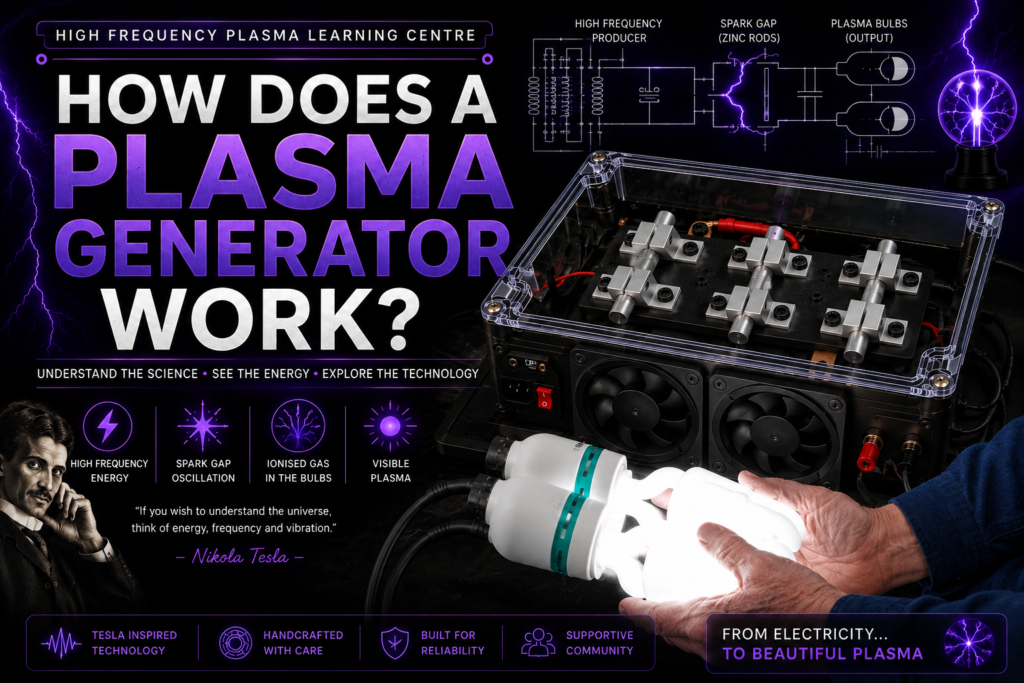
If you’ve ever watched a plasma bulb glowing with beautiful streams of coloured light, you may have wondered how does a plasma generator work and how such an impressive effect is created.
Although high frequency plasma generators can appear mysterious at first, the science behind them is surprisingly logical. These machines convert ordinary electrical power into rapidly oscillating high-frequency electrical energy. That energy is then used to ionise the gas inside specially designed plasma bulbs, producing the glowing plasma that has fascinated scientists and engineers for well over a century.
Modern high frequency plasma generators are inspired by the pioneering experiments of Nikola Tesla, who devoted much of his career to exploring high-frequency electricity, resonance, electrical discharge, and wireless energy transmission.
In this lesson, you’ll learn exactly how does a plasma generator work, the role of each component inside the machine, and how these parts work together to produce visible plasma.
Every Plasma Generator Begins With Electricity
Every plasma generator starts with a source of electrical energy.
Although the machine produces high-frequency electrical energy internally, it first needs an ordinary power source to begin the process.
Once the machine is switched on, electrical energy enters the generator and is directed towards the high-frequency circuitry.
From this point onwards, the machine begins transforming that incoming electrical power into something completely different.
Instead of producing the familiar 50 Hz alternating current used in homes throughout the UK, the generator creates rapidly oscillating electrical energy capable of exciting the gas inside the plasma bulbs.
This transformation is what makes plasma generators so fascinating.
The Main Parts of a Plasma Generator
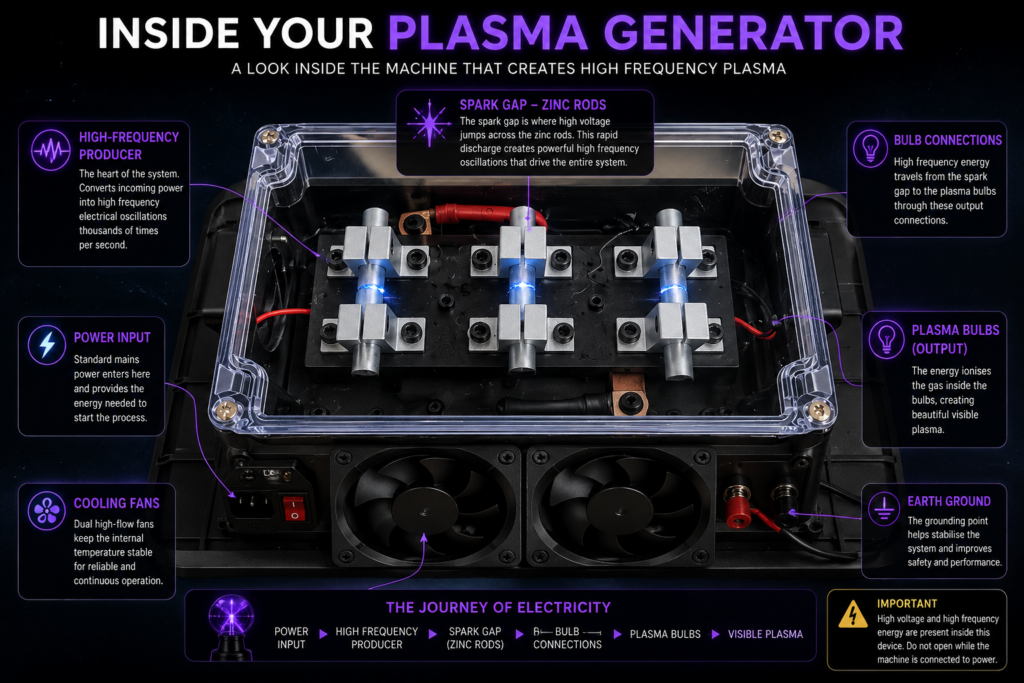
Although different builders use different designs, most traditional spark-gap plasma generators contain five main sections. These sections need to be understood to understand fully on “how does a plasma generator work”
These are:
- High Frequency Producer
- Spark Gap Generator
- Plasma Output Bulbs
- Cooling System
- Electrical Controls
Each part performs an important role.
Let’s look at them individually.
The High Frequency Producer
The high frequency producer is often described as the heart of the machine.
Its purpose is to generate rapidly oscillating electrical energy.
Rather than simply passing household electricity directly to the plasma bulbs, the high frequency producer converts the incoming power into electrical oscillations that are far more suitable for plasma generation.
Without this stage, the plasma effect would not occur.
This section determines many of the electrical characteristics that make Tesla-inspired plasma technology unique.
The Spark Gap Generator
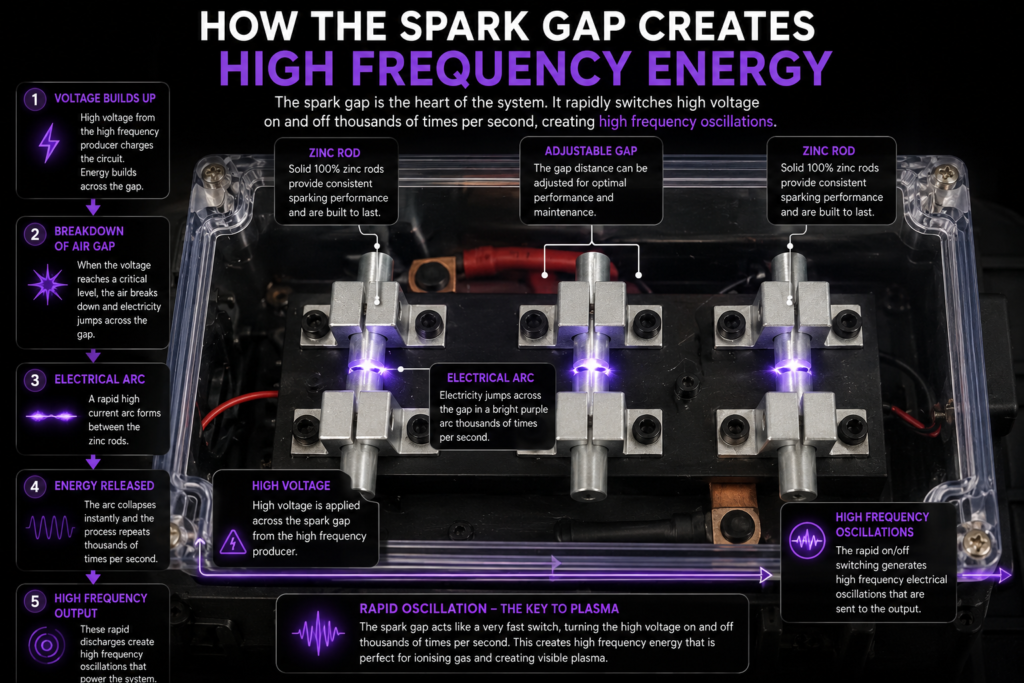
To explain how does a plasma generator work One of the most important features of a traditional plasma generator is the spark gap.
When the machine is operating, you’ll hear a characteristic buzzing or crackling sound.
This sound comes from thousands of tiny electrical discharges occurring every second.
As electrical energy builds, the voltage eventually becomes high enough to jump across a small air gap between two electrodes.
This sudden electrical discharge releases energy extremely quickly.
The process repeats continuously while the machine is operating.
These rapid discharges create the oscillations needed for plasma generation.
Spark-gap technology was widely used during the early years of radio engineering and also appeared in many of Nikola Tesla’s experimental systems.
Although modern electronics can produce high-frequency energy using semiconductor devices, many enthusiasts continue to appreciate traditional spark-gap systems because of their simplicity, historical significance, and distinctive operating characteristics.
Why My Machine Uses Adjustable Zinc Spark Gap Rods
The spark gap is one of the most important parts of the machine and is crucial in explaining how does a plasma generator work, so careful attention has been given to its design.
Rather than permanently sealed electrodes, my plasma generators use adjustable 100% zinc spark-gap rods.
This provides several practical engineering advantages.
Easy Maintenance
The spark gap can be inspected and maintained without dismantling the entire machine.
Adjustable Operation
Owners can adjust the spacing between the rods when routine maintenance is required.
Replaceable Components
Because the rods are accessible, replacement is straightforward if they eventually wear after extended use.
Reliable Construction
The design focuses on simplicity and long-term serviceability.
One of my design philosophies has always been that owners should understand how their machine works rather than being unable to access important components.
What Happens After the Spark Gap?
Once the spark gap begins operating, the rapidly oscillating electrical energy is directed towards the plasma output circuit.
At this point the machine is producing high-frequency electrical energy that is very different from ordinary household electricity.
This energy travels through the cables connected to the plasma bulbs.
The bulbs themselves contain specially selected gases sealed inside glass.
As the electrical field reaches the bulb, something remarkable begins to happen.
Inside the Plasma Bulbs
The plasma bulbs are one of the most visually striking parts of the entire machine.
Although they appear simple from the outside, a fascinating process is taking place inside the glass.
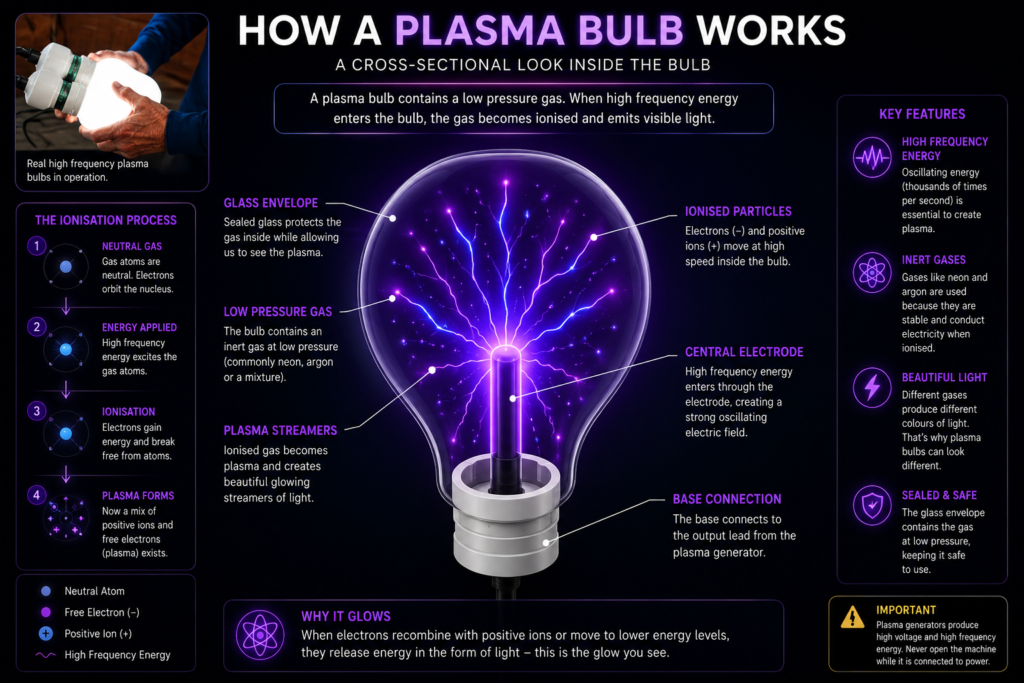
Each bulb contains a carefully sealed gas at low pressure.
When exposed to the high-frequency electrical field produced by the generator, the gas becomes energised.
Some of the atoms inside the gas lose electrons.
This process is known as ionisation.
Once ionisation begins, the gas changes into plasma.
Because plasma contains charged particles, it can conduct electricity far more effectively than an ordinary gas.
As these particles interact and release energy, visible light is emitted.
This is the beautiful glowing plasma that makes these devices so distinctive.
In Lesson 3 we’ll explore plasma itself in much greater detail, including why it is often called the fourth state of matter.
Why Do Plasma Bulbs Glow?
Many people assume the glass itself is glowing.
In reality, it is the ionised gas inside the bulb that produces the light.
Different gases emit different colours when energised.
This is why plasma globes, neon signs, and scientific discharge tubes often display different colours.
The colour depends on the gas used and the energy supplied.
The glass simply allows us to observe the plasma safely.
Why Cooling Matters
High-frequency electrical systems naturally generate heat.
For reliable operation, many plasma generators include cooling fans.
These help circulate air through the enclosure and remove excess heat from key components.
Keeping the internal temperature under control helps maintain stable operation and prolongs the life of the electronic components.
My machines incorporate dedicated cooling fans as part of their design so they can operate reliably during normal use.
How Does Electricity Become Visible Plasma?
One of the most fascinating aspects to cover when explaining how does a plasma generator work is actually watching electrical energy being transformed into visible plasma.
Although the process happens almost instantly, several important stages occur inside the machine.
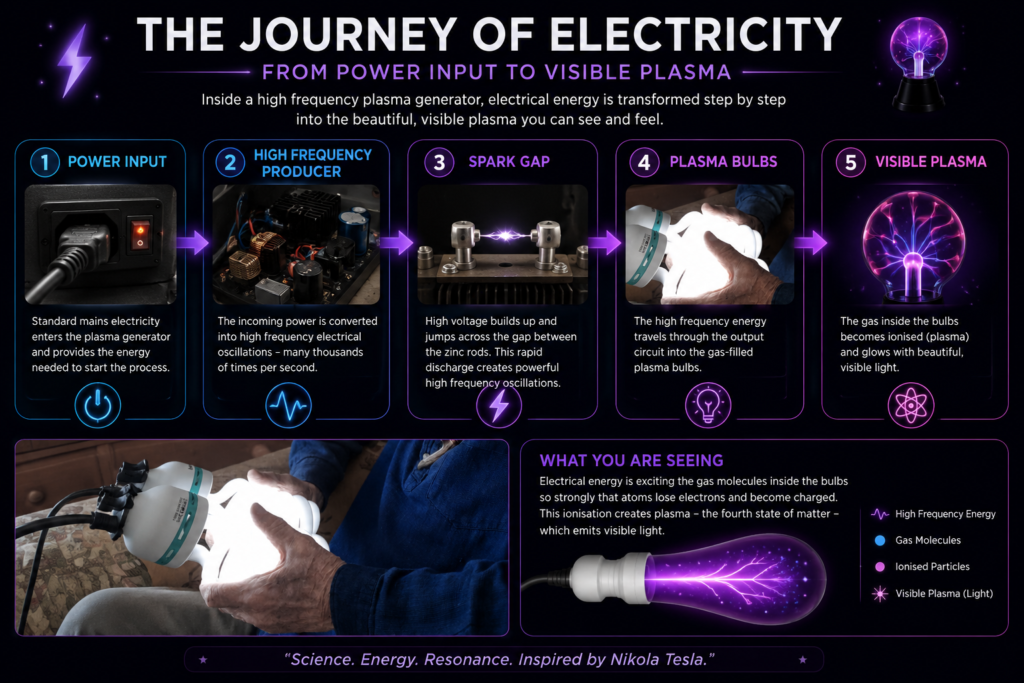
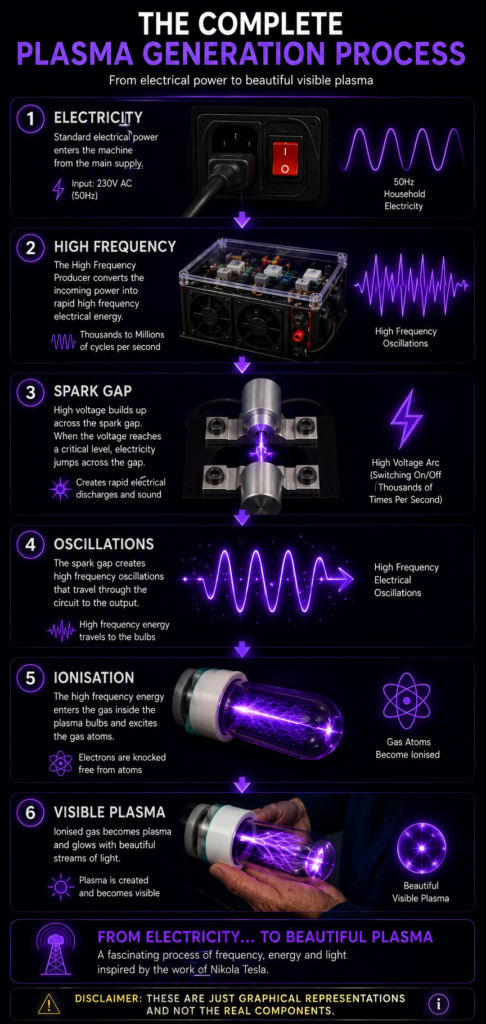
Step 1 – Electrical Power Enters the Machine
The process begins when the machine is connected to a standard electrical supply.
At this stage, the electricity is simply providing the energy needed to operate the generator.
It has not yet become the high-frequency electrical energy required to create plasma.
Step 2 – The High Frequency Producer Begins Operating
The incoming electrical power is fed into the high frequency producer.
This section of the machine transforms ordinary electrical power into rapidly oscillating electrical energy.
Instead of operating at the standard 50 Hz used by household electricity in the UK, the electrical energy is converted into much higher-frequency oscillations that are suitable for exciting gases inside the plasma bulbs.
This conversion is one of the key reasons why plasma generators behave so differently from ordinary electrical appliances.
Step 3 – The Spark Gap Starts Oscillating
As the voltage increases, the spark gap begins to operate.
Electrical energy repeatedly jumps across the small gap between the zinc electrodes.
These rapid electrical discharges occur many times every second and generate the distinctive buzzing or crackling sound associated with traditional spark-gap equipment.
The spark gap acts as a fast electrical switch, creating rapidly changing electrical oscillations that help produce the high-frequency energy required for plasma generation.
This style of spark-gap oscillator has its roots in the pioneering work of Nikola Tesla and early wireless radio technology.
Step 4 – High Frequency Energy Travels to the Plasma Bulbs
Once the oscillating electrical energy has been produced, it travels from the generator to the plasma output bulbs.
Although the bulbs appear to be simple glass tubes, they have been specially designed to contain gas at a carefully controlled pressure.
The electrical field produced by the generator surrounds the gas inside the bulb.
As the energy increases, the gas begins to ionise.
Step 5 – Plasma Is Produced
When enough atoms become ionised, the gas changes into plasma.
This plasma allows electrical energy to move through the bulb in beautiful glowing streams that can be observed through the glass.
The result is the spectacular display that has fascinated scientists, engineers and enthusiasts for generations.
Why Every Plasma Generator Is Different
Although many plasma generators follow similar principles, no two builders produce identical machines.
Some differences include:
- Circuit design
- Spark-gap construction
- Cooling arrangements
- Component quality
- Accessibility for maintenance
- Overall build philosophy
This is one of the reasons why researching a builder before purchasing a machine is worthwhile.
Good engineering is often found in the small details.
Why I Designed My Plasma Generator This Way
When designing my own High Frequency Plasma Generator, my aim was not simply to build another plasma machine.
I wanted to create a system that was reliable, easy to maintain, and straightforward for owners to understand.
Some of the features I deliberately included are:
Adjustable Spark Gap
The spark gap can be adjusted and maintained easily rather than being permanently enclosed.
100% Zinc Spark Gap Rods
I chose solid zinc rods because they provide consistent spark characteristics while remaining simple to replace and maintain.
Plug-and-Play Operation
The machine has been designed so that new owners can begin using it without complicated assembly or technical setup.
Handcrafted Construction
Each unit is individually assembled and tested rather than being mass-produced on an automated production line.
Ongoing Customer Support
Every owner receives access to my private Telegram community where they can ask questions, learn more about the technology and connect with other enthusiasts.
For me, the support after purchase is just as important as the machine itself.
Frequently Asked Questions
Is a Plasma Generator the Same as a Cosmetic Plasma Device?
No.
Cosmetic plasma devices used in aesthetic treatments operate using different principles and are designed for entirely different applications.
The machine described in this Learning Centre uses high-frequency electrical energy to generate visible plasma inside specially designed gas-filled bulbs.
Why Does the Spark Gap Make a Buzzing Noise?
The buzzing sound is produced by thousands of rapid electrical discharges occurring across the spark gap.
It is a normal characteristic of traditional spark-gap technology.
Why Do the Plasma Bulbs Glow?
The glow comes from the ionised gas inside the bulb.
As excited atoms return to lower energy states, they emit light that becomes visible through the glass.
Can the Spark Gap Be Adjusted?
Yes.
One of the advantages of my design is that the spark gap is fully accessible and adjustable, making routine maintenance straightforward.
Why Are Zinc Rods Used?
The zinc rods are an engineering choice.
They are easy to maintain, simple to replace, and provide consistent sparking characteristics.
Why Are Cooling Fans Installed?
High-frequency electrical systems naturally generate heat during operation.
Cooling fans help remove this heat and maintain reliable performance.
How Long Do Plasma Bulbs Last?
The lifespan of plasma bulbs depends on factors such as operating time, usage patterns and handling.
With normal use and careful handling, they can provide many hours of operation.
Summary
A high frequency plasma generator works by converting ordinary electrical power into rapidly oscillating electrical energy.
This energy passes through a spark-gap assembly before travelling to specially designed gas-filled plasma bulbs.
Inside the bulbs, the electrical field ionises the gas, creating visible plasma that glows with beautiful streams of light.
Although the process may appear complex, each stage follows well-established electrical principles that have fascinated engineers for more than a century.
Understanding how each component contributes to plasma generation helps explain why these machines continue to capture the interest of people around the world.
Continue Your Learning Journey
⬅ Previous Lesson
📘 Lesson 1 of 24
What Is High Frequency Plasma?
Learn the fundamentals of plasma, the fourth state of matter, and discover how Nikola Tesla inspired modern plasma technology.
➡ Next Lesson
What Is Plasma?
Discover why plasma is called the fourth state of matter, how it forms, and why it is found throughout the universe.
Related Lessons
Continue exploring the High Frequency Plasma Learning Centre:
- What Is a Spark Gap?
- Why Does My Machine Use Zinc Rods?
- Why Are Plasma Bulbs Used?
- What Is High Frequency Electricity?
- Tesla’s High Frequency Experiments Explained
Disclaimer
This Learning Centre has been created to explain the engineering, history and operation of Tesla-inspired high-frequency plasma technology.
The High Frequency Plasma Generator is intended for educational, experimental, research, relaxation and personal wellness purposes only.
It is not a medical device and is not intended to diagnose, treat, cure or prevent any disease or medical condition.
Always seek advice from a suitably qualified healthcare professional regarding any medical concerns.
🎉 Lesson Complete
Congratulations!
You have now completed:
📘 Lesson 2 of 24
How Does a Plasma Generator Work?
You’re building a solid understanding of Tesla-inspired plasma technology.
In the next lesson, we’ll explore What Is Plasma?, where you’ll learn why plasma is known as the fourth state of matter, how it is created, and why it makes up most of the visible universe.