
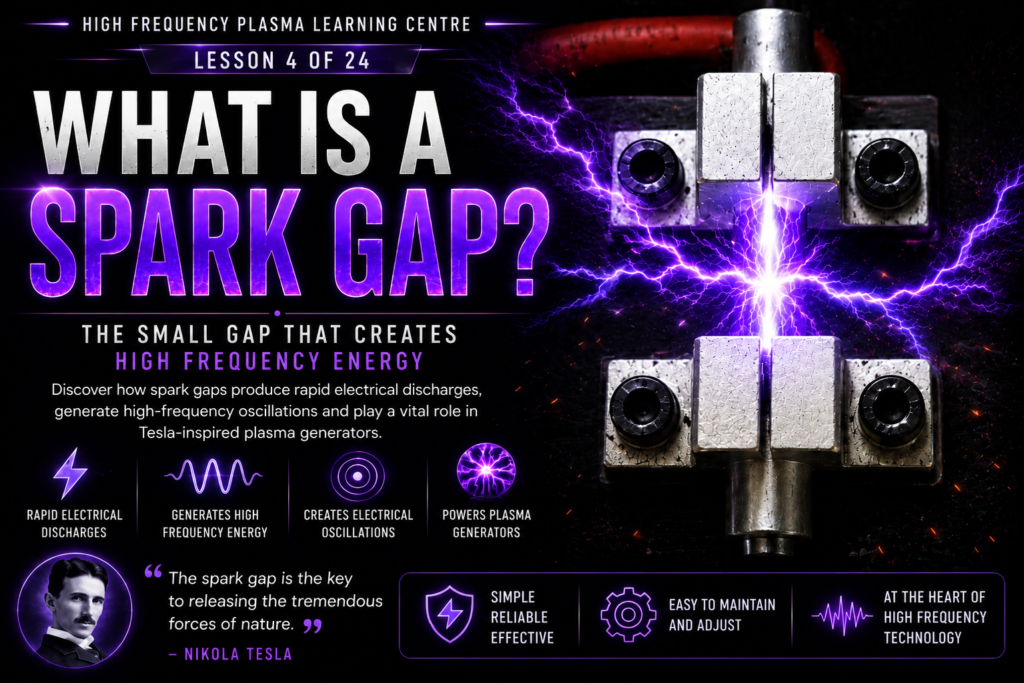
What is a spark gap? If you’ve ever looked inside a traditional high frequency plasma generator, you’ve probably noticed a pair of metal rods separated by a very small gap.
📚 High Frequency Plasma Learning Centre
📘 Lesson 4 of 24
What Is a Spark Gap?
Estimated Reading Time: 12–15 Minutes
Difficulty: 🟢 Foundation
When the machine is operating, brilliant electrical sparks repeatedly jump across this gap, producing the distinctive buzzing sound associated with Tesla-inspired equipment.
So, what is a spark gap?
A spark gap is one of the simplest yet most important components found in many traditional high-frequency electrical systems. Its job is to allow electricity to jump across a carefully controlled air gap once the voltage becomes high enough.
Each time this happens, a brief electrical discharge is created. These rapid discharges help generate the high-frequency oscillations used in Tesla-style electrical circuits.
Although modern electronics often use semiconductor switches, spark gaps remain popular in traditional Tesla-inspired designs because of their simplicity, durability and historical significance.
The History of the Spark Gap
The spark gap played a vital role in the early development of electrical engineering.
During the late nineteenth century, inventors such as Nikola Tesla and Guglielmo Marconi used spark-gap technology in experiments involving wireless communication and high-frequency electricity.
Tesla devoted much of his research to understanding how rapidly changing electrical currents behaved.
His work with transformers, resonant circuits and spark gaps helped lay the foundations for many later developments in radio technology and high-voltage engineering.
While modern electronic switching methods are now common, spark gaps remain closely associated with Tesla’s pioneering experiments.
How Does a Spark Gap Work?
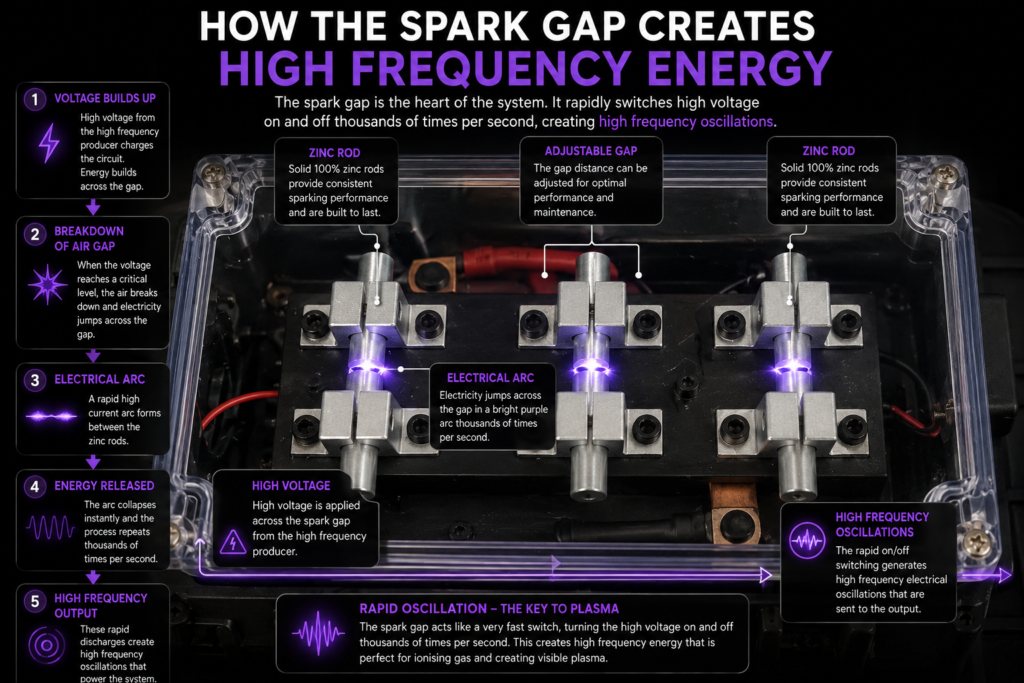
Although the effect looks dramatic, the operating principle is straightforward.
The two electrodes are positioned a short distance apart.
Under normal conditions, the air between them acts as an insulator.
As voltage builds, the electrical field between the electrodes becomes stronger.
Eventually, the air can no longer resist the voltage.
At that moment, the air becomes ionised.
A bright electrical arc jumps across the gap.
The voltage then falls.
The air returns to being an insulator.
The process immediately repeats.
This rapid cycle occurs many times every second, producing both the visible sparks and the characteristic buzzing sound.
Why Doesn’t Electricity Jump All the Time?
One question many beginners ask is why the spark doesn’t remain continuous.
The answer lies in the behaviour of air.
Air is normally an excellent electrical insulator.
Only when the electrical field becomes strong enough does the air break down and temporarily conduct electricity.
Once the voltage falls again, the air quickly regains its insulating properties.
This repeating cycle creates thousands of rapid electrical discharges.
Why Spark Gaps Produce High Frequency Oscillations
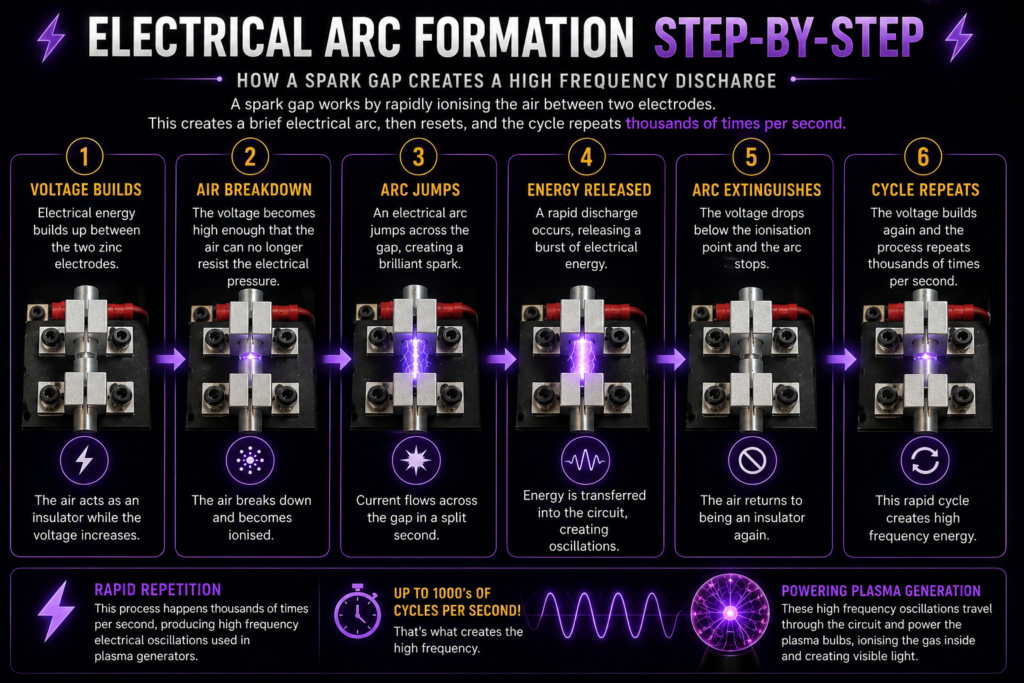
The spark gap acts like an extremely fast electrical switch.
Each time the arc forms and extinguishes, energy stored within the circuit is rapidly released.
Combined with inductors and capacitors in the circuit, these rapid switching events create oscillations at much higher frequencies than ordinary mains electricity.
These oscillations are an essential part of traditional Tesla-inspired plasma generators.
Why My Plasma Generator Uses Adjustable Zinc Rods
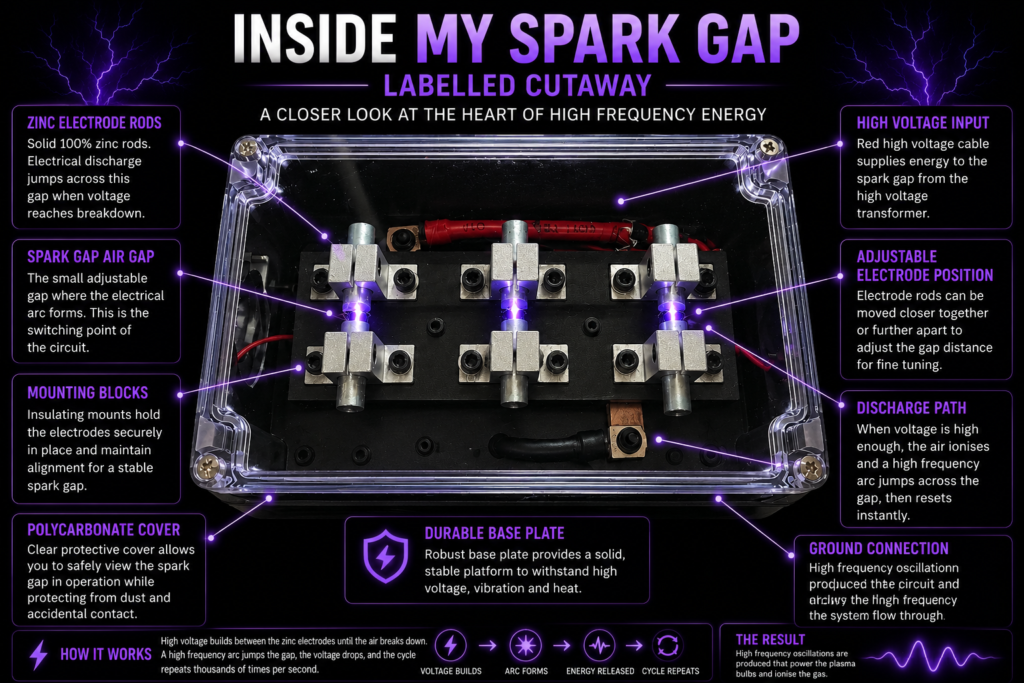
One of the design features of my High Frequency Plasma Generator is the use of adjustable spark gap electrodes made from solid zinc.
This allows the spark gap spacing to be inspected, adjusted and maintained when necessary.
Rather than sealing the spark gap permanently inside the machine, I wanted owners to have easy access for routine inspection and maintenance.
Adjustable electrodes also allow fine tuning of the gap as the rods gradually wear through normal use.
Why Zinc?
Different builders choose different electrode materials depending on their design goals.
I chose solid zinc rods because they are easy to maintain and replace, allowing the spark gap to continue operating consistently over time.
As with any spark-gap system, the electrodes naturally experience wear from repeated electrical discharges, so being able to replace or adjust them is a practical feature of the design.

Fixed vs Adjustable Spark Gaps
Not all spark gaps are built in the same way.
Some high-frequency devices use a fixed spark gap, where the distance between the electrodes is permanently set during manufacture.
Others, like my High Frequency Plasma Generator, use an adjustable spark gap, allowing the spacing between the zinc electrodes to be changed.
This gives the user greater control over the operation of the spark gap and makes routine maintenance much easier.
Fixed Spark Gaps
A fixed spark gap has a permanently set electrode spacing.
Advantages include:
- Simple construction
- Consistent operation
- No adjustment required
- Suitable for sealed equipment
However, because the spacing cannot be changed, there is little opportunity for tuning if the electrodes wear over time.
Adjustable Spark Gaps
An adjustable spark gap allows the electrode spacing to be altered by moving the zinc rods closer together or further apart.
Small adjustments can change the voltage required before the electrical arc forms, which in turn influences how the spark gap operates within the overall high-frequency circuit.
The exact effect depends on the complete design of the generator, including the transformer, capacitors, inductance and operating conditions.
This is one reason many enthusiasts appreciate adjustable spark gaps—they provide flexibility for maintenance and careful tuning.
Why Spark Gap Adjustment Matters
The spark gap acts as the switching point of the circuit.
Before each spark occurs, electrical energy builds between the electrodes.
When the voltage becomes high enough, the air breaks down and the spark jumps across the gap.
Changing the gap distance changes the conditions under which this breakdown occurs.
Depending on the design of the generator, careful adjustment may influence:
- The voltage required before the spark forms
- The timing of the discharge
- The behaviour of the oscillating circuit
- The appearance of the spark
- The overall operating characteristics of the plasma generator
Because every design is different, adjustments should be made gradually and with care.
Spark Gap Maintenance
One advantage of an accessible spark gap is that it can be inspected regularly.
Every electrical discharge removes a microscopic amount of material from the electrode surfaces.
After many hours of operation, the rods may develop small pits or deposits.
Routine inspection helps ensure reliable operation.
Typical maintenance includes:
- Checking the condition of the zinc rods
- Keeping the electrode faces clean
- Verifying that the gap spacing remains consistent
This straightforward maintenance is one reason I chose a design that gives owners easy access to the spark gap.
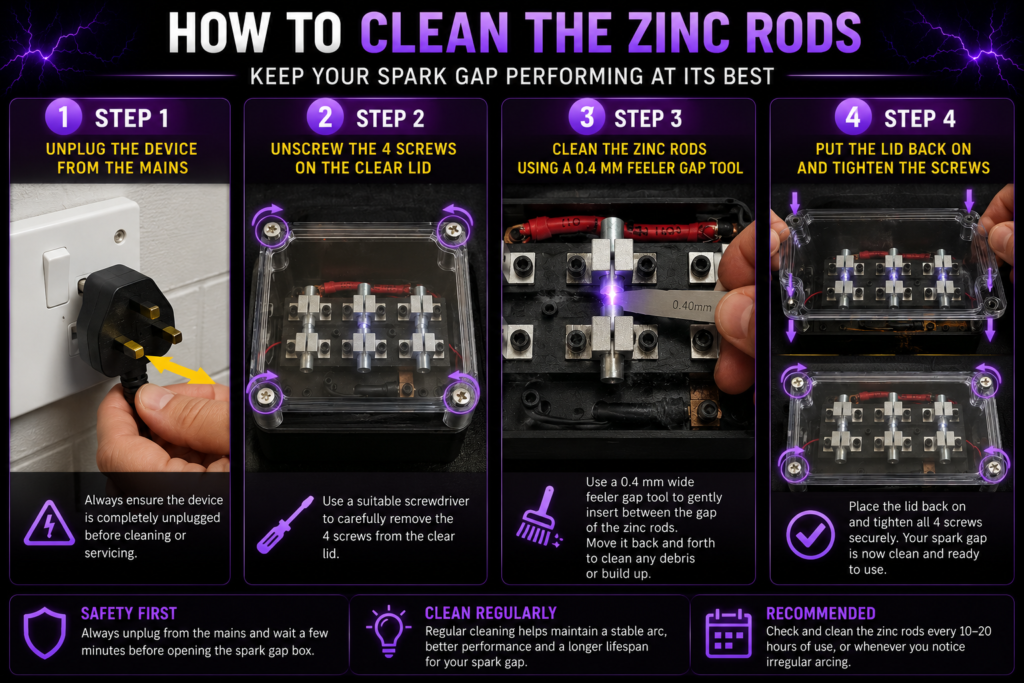
Why I Use 100% Zinc Rods
The spark gap in my High Frequency Plasma Generator uses solid zinc rods.
The rods are designed to be:
- Easy to inspect
- Easy to adjust
- Easy to replace
- Simple to maintain
This practical design means owners do not need to replace the entire spark gap assembly if the electrodes eventually wear through normal operation.
Instead, routine maintenance can help keep the generator operating consistently for years.
Common Spark Gap Myths
As with many areas of high-voltage engineering, there are several common misconceptions.
Myth 1 – Bigger Sparks Always Mean Better Performance
A larger visible spark does not automatically mean a better-performing circuit.
Spark appearance is only one part of a much larger electrical system.
Myth 2 – Spark Gaps Never Wear Out
Every spark removes a tiny amount of material from the electrodes.
Over time, all spark gaps experience wear and benefit from periodic inspection.
Myth 3 – Any Metal Will Perform Exactly the Same
Different electrode materials have different electrical and physical properties.
Many builders experiment with various materials depending on the characteristics they are seeking.
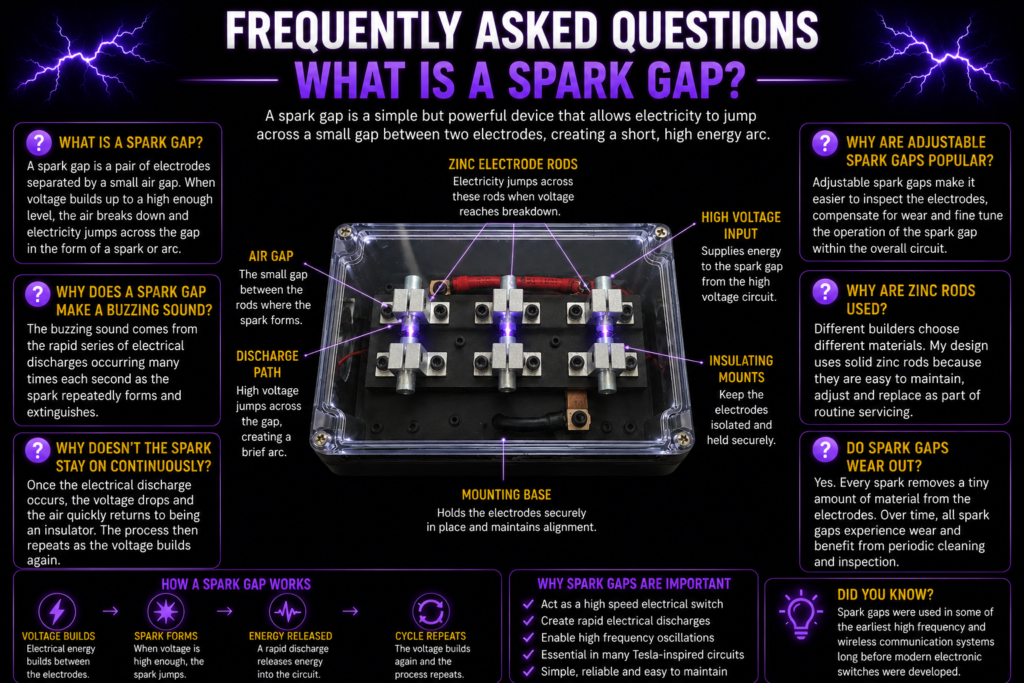
Frequently Asked Questions
What Is a Spark Gap?
A spark gap is a pair of electrodes separated by a small air gap. When the voltage becomes high enough, electricity jumps across the gap, creating a brief electrical discharge.
Why Does a Spark Gap Make a Buzzing Sound?
The buzzing sound comes from the rapid series of electrical discharges occurring many times each second as the spark repeatedly forms and extinguishes.
Why Doesn’t the Spark Stay On Continuously?
Once the electrical discharge occurs, the voltage falls and the air quickly returns to being an insulator. The process then repeats as the voltage builds again.
Why Are Adjustable Spark Gaps Popular?
Adjustable spark gaps make it easier to inspect the electrodes, compensate for normal wear and fine-tune the operation of the spark gap within the overall circuit.
Why Are Zinc Rods Used?
Different builders choose different electrode materials. My design uses solid zinc rods because they are easy to maintain, adjust and replace as part of routine servicing.
Summary
The spark gap is one of the defining components of traditional Tesla-inspired high-frequency equipment.
Although its operation appears simple, it performs a vital role by repeatedly creating controlled electrical discharges that allow the oscillating circuit to function.
From Nikola Tesla’s pioneering experiments to modern high-frequency plasma generators, the spark gap has remained an important part of electrical engineering history.
Understanding how it works provides a deeper appreciation of the science taking place inside every high-frequency plasma generator.
🧠 Key Takeaways
A spark gap acts as a very fast electrical switch ✔
Electrical energy builds until the air breaks down. ✔
The resulting spark creates a rapid electrical discharge. ✔
The process repeats many times each second. ✔
Adjustable spark gaps make maintenance and tuning easier. ✔
My plasma generator uses adjustable 100% zinc rods for simple servicing. ✔
Spark gaps remain one of the most recognisable features of Tesla-inspired high-frequency technology. ✔
🔬 Spark Gap Fact
Did you know?
Long before modern electronic switching devices existed, spark gaps were used in some of the earliest high-frequency experiments and wireless communication systems. Although today’s electronics often use semiconductor switches, the spark gap remains an iconic component of classic Tesla-inspired equipment.

Continue Your Learning Journey
⬅ Previous Lesson
What Is Plasma?
Learn why plasma is called the fourth state of matter and how ionised gases create the beautiful glowing effects seen in plasma devices.
➡ Next Lesson
Why Does My Machine Use Zinc Rods?
Discover why electrode material matters, how zinc performs inside a spark gap, and why easy maintenance was an important part of my design.
Disclaimer
The information contained within the High Frequency Plasma Learning Centre is provided for educational purposes to explain the history, science and engineering of plasma technology.
The High Frequency Plasma Generator is intended for educational, experimental, research, meditation, relaxation and personal wellness purposes only.
It is not a medical device and is not intended to diagnose, treat, cure, mitigate or prevent any disease or medical condition.
Always seek advice from a suitably qualified healthcare professional regarding medical concerns.
🎉 Lesson Complete
Congratulations!
You have now completed:
📘 Lesson 4 of 24
What Is a Spark Gap?
You now understand how spark gaps create rapid electrical discharges, why they are central to traditional high-frequency electrical systems, and why adjustable zinc electrodes are an important feature of this style of plasma generator.
In the next lesson, we’ll take a closer look at one specific component of the spark gap and answer the question:
Why Does My Machine Use Zinc Rods?