What Is Resonance? If you’ve ever pushed a child on a swing, you’ve already seen it in action.
📚 High Frequency Plasma Learning Centre
📘 Lesson 9 of 24
Estimated Reading Time: 12 Minutes
Difficulty: 🟢 Beginner
What You’ll Learn
By the end of this lesson you’ll understand:
What resonance is. ✔
What natural frequency means. ✔
Why some objects vibrate more strongly than others. ✔
Everyday examples of it. ✔
Why engineers studied it. ✔
Why Nikola Tesla became fascinated by it. ✔
How it relates to high-frequency plasma technology. ✔
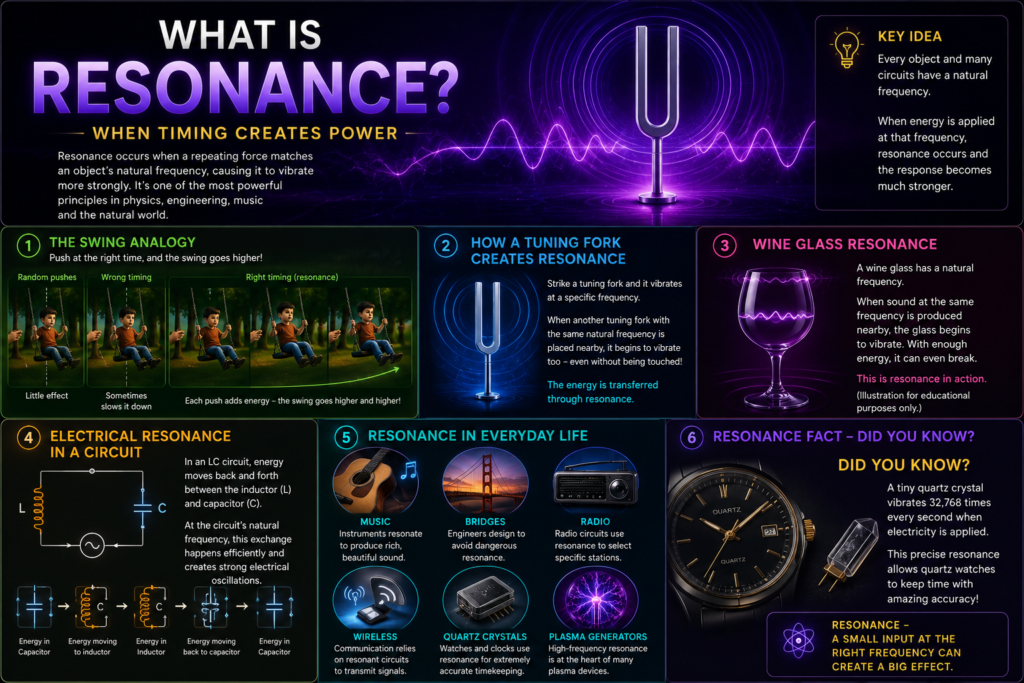
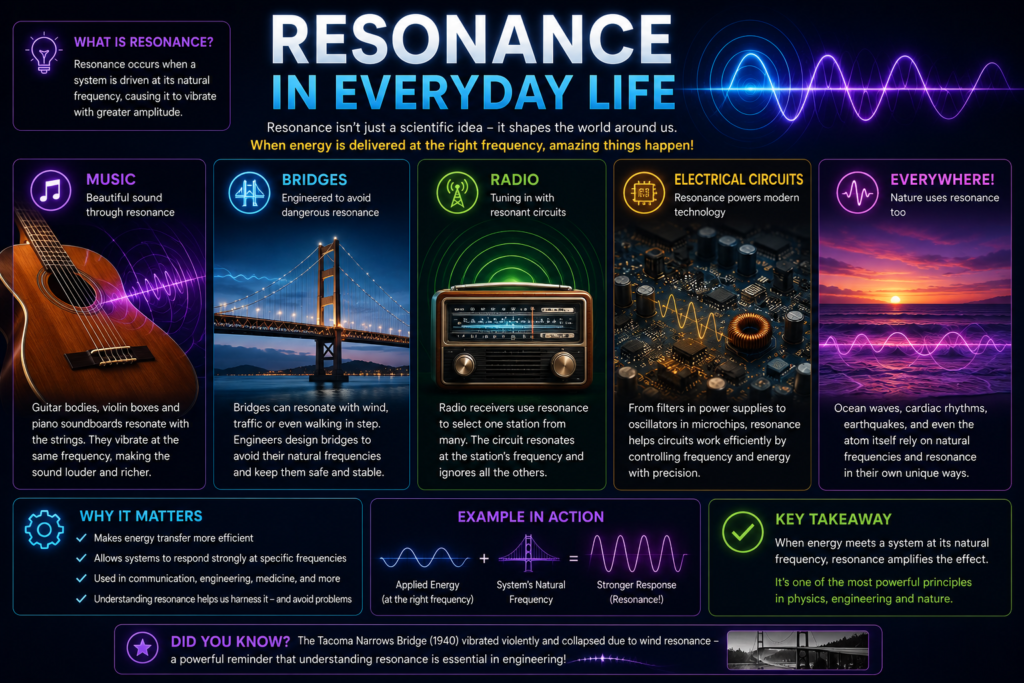
Resonance is one of the most fascinating principles in physics, yet it can be understood with a very simple idea.
It occurs when a repeating force matches an object’s natural frequency, causing it to vibrate more strongly.
Instead of fighting against the movement, each push adds a little more energy at exactly the right moment.
The result is a much larger motion with surprisingly little effort.
This simple principle appears throughout nature, music, engineering and electrical systems.
Understanding what is resonance is an important step in understanding how waves, oscillations and many electrical devices behave.
Understanding Natural Frequency
Every object has what scientists call a natural frequency.
This is the rate at which it naturally prefers to vibrate.
Examples include:
- A guitar string.
- A tuning fork.
- A wine glass.
- A bridge.
- A building.
- An electrical circuit.
Even if two objects appear similar, they may have different natural frequencies depending on their size, shape and material.
When energy is applied at the right frequency, resonance can occur.
The Swing Example
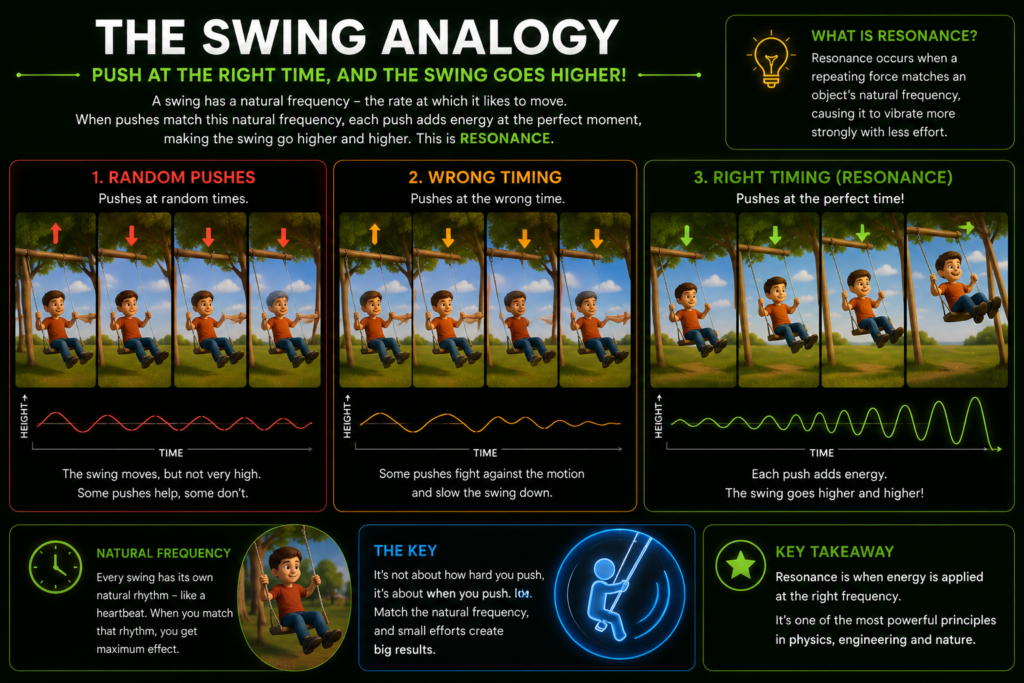
Imagine a child sitting on a playground swing.
If you push the swing at random times, it won’t move very efficiently.
Sometimes your pushes will help.
Sometimes they’ll actually slow the swing down.
However, if you push at exactly the right moment every time, each push adds more energy to the swing.
It climbs higher and higher while requiring very little extra effort.
This is resonance.
The timing of the pushes matches the swing’s natural frequency.
Resonance Is All Around Us
Although it may sound like a complicated scientific term, it appears in everyday life.
Examples include:
🎵 Musical instruments
🔔 Bells
🍷 Crystal glasses
🌉 Bridges
🏢 Buildings
📡 Radio circuits
⚡ Electrical systems
🌊 Ocean waves
Wherever something vibrates, it may play a role.
Why Does Resonance Matter?
It can be both useful and important.
Engineers often design systems to make use of it because it allows energy to be transferred efficiently.
Examples include:
- Musical instruments producing rich sounds.
- Radio receivers selecting specific frequencies.
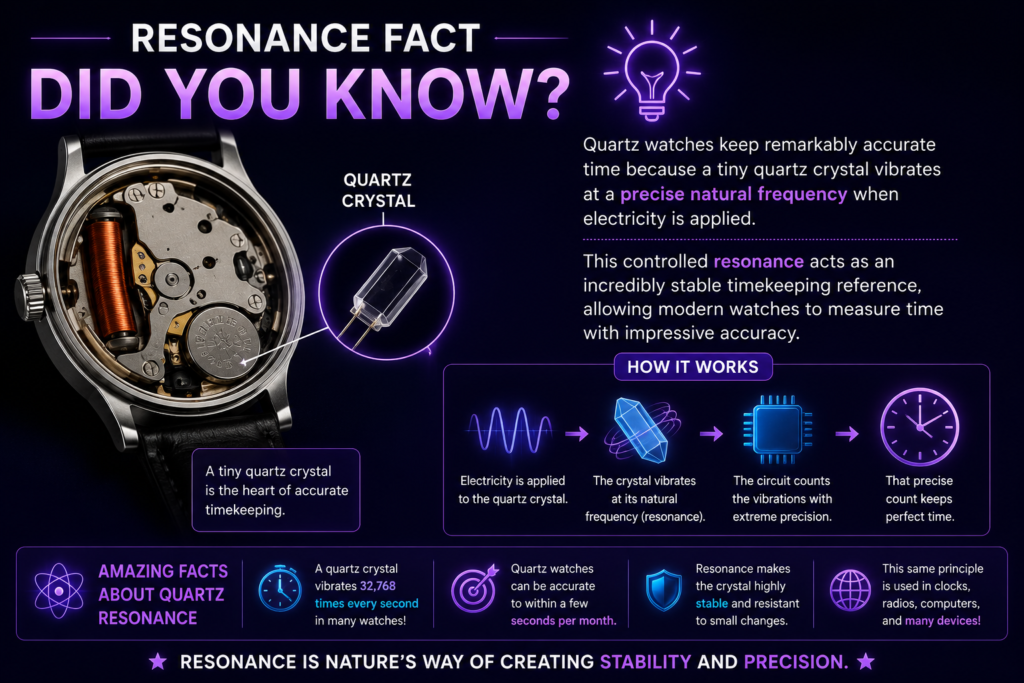
- Quartz crystals keeping accurate time in watches.
- Scientific equipment detecting tiny signals.
At the same time, engineers also need to understand resonance to avoid unwanted vibrations in structures and machines.
Knowing when it can occur helps engineers design safer and more reliable equipment.
Resonance and Nikola Tesla
Few inventors explored it as passionately as Nikola Tesla.
Tesla believed that understanding resonance was essential to understanding electricity and energy.
Throughout his experiments with high-frequency electrical systems, Tesla investigated how electrical circuits could be made to resonate, allowing energy to move efficiently through carefully designed components.
Many of his demonstrations involved tuned electrical circuits operating at specific resonant frequencies.
His pioneering work continues to influence electrical engineering today.
Mechanical vs Electrical Resonance
When people first learn what it is, they often think only about physical objects moving back and forth. While this is certainly one type of resonance, the same principle also exists in electrical systems.
Mechanical Resonance
It occurs when physical objects vibrate at their natural frequency.
Examples include:
- A child on a swing.
- A tuning fork.
- A guitar string.
- A church bell.
- A wine glass.
- A suspension bridge.
When the timing of an external force matches the object’s natural frequency, the vibrations become larger and more noticeable.

Electrical Resonance
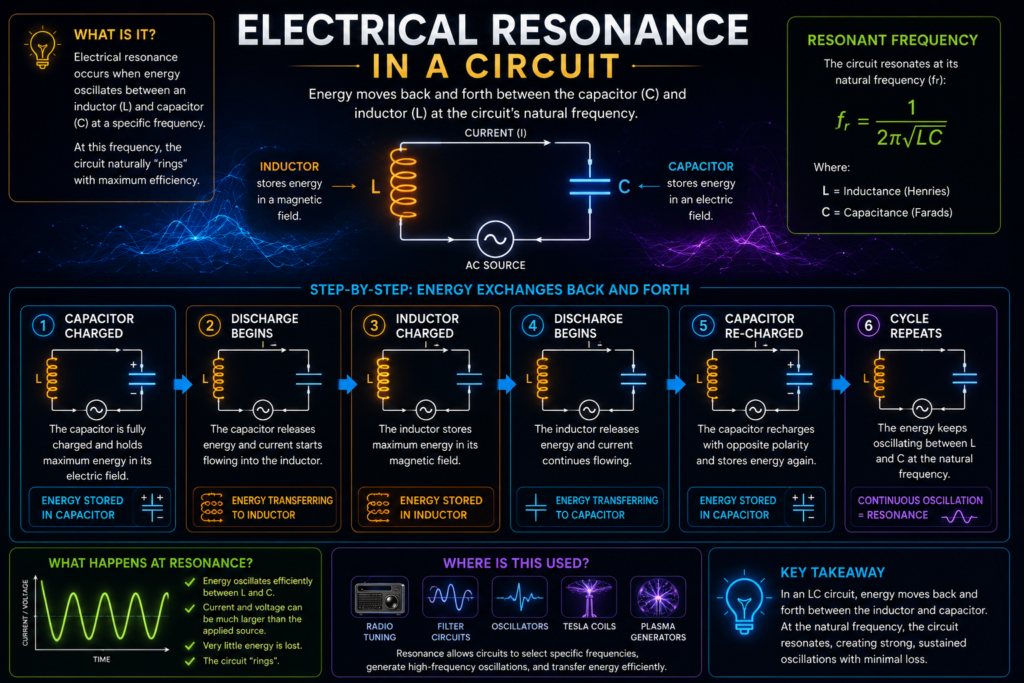
It follows exactly the same principle, but instead of physical movement, energy oscillates within an electrical circuit.
Rather than objects moving backwards and forwards, electrical energy repeatedly transfers between different components, creating a continuous oscillation.
This principle is used in many technologies, including:
- Radio receivers.
- Television transmitters.
- Wireless communication systems.
- Scientific instruments.
- High-frequency electrical equipment.
Although the movement cannot usually be seen, the underlying idea is the same: energy is repeatedly exchanged at a preferred frequency.
Resonance in Electrical Circuits
Electrical engineers often use specially designed circuits that naturally resonate at particular frequencies.
These circuits typically contain components that store and release electrical energy in a repeating cycle.
When these components are correctly matched, energy moves smoothly back and forth through the circuit, creating electrical oscillations.
This behaviour allows circuits to become highly selective, responding most strongly to particular frequencies while rejecting others.
That is why it plays such an important role in radio communications, signal processing and many areas of electronics.
Why Resonance Matters in High Frequency Plasma Technology
As you’ve progressed through the High Frequency Plasma Learning Centre, you’ve already discovered that a plasma generator contains several key stages:
- Electrical power enters the generator.
- High-frequency energy is produced.
- The spark gap rapidly switches the electrical energy.
- Plasma is created inside the bulbs.
Resonance is one of the scientific principles that helps explain how oscillating electrical systems behave.
Traditional spark-gap circuits naturally generate rapidly changing electrical oscillations, and understanding it provides valuable background knowledge for appreciating how these systems function.
In future lessons, we’ll explore electrical oscillations in greater detail and see how it became one of Nikola Tesla’s favourite areas of research.
Why Engineers Study Resonance
It can be extremely useful when it is understood and controlled.
Engineers deliberately use it in many applications, including:
- Musical instruments.
- Radio tuning circuits.
- Quartz crystal clocks.
- Medical imaging equipment.
- Wireless communication systems.
- Scientific measuring instruments.
At the same time, engineers also work hard to prevent unwanted resonance.
If large structures resonate unexpectedly, excessive vibrations can develop over time.
This is why buildings, bridges, aircraft and vehicles are carefully designed and tested to avoid operating at problematic resonant frequencies.
Understanding what it is allows engineers to both harness its benefits and minimise potential problems.
Common Myths About Resonance
Myth 1 – It Only Happens in Musical Instruments
Not at all.
Although musical instruments are excellent examples, resonance occurs throughout nature, engineering and electronics.
Myth 2 – It Always Means Something Dangerous
No.
Most examples of resonance are completely harmless and incredibly useful.
Many everyday technologies rely on it to function efficiently.
Myth 3 – Resonance Is Complicated
The science behind it can become advanced, but the basic idea is remarkably simple.
Whenever something is repeatedly driven at its natural frequency, its response becomes stronger.
That simple principle explains countless natural and engineered systems.
Frequently Asked Questions
What Is Resonance?
It occurs when a repeating force matches an object’s natural frequency, causing larger vibrations or oscillations.
What Is a Natural Frequency?
A natural frequency is the frequency at which an object or system naturally prefers to vibrate.
Does Resonance Only Apply to Physical Objects?
No.
It occurs in both mechanical systems and electrical circuits.
Why Did Nikola Tesla Study Resonance?
Tesla recognised that it allowed electrical energy to move efficiently within carefully designed circuits, making it a key principle in many of his experiments with high-frequency electricity.
Is Resonance Used Today?
Yes.
Modern electronics, communications, engineering and scientific equipment all make use of it in various ways.
Summary
It is one of the most important concepts in physics and engineering.
Although it may sound technical, the underlying idea is surprisingly simple.
Every object and many electrical systems have a natural frequency.
When energy is applied at exactly the right rate, it occurs, producing a much stronger response.
From playground swings and musical instruments to electrical circuits and modern communications, it appears throughout the world around us.
Understanding what is resonance provides another important piece of the puzzle as you continue learning about high-frequency plasma technology.
🧠 Key Takeaways
Every vibrating system has a natural frequency. ✔
Resonance occurs when energy is applied at that natural frequency. ✔
Resonance exists in both mechanical and electrical systems. ✔
Engineers use resonance in many everyday technologies. ✔
Nikola Tesla’s work helped advance our understanding of electrical resonance. ✔
Resonance is an important foundation for understanding high-frequency plasma technology. ✔
🔬 Resonance Fact
Did you know?
Quartz watches keep remarkably accurate time because a tiny quartz crystal vibrates at a precise natural frequency when electricity is applied. This controlled resonance acts as an incredibly stable timekeeping reference, allowing modern watches to measure time with impressive accuracy.
Continue Your Learning Journey
⬅ Previous Lesson
What Is Frequency? (Hz, kHz & MHz Explained)
Learn how frequency is measured, what Hertz means and why frequency is fundamental to understanding electricity, waves and plasma technology.
➡ Next Lesson
What Are Electrical Oscillations?
Discover how electrical energy repeatedly moves through circuits, creating oscillations that form the foundation of high-frequency electrical systems and traditional spark-gap plasma generators.
Disclaimer
The information contained within the High Frequency Plasma Learning Centre is provided for educational purposes to explain the science, history and engineering of plasma technology.
The High Frequency Plasma Generator is intended for educational, experimental, research, meditation, relaxation and general wellness purposes only.
It is not a medical device and is not intended to diagnose, treat, cure, mitigate or prevent any disease or medical condition.
Always seek advice from a suitably qualified healthcare professional regarding medical concerns.
🎉 Lesson Complete
Congratulations!
You have now completed:
📘 Lesson 9 of 24
What Is Resonance? A Beginner’s Guide to Understanding Resonance
You now understand what resonance is, how natural frequency influences vibrating systems, why resonance is important in both mechanical and electrical engineering, and why it became such an important area of study for Nikola Tesla.