Resonant frequency therapy is a broad and sometimes confusing term for using sound, vibration, electricity, magnetic fields or radio-frequency energy in an attempt to produce a response in the body. It does not describe one standard treatment, one machine or one accepted medical speciality.
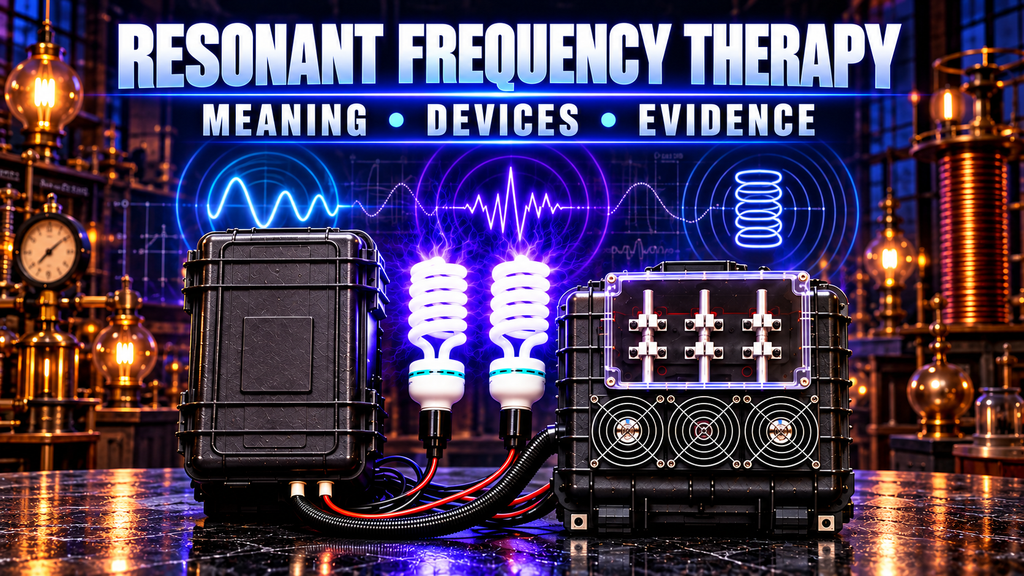
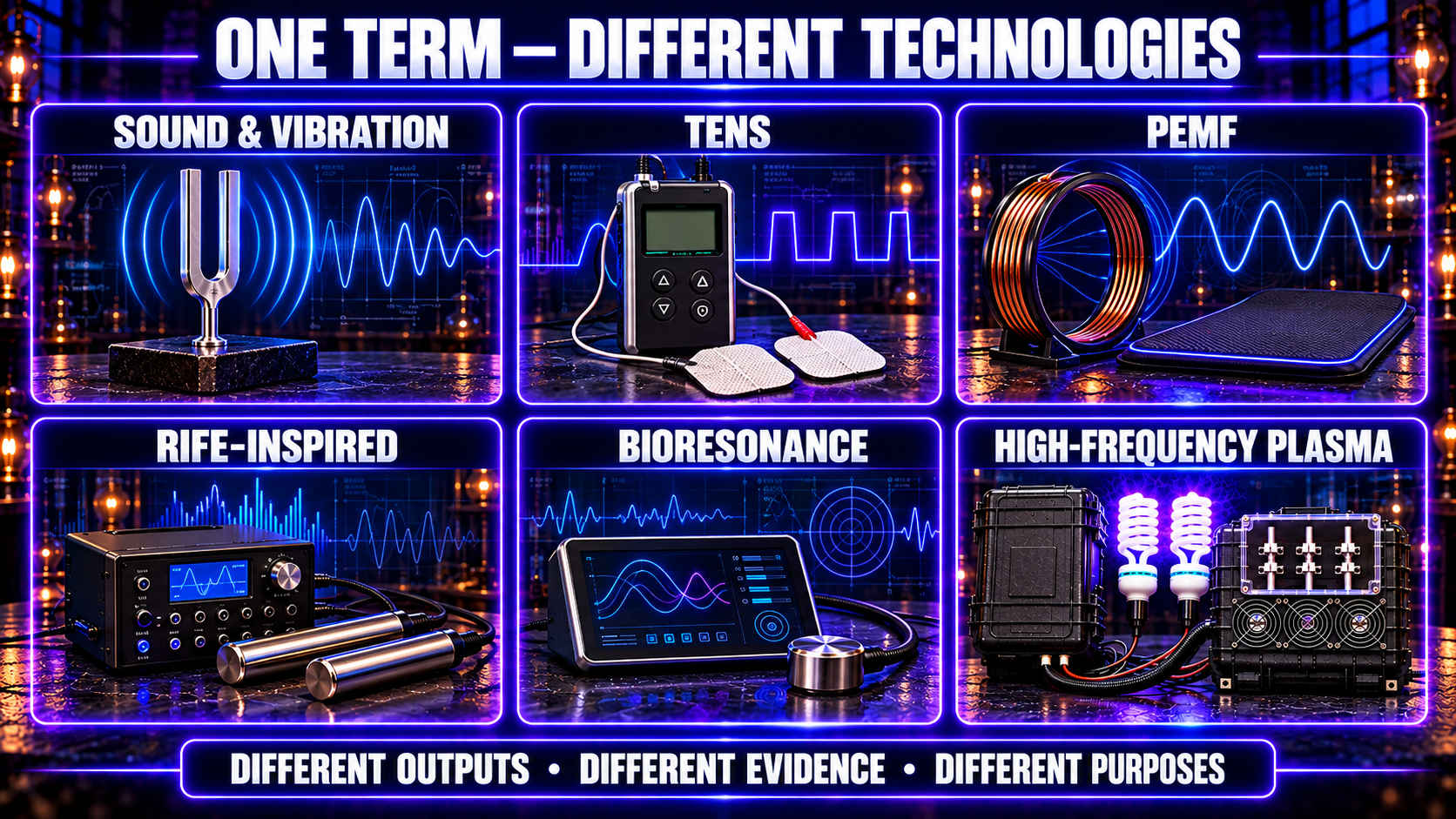
That distinction matters. A tuning fork, vibroacoustic bed, TENS unit, PEMF mat, Rife-inspired generator and high-frequency plasma machine can all be promoted with words such as frequency or resonance, yet they create different forms of energy and interact with the user in different ways. Evidence for one cannot be transferred to another simply because their marketing uses similar language.
This guide explains the physics behind resonance, the history of the phrase, the main devices people encounter and what research and UK advertising guidance actually say. It then shows where my handcrafted High Frequency Plasma Generator fits: a Tesla-inspired spark-gap system for education, experimentation, meditation, relaxation and general wellness—not a medical device or programmable treatment machine.
What Is Resonant Frequency Therapy?
In physics, frequency is the number of times a repeating event occurs each second, measured in hertz. Resonance occurs when a repeating input matches or approaches a system’s natural frequency, allowing energy to build more efficiently.
A playground swing provides a simple example. Random pushes may add or remove energy. Push at the right point in every cycle and the movement becomes larger. Electrical circuits can also resonate. In a circuit containing inductance and capacitance, energy moves between magnetic and electric fields at a preferred rate.
You can explore the foundation in my Learning Centre guide, What Is Resonance?.
The phrase adds a therapeutic idea to that physical principle. It may refer to:
- acoustic vibration from sound or music;
- mechanical vibration delivered through a chair, table or platform;
- electrical current passed through skin electrodes;
- pulsed magnetic fields generated by coils;
- programmed Rife-style electrical or radio-frequency signals;
- bioresonance testing and feedback systems; or
- high-frequency resonant circuits that illuminate plasma bulbs.
These are not different names for one process. Ask what energy is generated, at what output, how it reaches the user and what evidence supports that use.
Where Did the Term Come From?
Sound, vibration, electrical stimulation and high-frequency currents have each been explored during different periods of medicine and engineering.
The exact phrase appears in James E. Bare’s US Patent 5,908,441, “Resonant Frequency Therapy Device”, filed in 1997. It describes an audio oscillator, RF transmitter and amplifier, tuning equipment and a plasma-tube antenna in the Rife/Bare tradition.
A patent records an invention and its claims; it is not a clinical trial or regulatory approval and does not demonstrate that a device can diagnose or cure disease.
Royal Raymond Rife is associated with claims that particular frequencies could affect microorganisms. Modern Rife-inspired products use electrodes, coils or an RF carrier connected to a gas tube. They should not be assumed to reproduce one historical instrument or possess proven disease programmes.
Nikola Tesla’s work involved high-voltage, high-frequency electricity, transformers and resonant circuits. Tesla engineering and Rife claims are often blended online, although their apparatus and aims differed.
The Main Types of Frequency and Resonance Devices
The clearest way to understand the market is to compare how each device creates and transfers energy.
| Device type | Main output | How it reaches the user | What distinguishes it |
|---|---|---|---|
| Tuning forks and sound tools | Audible sound and mechanical vibration | Through air, touch or a resonating surface | Simple acoustic experience; no electrical field required |
| Vibroacoustic chair or bed | Low-frequency sound vibration | Speakers or transducers in furniture | The user hears and physically feels sound |
| TENS or electrical stimulation | Low-voltage electrical pulses | Adhesive skin electrodes | Direct contact current with controlled intensity |
| PEMF machine | Pulsed magnetic field | Coil, mat, pad, paddle or ring | Magnetic output; often has selectable pulse programmes |
| Rife-inspired generator | Programmed electrical or modulated RF signals | Electrodes, coils or plasma tube | Usually emphasises selectable numerical frequencies |
| Bioresonance system | Purported measurement and corrective signals | Sensors, hand contacts or electrodes | Claims to analyse or balance body “frequencies” require robust evidence |
| High-frequency plasma generator | Resonant high-voltage oscillations and visible plasma | Gas-filled bulbs coupled to the output circuit | Spark-gap operation, audible discharge and illuminated sealed bulbs |
Sound and vibroacoustic devices
Sound is a mechanical pressure variation. Speakers or transducers can transfer vibration into a chair, mattress or table—physically different from an electric or magnetic field.
Research has explored vibroacoustic methods, but the evidence is unsettled. A 2022 scoping review of vibroacoustic therapy in adults experiencing pain found varied protocols and insufficient research to identify reliably beneficial properties. Frequency, amplitude, pulsation and loudness all matter.
Calming sound may still be enjoyable, but this does not mean a particular tone cures illness.
TENS and contact electrical stimulation
A TENS machine sends weak current through skin pads. The NHS describes TENS as providing temporary relief for some types of pain while noting that it does not work for everyone.
TENS shows why specifications matter: electrode position, current, pulse pattern, contraindications and intended outcome are defined. Its evidence does not validate a plasma, sound or bioresonance device.
Pulsed electromagnetic field machines
PEMF systems drive coils to create changing magnetic fields. Products range from local applicators to full-body mats, with controls for pulse rate, field strength, waveform and time.
Some regulated devices use these forms of stimulation for narrow indications. The US FDA, for example, classifies a non-invasive bone-growth stimulator as a prescription device for defined bone-healing uses. This does not validate every consumer PEMF mat.
A systematic review of PEMF for non-specific lower-back pain found promising results in some of nine trials, but settings varied greatly. This supports device- and indication-specific evaluation rather than a universal “healing frequency” conclusion.
For the engineering differences, read High Frequency Plasma vs PEMF.
Rife-inspired frequency generators
Modern Rife-style machines commonly use a signal generator with selectable frequencies, waveforms, sweeps or stored programmes. Output may use hand cylinders, footplates, pads, coils or an RF-driven plasma tube.
Displaying an exact number does not prove a medical effect. A machine can accurately generate 1,000 Hz while the claim attached to that number remains unproven.
See Plasma Generator vs Rife Machine for the detailed distinction from my spark-gap generator.
Bioresonance devices
Bioresonance systems are marketed as detecting body-frequency patterns and returning corrective signals, proposing both diagnosis and treatment rather than merely generating a measured waveform.
The UK Committee of Advertising Practice’s bioresonance guidance says diagnosis and treatment claims require robust clinical evidence. It states that the ASA and CAP have not seen evidence establishing that these devices can diagnose, prevent or treat disease.
Personal experiences do not provide independent validation of diagnostic readouts or disease claims.
High-frequency plasma generators
A traditional plasma generator uses high-voltage oscillations to energise low-pressure gas sealed inside a bulb. Capacitors store energy until a discharge crosses the spark gap, exciting the resonant output circuit and visibly ionising the gas.
The plasma remains inside the glass; it is not injected into the body. The relevant concepts are electrical fields, resonance, capacitive coupling and gas discharge.
Unlike a programmable Rife machine, a spark-gap generator does not provide exact numerical programmes. Electrode adjustment changes firing behaviour; it does not select a proven condition-specific frequency.
Does Resonant Frequency Therapy Work?
Because the label covers many interventions, ask whether the exact device and exposure have evidence for the stated purpose.
Several principles help separate engineering facts from therapeutic claims:
- A frequency can be measured. Instruments can characterise an output.
- Resonance does not prove treatment. A circuit can resonate without producing a clinical effect.
- Dose is more than hertz. Intensity, waveform, pulse width, distance and time matter.
- Laboratory effects are not clinical proof. Cell, microorganism or animal findings may not predict human benefit.
- Evidence does not transfer. A trial of one prescription device cannot validate unrelated consumer products.
Claims about “restoring cellular resonance” or destroying pathogens at one frequency deserve caution when output, mechanism and human evidence remain undefined.
Medical Claims, Evidence and UK Rules
In Great Britain, presentation matters. The MHRA’s borderline-products guidance says medical-device status depends on intended purpose, labelling, instructions, promotion and mode of action.
A disclaimer cannot cancel medical claims made elsewhere. If a website says a device treats pain, kills pathogens or improves a named disease, adding “not a medical device” at the bottom does not remove the implied intended purpose. Testimonials repeated in marketing can also function as claims.
Responsible sellers explain the physical output and intended use, avoid borrowed evidence and never advise delaying professional care.
How to Compare Resonant Frequency Therapy Devices
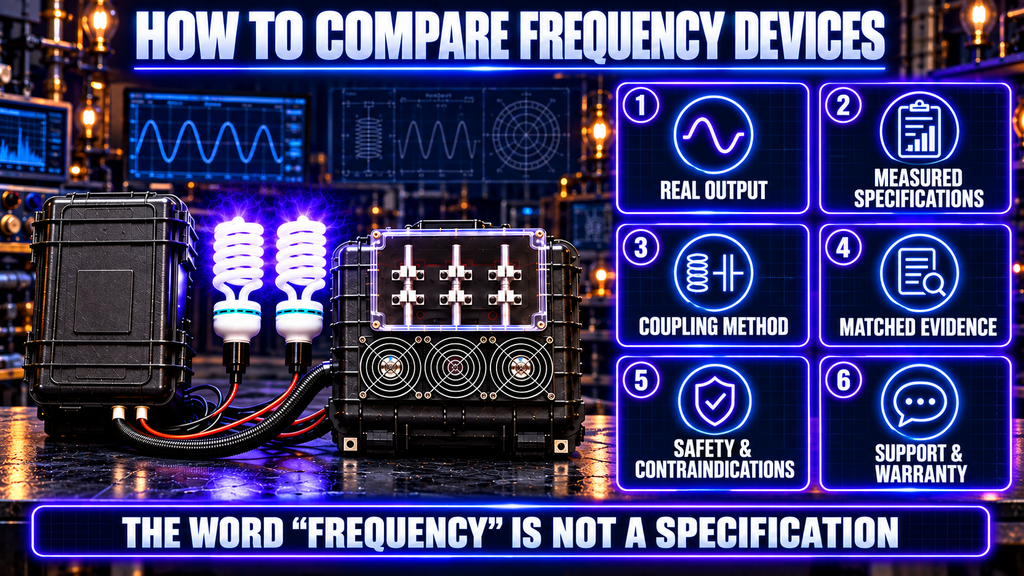
Before buying any frequency-based equipment, ask the following questions.
What is the real output?
Is it sound, vibration, contact current, a magnetic field, RF energy or plasma? “Energy” alone is not a specification.
Can it be measured?
Ask for frequency range, waveform, intensity, measurement distance and tolerances. One impressive number reveals little by itself.
How is the energy coupled?
Headphones, vibrating furniture, pads, coils and plasma bulbs create different exposures. The delivery route should match the explanation and purpose.
What evidence matches the exact device and claim?
Look for controlled human studies of the same model or equivalent output. Patents, testimonials and unrelated laboratory papers are not substitutes.
What are the contraindications?
Electrical equipment may be unsuitable around implanted or body-worn electronics. Pregnancy, epilepsy, electrode placement and other considerations vary; follow the manufacturer’s guidance and seek qualified advice.
Is support available after purchase?
Ask who built it, which parts wear, whether replacements and instructions are available, and what the warranty excludes.
Where My High Frequency Plasma Generator Fits
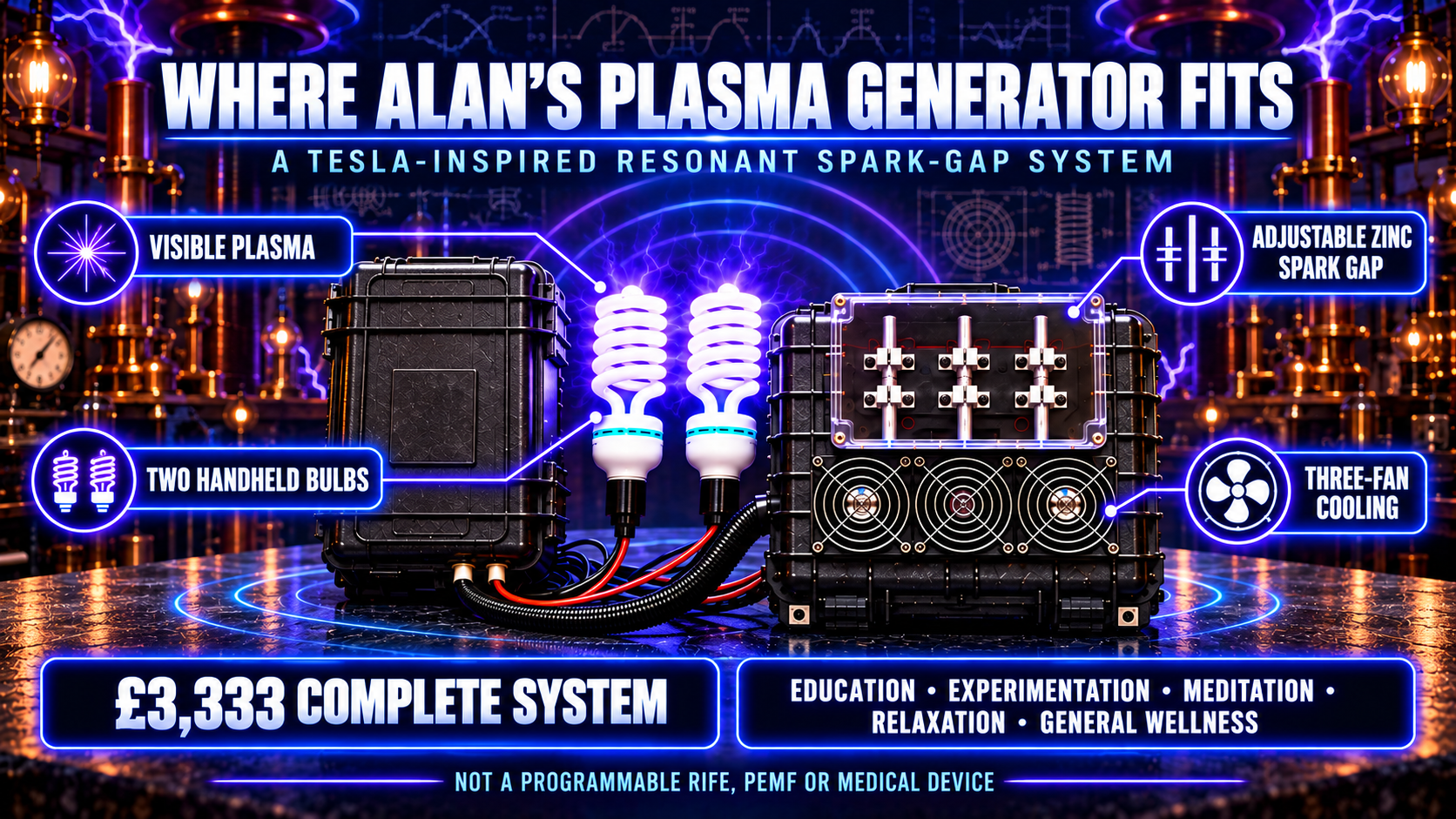
My High Frequency Plasma Generator is a handcrafted, Tesla-inspired resonant spark-gap system built and tested in the UK. It is not a Rife machine, bioresonance scanner, TENS unit or PEMF mat.
Its high-frequency producer, transformer, capacitor banks, adjustable spark gap and resonant output excite gas sealed inside two spiral bulbs, creating visible plasma.
Two rugged enclosures separate the producer from the protected resonant and spark-gap section. A clear cover keeps the working gap visible, while three front fans manage heat.
The adjustable spark gap uses replaceable 100% zinc rods. Accessibility simplifies inspection, cleaning, alignment and replacement as arcing marks the surfaces. Maintenance is performed only after disconnection and in accordance with the instructions.
The complete £3,333 package currently includes:
- one high-frequency producer;
- one separate spark-gap and resonant-coil generator;
- two handheld plasma bulbs;
- adjustable, replaceable zinc electrodes;
- three-fan cooling;
- connecting leads and power supply;
- operating and maintenance instructions;
- individual testing before dispatch;
- shipping under the published terms;
- direct customer support;
- access to the private High Frequency Plasma Community Group; and
- a 12-month parts-and-labour warranty on the main machine, with the glass bulbs excluded.
Some premium plasma systems are advertised at around $11,111 or more. Packages and currencies differ, so this is not a like-for-like performance claim. My aim is a complete, maintainable system at a more accessible price.
Why Owners Are Drawn to the Plasma Experience
People come to this technology for different reasons. Some are interested in Tesla, electrical resonance and plasma physics. Others appreciate the visual glow, audible spark gap and the routine of sitting quietly with one bulb in each hand.
The machine can accompany meditation, reading or reflection. Personal sensations vary and are not proof of treatment; the device has no disease programmes or guaranteed outcomes.
If your main goal is a calm personal routine, my guide to choosing a Frequency Machine for Meditation and Relaxation explains the differences between sound, apps, PEMF and plasma in more detail.
Essential Safety Information
High frequency does not mean harmless. A spark-gap plasma generator contains high voltage, produces electrical arcing and may interfere with nearby electronics.
Use the machine only as described in the supplied Owner’s Guide. Keep it dry, stable and well ventilated. Do not obstruct the fans or operate it near flammable vapours. Never open, adjust or clean the spark gap while the unit is connected. Keep televisions, computers, storage devices and other sensitive electronics at a suitable distance.
Do not use the generator during pregnancy or if you have a pacemaker, implanted defibrillator, neurostimulator, insulin pump, cochlear implant or another implanted or body-worn electronic medical device unless the relevant manufacturer and an appropriately qualified healthcare professional have specifically confirmed safety for your circumstances.
Frequently Asked Questions
Is resonant frequency therapy a recognised medical treatment?
No. Some electrical, magnetic, acoustic or ultrasonic technologies have regulated, indication-specific uses, but the broad phrase does not name one recognised treatment.
Is resonance scientifically real?
Yes. Mechanical and electrical resonance are established physics. That does not establish a safe, clinically useful effect from a particular device.
Is Alan’s plasma generator a resonant frequency therapy machine?
It contains a resonant electrical system but is sold as a non-medical generator for education, experimentation, meditation, relaxation and general wellness.
Can I programme exact frequencies into it?
No. It uses traditional spark-gap resonance, not selectable Rife or PEMF programmes. Moving the zinc rods affects firing behaviour; it is not a disease-frequency selector.
Does a glowing bulb mean two machines work the same way?
No. Different RF and spark-gap systems can both illuminate gas while using different signals, modulation, power and coupling. Examine the circuit, not just the glow.
Can a frequency device replace medical care?
No. Seek appropriate medical help rather than delaying diagnosis or replacing recommended care.
Final Thoughts
Resonant frequency therapy combines real physics, established medical technologies, experimental devices and sometimes unsupported marketing. Scientific terminology alone does not prove diagnosis or treatment.
Identify each machine’s energy, output, coupling, evidence, intended purpose and safety limits. Sound beds, TENS, PEMF, Rife, bioresonance and plasma systems must be assessed separately.
My High Frequency Plasma Generator offers a particular experience: visible plasma, traditional spark-gap operation, a resonant electrical circuit, two handheld bulbs and direct support from the builder. It is designed for people who value Tesla-inspired engineering, personal exploration and a structured relaxation or meditation routine—not for anyone seeking a promised cure.
If that is the kind of frequency technology you want to explore, visit the High Frequency Plasma Generator page for the latest package, price and ordering information.
Important disclaimer: This article is for general education and product comparison, not medical advice. Alan’s High Frequency Plasma Generator is not a medical device and is not intended to diagnose, treat, cure, mitigate or prevent any disease or medical condition. Historical claims, patents and research involving other equipment do not establish efficacy for this generator. Never delay or replace professional medical care because of information about frequency or plasma devices.