
When comparing a plasma generator vs Rife machine, it is easy to assume that they are versions of the same technology. Both may be associated with frequency, resonance, plasma, energy and wellness, and both can feature glowing gas-filled bulbs or tubes. Underneath the surface, however, they may operate very differently.
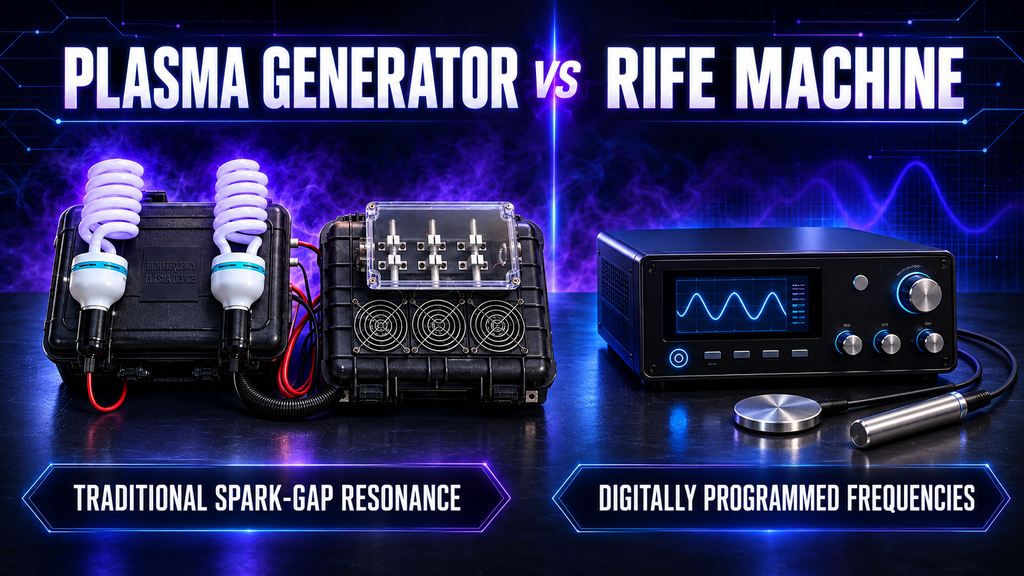
A traditional Tesla-inspired plasma generator can use a transformer, capacitors, a spark gap and a resonant coil to create rapidly oscillating electrical energy. A modern Rife-inspired machine is normally built around an electronic signal generator that produces selected frequencies and waveforms. Its output may use electrodes, a coil or a plasma tube.
This guide provides a straightforward comparison of a plasma generator vs Rife machine and explains where Alan’s handcrafted High Frequency Plasma Generator fits within the wider frequency-technology market.
Why Do People Compare Plasma Generators and Rife Machines?
People frequently discover these technologies through the same online communities. Research into Nikola Tesla, Royal Raymond Rife, resonance or alternative wellness equipment often produces several machines described with similar language.
Some Rife-inspired systems use an illuminated plasma tube, making them look similar to a Tesla-inspired generator. Yet an ionised gas tube does not mean two machines generate or control their output in the same way.
The useful comparison centres on practical questions:
- How is the electrical signal generated?
- Can the operator select exact frequencies?
- Is the output naturally resonant or digitally programmed?
- Does the machine use contact electrodes, magnetic coils or plasma bulbs?
- What maintenance is required?
- What is the manufacturer honestly claiming the equipment can do?
Answering these points makes the decision easier.
The Short Answer
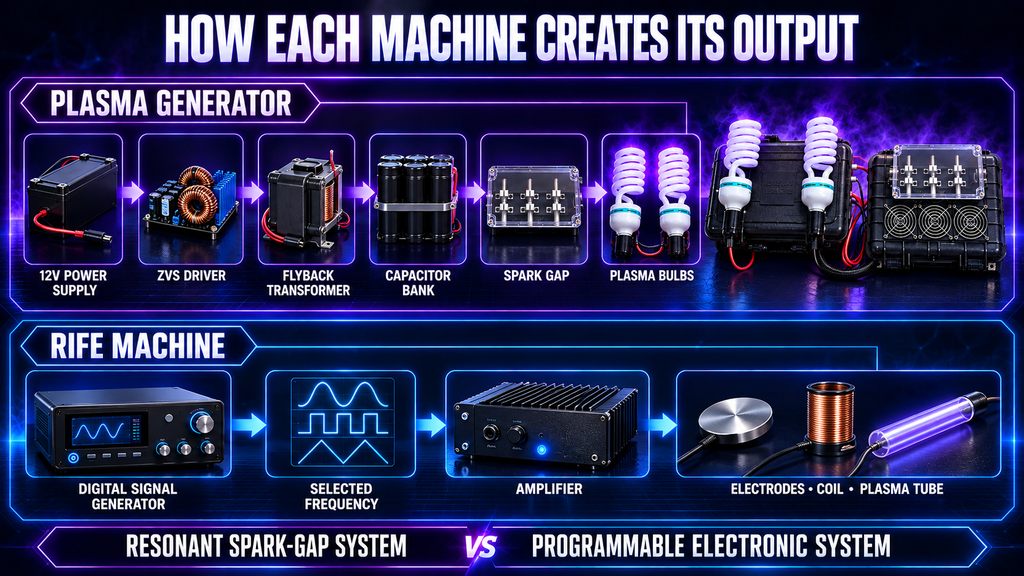
A traditional plasma generator uses high-frequency, high-voltage electrical oscillations to ionise gas inside a bulb or tube. In a spark-gap design, capacitors repeatedly charge and discharge across a small air gap, exciting a resonant circuit and producing visible plasma.
A Rife-inspired machine usually uses an electronic oscillator or digital signal generator to create selected frequencies. The signal may then be delivered through hand cylinders, footplates, adhesive pads, coils or a separate plasma tube. Features vary widely between manufacturers.
In simple terms:
- A Tesla-inspired plasma generator emphasises spark-gap operation, resonance and visible plasma.
- A Rife-inspired machine usually emphasises selectable frequencies, programmes and controlled waveforms.
What Is a Traditional Plasma Generator?
A high-frequency plasma generator is an electrical system that supplies high-voltage, rapidly changing energy to a gas-filled bulb or tube. The energy excites the low-pressure gas, causing it to become ionised and glow.
Traditional designs draw on high-frequency experiments conducted by Nikola Tesla, Jacques-Arsène d’Arsonval, Paul Marie Oudin and others, although their original apparatus was not identical.
A modern spark-gap plasma generator may include:
- A low-voltage power supply
- An electronic high-frequency producer
- A high-voltage transformer
- Capacitors for temporary energy storage
- A spark gap with metal electrodes
- A resonant Oudin, d’Arsonval or Tesla-inspired coil
- Insulated output cables
- Gas-filled plasma bulbs
- Cooling fans and protective enclosures
As voltage builds, the spark gap fires and releases stored energy rapidly. This produces oscillations that excite the resonant output section. The resulting energy travels to the bulbs, where the gas becomes visibly illuminated.
Alan’s High Frequency Plasma Generator uses adjustable, replaceable zinc spark-gap rods and two handheld plasma bulbs. It is a plug-and-use system intended for education, personal experimentation, meditation, relaxation and general wellness—not a programmable medical machine.
For a fuller technical introduction, visit How Does a Plasma Generator Work?.
What Is a Rife Machine?
The phrase Rife machine is applied to equipment inspired by Royal Raymond Rife. There is no single standard design: modern products range from small electronic frequency generators to complex systems with amplifiers, carrier frequencies, plasma tubes and multiple accessories.
A typical electronic system may allow the user to select:
- A numerical frequency in hertz or kilohertz
- A waveform, such as sine or square
- Pulse width or duty cycle
- Sweep ranges
- Session duration
- Stored frequency programmes
- Carrier or modulation settings
Output can use conductive hand cylinders, footplates, adhesive electrodes or electromagnetic coils. More expensive models may use an illuminated plasma tube, with the programmed signal modulating a higher-frequency carrier.
Modern commercial devices should not automatically be assumed to reproduce Rife’s historical equipment precisely. Ask what the machine actually generates, how the output has been measured and whether advertised programmes have credible supporting evidence.
Plasma Generator vs Rife Machine: Side-by-Side Comparison
| Feature | Tesla-inspired plasma generator | Rife-inspired machine |
|---|---|---|
| Main principle | Spark-gap oscillation and resonance | Electronic frequency generation |
| Frequency selection | Usually not individually programmable | Often selectable or programmed |
| Typical output | High-frequency energy and visible plasma | Electrical signal, contact output or modulated carrier |
| Delivery method | Gas-filled bulbs or tubes | Electrodes, pads, coils or plasma tube |
| User controls | Normally simple | Can include menus and numerous settings |
| Visual experience | Strong visible plasma display | Depends on the chosen accessory |
| Maintenance | Spark-gap cleaning and electrode inspection | Usually electronic; plasma accessories may need care |
| Best suited to | Tesla enthusiasts, resonance exploration and visible plasma | Users wanting programmable frequency functions |
This table describes broad tendencies. Individual machines may differ significantly, so specifications should always be checked before purchase.
Difference One: How the Signal Is Created
The greatest difference in a plasma generator vs Rife machine comparison is usually the signal source.
In a traditional spark-gap generator, capacitors charge until the voltage crosses the space between the electrodes. This rapid discharge excites the resonant circuit and creates damped high-frequency oscillations. Its behaviour depends on capacitance, inductance, electrode spacing, coupling and resonance.
A modern Rife-inspired device normally begins with an electronic oscillator, microcontroller or direct digital synthesis circuit. These electronics are used to generate a chosen frequency with a defined waveform. An amplifier may increase the signal before it reaches the output accessory.
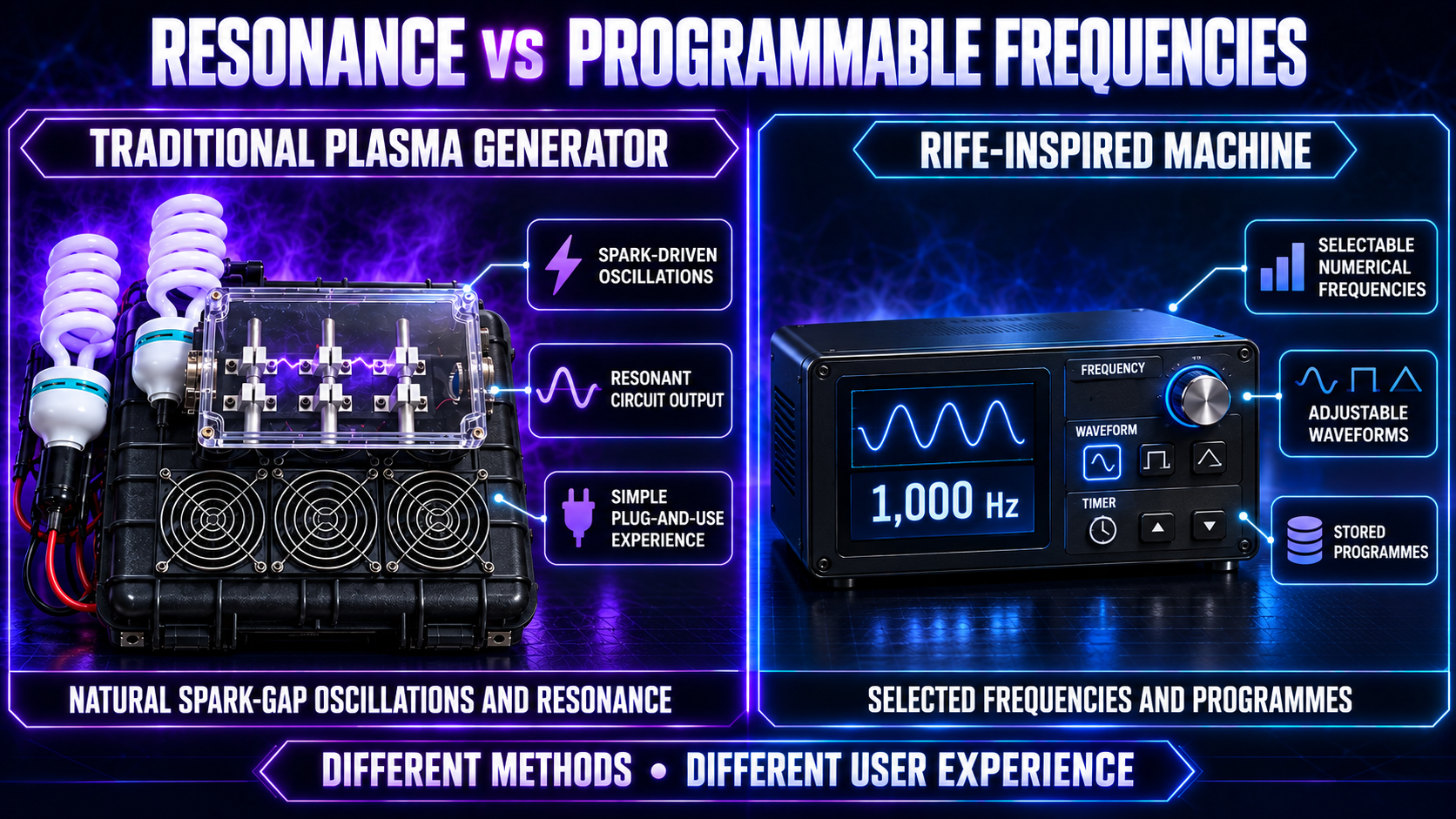
One approach is naturally resonant and spark-driven; the other is normally programmed and electronically controlled.
Difference Two: Exact Frequency Selection
A Rife-inspired generator commonly allows the operator to enter or select numerical frequencies. That programmability is a central part of the product’s appeal. Some systems also allow frequency sweeps, multiple programmes or modulation of a carrier signal.
A traditional spark-gap plasma generator should not be assumed to work this way. It generates high-frequency electrical activity, but an adjustable spark gap is not a digital frequency selector. Moving the rods changes the firing behaviour; it does not let the user enter a precise condition-specific frequency.
If exact numerical control is essential, request measured specifications showing how the output is set and verified. If the attraction is Tesla-inspired resonance, visible plasma and simple operation, a spark-gap generator may be more appropriate.
Difference Three: How the Output Reaches the User
Alan’s generator sends its output to two sealed spiral plasma bulbs. When one is held in each hand, the body changes the electrical conditions around the glass through capacitive coupling, and the plasma often brightens towards the hand. The ionised gas remains inside the bulbs.
A contact Rife-inspired device passes an electrical signal through conductive accessories such as hand cylinders or adhesive pads. A PEMF-style accessory uses a coil to produce a changing magnetic field. A plasma Rife system uses a gas-filled tube as part of a radio-frequency output stage.
These methods create different electrical environments. The presence of a glowing tube alone does not prove that a system delivers the same signal as a spark-gap plasma generator.
Difference Four: Controls and User Experience
A home plasma generator can be deliberately simple. Alan’s machine requires no software, programme libraries or technical calibration. The owner connects the bulbs, follows the instructions and switches it on. The spark gap can be heard and the plasma seen inside the bulbs.
Rife-inspired machines can offer more control and a steeper learning curve. Users may need to understand frequency lists, waveforms, carriers, sweeps and output levels. Those controls appeal to someone who values programmability but may be unnecessary for a straightforward Tesla-inspired experience.
Neither approach is automatically better. The right choice depends on what the buyer genuinely wants to explore.
Difference Five: Maintenance and Serviceability
Spark gaps are working components. Repeated discharges cause heat, deposits and gradual electrode erosion, so rods may need inspection, cleaning, alignment or replacement. Maintenance must only be performed after the machine is switched off, disconnected and fully discharged.
Alan’s design uses adjustable solid zinc rods held in accessible dedicated supports. Worn rods can be repositioned or replaced without discarding the complete spark-gap assembly. The clear cover allows the owner to observe the assembly safely during normal operation.
Electronic Rife-inspired generators may need less mechanical maintenance but can contain specialised electronics, amplifiers or proprietary software that require manufacturer support.
Ask whether replacement parts are available, whether repairs can be completed in the UK and whether the seller provides continuing support.
Can a Rife Machine Also Use Plasma?
Yes. This is one of the main reasons people become confused when researching a plasma generator vs Rife machine.
Some Rife-inspired systems connect an electronic frequency generator to an amplifier and plasma tube. A higher-frequency carrier can energise the gas while the selected lower-frequency signal modulates that carrier. The tube glows, but the programmed signal architecture is different from a traditional spark-gap resonant generator.
The word plasma describes ionised gas, not the complete electrical design. Two machines can illuminate a gas tube while using different circuits, frequencies, modulation methods and power levels.
Before buying a plasma-based Rife product, ask for a diagram showing the signal path from generator to tube. It is more useful than broad claims about energy or resonance.
Evidence, Wellness Claims and Responsible Marketing
Neither the words plasma nor frequency prove that a device can diagnose or treat illness. Engineering evidence showing that a machine produces an electrical output is different from clinical evidence demonstrating a health outcome.
Be cautious when a seller promises guaranteed results, assigns frequencies to diseases or suggests that equipment can replace medical care. Testimonials describe individual experiences, not controlled clinical evidence.
Alan’s High Frequency Plasma Generator is supplied for education, electrical experimentation, meditation, relaxation and general personal wellness. It is not medical equipment and is not intended to diagnose, treat, cure, mitigate or prevent disease.
This distinction allows people to investigate the technology without presenting speculation as medicine.
Which Machine Is Better for Home Use?
The answer depends on your priorities.
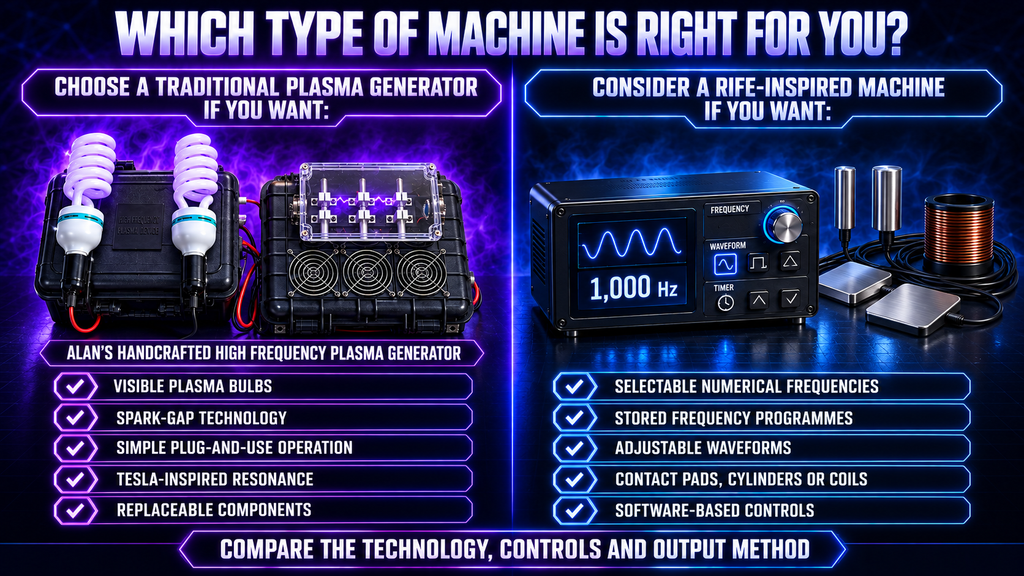
A Tesla-inspired plasma generator may suit you if you value:
- Traditional spark-gap technology
- Visible electrical operation
- Two handheld glowing bulbs
- Resonance and plasma experimentation
- Simple plug-and-use operation
- Replaceable mechanical components
- Direct support from the builder
A Rife-inspired machine may be more suitable if you specifically want:
- Selectable numerical frequencies
- Stored programmes
- Adjustable waveforms or sweeps
- Contact electrodes or pads
- Computer or software control
- Compatibility with specialist output accessories
Anyone seeking medical treatment should consult a qualified professional and use regulated equipment for its authorised purpose.
Cost and Long-Term Value
Prices vary widely. A basic electronic generator may cost relatively little, while a sophisticated plasma-tube system can cost thousands. Tesla-inspired machines also vary by construction, cooling, coil design, spark gap, accessories and support.
Alan’s complete High Frequency Plasma Generator is priced at £3,333. The package includes two plasma bulbs, the high-frequency producer, adjustable zinc spark-gap generator, operating instructions, shipping, direct customer support, community access and a 12-month machine warranty. The glass bulbs are excluded from the warranty.
Consider the complete ownership experience. A cheaper machine may be poor value if instructions are unclear, parts are unavailable or support disappears after purchase.
Questions to Ask Before Buying Either Machine
Before purchasing, ask the seller:
- How is the frequency or oscillation generated?
- Is the output naturally resonant or digitally programmed?
- Can exact frequencies be selected and independently measured?
- How does the output reach the user?
- What maintenance and consumable parts are expected?
- What safety testing and instructions are supplied?
- What does the warranty cover and exclude?
- Is the equipment sold for medical use or non-medical personal exploration?
Clear answers make it much easier to compare genuinely different products.
Why Consider Alan’s High Frequency Plasma Generator?
Alan’s generator is intended for people who are attracted to traditional Tesla-inspired engineering rather than complicated programme libraries. Its principal advantages are practical and visible:
- Handcrafted and individually tested in the UK
- Adjustable spark gap with replaceable 100% zinc rods
- Two large handheld plasma bulbs
- Built-in cooling
- Clear protective spark-gap enclosure
- Simple plug-and-use operation
- Direct access to the builder
- Private Telegram owner community
- Shipping included
- 12-month machine warranty
At £3,333, the generator costs substantially less than some premium plasma systems advertised above $11,000. Buyers can view the complete plasma generator package here.
Frequently Asked Questions
Is Alan’s plasma generator a Rife machine?
No. It is a traditional Tesla-inspired spark-gap plasma generator. It does not rely on a library of selectable Rife frequency programmes.
Can a spark gap select exact frequencies?
Not in the way a digital signal generator can. Electrode spacing affects firing behaviour, but it should not be presented as a keypad-style selector for precise programmes.
Which machine is easier to use?
A simple plasma generator can be easier for someone who does not want menus or software. A Rife-inspired generator offers greater programmability but may require more technical learning.
Are either of these medical devices?
Not automatically. Classification depends on the product’s intended purpose, evidence, claims and regulatory status. Alan’s generator is explicitly supplied as non-medical equipment for education, experimentation, meditation, relaxation and general wellness.
Who should not use a high-frequency plasma generator?
It should not be used during pregnancy or by anyone with a pacemaker or other implanted electronic device. It should also be kept away from televisions, computers, laptops and other sensitive electronics. Always follow the supplied safety instructions.
Final Thoughts
The plasma generator vs Rife machine question is a comparison between different approaches to generating, controlling and delivering electrical frequencies.
The best choice depends on whether you want programmability or a direct Tesla-inspired plasma experience. Whichever category you investigate, look for honest specifications, realistic claims, clear safety guidance, replaceable parts and reliable support.
If traditional spark-gap engineering, visible plasma and simple home use appeal to you, explore Alan’s handcrafted High Frequency Plasma Generator or join the High Frequency Plasma Community Group to learn more.
Important disclaimer: This article is provided for education and general product comparison. Alan’s High Frequency Plasma Generator is not a medical device and is not intended to diagnose, treat, cure, mitigate or prevent any disease. Never delay or replace professional medical care because of information about a frequency or wellness device.