
A plasma frequency machine for home use is an electrical device that generates high-frequency energy and uses it to energise a gas inside a glass bulb or tube. When the gas becomes ionised, it produces the colourful glowing effect known as plasma.
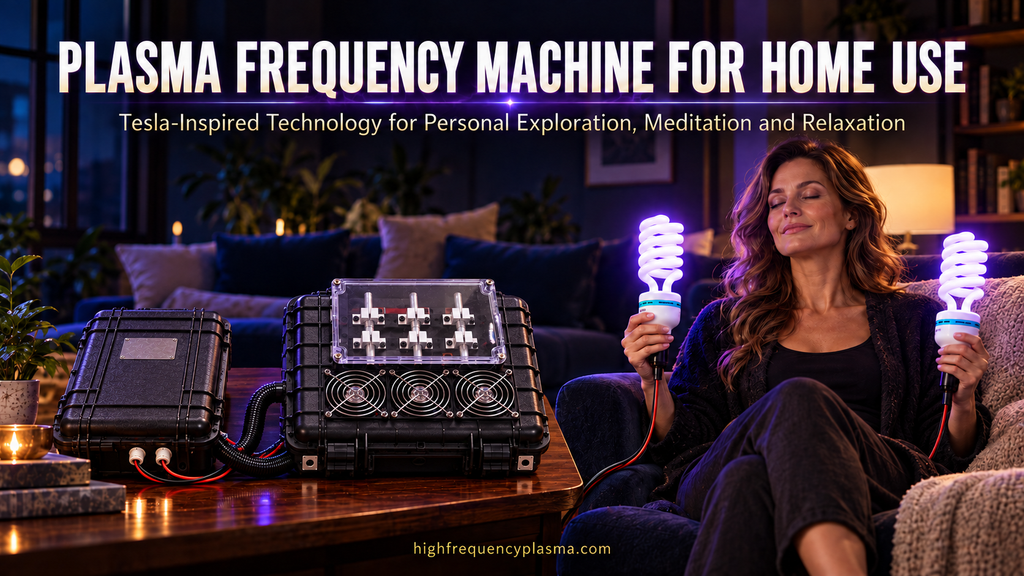
The phrase is not a formal scientific or regulatory product category. Different manufacturers use it to describe machines with very different circuits, outputs and intended purposes. Before comparing prices, it is therefore important to identify the actual technology inside each product.
A traditional Tesla-inspired home system may contain:
- A mains power supply
- A high-frequency producer
- A high-voltage transformer
- Capacitors that temporarily store electrical energy
- A spark gap that repeatedly releases the stored energy
- A resonant coil based on Tesla, Oudin or d’Arsonval principles
- High-voltage output cables
- Gas-filled plasma bulbs or tubes
- Cooling fans and protective enclosures
Alan’s High Frequency Plasma Generator uses this traditional spark-gap approach. It is designed for education, electrical experimentation, meditation, relaxation and general personal wellness. It is not a programmable medical machine and is not intended to diagnose, treat, cure or prevent disease.
Why Are People Looking for a Home Plasma Frequency Machine?
Interest comes from several overlapping communities. Some people are fascinated by Nikola Tesla and high-frequency electricity; others are interested in resonance, plasma physics, meditation or personal wellness. A home machine lets the owner observe the spark gap, see the plasma respond when a bulb is held and develop a personal routine without travelling to a practitioner.
These interests should not be confused with proof of medical effectiveness. A responsible manufacturer should describe the engineering honestly and distinguish personal experiences from clinically established outcomes.
How Does a Spark-Gap Plasma Frequency Machine Work?
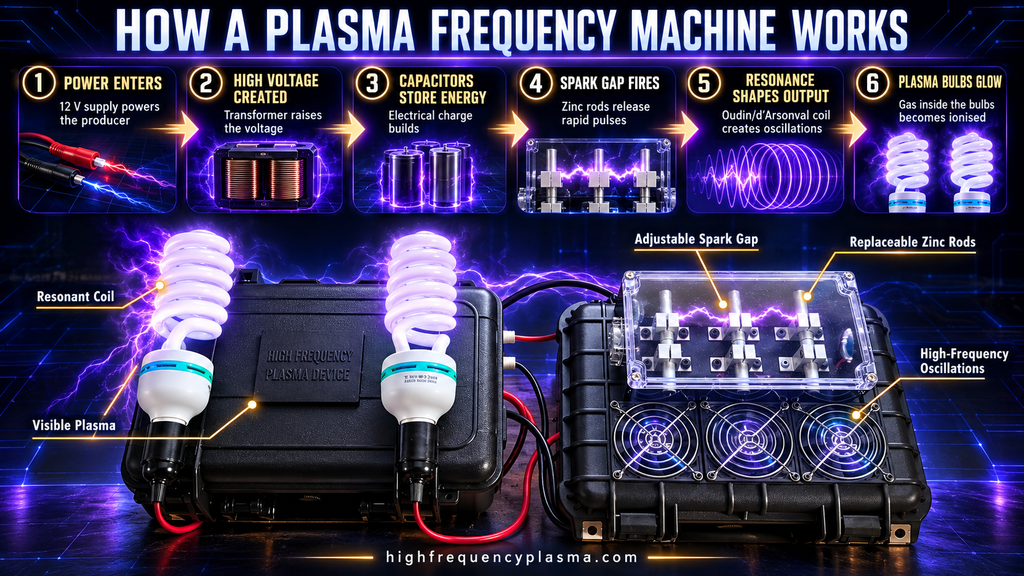
The operating sequence can be understood as a chain of electrical events.
First, power enters the high-frequency producer. The internal switching circuit drives a high-voltage transformer, which raises the voltage. Capacitors collect and temporarily store electrical charge.
As the voltage rises, it eventually becomes high enough to cross the small air space between the spark-gap electrodes. The gap fires, releasing the stored energy rapidly. This creates a burst of oscillating electrical activity rather than a simple steady flow of electricity.
Those oscillations excite the resonant output section. The resulting high-frequency, high-voltage energy travels through insulated cables to the plasma bulbs. The low-pressure gas sealed inside the glass becomes ionised and produces visible streams of light.
When a person holds a bulb, the pattern often becomes brighter or concentrates towards the hand. The body changes the electrical conditions around the bulb through capacitive coupling. The gas remains sealed inside the glass; it does not enter the body.
For a more detailed explanation, visit How Does a Plasma Generator Work? in the High Frequency Plasma Learning Centre.
Is a Plasma Frequency Machine the Same as a Rife Machine?
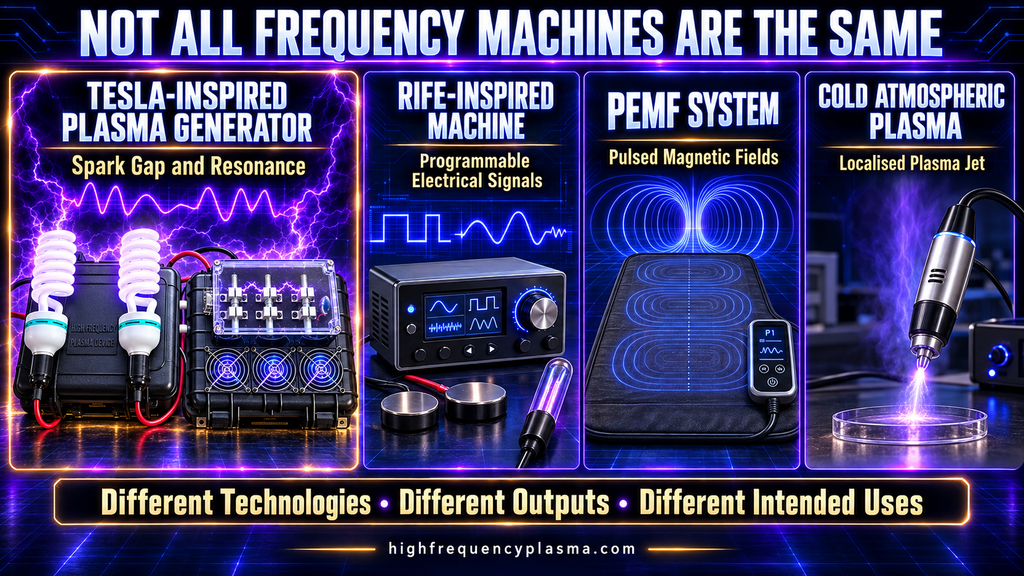
No. Although the words frequency and plasma may appear in descriptions of both technologies, a traditional Tesla-inspired plasma generator should not automatically be described as a Rife machine.
Many Rife-inspired devices are signal generators that let the operator select numerical frequencies, waveforms or programmed sets. Output may be delivered through contact electrodes or a gas-filled tube using a radio-frequency carrier.
A traditional spark-gap plasma generator operates differently. Its characteristic output is created by repeated capacitor discharges, a spark gap and a resonant circuit. It produces high-frequency oscillations, but that does not necessarily mean the user can type in or select an exact numerical wellness frequency.
Never assume that every machine with plasma bulbs has programmable Rife functions. Ask what is adjustable, what has been measured and how the output is produced.
How Is It Different From PEMF?
PEMF stands for pulsed electromagnetic field. A PEMF machine sends controlled pulses through a coil to create a changing magnetic field. Some models offer selectable frequencies, waveforms and intensities.
A high-frequency plasma generator uses high voltage to ionise gas in a bulb or tube. It creates visible plasma as well as rapidly changing electrical fields. Its construction and user experience are therefore very different from lying on a PEMF mat or placing a magnetic applicator near the body.
The two categories should not be treated as equivalent merely because both involve frequency. Compare the physical output, controls, intended purpose, safety information and evidence for each product.
Is It the Same as Cold Atmospheric Plasma?
Cold atmospheric plasma, often abbreviated to CAP, is a separate specialist field. CAP systems can create a localised plasma jet or discharge at or near room temperature for controlled clinical, research or industrial applications.
A Tesla-inspired home generator with sealed handheld bulbs should not be presented as equivalent to regulated cold atmospheric plasma equipment. The plasma in the home system is visible inside a sealed glass bulb, and the machine has a different design, output and intended purpose.
A home generator can be fascinating equipment for personal exploration without being described as a clinical CAP treatment device.
What Features Should You Look For Before Buying?
Choosing a plasma frequency machine for home use requires more than comparing photographs. A bright display does not automatically prove that a machine is well constructed or easy to maintain.
Look for the following practical features.
Clear technical description: The seller should explain whether the machine uses a spark gap, solid-state switching, a resonant coil or a programmable generator.
Protective enclosures: High-voltage components and the spark gap must not be accessible during normal operation.
Adequate cooling: Transformers and switching electronics produce heat, so the machine needs proper airflow.
Serviceable electrodes: Spark-gap electrodes gradually wear. Replaceable electrodes make long-term ownership more practical.
Quality cables and connectors: High-voltage output cables require suitable insulation and secure connections.
Clear instructions: Guidance should cover setup, operation, maintenance and safety.
Warranty and support: Find out who will help if a component fails. Direct access to the builder is valuable with handcrafted technology.
Honest claims: Be cautious of guaranteed health results, disease-treatment claims or scientific language unsupported by evidence.
Why Does an Adjustable Spark Gap Matter?
Every time a spark crosses the gap, heat and electrical discharge affect the electrode surfaces. Over time, deposits can form and the ends of the rods can become uneven. The effective spacing may also change as material is gradually eroded.
A sealed or awkwardly positioned spark gap can make routine inspection difficult. A properly designed adjustable assembly allows the owner to inspect, clean, align and eventually replace the electrodes after the generator has been disconnected and allowed to discharge fully.
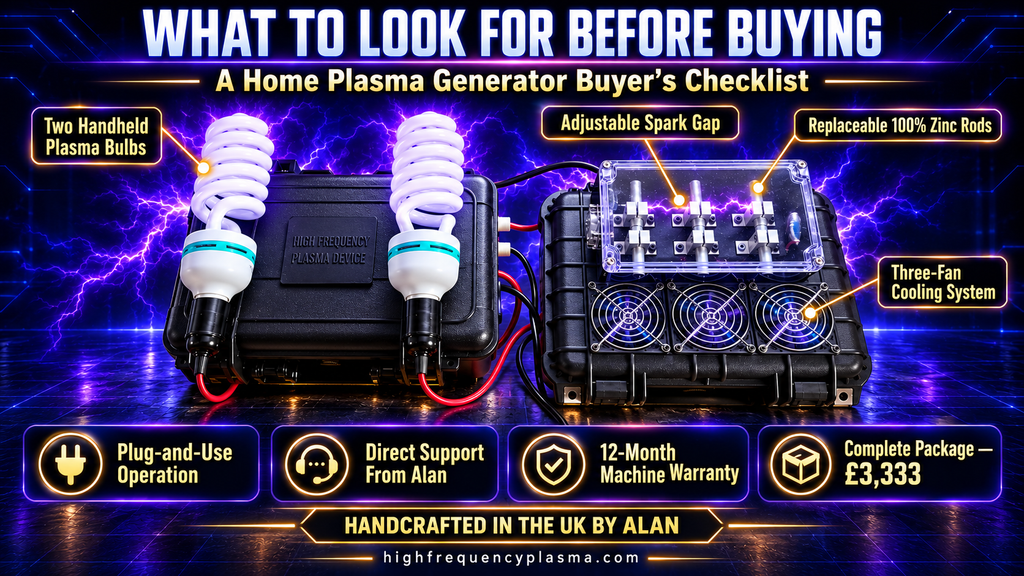
Alan’s generator uses solid zinc rods held in dedicated adjustable holders. The clear protective enclosure allows the assembly to be observed without exposing it during operation. When maintenance is required, the rods can be cleaned, repositioned or replaced rather than forcing the owner to replace the complete machine.
You can learn more in What Is a Spark Gap?.
Why Are Handheld Plasma Bulbs Used?
The bulbs indicate that the system is operating and make the experience interactive: when a hand is placed around the glass, luminous streams tend to gather towards the contact area.
Their colour and appearance depend on the gas mixture, pressure, geometry and electrical excitation. When excited particles return to lower energy states, they release visible light.
The bulbs are fragile glass components and must not be overtightened. Ask whether replacements are available and whether they are included in the warranty.
Read Why Are Plasma Bulbs Used? for a fuller introduction.
Is a Home Plasma Machine Easy to Use?
A well-designed home generator should not require specialist software or complex calibration. Alan’s system has been developed as a plug-and-use machine: connect the two bulbs, connect the equipment as instructed and switch it on.
New owners are advised to begin with a 15-minute session and gradually increase the duration during the first week, up to a maximum of approximately 30 minutes per session. One bulb is held comfortably in each hand while the user sits in a calm environment.
The spark gap is audible. The generator also needs a stable surface, clear ventilation and suitable distance from televisions, laptops and other sensitive electronics.
The full Owner’s Guide explains setup, bulb installation, session times and maintenance.
Safety Considerations for Home Use
High-frequency plasma equipment contains high voltage, stored electrical energy and an operating spark gap. It must be treated as serious electrical equipment even when the user-facing experience appears simple.
Follow these essential precautions:
- Read the complete instructions before the first session.
- Never open an enclosure while the machine is connected to power.
- Never touch or adjust the spark gap during operation.
- Disconnect the equipment and allow stored energy to discharge before maintenance.
- Keep the generator and bulbs away from water and damp conditions.
- Operate the machine on a stable surface with ventilation openings clear.
- Keep children and pets away from the equipment while it is operating.
- Do not use damaged bulbs, cables, connectors or enclosures.
- Keep the generator away from flammable vapours and materials.
- Maintain distance from televisions, computers, mobile devices and other sensitive electronics.
The machine should not be used during pregnancy or by anyone with a pacemaker, implanted defibrillator, neurostimulator, insulin pump, cochlear implant or other implanted electronic medical device. Anyone with a medical concern should obtain advice from an appropriately qualified healthcare professional before using electrical or electromagnetic wellness equipment.
Safety information should be clear and consistent across the sales page, manual and customer support materials.
How Much Does a Plasma Frequency Machine for Home Use Cost?
Prices vary because the same search phrase can describe a handheld wand, programmable generator, plasma-tube Rife system or handcrafted spark-gap machine.
When comparing prices, establish exactly what is included. Check whether the advertised amount covers the generator, resonant section, plasma bulbs, cables, shipping, warranty and after-sales support. Also consider whether replacement parts are proprietary and how much routine maintenance might cost.
Some premium Tesla-inspired systems have been advertised for approximately $11,111 or more. Alan’s handcrafted High Frequency Plasma Generator is available for £3,333, including shipping, two plasma bulbs, the high-frequency producer, adjustable zinc spark-gap generator, instructions, customer support, community access and a 12-month machine warranty. The plasma bulbs are consumable glass components and are not included within the 12-month warranty.
Build quality, serviceability, honest documentation and knowledgeable support are more important than an impressive list of unsupported claims.
What Is Included With Alan’s Generator?
The complete package includes:
- Two handheld plasma bulbs
- One high-frequency producer
- One spark-gap generator with adjustable 100% zinc rods
- Cooling built into the generator
- Straightforward operating instructions
- Shipping included in the purchase price
- Direct customer support
- Access to the High Frequency Plasma Community Group on Telegram
- A 12-month warranty covering the machine, parts and labour, subject to the warranty terms
Every generator is individually assembled and tested by Alan. Customers purchase directly from the builder and receive continuing help with setup, operation and maintenance.
Who Might This Technology Suit?
A plasma frequency machine for home use may appeal to:
- Nikola Tesla enthusiasts
- People interested in resonance and high-frequency electricity
- Plasma and electrical experimenters
- Meditation and wellness practitioners
- People comparing a TZLA-style generator with alternatives
- Buyers who value direct contact with the builder
It will not suit someone seeking a silent pocket device, an approved medical treatment or a programmable generator for selecting exact numerical protocols.
Questions to Ask Any Plasma Machine Seller
Before ordering, ask how the output is created, whether the machine uses spark-gap or solid-state switching and whether exact frequencies are selectable. Confirm which bulbs are supplied, whether electrodes are replaceable, what cooling and safety features are built in and what maintenance is expected. Also ask what the warranty excludes, whether shipping and support are included, what contraindications apply and whether the product is a regulated medical device or a non-medical experimental and wellness device. Clear answers demonstrate that the seller understands the equipment.
Frequently Asked Questions
Is this a medical device?
No. Alan’s High Frequency Plasma Generator is intended for education, research, personal exploration, meditation, relaxation and general wellness. It is not intended to diagnose, treat, cure, mitigate or prevent any disease.
Can I select individual frequencies?
This is a traditional spark-gap plasma generator, not a programmable Rife-style frequency generator. Its adjustable spark gap is provided for alignment and maintenance and should not be confused with selecting precise condition-specific frequency programmes.
Does plasma leave the bulbs and enter the body?
No. The ionised gas remains sealed inside the glass bulbs. Holding a bulb changes the surrounding electrical conditions through capacitive coupling, which is why the visible plasma responds to the hand.
Can the machine be used near a television or computer?
It should be kept away from televisions, computers, laptops and other sensitive electronic equipment because a high-frequency generator can cause electromagnetic interference.
Is the machine suitable for someone with a pacemaker?
No. People with pacemakers or other implanted electronic devices should not use the generator.
Final Thoughts
Finding the right plasma frequency machine for home use begins with understanding the name. A Tesla-inspired spark-gap generator is not automatically a Rife machine, PEMF system, violet-ray wand or clinical cold atmospheric plasma device.
Look beyond dramatic photographs and consider construction, safety, cooling, serviceability, instructions, warranty and support. Replaceable electrodes and direct contact with the builder can add long-term value.
Alan’s handcrafted High Frequency Plasma Generator combines a traditional adjustable spark gap, solid zinc electrodes and two handheld plasma bulbs in a straightforward home system. It is supplied as a complete package for £3,333, with shipping, instructions, customer support, community access and a 12-month machine warranty.
If you are fascinated by Tesla-inspired technology, visible plasma, resonance and high-frequency electrical experimentation, you can discover the High Frequency Plasma Generator here or join the High Frequency Plasma Community Group on Telegram to learn more.
Important disclaimer: This equipment is not a medical device and is not intended to diagnose, treat, cure, mitigate or prevent any disease or medical condition. Information in this article is provided for education and general product understanding. Always follow the supplied safety instructions and seek qualified medi