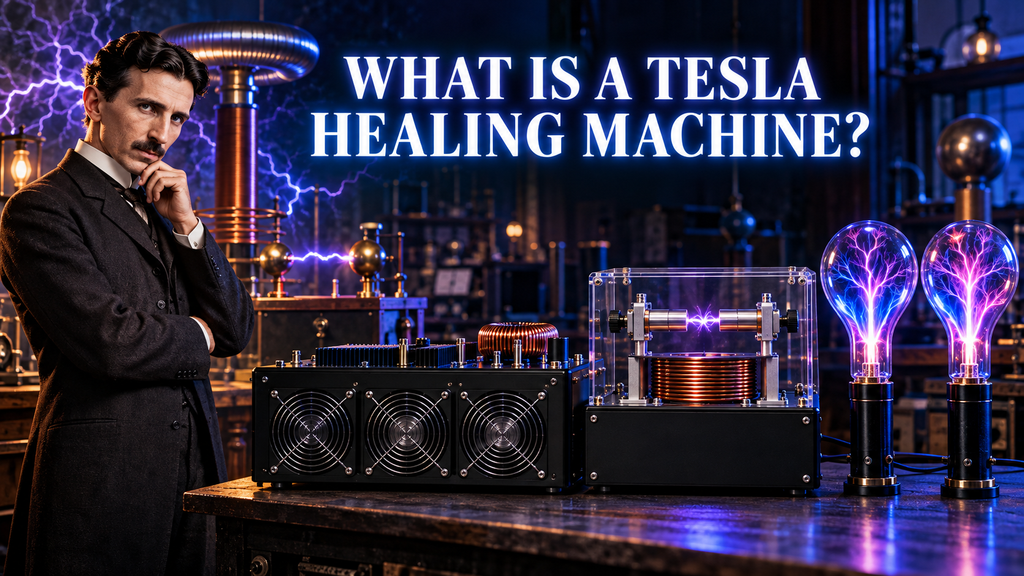
What is a Tesla healing machine? It is an informal name for equipment inspired by Tesla’s experiments with high-voltage, high-frequency electricity, resonant circuits, glowing gas-filled tubes and electrical discharges. Some modern versions use a spark gap and handheld plasma bulbs; others are very different products that simply use Tesla’s name.
The word “healing” needs to be understood carefully. It describes how people commonly search for these machines; it does not prove that a particular product can diagnose, treat or cure a medical condition. A responsible buyer should separate three things: Tesla’s documented electrical work, later high-frequency electrotherapy, and the clinical research on specific modern medical plasma devices. They are connected historically, but they are not interchangeable.
What Is a Tesla Healing Machine in Simple Terms?
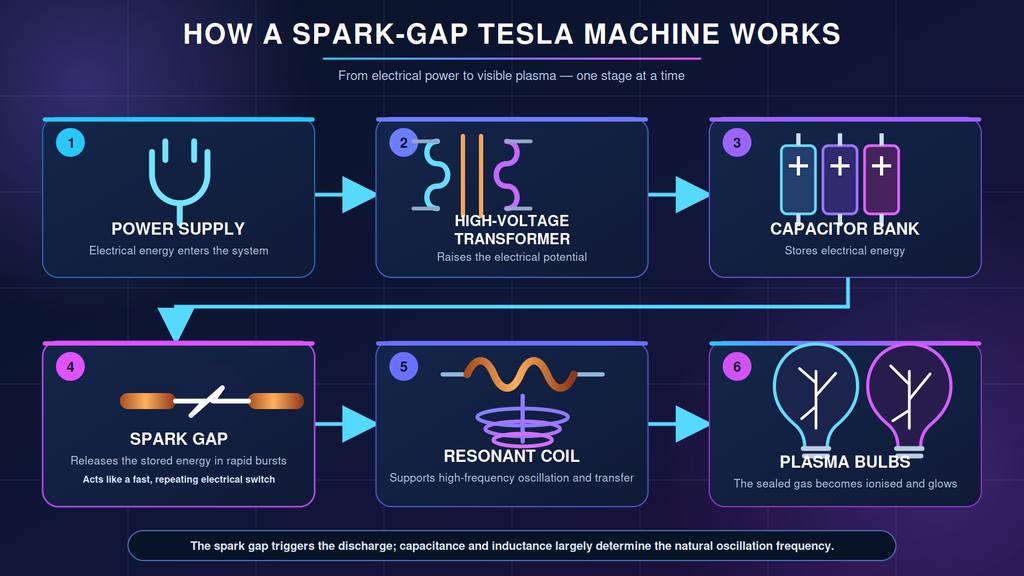
A Tesla healing machine is generally a high-frequency electrical device inspired by Nikola Tesla’s late nineteenth-century experiments. A traditional system may include a power supply, high-voltage transformer, capacitors, a spark gap, a resonant coil and gas-filled output bulbs. During operation, electrical energy builds in the capacitor network and is released in rapid bursts. The resulting oscillations energise the output stage and cause the gas inside the bulbs to glow.
That visible glow is plasma: an ionised gas containing free electrons and charged particles. The plasma remains inside the sealed bulb. A person holding a suitable bulb interacts with the changing electrical field; the physical gas is not delivered into the body.
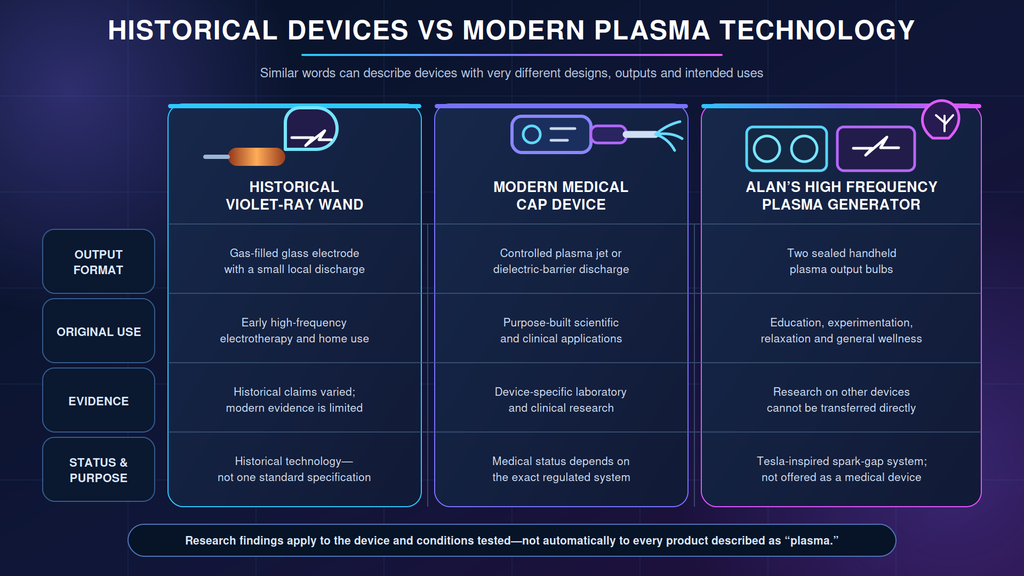
There is no universally recognised design called a Tesla healing machine. The phrase is used for violet-ray wands, spark-gap plasma generators, solid-state devices, coils and room systems. One machine’s construction and output cannot be assumed to match another’s.
Who Was Nikola Tesla?
Nikola Tesla was a Serbian-American inventor and electrical engineer whose work helped shape the alternating-current power system. He is remembered for polyphase AC, induction motors, resonant transformers and pioneering investigations into currents of very high frequency and potential.
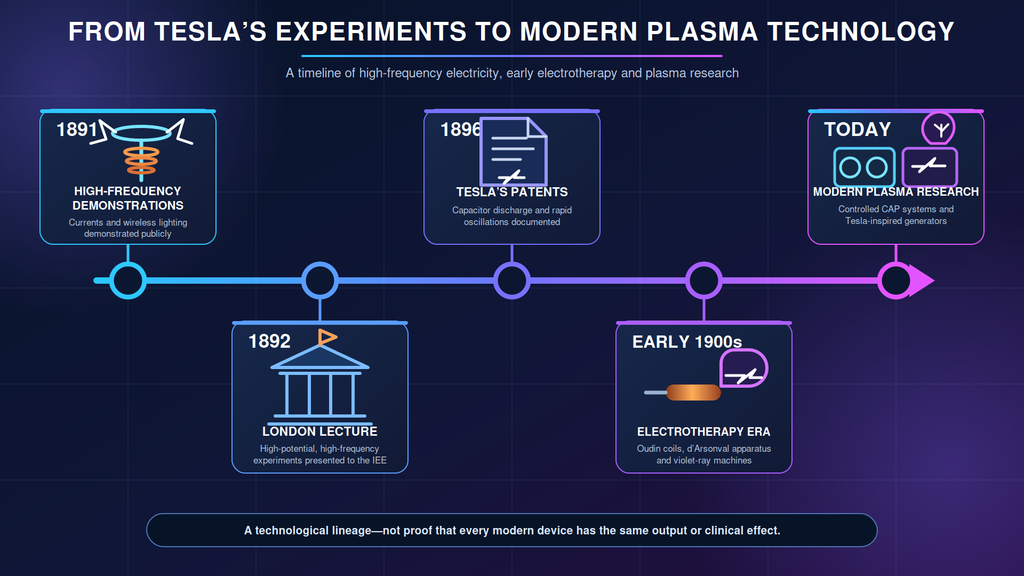
In an 1891 lecture, Tesla demonstrated spectacular effects using high-frequency currents, including illumination of lamps and tubes without conventional wired connections. His later lectures and patents described practical ways to charge capacitors and discharge them through low-inductance circuits, producing rapid electrical oscillations.
Tesla did not invent a consumer product officially called a “Tesla healing machine.” The later phrase draws on principles that influenced Tesla coils, early electrotherapy, violet-ray devices, radio and plasma research.
Readers who want the original history can explore the Smithsonian catalogue record for Tesla’s 1891 work and his patent for a method and apparatus for producing currents of high frequency.
How Tesla Used Spark Gaps to Produce High-Frequency Oscillations
The spark gap is one of the most recognisable features of an early Tesla-style system. It usually consists of two conductive electrodes separated by a small air space. As voltage rises, the air initially acts as an insulator. When the electric field becomes strong enough, the air breaks down, an arc crosses the gap and the stored energy is released into the oscillating circuit.
It is common to say that a spark gap “generates frequencies,” but the more accurate explanation is that it acts as a fast, repeating switch. The capacitor and the circuit’s inductance largely determine the natural oscillation frequency. The gap allows the stored charge to discharge into that circuit, producing a short burst of damped oscillations. The process repeats as the capacitors recharge and the gap fires again.
Tesla’s 1896 patent US568179A describes periodically charging a condenser—what we now call a capacitor—and discharging it through a circuit of low self-induction to obtain rapid impulses. A related patent, US568176A, describes converting ordinary current into currents of higher frequency and potential using a condenser, an interrupter and a transformer.
The spark gap does not create one perfectly clean, selectable frequency like a laboratory signal generator. It excites oscillations and can produce a complex spectrum. Capacitance, inductance, coupling, voltage, geometry, load and operating conditions influence the result.
For a beginner-friendly explanation, see What Is a Spark Gap? and How Does a Tesla Coil Work? in the High Frequency Plasma Learning Centre.
How Does a Modern Tesla-Inspired Plasma Machine Work?
Although designs differ, a traditional home spark-gap plasma generator usually follows a recognisable sequence:
- Electrical power enters the high-frequency producer.
- A transformer increases the voltage.
- A capacitor network stores electrical energy.
- Voltage builds across the spark gap.
- The air in the gap breaks down and an arc forms.
- The stored energy is released into an inductive-capacitive circuit.
- Rapid, damped electrical oscillations are produced.
- A resonant output coil transfers the changing energy to the output arrangement.
- The field energises the gas sealed inside the bulbs, creating visible plasma.
Bulb shape, gas filling, pressure, glass and electrical connection affect behaviour. However, colour, brightness or a dramatic spark does not measure therapeutic effectiveness or prove one generator is better.
Why Were High-Frequency Devices Historically Associated With Healing?
After Tesla and the French physiologist Jacques-Arsène d’Arsonval demonstrated high-frequency electrical phenomena, doctors and inventors began exploring electrotherapy. By the early twentieth century, clinics and homes contained various diathermy machines, Oudin coils, d’Arsonval apparatus and violet-ray wands.
Historical advertisements claimed benefits for many conditions, often without evidence that would satisfy modern standards. Some devices nevertheless created electrical discharges and plasma at or near gas-filled glass electrodes.
A 1902 paper in the British Medical Journal, The Therapeutic Employment of High Frequency Currents (“D’Arsonvalisation”), documents contemporary medical interest. It is valuable historical evidence that high-frequency currents were used and investigated; it is not modern proof that the same claims were correct.
A later review, The History of Electrostimulation in Rehabilitation Medicine, places d’Arsonval’s work within the development of electrical stimulation. These sources explain the phrase’s background; they do not make it a recognised medical category.
What Does Modern Research Actually Show?
Research shows that particular electrical and plasma technologies can produce biological effects under defined conditions. Results from one device, output and exposure cannot simply be transferred to every product labelled Tesla, frequency or plasma.
One especially relevant study is On the History of Plasma Treatment and Comparison of Microbiostatic Efficacy of a Historical High-Frequency Plasma Device With Two Modern Devices. Researchers compared a historical violet wand with two modern cold atmospheric plasma sources—a plasma jet and a dielectric-barrier-discharge device—against bacterial wound isolates on agar. The study reported microbiostatic activity and showed that old high-frequency equipment has a meaningful place in the history of plasma medicine.
It was an in-vitro experiment on cultured organisms—not a clinical trial of Alan’s generator or evidence that holding plasma bulbs treats disease.
A 2022 laboratory paper, High-Frequency Devices’ Effect In Vitro: A Promising Approach in the Treatment of Acne Vulgaris?, examined a commercial device and skin-related microorganisms. In-vitro findings are a starting point, not clinical proof.
Modern CAP has also been studied clinically. A randomised trial, Effect of Cold Atmospheric Plasma Therapy vs Standard Therapy Placebo on Wound Healing in Patients With Diabetic Foot Ulcers, reported improved wound-surface reduction with the investigated medical system.
These trials concern purpose-built, controlled medical plasma devices used in clinical settings. Cold atmospheric plasma jets, dielectric-barrier-discharge equipment, violet wands and handheld-bulb spark-gap generators have different outputs and exposure routes. Evidence for one should not be presented as proof for all.
Tesla helped establish high-frequency electrical techniques, historical devices sometimes produced plasma, and modern plasma medicine is a genuine research field. This is not clinical evidence that every Tesla healing machine can treat illness.
Is a Tesla Healing Machine the Same as Cold Atmospheric Plasma?
No—not automatically. Cold atmospheric plasma, often abbreviated to CAP, is a technical category in which ionised gas is generated near room temperature. Medical researchers carefully characterise factors such as gas composition, temperature, voltage, power, reactive species, ultraviolet output, treatment distance and exposure time.
A historical violet wand may create local plasma around or inside an electrode and can share some effects with modern CAP equipment. A two-bulb Tesla-inspired home generator may also create visible plasma in sealed bulbs. Yet these machines should not be labelled equivalent unless measurements demonstrate equivalent output and exposure.
This distinction lets us discuss legitimate research without borrowing conclusions from a different device.
What Should You Look for Before Buying?
If you are comparing machines, ask practical questions instead of relying on dramatic health promises:
- Is it a genuine spark-gap system, a solid-state generator or another type of product?
- Can the seller explain the electrical path in plain language?
- Are the spark-gap electrodes adjustable, accessible and replaceable?
- What maintenance will the electrodes require?
- Does the system have suitable cooling and protected enclosures?
- What bulbs, leads and accessories are included?
- Is every unit tested before dispatch?
- Are clear operating and safety instructions supplied?
- Can you contact the person who understands or built the machine?
- What warranty and continuing support are provided?
- Does the seller distinguish personal wellness from medical treatment?
The highest price, strongest spark or longest list of claims does not prove superiority. Clear specifications and responsible language are more useful.
My Updated High Frequency Plasma Generator
For people who want to explore this technology at home, I build an updated High Frequency Plasma Generator in the UK. It is inspired by traditional Tesla, Oudin and d’Arsonval-era high-frequency principles while being arranged for straightforward modern ownership.
Every machine is handcrafted, tested before dispatch and purchased directly from me, Alan, so customers can speak to the person who built it.
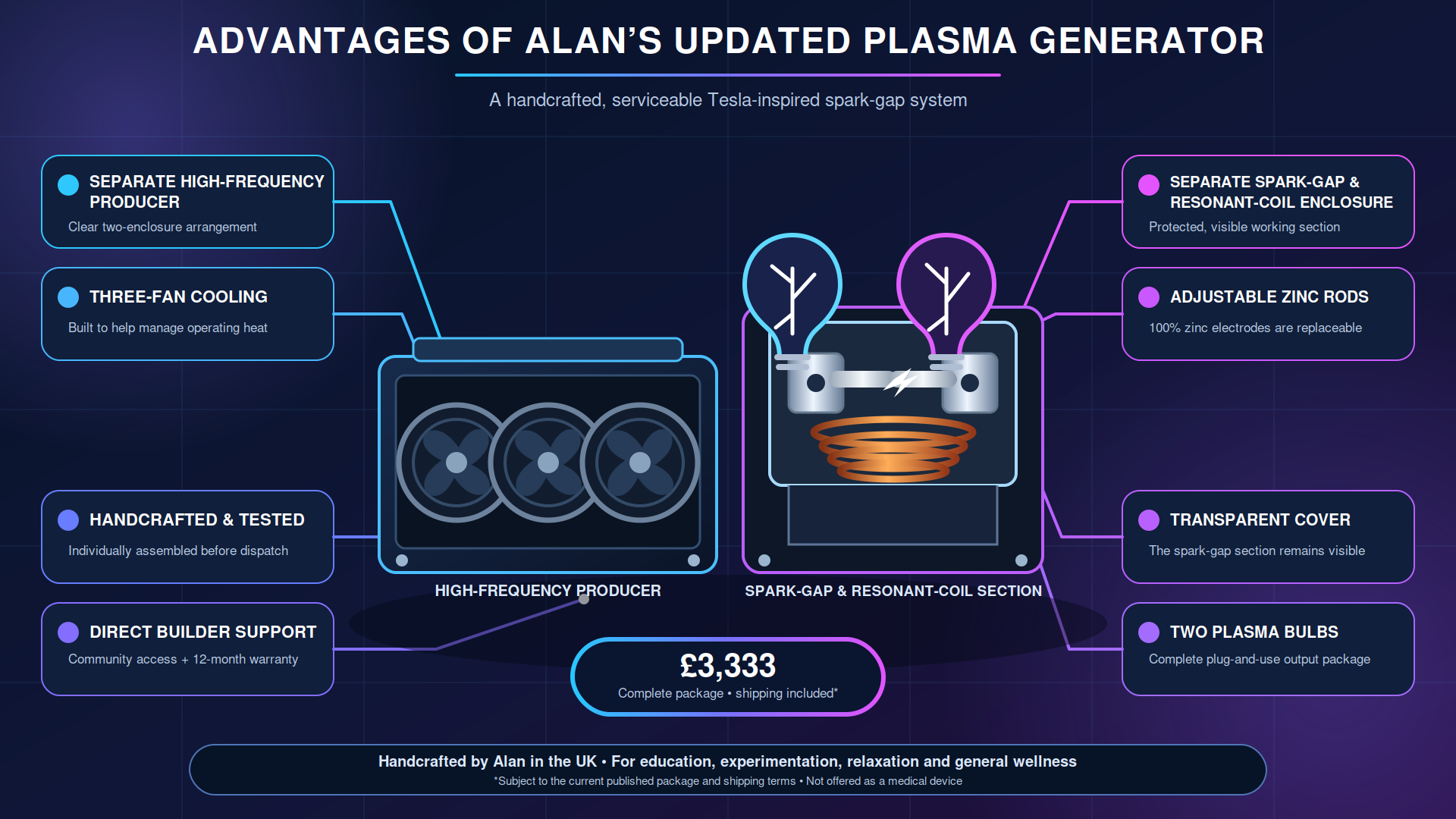
The updated design uses separate enclosures for the high-frequency producer and spark-gap/resonant-coil section. Its adjustable spark gap has solid, replaceable 100% zinc rods in dedicated supports beneath a transparent protective cover. Because electrodes gradually erode, easy inspection, alignment, cleaning and replacement are practical advantages.
A three-fan cooling arrangement helps manage operating heat. The system supplies two handheld plasma output bulbs and has been designed as a complete, plug-and-use package rather than a collection of experimental parts that the owner must source and assemble.
The package includes:
- two plasma output bulbs;
- one high-frequency producer;
- one separate spark-gap and resonant-coil enclosure;
- adjustable, replaceable solid zinc electrodes;
- three-fan cooling;
- straightforward operating instructions and an Owner’s Guide;
- individual testing before dispatch;
- shipping under the current published terms;
- direct customer support;
- access to the private High Frequency Plasma community; and
- a 12-month warranty covering manufacturing defects and workmanship.
The price is £3,333. Some premium Tesla-inspired plasma systems have been advertised at around $11,111 or more, although specifications and packages vary and buyers should always request a current written quotation. My aim is not to claim that every machine is identical. It is to offer a serviceable, handcrafted spark-gap plasma system based on the same broad historical principles at a more accessible price.
Advantages of an Adjustable and Maintainable Design
Spark gaps are working components. Repeated arcing changes the electrode surfaces, so cleaning, alignment and gradual adjustment are normal maintenance—not evidence that the whole machine has failed.
My updated design uses dedicated holders and replaceable zinc rods. Once the generator has been switched off, unplugged and made safe according to its instructions, the gap can be inspected and maintained without redesigning the assembly.
Separate enclosures also make the functional sections easier to understand. Visible construction, protected access, cooling and direct builder support provide practical value long after the initial purchase. For a fuller comparison, read Tesla Plasma Machine: Design, Maintenance and Value.
How Owners Commonly Use the Generator
Owners may be interested in Tesla history, visible plasma, experimentation, meditation, relaxation or general wellness.
New owners should follow the supplied Owner’s Guide rather than copying another machine’s settings. A gradual approach is recommended: begin with a short introductory session and increase only in line with the guidance and personal comfort. More time or intensity is not automatically better.
The generator is intended for education, experimentation, research, meditation, relaxation and general wellness. It is not a medical device and is not offered to diagnose, treat, cure, mitigate or prevent any disease. Anyone with symptoms or a health concern should obtain advice from a suitably qualified healthcare professional rather than delaying evidence-based care.
Important Safety Considerations
A Tesla-inspired spark-gap machine contains high voltage and can produce strong electromagnetic interference. It must be treated as real electrical equipment, not as a harmless toy.
Use it only in a dry, stable and well-ventilated position. Keep it away from water, flammable vapours, oxygen-rich environments, children, pets and sensitive electronics. Never open an enclosure, adjust a spark gap, touch internal wiring or begin maintenance while the equipment is connected to power. Capacitors can retain dangerous energy after switch-off, so follow the supplied isolation and discharge instructions.
People who are pregnant or who have a pacemaker, implanted defibrillator, neurostimulator, insulin pump, cochlear implant or other implanted or body-worn electronic medical equipment should not use the generator unless the relevant medical-device manufacturer and an appropriately qualified healthcare professional have specifically confirmed that it is safe for their circumstances. UK government guidance recognises that electromagnetic fields can interfere with some implanted medical devices.
The phrase also has regulatory implications. The UK MHRA says intended purpose is judged from labelling, instructions, promotional material and mode of action. Calling something a healing machine does not establish efficacy. Here the phrase answers a popular search while my generator is accurately described as a non-medical general-wellness and experimental device.
Frequently Asked Questions About Tesla Healing Machines
Did Nikola Tesla invent a healing machine?
Tesla invented and demonstrated high-frequency electrical apparatus, resonant transformers and systems using capacitors, switching or disruptive discharges. He did not invent a consumer product officially known by today’s generic phrase “Tesla healing machine.”
Do all Tesla healing machines use a spark gap?
No. Traditional Tesla-inspired machines often use spark gaps, but some modern products use solid-state electronics, and others use Tesla’s name mainly for marketing. Always inspect the actual design.
Does the spark gap set the frequency?
Not by itself. The gap triggers repeated discharges. Capacitance, inductance, coupling, load, geometry and switching behaviour all help determine the resulting oscillations and spectrum.
Are plasma bulbs the same as medical cold-plasma treatment?
No. A glowing sealed bulb and a purpose-built clinical CAP jet or dielectric-barrier-discharge system may both involve ionised gas, but their outputs and routes of exposure differ. Research on one is not proof for the other.
Where can I learn more or ask questions?
Read the free High Frequency Plasma Learning Centre or join the High Frequency Plasma Community on Telegram to ask questions and hear from people interested in the technology.
Final Answer: What Is a Tesla Healing Machine?
So, what is a Tesla healing machine? It is a modern, informal label for equipment inspired to varying degrees by Nikola Tesla’s experiments with high-frequency, high-potential electricity, resonance, capacitors, spark gaps, coils and glowing gas-filled tubes.
Tesla’s patents document charging capacitors and releasing their energy to create rapid oscillations. Researchers have also measured biological effects from specific high-frequency and cold-plasma devices under controlled conditions.
What has not been established is that every home machine carrying Tesla’s name has the same output or can heal disease. A credible supplier should make that limitation clear.

My updated High Frequency Plasma Generator offers two plasma bulbs, separate protected enclosures, adjustable replaceable zinc rods, three-fan cooling, individual testing, direct support, community access and a 12-month warranty for £3,333.
You can view the complete generator and current package or join the free Telegram community before deciding whether it is right for you.