
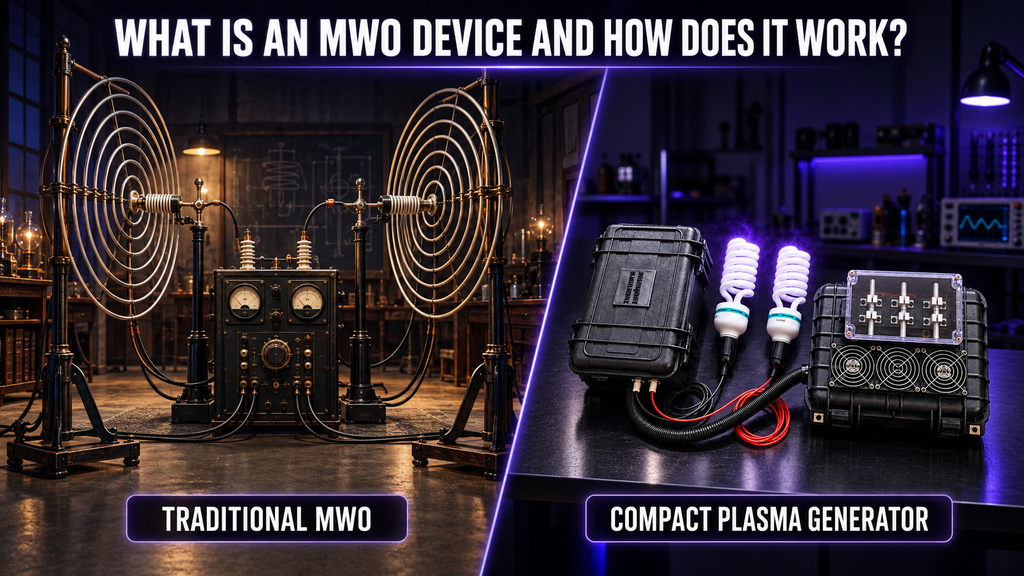
If you have been researching Tesla-inspired equipment or frequency technology, you may have encountered the initials MWO. But what is an MWO device and how does it work?
MWO stands for Multiple Wave Oscillator, also written as Multi Wave Oscillator. It is a high-frequency apparatus associated with engineer Georges Lakhovsky. A traditional system combines a high-voltage generator, capacitors, a spark gap, resonant coils and distinctive antennas made from concentric open rings of different sizes. When the rings are excited by rapid electrical impulses, they respond at different natural frequencies and harmonics.
Original-style systems can be fascinating, but also large, heavy and extremely expensive. This guide explains (What Is an MWO Device and How Does It Work?) the technology and compares it with my handcrafted High Frequency Plasma Generator. My smaller, lower-cost device uses some of the same broad principles—high voltage, capacitance, spark-gap discharge, oscillation and resonance—but it is not an MWO replica.
What Is an MWO Device and How Does It Work? The Short Answer
An MWO is a high-frequency oscillator intended to excite several resonant circuits together. Its most recognisable feature is an antenna containing multiple split rings. Every ring has a different diameter and therefore a different electrical response.
Lakhovsky’s 1934 US patent describes concentric, insulated split rings of different diameters, sometimes ending in small metal spheres that add capacitance. Some rings are connected to the energising circuit; others are excited by induction. The original Lakhovsky patent US1962565A remains the best primary source for the design.
In simple terms, the generator creates rapid electrical impulses, a resonant circuit turns them into oscillations, and the differently sized rings respond across multiple frequencies. That is the basis of the name Multiple Wave Oscillator.
Who Invented the Multiple Wave Oscillator?
The MWO is associated with Georges Lakhovsky, a Russian-born engineer who settled in France. He believed living cells behaved like tiny oscillating circuits and proposed that external frequencies might reinforce their natural oscillations. This remains a historical theory, not an established principle of modern biology.
His US patent was filed in 1931 and granted in 1934. It specifies an induction coil, capacitor, spark gap, self-induction coils and split-ring radiators. A patent documents an invention; it does not prove medical safety or effectiveness.
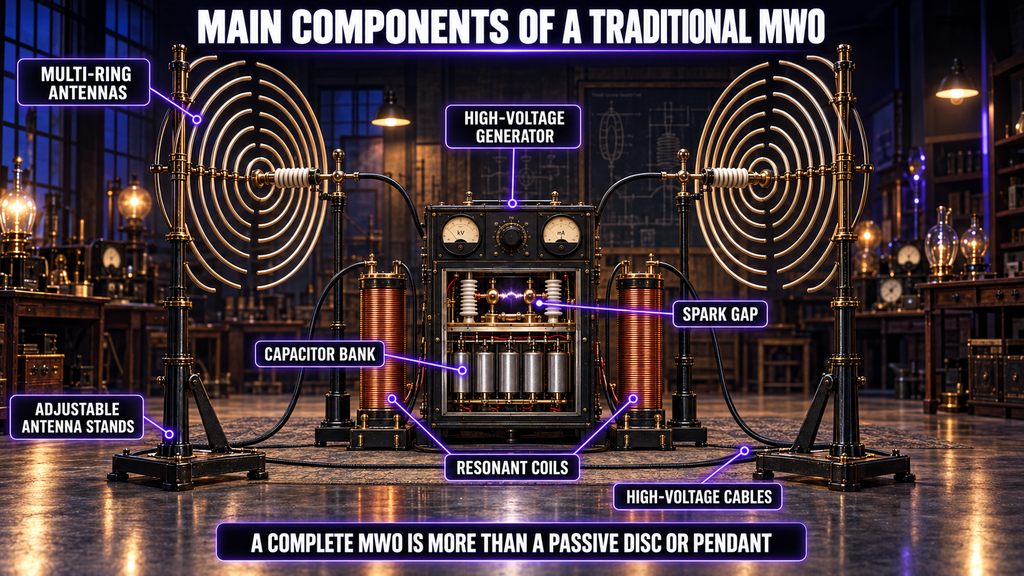
What Are the Main Parts of a Traditional MWO?
A complete historical-style system commonly includes:
- A power supply and high-voltage transformer
- Capacitors for storing electrical charge
- A spark gap that repeatedly releases the stored energy
- Resonant or Oudin-style coils
- High-voltage cables and controls
- One or two multi-ring antennas on adjustable stands
- Earthing, cooling and electrical protection
Some systems also include hand-held electrodes or a footplate. Many inexpensive “MWO devices” sold online are only passive discs, pendants or small antennas, not powered oscillators with full-sized radiators. This difference is essential when comparing prices.

What Is an MWO Device and How Does It Work Step by Step?
Although the circuitry can be sophisticated, its operating sequence can be understood in seven stages.
1. Power enters the generator
The incoming supply provides energy; ordinary mains electricity is not passed straight to the antennas.
2. A transformer increases the voltage
A transformer or induction coil creates the high voltage needed to energise the oscillator.
3. Capacitors accumulate charge
Capacitors store energy until the voltage across the spark gap becomes high enough for the air between its electrodes to break down.
4. The spark gap fires
The gap releases the stored energy rapidly. In a traditional oscillator, the spark acts as a fast switch and the charge-and-discharge process repeats.
5. The resonant circuit oscillates
The discharge excites a circuit formed by capacitance and inductance, producing high-frequency oscillations, harmonics and transient components.
6. The ring antennas respond
Energy reaches the antennas through connection and induction. Each differently sized ring has its own natural response, contributing to the combined output.
7. A complex field forms
The result is a complex electromagnetic environment rather than one pure frequency. Full systems may place two antennas on opposite sides of the working area.
That is the practical answer to what is an MWO device and how does it work? It is a pulsed high-frequency generator coupled to several resonant radiators of different sizes.
Why Is It Called a “Multiple Wave” Oscillator?
The name does not necessarily mean that thousands of separately programmed frequencies are produced. The multiple-wave effect comes mainly from pulsed excitation, harmonics and the resonant behaviour of the differently sized rings.
An impulse is broader in frequency content than a steady tone. The spark gap and resonant circuit create oscillations, while every ring adds its own response. Ring spacing, coupling and nearby objects can affect the measured output.
This is why an MWO cannot be accurately summarised by quoting one “healing frequency.” Its real output must be measured on the particular machine in its actual operating arrangement.
For simpler introductions, read my guides to frequency, electrical oscillations and resonance.
Why Can a Complete MWO Need So Much Room?
A full MWO is more than an electronic box. It may include a heavy generator, two resonator coils, two large antennas on stands, cables, electrodes and safe operating clearance. The antennas may be arranged around the user rather than placed together on a tabletop.
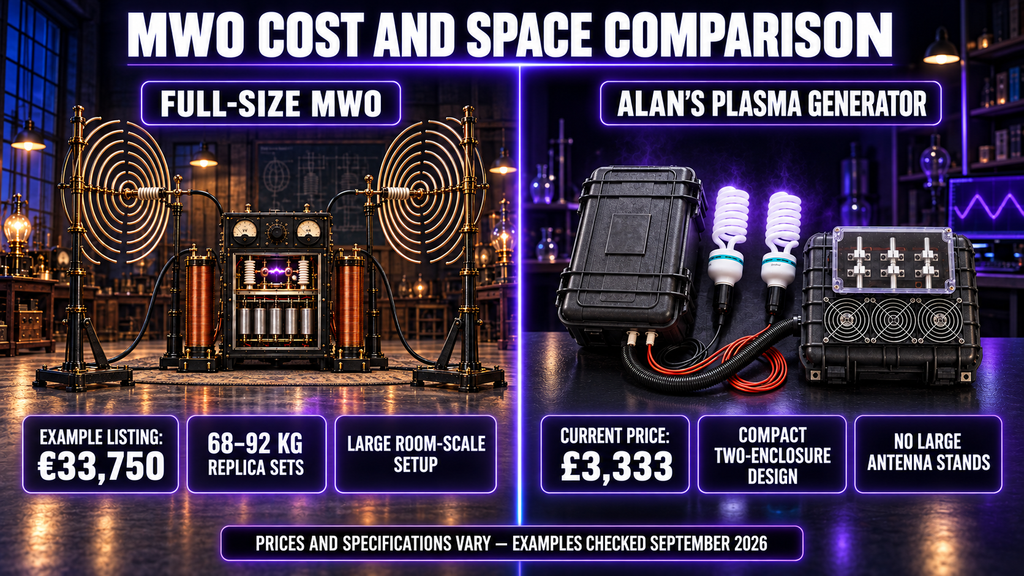
One specialist maker lists a standard replica enclosure measuring 590 × 542 × 590 mm and a floor-standing version measuring 640 × 570 × 1,060 mm. Complete sets weigh 68 kg and 92 kg respectively. Each also includes two antennas, two resonator coils and stands, making the real footprint larger than the enclosure alone. These figures come from RT17’s current BV2 replica specifications.
An owner may therefore need to consider storage, transport, ventilation, antenna positioning and distance from sensitive electronics.
How Much Does an MWO Device Cost?
There is no standard MWO price because the name is used for radically different products. Prices checked in September 2026 ranged from inexpensive passive objects to professional high-voltage systems.
| Product using the MWO name | Example price or method | Important distinction |
|---|---|---|
| Passive disc, pendant or small antenna | Often tens or hundreds of pounds | Not a complete powered MWO |
| Simplified active MWO/Tesla-coil system | One eBay example was about £887 | Specifications and safety provisions vary |
| Large specialist MWO system | One Meditech listing showed €33,750 | Major investment; out of stock when checked |
| Historically faithful BV2 replica | Price on request | 68–92 kg sets with coils, antennas and custom parts |
The active example appears in this Lakhovsky MWO eBay listing; the high-end example appears on Meditech Europe’s MWO page. Prices, exchange rates, availability, taxes and shipping can change.
The cost of a full machine can reflect custom transformers, antennas, pulse capacitors, shielded cables, cooling, stands, specialist labour and shipping. Nevertheless, a high price alone does not prove historical accuracy, quality or medical effectiveness.
Always establish whether an offer is for a complete working oscillator, a simplified interpretation or only an antenna accessory.
What Does Science Say About MWO Health Claims?
Historical MWO literature contains ambitious claims, but they are not settled medical science. Lakhovsky’s cellular-oscillation theory is historically interesting, not a clinically validated explanation of disease.
A modern scientific review mentions Lakhovsky’s apparatus as part of the history of radiofrequency research. It also shows that present-day medical RF technologies use defined exposures, specific delivery systems and clinical evaluation. The existence of medically approved electromagnetic treatments does not validate every historical or consumer frequency machine. See this peer-reviewed review of radiofrequency electromagnetic fields.
I have not found robust modern clinical trials demonstrating that a traditional MWO diagnoses, treats or cures illness. Personal accounts may matter to those reporting them, but testimonials do not establish clinical efficacy. An MWO or plasma generator should never replace professional diagnosis or treatment.
How Is My High Frequency Plasma Generator Related to an MWO?
My device works from some of the same basic high-frequency electrical principles, but it is not a copy of Lakhovsky’s Multiple Wave Oscillator.
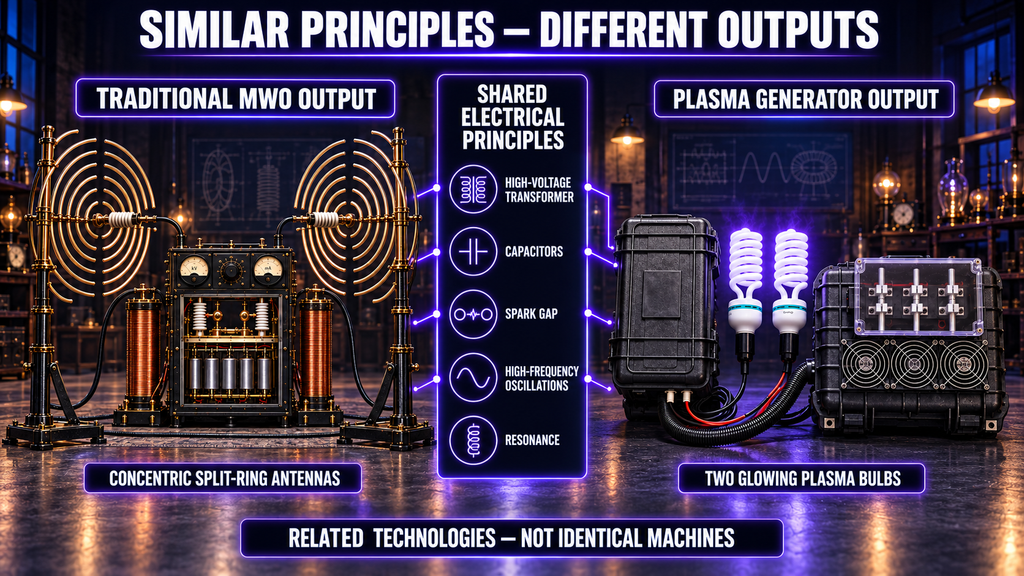
Both technologies use a power source, transformer, capacitance, rapid spark-gap discharge, coils, oscillation and resonance. Both create high-frequency electrical effects that differ greatly from ordinary 50 Hz household power.
The main difference is the output. A classic MWO excites arrays of differently sized open rings. My High Frequency Plasma Generator sends its output to two gas-filled plasma bulbs. The changing electric field ionises the low-pressure gas inside the glass, producing visible plasma.
| Feature | Traditional full MWO | My High Frequency Plasma Generator |
| Main inspiration | Lakhovsky’s multi-ring system | Tesla-inspired spark-gap and plasma experiments |
| Shared ideas | High voltage, capacitors, spark gap, coils, resonance | High voltage, capacitor banks, spark gap, coils, resonance |
| Output | Concentric split-ring antennas | Two hand-held plasma bulbs |
| Installation | Generator, coils, antenna stands and working area | Compact two-enclosure, plug-and-use arrangement |
| Example cost | Up to €33,750 above; some replicas are price-on-request | £3,333, including the stated package and shipping |
| Intended status | Varies; some replicas specify research or exhibition use | Education, exploration, relaxation and general wellness; not a medical device |
This distinction makes the comparison accurate. My generator belongs to the wider family of Tesla-inspired high-frequency and spark-gap technologies, but it does not claim to reproduce a BV2 MWO’s antenna geometry, spectrum or field pattern.
How Does My Plasma Device Work?
First, power enters the high-frequency producer and the transformer raises the voltage. Capacitor banks store energy. When the voltage across the adjustable spark gap becomes sufficient, the gap conducts and releases a rapid pulse.
The discharge excites high-frequency oscillations in the connected circuit. The output then reaches two plasma bulbs, where the changing field energises and ionises the sealed gas. The glowing bulbs give a clear visual indication that the plasma output is active.
The protected spark-gap enclosure uses adjustable, replaceable solid zinc rods. Built-in cooling helps manage operating heat. Learn more in How Does a Plasma Generator Work? and What Is a Spark Gap?.
Unlike a full MWO installation, it does not require two large ring antennas, tall stands or a dedicated area between radiators. It still needs a dry, stable surface, unobstructed ventilation and separation from sensitive electronics.
A More Compact and Lower-Cost Way to Explore Spark-Gap Plasma
Someone mainly interested in visible plasma and high-frequency experimentation may find that a complete historical MWO requires far more room and equipment than needed. It may also demand a five-figure budget.
My High Frequency Plasma Generator costs £3,333. Each system is handcrafted in the UK and tested before dispatch. The package includes:
- Two plasma output bulbs
- One high-frequency producer
- One spark-gap generator with adjustable, replaceable zinc rods
- Built-in cooling and operating instructions
- Shipping, direct customer support and community access
- A 12-month warranty covering manufacturing defects and workmanship
It is not the cheapest frequency-labelled object online; it is a complete, serviceable plasma system with visible output, personal support and replaceable spark-gap components. Compared with a full MWO listed at €33,750, it offers a substantially more accessible route into traditional spark-gap and plasma technology.
See the High Frequency Plasma Generator product page for current details.
Which Type of Device Is Right for You?
A faithful MWO may suit a collector, historian or researcher specifically interested in Lakhovsky’s multi-ring system and willing to accept its cost, mass and space requirements.
My generator may be more practical for exploration, meditation, relaxation or learning. It provides the characteristic spark-gap sound and visible plasma bulbs without a large antenna installation.
Before buying either type, ask:
- Is it a complete powered system or only a passive antenna?
- What components are included in the price?
- What are the assembled dimensions and weight?
- What ventilation and operating clearance are required?
- Which parts need cleaning, adjustment or replacement?
- What instructions, warranty and support are supplied?
- Has the seller separated measured output from wellness claims?
Spark gaps can also produce radio-frequency interference. UK Electromagnetic Compatibility Regulations guidance explains the obligations applying to electrical equipment capable of generating electromagnetic disturbance.
Essential High-Voltage Safety
MWOs and spark-gap plasma generators are high-voltage devices. Never touch internal parts, adjust a gap or connect accessories while equipment is energised.
Use a finished, enclosed system according to its instructions. Operate it on a dry, stable surface with ventilation unobstructed. Keep it away from water, flammable vapours, oxygen-enriched environments, children, pets and sensitive electronics. Spark gaps can generate heat, ozone, ultraviolet light and electromagnetic interference.
People who are pregnant or use pacemakers, neurostimulators, insulin pumps or other implanted or body-worn electronic medical equipment should not use this type of device unless compatibility has been confirmed by the medical-device manufacturer and an appropriately qualified healthcare professional.
What Is an MWO Device and How Does It Work?Frequently Asked Questions
What does MWO stand for?
MWO means Multiple Wave Oscillator or Multi Wave Oscillator. It describes a high-frequency system that excites multiple resonant circuits, producing several wavelengths, harmonics and transient components.
What is an MWO device and how does it work in simple terms?
It uses a high-voltage source, capacitors, a spark gap and coils to create rapid electrical oscillations. These excite concentric split-ring antennas of different sizes. Each ring has its own resonant response, contributing to a complex electromagnetic field.
Is an MWO the same as a Tesla coil?
No. They share high-voltage and resonance concepts, and some MWO versions use Tesla- or Oudin-style coils. A classic MWO is distinguished by multiple split-ring radiators, while a Tesla coil has its own primary-and-secondary resonant-transformer architecture.
Is a plasma generator an MWO?
Not automatically. My generator shares transformer, capacitor, spark-gap, oscillation and resonance principles with traditional high-frequency systems. Its output uses gas-filled plasma bulbs rather than Lakhovsky’s concentric ring antennas, so it is not sold as an MWO replica.
Can an MWO cure illness?
Robust modern clinical evidence has not established a traditional MWO as a cure for disease. Historical theories and testimonials should not be confused with controlled clinical proof. Always seek qualified medical care for symptoms or a diagnosis.
Final Thoughts: What Is an MWO Device and How Does It Work?
The Multiple Wave Oscillator converts electrical power into high-voltage oscillations and excites differently sized split-ring resonators. A complete historical-style system can be impressive, but also exceptionally large, heavy and costly.
My High Frequency Plasma Generator explores related high-frequency principles in a more compact form. It combines a transformer, capacitor banks, spark gap and resonant circuitry, then makes the output visible in two plasma bulbs. At £3,333, it is far less costly than the €33,750 MWO example above and does not require a room-sized antenna arrangement.
For an exact Lakhovsky replica, choose a supplier able to document its construction and measurements. For a smaller handcrafted plasma system with direct support, explore my High Frequency Plasma Generator or join the free High Frequency Plasma Community on Telegram.
Important Disclaimer
This article is for historical, technical and educational information. The High Frequency Plasma Generator is intended for education, research, personal exploration, meditation, relaxation and general wellness. It is not a medical device and is not offered to diagnose, treat, cure, mitigate or prevent illness. No MWO or plasma generator should replace advice, diagnosis or treatment from a qualified healthcare professional.