
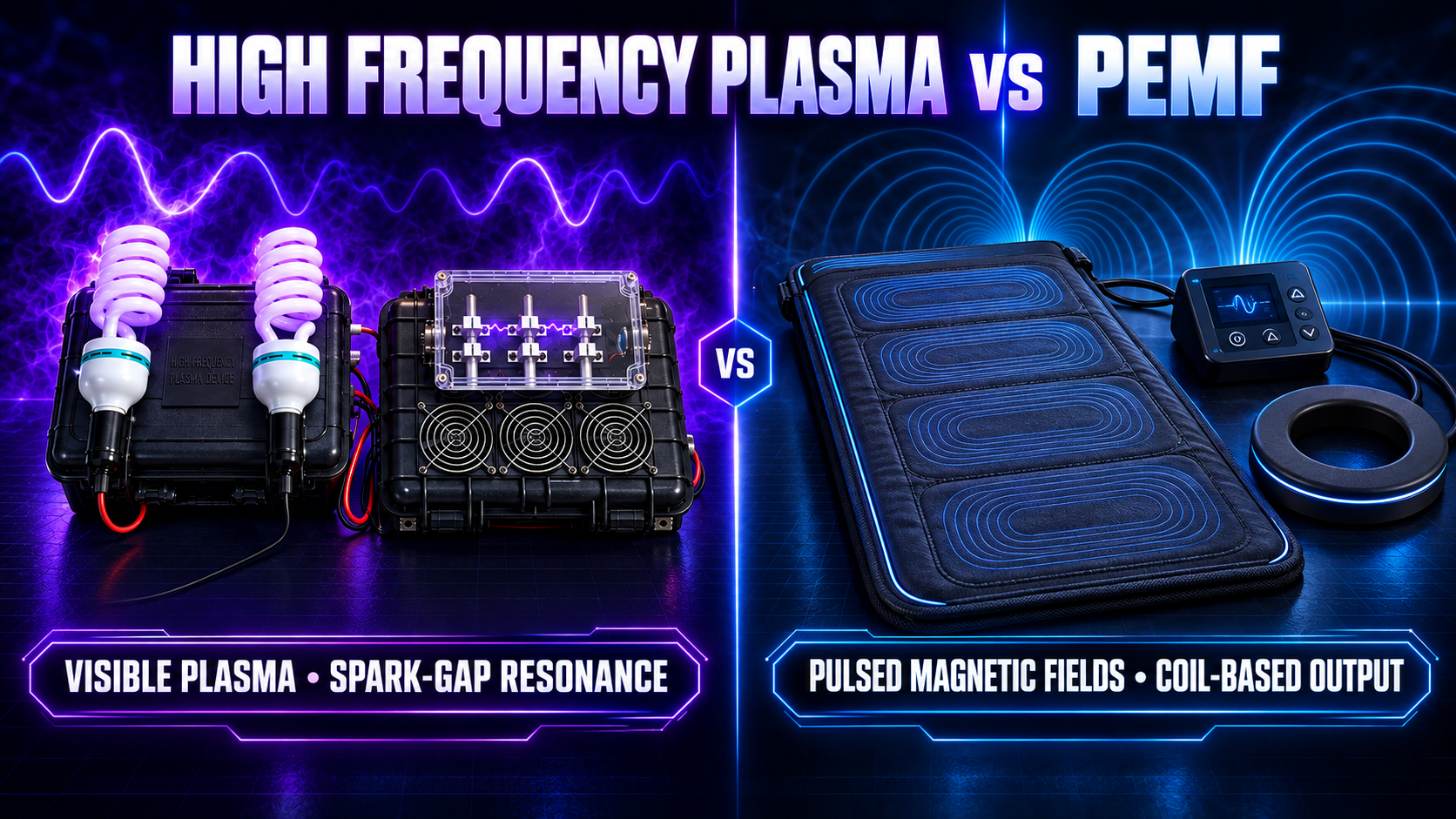
When comparing high frequency plasma vs PEMF, it is easy to assume that both machines do roughly the same thing. Both appear in frequency-technology and wellness communities, but their engineering, output and user experience are very different.
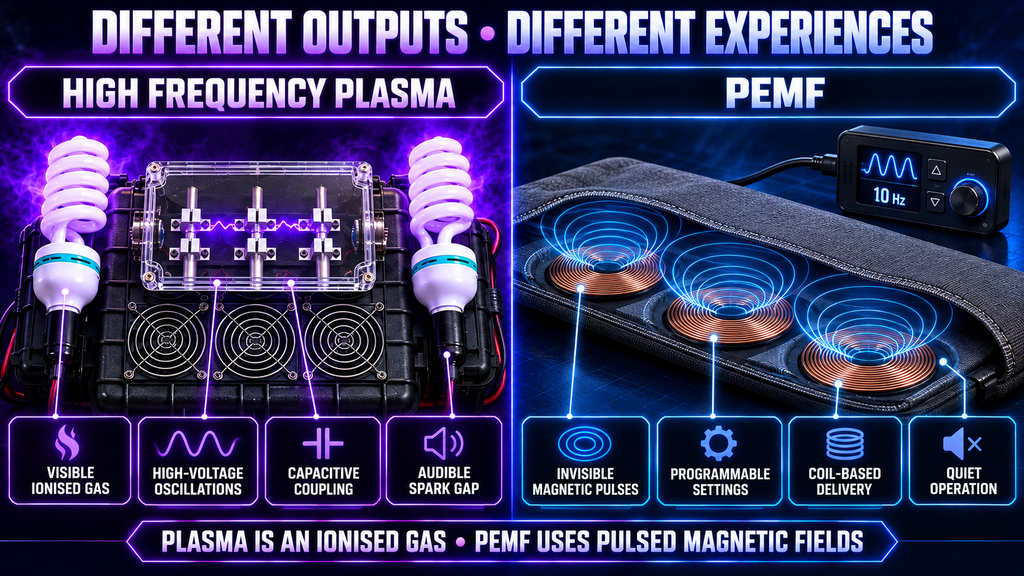
A traditional high-frequency plasma generator uses high voltage, rapid electrical oscillations, resonance and a spark gap to energise gas inside sealed bulbs. The result is visible plasma: the characteristic coloured glow and moving filaments seen inside the glass.
A PEMF machine—short for pulsed electromagnetic field machine—normally sends controlled electrical pulses through a coil. The changing current creates a changing magnetic field around that coil. Depending on the product, the coil may be built into a mat, pad, paddle, ring or full-body bed.
Neither name establishes medical suitability. Design, output, evidence, intended use and regulatory status all matter. This guide explains the practical differences without relying on vague claims about “energy” or “frequency.”
High Frequency Plasma vs PEMF: The Short Answer
The simplest distinction is the output device:
- A high-frequency plasma generator energises low-pressure gas inside glass bulbs, producing visible plasma.
- A PEMF machine drives one or more coils, producing timed magnetic-field pulses.
Alan’s High Frequency Plasma Generator is a Tesla-inspired spark-gap system with two handheld bulbs. It emphasises visible plasma, resonance and simple plug-and-use operation.
A typical PEMF system emphasises programmed pulses, adjustable intensity and coils placed near part or all of the body. It needs no plasma bulb or visible spark gap.
Both technologies involve electromagnetism, but that shared foundation does not make them interchangeable.
What Is a High-Frequency Plasma Generator?
A high-frequency plasma generator transforms an ordinary electrical supply through several stages. In Alan’s design, a 12-volt power supply feeds a ZVS driver, which drives a flyback transformer. Capacitors store electrical energy before it is released through an adjustable spark gap. The resulting rapid oscillations energise the output circuit and the two gas-filled bulbs.
A simplified pathway is:
Power supply → ZVS driver → flyback transformer → capacitor bank → spark gap → plasma bulbs
When sufficient voltage develops, a discharge jumps across the spark gap and excites the resonant circuit. This repeats rapidly during operation.
Inside each bulb is gas at reduced pressure. The changing electrical field causes ionisation, creating charged particles and visible light. The plasma remains inside the sealed glass; holding the bulb changes the surrounding electrical conditions through capacitive coupling, so glowing filaments may move towards the hand.
This is traditional spark-gap technology, not a digital frequency programme. The adjustable zinc rods affect firing behaviour and allow worn electrodes to be repositioned or replaced; they do not select precise, condition-specific frequencies.
You can explore the process in more detail in How Does a Plasma Generator Work? and What Is High Frequency Electricity?.
What Is a PEMF Machine?
PEMF stands for pulsed electromagnetic field. A changing current passes through a conductive coil, producing a changing magnetic field. Through electromagnetic induction, that field can create small electric fields in nearby conductive tissue.
The operating idea follows Faraday’s law: a changing magnetic field can induce an electric field. The exact output depends on several parameters, including:
- Pulse repetition frequency
- Magnetic flux density or field strength
- Waveform and pulse shape
- Pulse duration
- Coil size and geometry
- Distance between the coil and the body
- Session duration
Two PEMF products operating at the same number of hertz may therefore create different exposures. A 10 Hz label describes repetition rate, not waveform, intensity, rise time or induced electric field.
PEMF equipment includes local applicators, mats, beds, paddles and loops. Some products offer a few preset programmes; others allow changes to intensity, pulse rate and session time.
The International Commission on Non-Ionizing Radiation Protection explains that time-varying electric and magnetic fields are distinct but related components of electromagnetic exposure. That distinction is useful when comparing a magnetic-coil system with a high-voltage plasma generator.
High Frequency Plasma vs PEMF: Side-by-Side Comparison
| Feature | High-frequency plasma generator | PEMF machine |
|---|---|---|
| Primary output component | Gas-filled plasma bulbs | Magnetic coils |
| Main electrical approach | High-voltage oscillation, spark gap and resonance | Controlled current pulses through a coil |
| Visible effect | Illuminated plasma inside the bulbs | Usually no visible field |
| Frequency control | Normally determined by the resonant system | Often digitally selected or programmed |
| Common format | Generator with handheld bulbs | Mat, pad, paddle, loop or bed |
| User experience | Audible spark gap and visible glow | Usually quiet, with little or no sensation |
| Maintenance | Spark-gap inspection, electrode care and bulb handling | Mainly cables, connectors, electronics and fabric/coil care |
| Typical attraction | Tesla technology, plasma, resonance and experimentation | Adjustable magnetic-pulse programmes and targeted coil placement |
These are general characteristics, not universal rules. Specifications vary considerably, particularly among products sold under broad wellness terminology.

Difference One: How the Energy Is Produced
The most important difference in the high frequency plasma vs PEMF comparison is how electrical energy is converted at the output.
In a spark-gap plasma generator, stored electrical energy discharges across an air gap and excites a resonant circuit. The equipment operates at high voltage and creates rapid, complex oscillations. Those oscillations energise gas in the bulbs and make the plasma visible.
In a PEMF machine, solid-state electronics normally switch current through a coil according to a timed pattern. The coil’s magnetic field rises, falls or reverses as the current changes. There is no requirement for an electrical arc or ionised gas.
That difference shapes the construction, controls, maintenance, output measurement and user experience.
Difference Two: Electrical Fields, Magnetic Fields and Plasma
All electrical equipment produces some combination of electric and magnetic fields, but the intended output differs.
A PEMF machine is designed around a coil-generated magnetic field. It may be specified in tesla, millitesla, microtesla or gauss at a stated distance and changes according to the selected pulse pattern.
A plasma generator creates high-frequency electrical activity and visible ionisation inside its bulbs. Its electric-field characteristics, resonance and capacitive coupling are central to operation. It is not simply a PEMF coil with lights attached.
Likewise, a PEMF coil is not producing plasma. Plasma is an ionised gas; a magnetic pulse passing through air does not automatically create it.
Difference Three: Frequency Settings and Programmes
PEMF products often feature labelled pulse rates, preset programmes or manual adjustment. Frequency alone is not a complete output description; field strength, waveform, pulse duration, coil design and placement also matter.
Alan’s plasma generator does not contain a menu of numbered wellness programmes. Its oscillations arise from the spark-gap discharge and resonant electrical components. Adjusting the electrode spacing changes the way the gap fires, but it is not equivalent to entering 10 Hz, 50 Hz or another exact value on a PEMF controller.
If repeatable pulse settings are essential, seek a PEMF system with clear measured specifications. If your interest is Tesla-inspired spark-gap operation, visible plasma and resonance, a plasma generator offers a different experience.
Difference Four: What the User Experiences
High-frequency plasma is highly visual. The bulbs illuminate as gas becomes ionised, and the filaments respond when the glass is held. The spark gap and cooling fans can be heard. Some owners use a session for relaxation, meditation or personal exploration.
PEMF operation is less visible. A user may lie on a mat, position a pad or hold a coil nearby, sometimes without an obvious sensation. Indicator lights or a screen confirm that a programme is running.
Neither experience proves a biological or medical result. A bright bulb is evidence that gas has been ionised; it is not clinical proof of a health outcome. Similarly, the absence of sensation during PEMF use does not show that the coil is inactive.
Difference Five: Maintenance and Long-Term Ownership
A traditional spark gap is a working mechanical component. Repeated discharges gradually mark and erode the electrode surfaces. Alan’s system uses accessible, adjustable 100% zinc rods so they can be inspected, repositioned and replaced. Maintenance must only be performed after the unit is switched off, unplugged and fully discharged. The glass bulbs also require careful handling, and cooling vents should remain unobstructed.
PEMF maintenance may be limited to checking mats, cables, plugs and connectors. Proprietary controllers can require specialist repair, so ask whether replacement applicators and technical support will remain available.
What Does the Scientific Evidence Say?
PEMF is not one single treatment. Research results apply to a defined device, signal, intensity, schedule and clinical situation. A review of PEMF and skeletal response discusses its established history in specific bone-healing applications, including regulated equipment used for non-union fractures. That does not mean every consumer PEMF mat is approved to treat bone conditions—or any other condition.
Because electromagnetic studies use varied parameters, manufacturers should identify evidence for their own intended use instead of borrowing conclusions from unrelated equipment.
Clinical research into cold atmospheric plasma should not be transferred automatically to a home spark-gap generator either. Cold atmospheric plasma jets, dielectric-barrier discharges and sealed handheld plasma bulbs are different configurations with different outputs and exposure conditions.
Alan’s High Frequency Plasma Generator is not medical equipment. It is supplied for education, electrical experimentation, research, meditation, relaxation and general personal wellness. No claim is made that it diagnoses, treats, cures, mitigates or prevents disease.
Can High-Frequency Plasma Vs PEMF Be Used Together?
Some people own both technologies, but they should not be connected or assumed safe to operate simultaneously.
A spark-gap generator can produce electromagnetic interference. Do not place a PEMF controller, computer, television, phone or other sensitive electronics beside the operating plasma machine. Keep equipment physically separate, use only one system at a time and follow each manufacturer’s instructions. Never connect the plasma-generator output to a PEMF mat or coil unless the complete system has been professionally designed and tested for that exact purpose; doing so can damage equipment and create serious electrical hazards.
Treat them as separate systems with separate operating principles.
Which Is Better for Home Use?
There is no universal winner in the high frequency plasma vs PEMF decision. The appropriate choice depends on what you expect the equipment to do.
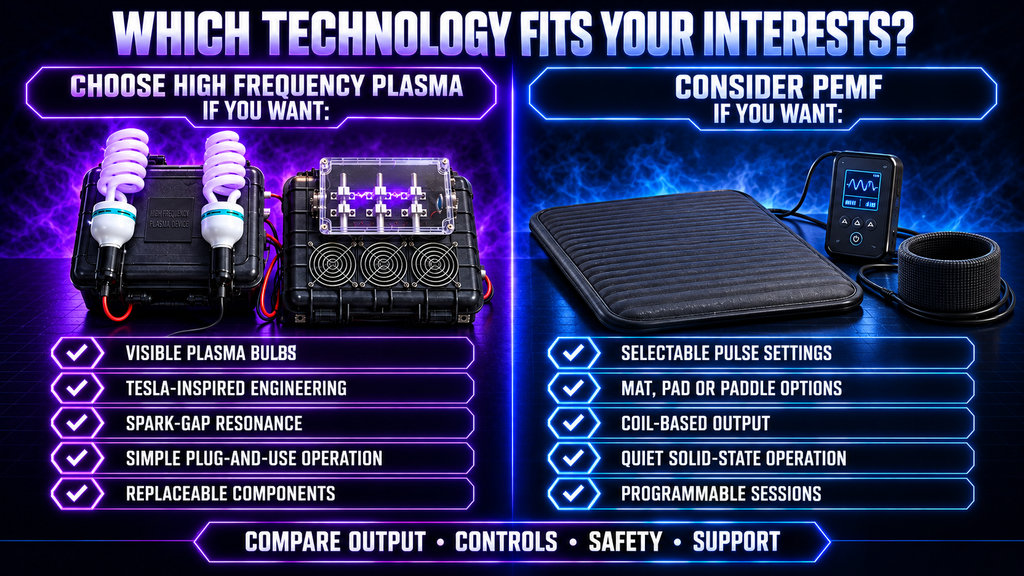
A traditional plasma generator may suit you if you value:
- Visible plasma and an interactive electrical display
- Tesla-inspired spark-gap engineering
- Resonance and high-frequency experimentation
- Straightforward operation without software
- Accessible, replaceable wear components
- Two handheld bulbs rather than a mat or local coil
- Direct support from the person who built the machine
A PEMF machine may suit you if you specifically want:
- Adjustable pulse repetition settings
- Preset or programmable sessions
- A mat, bed, paddle or targeted coil
- Quiet, solid-state operation
- Published specifications for magnetic flux density
- A regulated device for a clearly defined medical indication, when prescribed or recommended by an appropriate healthcare professional
Do not choose from impressive frequency numbers alone. Ask what is generated, how and where it is measured, and what evidence supports the intended use.
Questions to Ask Before Buying
Before purchasing a plasma generator or PEMF system, ask:
- What physical output does the machine create?
- Which measurements and units describe that output?
- Is the frequency fixed, resonant, swept or programmable?
- Where was the output measured, and with what instrument?
- What accessories are included?
- What maintenance or replacement parts are required?
- Which safety instructions and contraindications apply?
- What does the warranty cover?
- Is technical support available after purchase?
- Is it a regulated medical device for the advertised purpose, or non-medical wellness and experimental equipment?
Clear answers are more valuable than a long list of unsupported benefits.
Why Consider Alan’s High Frequency Plasma Generator?
Alan’s High Frequency Plasma Generator is designed for people attracted to traditional spark-gap plasma technology rather than programmable magnetic-field sessions.
The complete system costs £3,333 and includes:
- Two plasma output bulbs
- One high-frequency producer
- One spark-gap generator with adjustable 100% zinc rods
- Built-in cooling
- Simple operating instructions
- Shipping
- Direct customer support
- Access to the High Frequency Plasma Community Group
- A 12-month machine warranty; the glass bulbs are excluded
Each generator is handcrafted and tested in the UK. The plug-and-use format avoids software and programme libraries. Its accessible spark gap supports practical electrode inspection and replacement, with direct help available after purchase.
It is not a PEMF replacement, but an alternative for buyers interested in plasma, resonance, Tesla-inspired technology and visible electrical operation.
Safety Considerations
Both technologies should be used only according to their supplied instructions. Alan’s plasma generator must not be used during pregnancy or by anyone with a pacemaker or other implanted electronic device. Keep it away from televisions, computers, laptops, data-storage equipment and other sensitive electronics. Never open or adjust it while connected to power.
PEMF restrictions may also involve implanted electronics, pregnancy or medical conditions. Follow the manufacturer’s guidance and use prescription equipment only for its authorised purpose.
Frequently Asked Questions
Is high-frequency plasma the same as PEMF?
No. A plasma generator uses high-frequency electrical oscillations to ionise gas inside bulbs. A PEMF machine drives a coil to create pulsed magnetic fields.
Does Alan’s plasma generator contain PEMF programmes?
No. It is a traditional resonant spark-gap system rather than a digital machine with selectable PEMF programmes.
Is a higher frequency always better?
No. Frequency is only one parameter. Voltage, current, magnetic flux density, waveform, pulse duration, coupling, distance and intended use all affect how equipment operates.
Can I connect plasma-generator wires to a PEMF mat?
No. The systems have different electrical requirements. Connecting them without a professionally engineered interface can destroy components and create shock, fire or high-voltage hazards.
Which technology is more visible during use?
High-frequency plasma. Ionised gas produces a bright glow inside the bulbs. PEMF fields are normally invisible.
Are all PEMF machines medical devices?
No. Some specific PEMF products are regulated for defined clinical uses, while many consumer products are sold only for general wellness. Check the exact model, intended purpose and regulatory documentation.
Final Thoughts
The high frequency plasma vs PEMF comparison becomes much simpler once you look beyond the shared word frequency.
PEMF machines energise coils to produce controlled magnetic pulses, often with selectable programmes and targeted or full-body applicators. Plasma generators use high voltage, spark-gap discharge and resonance to create visible plasma inside gas-filled bulbs.
Choose according to the technology you genuinely want—not an unsupported promise. Compare the output, controls, specifications, maintenance, safety information, evidence and after-sales support.
If visible plasma, traditional spark-gap resonance and uncomplicated home operation appeal to you, explore Alan’s handcrafted High Frequency Plasma Generator or join the High Frequency Plasma Community Group to learn more.
Important disclaimer: This article is provided for education and general product comparison. Alan’s High Frequency Plasma Generator is not a medical device and is not intended to diagnose, treat, cure, mitigate or prevent any disease. Never delay or replace professional medical care because of information about a plasma, PEMF, frequency or wellness device.