When comparing a violet ray vs Tesla plasma generator, it is easy to assume that one is a smaller version of the other. Both use high-voltage, high-frequency principles, can make gas inside glass glow and are associated with Tesla-era experiments.
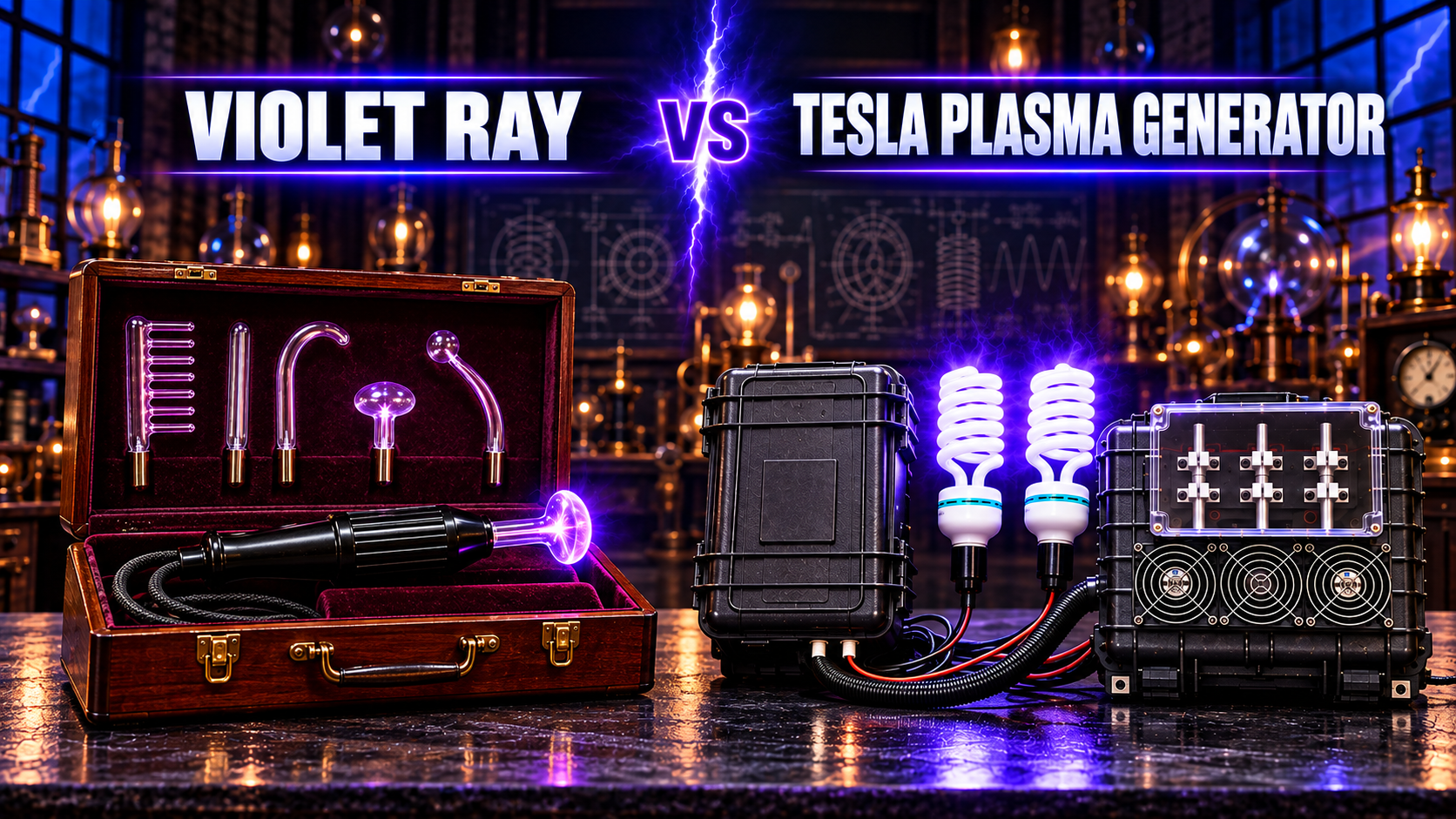
They are nevertheless different types of machine.
A violet ray normally uses a compact handpiece with small interchangeable glass electrodes intended for local application. My High Frequency Plasma Generator is a separate two-box spark-gap system that sends its output to two large spiral plasma bulbs, normally held one in each hand.
Their scale, circuitry, output and maintenance are very different. This guide explains why while separating electrical history from unproven medical claims.
Violet Ray vs Tesla Plasma Generator: The Short Answer
A violet ray is generally a portable wand or cased apparatus that energises a small glass electrode. Different shapes were historically supplied for local areas. The gas glows, and a corona or small spark can form near the surface.
A Tesla plasma generator is a broader term. Here it refers to my spark-gap system: a high-frequency producer, transformer, capacitor banks, adjustable zinc gap, resonant section and two large gas-filled bulbs.
In simple terms:
- A violet ray is a compact, single-electrode local wand.
- My generator is a larger, two-bulb resonant plasma system.
- They share high-frequency ancestry but are not interchangeable.
- Neither should be assumed to diagnose or treat disease.
What Is a Violet Ray?
Violet-ray machines became popular during the early twentieth century. Historical examples survive in the collections of the Smithsonian National Museum of American History and the Science Museum Group.
Typical sets included:
- A mains-powered control box or compact powered handpiece
- A high-frequency coil or transformer
- A holder for interchangeable glass electrodes
- Several electrode shapes stored in a fitted case
- An intensity control on some models
The glass electrodes were evacuated or contained low-pressure gas. When energised, they glowed—often violet, but sometimes red, blue or orange depending on their construction. This gave the violet ray its name.
Manufacturers offered mushroom electrodes, combs, tubes and curved attachments. Their shapes reflected local application rather than a different generator principle.
Violet rays were sold with sweeping claims for pain, baldness, skin conditions and unrelated illnesses. Museum records document those claims but do not validate them as clinical fact.
Did Nikola Tesla Invent the Violet Ray?
Violet-ray technology grew from high-frequency work associated with Tesla, d’Arsonval, Oudin and later manufacturers.
Tesla’s work with resonant transformers, gas-discharge tubes and high-frequency currents influenced the field. However, there was no single standard consumer appliance designed and marketed by Tesla as “the violet ray.” Later commercial sets differed considerably.
A product can therefore be Tesla-inspired without being a Tesla coil in the strict engineering sense. Two Tesla-inspired machines can work differently.
What Is a Tesla Plasma Generator?
“Tesla plasma generator” is not one regulated or standardised product category. It can describe different high-frequency machines, so the actual construction must be examined.
My High Frequency Plasma Generator follows a spark-gap and resonant-coil approach:
- Power enters the high-frequency producer.
- The switching circuitry drives a high-voltage transformer.
- Capacitors accumulate electrical charge.
- The voltage rises until the air in the spark gap breaks down.
- The gap fires and releases the stored energy rapidly.
- The discharge excites the resonant output circuit.
- High-frequency output reaches two low-pressure gas bulbs.
- The gas becomes partly ionised and visible plasma appears.
The plasma remains sealed inside the glass. When a bulb is held, capacitive coupling changes the surrounding conditions, so the glow may concentrate towards the hand.
For a detailed explanation, see How Does a Plasma Generator Work?.
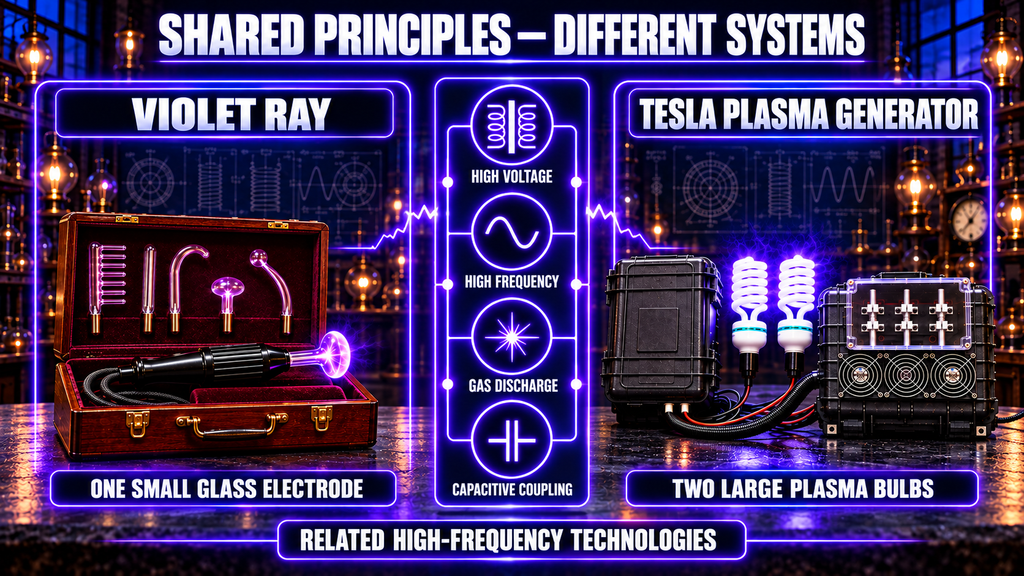
Violet Ray vs Tesla Plasma Generator Comparison
| Feature | Violet-ray wand or apparatus | Alan’s Tesla-inspired plasma generator |
|---|---|---|
| Typical format | Small handpiece or fitted portable set | Separate two-enclosure tabletop system |
| Output component | One small interchangeable glass electrode | Two large spiral plasma bulbs |
| Usual application | Electrode moved over or close to a local area | One bulb normally held in each hand |
| Electrical design | Compact high-frequency coil; design varies by age and model | Transformer, capacitor banks, external adjustable spark gap and resonant output |
| Visible effect | Coloured glow in the electrode; possible surface corona or spark | Bright moving plasma inside both bulbs |
| Spark-gap access | Usually absent, internal or not user-serviceable on modern wands | Visible, adjustable and serviceable zinc-rod assembly |
| Sound | Often a lighter buzz or crackle, depending on model | Distinct audible spark-gap operation |
| Accessories | Multiple electrode shapes may be supplied | Two plasma bulbs supplied |
| Maintenance | Electrode care; antique sets may require specialist restoration | Bulb care, clear ventilation and spark-gap inspection and cleaning |
| Size and price | Usually smaller and less expensive | Larger complete system priced at £3,333 |
| Intended status | Antique electrotherapy or modern cosmetic-style product, depending on model | Non-medical education, experimentation and personal wellness equipment |
What Do They Have in Common?
The technologies genuinely share several ideas.
High voltage and high frequency
Both raise the input voltage and create rapidly changing electrical conditions. Historical violet rays were described as high-voltage, high-frequency and comparatively low-current.
Gas discharge in glass
Both energise low-pressure gas sealed inside glass. Energetic electrons collide with gas atoms and help create the coloured glow; the plasma stays inside the glass.
Capacitive coupling
The user and nearby objects alter the electrical environment around an energised electrode or bulb, affecting its glow through capacitive coupling.
Shared historical lineage
Both belong to the history of resonant transformers, induction coils and gas-discharge experiments.
These common principles explain the visual resemblance. They do not make the machines identical.
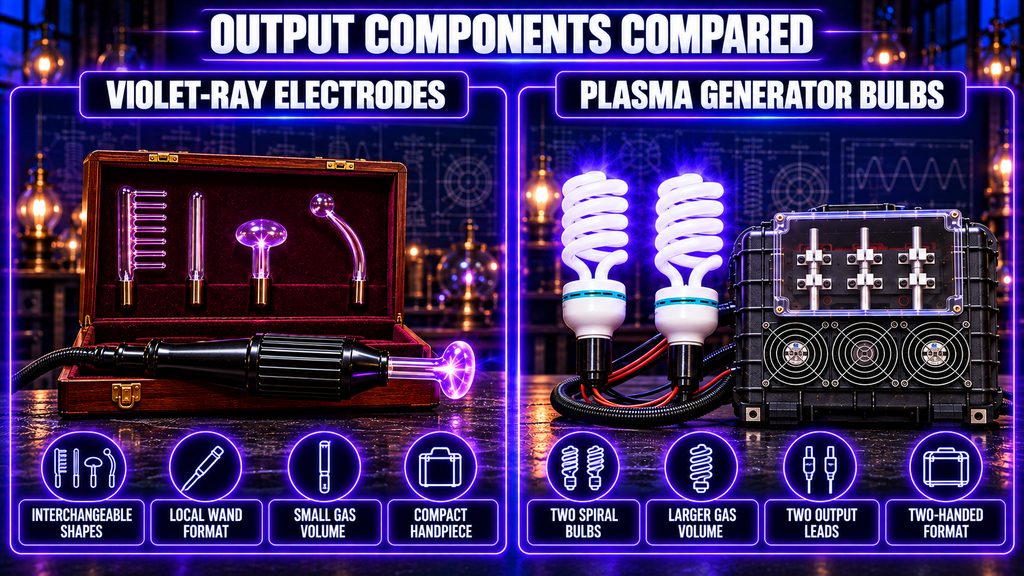
Difference 1: Small Electrodes vs Large Plasma Bulbs
The output component is the most obvious difference.
A violet ray normally accepts one mushroom, comb, spoon or tube electrode at a time. The powered handpiece moves it across or close to a local area.
My generator uses two larger spiral bulbs, normally held one in each hand. They are not interchangeable facial attachments, and the machine is not used like a cosmetic wand.
A small electrode produces a concentrated glow; the spiral bulbs display luminous paths through a larger gas volume.
Difference 2: Compact Wand vs External Spark-Gap System
Many modern violet rays place their electronics inside the handpiece or a small base. The user inserts an attachment and adjusts the control. There is normally no owner-adjustable external spark gap.
Historical sets varied and could use interrupters, coils or disruptive discharge. Their circuitry cannot be identified from appearance alone.
My generator makes its spark gap visible beneath a clear cover. Three pairs of zinc rods sit in adjustable mounts. Repeated discharge causes gradual wear, so inspection, cleaning and replacement form part of ownership.
The separate enclosure also contains the resonant output section and active cooling. This is a much larger and more serviceable architecture than a typical violet-ray wand.
Difference 3: Local Wand Use vs Two-Handed Bulb Use
Violet rays were designed for local application. Their attachments were shaped for particular external areas. Modern cosmetic wands retain this single-handpiece format, although claims and regulatory status vary.
My generator sits on a stable surface with cooling clear. Its bulbs remain connected by insulated leads and are normally held one in each hand.
Neither method proves a health effect. It simply describes the physical interface between the person and the machine.
Difference 4: Sound, Sensation and Electrical Character
A violet ray may buzz, crackle and produce a local tingling sensation. Moving the electrode away can create a concentrated spark. Output varies greatly between models.
My generator has an audible spark gap and larger plasma display. Its transformer, capacitors, gap, resonator, bulbs and surroundings shape the output.
A brighter glow, louder gap or stronger sensation does not demonstrate greater therapeutic effectiveness.
Difference 5: Maintenance and Long-Term Ownership
With a modern wand, glass electrodes are the main replaceable parts. Sealed electronics may be impractical to repair, and attachments must fit the specific holder and design.
Antique sets can hide deteriorated insulation, cable, plugs, capacitors and wiring. Do not connect an unrestored vintage unit to the mains; it needs inspection by someone competent in antique high-voltage equipment.
My generator is serviceable. After disconnection and cover removal, owners can follow instructions to inspect and clean the zinc rods. Cooling openings must remain clear and bulbs handled carefully.
Can Either Machine Select Exact Frequencies?
Do not assume that “high frequency” means an operator can enter one exact number.
Traditional violet rays and spark-gap generators are not automatically programmable signal generators. Coils, capacitance, switching, loading and surroundings influence the output.
My adjustable gap supports alignment, maintenance and operating behaviour. It is not a selector for condition-specific frequencies.
For exact frequency claims, ask where, how and under what load they were measured. Switching rate, resonant peak and complete spectrum are different measurements.
Is a Violet Ray the Same as Cold Atmospheric Plasma?
No. Historical violet-ray apparatus, modern cosmetic high-frequency wands, Tesla-inspired bulb generators and clinical cold atmospheric plasma systems should not be merged into one category merely because all can involve ionised gas.
Cold atmospheric plasma research uses defined devices, chemistry, distances, temperatures and protocols. Evidence for one CAP system cannot be transferred to violet rays or home bulb generators.
My device creates plasma inside sealed bulbs and is not a clinical CAP instrument. Research on one technology does not prove claims for another.
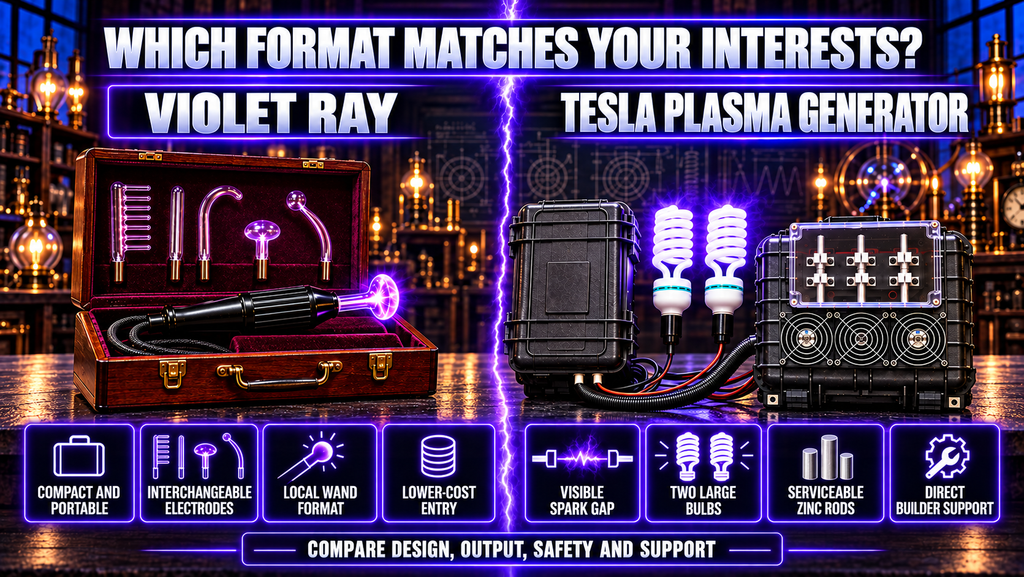
Which Is Better for Home Use?
There is no universal winner. The better format depends on what you want.
A violet ray may suit someone who:
- Collects historical electrical apparatus
- Wants a small, portable demonstration device
- Is specifically interested in interchangeable glass electrodes
- Wants a cosmetic-style wand and has checked its intended purpose and instructions
- Has a limited budget or storage space
A Tesla-inspired plasma generator may suit someone who:
- Wants a visible traditional spark gap
- Prefers two large handheld plasma bulbs
- Is interested in resonance and high-frequency electrical experimentation
- Values replaceable electrodes and owner maintenance
- Wants direct contact with the builder
- Has room for a two-enclosure tabletop system
Choose by physical design, intended use, instructions and support—not simply by the words “Tesla,” “violet” or “frequency.”
Why Consider Alan’s High Frequency Plasma Generator?
I build and test every generator in the UK. The £3,333 package includes:
- Two handheld plasma bulbs
- One high-frequency producer
- One separate spark-gap generator with adjustable 100% zinc rods
- Built-in cooling
- Operating and maintenance instructions
- Shipping under the published terms
- Direct customer support
- Access to the private owner community
- A 12-month machine warranty covering parts and labour under the warranty terms
The plasma bulbs are consumable glass components and are excluded from the machine warranty.
It is not a cosmetic violet-ray replacement or medical upgrade. It is a distinct system for education, experimentation, research, meditation, relaxation and general personal wellness.
Visit the High Frequency Plasma Generator product page for current specifications and ordering information.
Essential Safety Guidance
Both device types involve high voltage. Follow the exact model’s instructions.
- Keep the equipment dry and away from water.
- Do not use damaged glass electrodes, bulbs, cables or plugs.
- Keep ventilation openings unobstructed.
- Never open or adjust powered equipment.
- Keep sparks away from flammable vapours and oxygen-enriched environments.
- Keep high-frequency equipment away from computers, televisions, drives, routers and sensitive electronics.
- Do not use my generator during pregnancy or with a pacemaker or other implanted electronic device.
High-voltage discharge can produce heat, interference, ozone and ultraviolet radiation. Ventilation and operating limits matter.
People with health concerns should seek advice from an appropriately qualified healthcare professional. Do not use historical advertising or online testimonials as a substitute for diagnosis or treatment.
Frequently Asked Questions
What is the main violet ray vs Tesla plasma generator difference?
Not exactly. It shares high-frequency and gas-discharge principles, but normally uses one small interchangeable electrode and a compact coil arrangement. My generator uses a separate spark-gap system and two large plasma bulbs.
Why does a violet-ray electrode glow?
High-frequency electrical energy ionises part of the low-pressure gas sealed inside the glass. Excited gas atoms release light, creating the characteristic coloured glow.
Does Alan’s generator use violet-ray attachments?
No. It is supplied with two spiral plasma bulbs designed for its output arrangement. Violet-ray facial, comb or tube electrodes should not be connected unless equipment has been specifically engineered for them.
Which machine creates stronger plasma?
Brightness alone is not a reliable comparison of electrical output or usefulness. Electrode size, gas, pressure, voltage, frequency, circuit design and loading all affect what is visible.
Can I safely use an antique violet-ray machine?
Do not plug it in merely because it looks intact. Ageing insulation, capacitors, cables and plugs can create shock or fire risks. It should first be assessed by someone competent in antique high-voltage electrical equipment.
Are violet rays or Tesla plasma generators medical devices?
That depends on the particular product, its intended purpose, claims and regulatory status. Alan’s generator is explicitly sold as non-medical equipment and is not intended to diagnose, treat, cure, mitigate or prevent disease.
Final Thoughts: Violet Ray vs Tesla Plasma Generator
The key difference is not the colour of the glow. A violet ray is normally a compact device that energises one small interchangeable glass electrode for local use. My Tesla-inspired plasma generator is a two-enclosure system with capacitor banks, a visible adjustable spark gap, a resonant output section and two large handheld plasma bulbs.
Both reflect the heritage of high-frequency electricity and gas discharge. They provide different formats for exploring that history, but neither should be promoted through unsupported disease claims.
If you want a small wand with shaped electrodes, investigate the specifications and safety status of the particular violet ray. If you want a serviceable traditional spark gap, two visible plasma bulbs and direct UK builder support, explore my High Frequency Plasma Generator.
Important Disclaimer
This article is provided for historical, technical and educational information. The High Frequency Plasma Generator is intended for education, experimentation, research, meditation, relaxation and general personal wellness. It is not a medical device and is not intended to diagnose, treat, cure, mitigate or prevent any disease or medical condition. Nothing in this article replaces professional medical advice, diagnosis or treat