
Cold atmospheric plasma vs high frequency plasma explained. Compare pressure, equipment, output, applications, safety and what reaches the user.
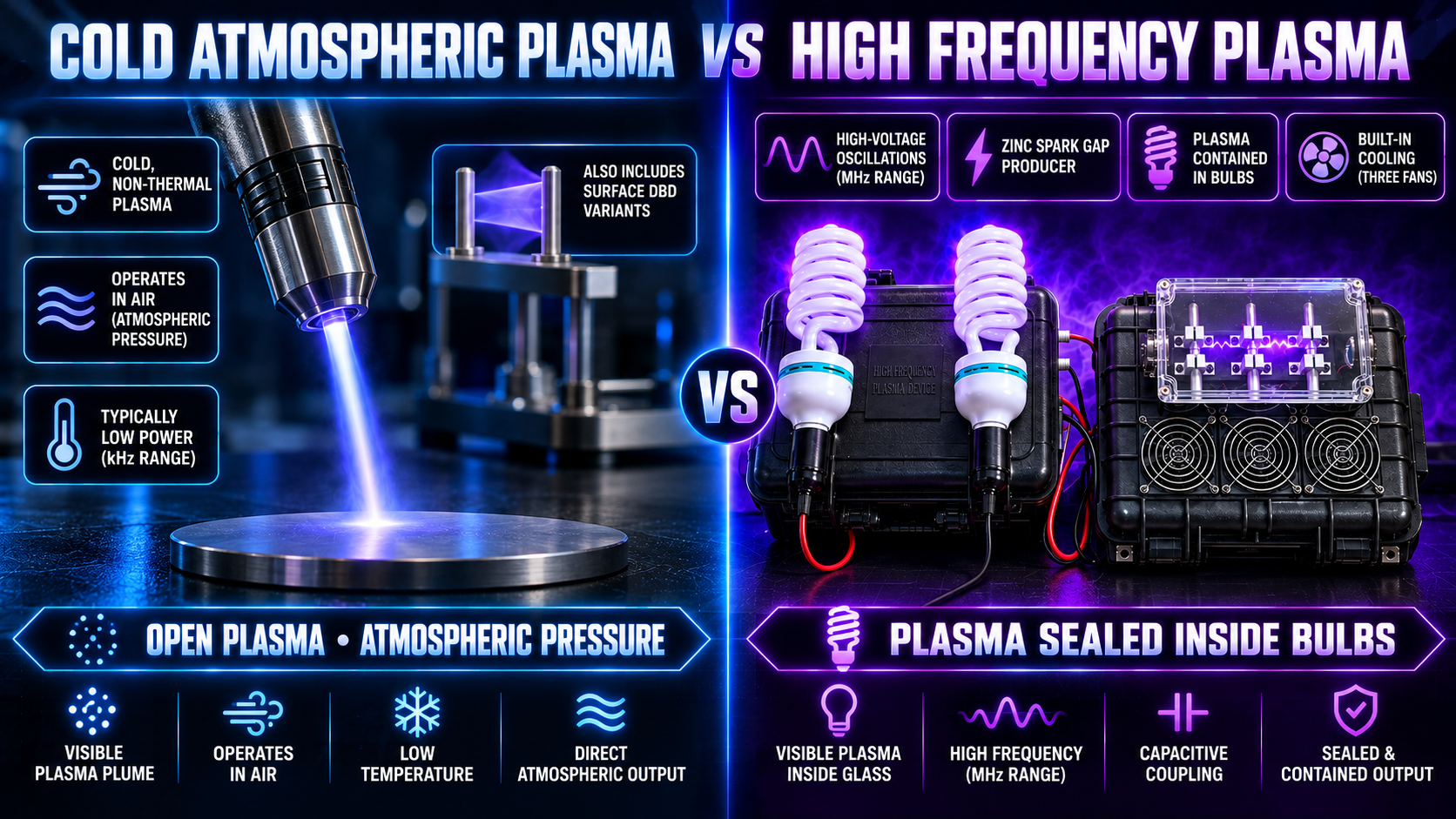
The comparison between cold atmospheric plasma vs high frequency plasma can be confusing because both create ionised gas and may use high voltage, changing electrical fields and glowing discharges. Plasma jets, violet-ray electrodes and handheld bulbs can also look superficially similar.
The equipment is not automatically equivalent.
Cold atmospheric plasma—usually shortened to CAP—is generally created in open air or flowing gas at approximately atmospheric pressure. Plasma may form between an applicator and target or emerge as a small jet. Purpose-built CAP systems are used in research, industry and plasma medicine.
Alan’s High Frequency Plasma Generator is a Tesla-inspired spark-gap system. High-frequency, high-voltage oscillations energise low-pressure gas inside two sealed bulbs. The plasma remains inside; it is not projected onto skin as an open plume.
Understanding that distinction prevents genuine CAP research from being incorrectly used as evidence for a different home plasma product.
Cold Atmospheric Plasma vs High Frequency Plasma: The Short Answer
The simplest difference concerns where the plasma exists and how it reaches the target.
- Cold atmospheric plasma: Plasma is produced at or near atmospheric pressure, often directly in ambient air or from a flowing process gas. Reactive species and other plasma components can reach a nearby surface.
- High-frequency bulb plasma: Plasma is produced inside a sealed, reduced-pressure glass bulb. The physical ionised gas stays behind the glass while the user interacts with changing electrical fields around the bulb.
CAP commonly uses a dielectric-barrier discharge (DBD), atmospheric-pressure plasma jet (APPJ), surface microdischarge or another carefully characterised source. Alan’s generator uses capacitors, an adjustable zinc spark gap and a resonant output circuit connected to two handheld bulbs.
Both involve plasma physics. They differ in pressure, geometry, gas handling, exposure route, output measurement and intended purpose.
What Is Plasma?
Plasma is often called the fourth state of matter. Supplying enough energy to a gas can separate electrons from atoms or molecules. The mixture contains electrons, ions, neutral particles and excited species, which can emit visible light.
A welding arc, the Sun, a fluorescent lamp and a plasma jet all involve ionised gas, yet differ enormously in temperature, pressure, density, power and chemistry.
The word plasma describes a physical state, not a complete machine or guaranteed effect. Ask how it is generated, where it forms, which gas is used, whether it contacts the target and how it was measured.
Learn more in What Is Plasma? The Fourth State of Matter Explained.
What Is Cold Atmospheric Plasma?
Cold atmospheric plasma is partially ionised gas generated near atmospheric pressure while keeping the bulk gas relatively cool. Cold does not mean frozen; energetic electrons drive ionisation without heating the entire gas to thermal-arc temperatures.
Two widely studied CAP arrangements are:
Atmospheric-Pressure Plasma Jets
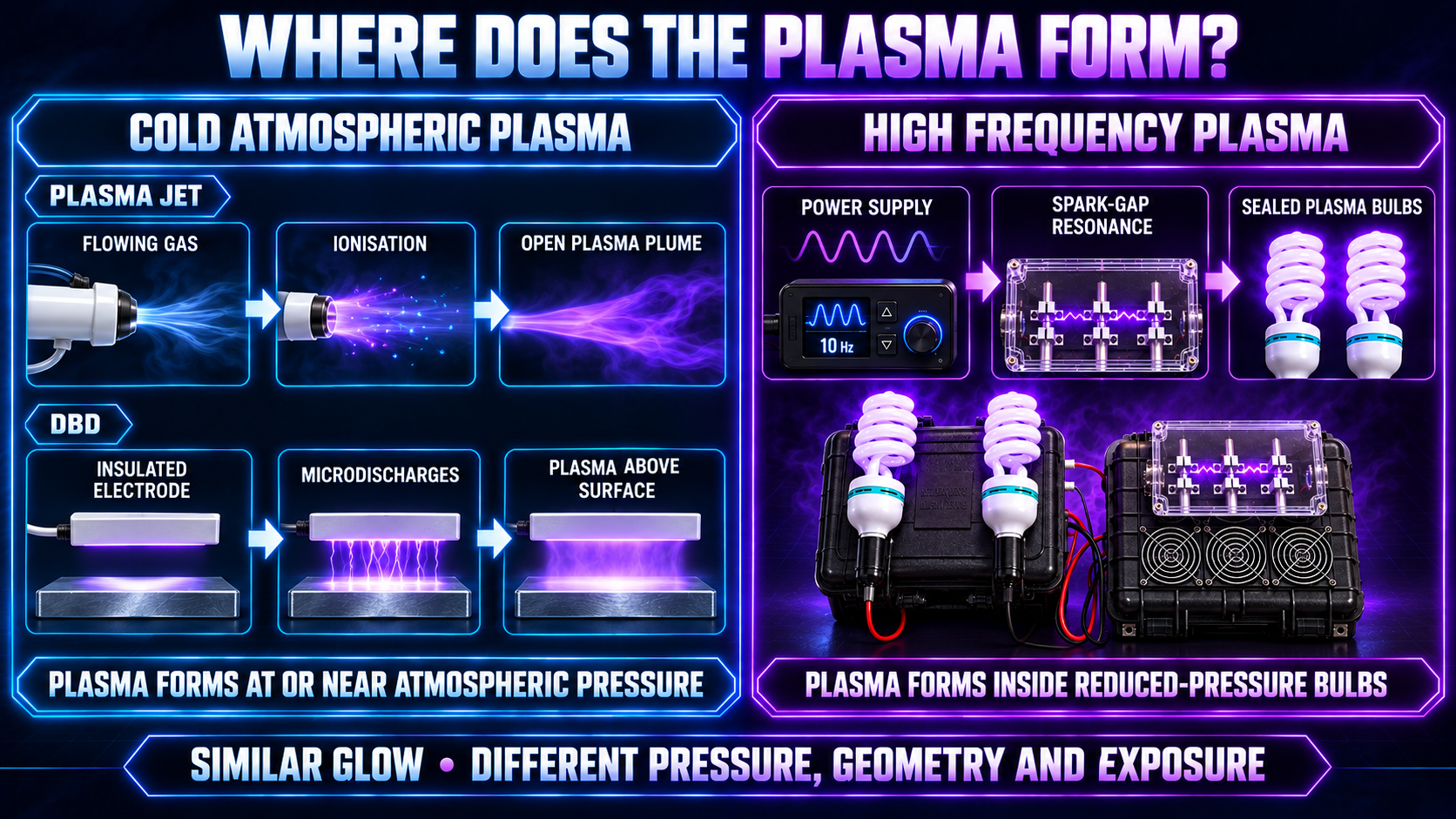
A plasma jet ionises a flowing gas such as argon or helium. Its plume extends from a nozzle and mixes with surrounding air before reaching a target. Gas, flow, voltage, pulse shape, distance and time affect the output.
Dielectric-Barrier Discharges
A DBD covers at least one electrode with an insulating barrier. High-voltage pulses create short microdischarges while the barrier limits current and helps prevent a continuous arc. Plasma can form in the gap above a target.
A review of physical plasmas and redox chemistry describes jets and DBDs as important medical-plasma categories. Their output can include electrons, ions, neutral particles and reactive oxygen and nitrogen species formed through interactions with ambient air.
CAP is also investigated for decontamination, food processing, agriculture and materials engineering. Equipment built for these purposes should not automatically be used on people.
What Is a High-Frequency Plasma Generator?
A high-frequency plasma generator converts ordinary power into high-voltage, rapidly oscillating energy. Alan’s system uses a power supply, ZVS driver, flyback transformer, capacitors, adjustable spark gap and resonant output.
A simplified electrical path is:
Power supply → ZVS driver → flyback transformer → capacitors → spark gap → plasma bulbs
Capacitors store energy until a discharge crosses the spark gap and excites the resonant circuit. The output energises sealed bulb gas, producing luminous plasma.
Holding the glass changes the surrounding electrical conditions through capacitive coupling, so filaments may gather towards the hand. The gas does not leave the bulb or enter the body.
Inspired by Tesla, Oudin, d’Arsonval and later violet-ray apparatus, it demonstrates plasma, discharge and resonance. It is not a clinical CAP jet or DBD system.
Read How Does a Plasma Generator Work? for a component-by-component explanation.
Cold Atmospheric Plasma vs High Frequency Plasma: Comparison Table
| Feature | Cold atmospheric plasma | Alan’s high-frequency plasma generator |
|---|---|---|
| Operating pressure | At or near atmospheric pressure | Reduced-pressure gas sealed inside bulbs |
| Common plasma source | Plasma jet, DBD or surface discharge | Spark-gap resonant generator and bulbs |
| Where plasma forms | In open air, a gas stream or a target gap | Inside sealed glass bulbs |
| Does plasma contact a target? | It can, depending on the source | No; the physical plasma remains behind glass |
| Gas supply | Ambient air or flowing gas such as argon/helium | Permanently sealed bulb gas |
| Main output interest | Reactive species, local plasma chemistry and surface interaction | Visible plasma, electrical fields, resonance and capacitive coupling |
| Typical controls | Gas flow, power, pulse parameters, distance and exposure time | Power, operating setup and adjustable spark-gap spacing |
| Typical setting | Laboratory, industry or purpose-specific clinical equipment | Education, experimentation, meditation, relaxation and personal wellness |
| Medical status | Depends on the exact device, purpose and jurisdiction | Not a medical device |
This table describes the broad distinction. Individual plasma sources can vary widely, so measurements and manufacturer documentation remain essential.
Difference One: Atmospheric Pressure vs Sealed Low-Pressure Gas
Pressure is central to the cold atmospheric plasma vs high frequency plasma comparison.
CAP is designed to operate without a vacuum chamber. The discharge forms at approximately normal atmospheric pressure, either in ambient air or in a gas flowing into it. That makes local interaction with an exposed surface possible.
Alan’s bulbs contain sealed gas at reduced pressure. Lower pressure changes the distance between particles and the conditions required for electrical breakdown. Once the bulb has been manufactured, its gas composition and pressure are not adjusted by the owner.
Similar glow does not make their chemistry or exposure conditions equal.
Difference Two: Open Plasma vs Plasma Behind Glass
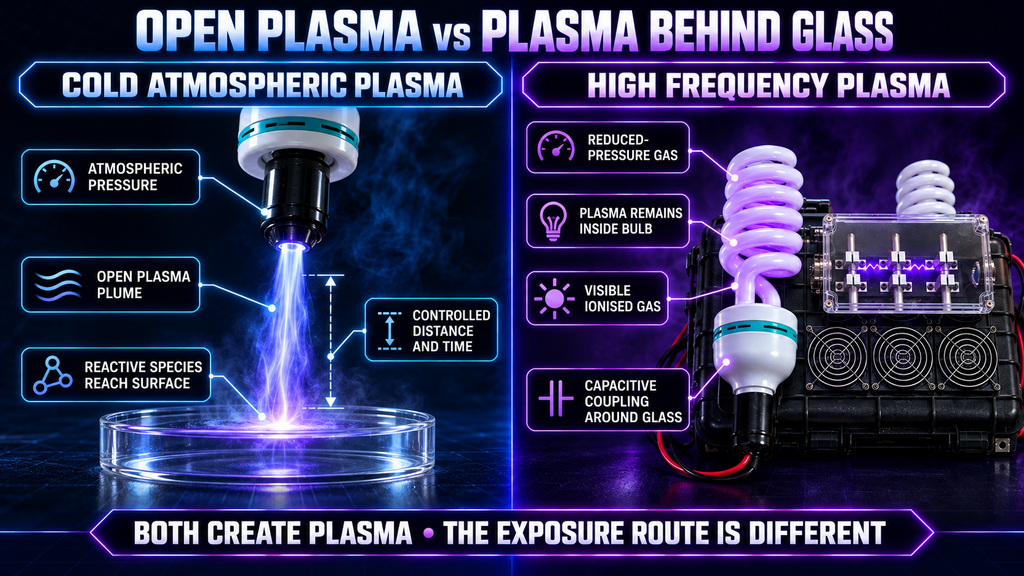
In a CAP jet, a plume extends towards the target. With direct DBD, plasma can form immediately above a surface, allowing reactive species to interact with it.
In Alan’s system, glass forms a boundary. The user holds the outside while ionised gas stays inside. Electrical interactions around the bulb differ from exposure to a CAP plume and its short-lived chemistry.
This is why the phrase “delivers plasma directly into the body” should not be used literally for a sealed bulb. What is visible inside the bulb is plasma; what surrounds the bulb is a changing electrical environment.
Difference Three: Plasma Chemistry and Reactive Species
CAP research often focuses on reactive oxygen and nitrogen species (RONS), including ozone, atomic oxygen, hydroxyl radicals, hydrogen-peroxide-related chemistry and nitrogen-containing species.
The mixture changes with gas, humidity, waveform, power, geometry, distance and time. Researchers use spectroscopy, chemical probes, temperature measurements, electrical diagnostics and biological assays to characterise exposure.
Alan’s bulbs also contain excited and ionised gas, but their glass envelope changes what can reach the surrounding environment. A paper describing RONS delivery from an open argon plasma jet cannot be cited as proof that the same chemical mixture crosses a sealed glass bulb.
Difference Four: What Does “Cold” Really Mean?
Scientifically, cold or non-thermal means electrons can be energetic while the bulk gas remains much cooler than thermal plasma.
Temperature still requires control because the applicator, target or plume can warm. Research therefore considers distance, duration and temperature alongside electrical and chemical output.
A bulb may also contain low-temperature plasma, but atmospheric matters: Alan’s plasma exists in sealed low-pressure gas, not as an open-air discharge delivered to tissue.
Difference Five: Controls and Measurement
A purpose-built CAP system may control or document:
- Feed gas and flow rate
- Voltage, current and pulse waveform
- Discharge power
- Gas and surface temperature
- Applicator-to-target distance
- Exposure duration
- Ozone, ultraviolet and reactive-species output
- Microbiological or material effects for a defined test
Alan’s generator is intentionally simpler. It does not use a gas cylinder, treatment nozzle or clinical dose programme. Its spark gap is adjustable for operating condition and maintenance, but the gap is not a selector for a validated medical dose or disease-specific frequency.
The useful question is whether each product describes and measures the output relevant to its intended purpose.
What About Historical Violet-Wand Research?
Historical high-frequency devices are relevant to the development of plasma medicine, but they must be interpreted carefully.
The study On the History of Plasma Treatment and Comparison of Microbiostatic Efficacy of a Historical High-Frequency Plasma Device With Two Modern Devices compared a historical violet-wand apparatus with a modern atmospheric-pressure plasma jet and a DBD device. Researchers tested antimicrobial effects against microorganisms grown on agar.
The work links early apparatus with modern plasma research. However:
- It was an in-vitro laboratory comparison, not a clinical trial in people.
- It examined a particular historical violet-wand configuration.
- A violet wand producing a local discharge near an electrode is not identical to Alan’s two sealed handheld bulbs.
- It does not show that every high-frequency product treats infection or disease.
The study supports further technical interest, not unrestricted health claims.
What Does the Medical Evidence Mean for Buyers?
CAP is a genuine biomedical research field. Defined jets and DBD systems have been investigated for microbial reduction and wound-related applications; some purpose-built systems have entered regulated European medical markets.
That applies to the exact equipment, protocol and authorised purpose—not every device producing a purple glow.
Evidence should be matched to:
- The same plasma-source design
- Comparable operating settings
- The same treatment route
- A relevant target or patient group
- Suitable controls and outcome measures
- The product’s actual regulatory status
Clinical CAP research cannot be transferred automatically to Alan’s High Frequency Plasma Generator. His machine is sold for education, experimentation, research, meditation, relaxation and general personal wellness. It is not intended to diagnose, treat, cure, mitigate or prevent disease.
Which Technology Is Suitable for Home Use?
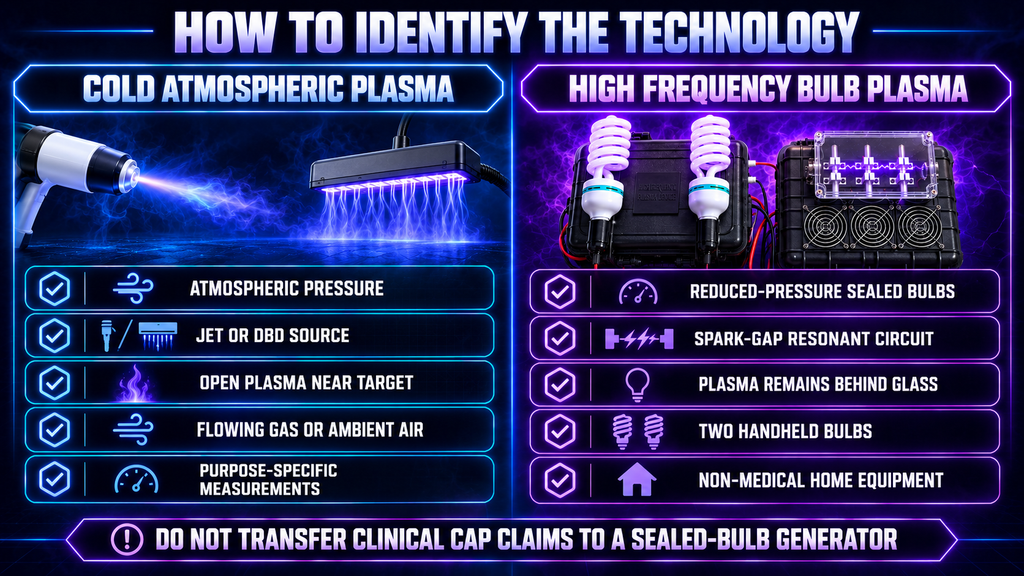
CAP products range from industrial surface-treatment tools to laboratory instruments and regulated medical devices. A technical plasma jet is not automatically a safe home wellness product. Gas cylinders, reactive emissions, high voltage, ozone, ultraviolet output and treatment distance may all require professional control.
Medical CAP should involve a qualified professional and suitable equipment for an authorised purpose, not a homemade jet or a device chosen merely because it says plasma.
Alan’s generator is an enclosed, plug-and-use home system for people interested in Tesla-inspired technology and visible plasma. Owners handle no process gas or exposed plume.
It still contains high-voltage equipment and requires strict instructions. It must not be used during pregnancy or by anyone with a pacemaker or other implanted electronic device. Keep it away from televisions, computers, laptops, data-storage devices and other sensitive electronics.
Questions to Ask Before Buying Any Plasma Device
Before purchasing, ask the seller:
- Where does the plasma form?
- Is it produced at atmospheric pressure or sealed inside a bulb?
- Does plasma or its reactive chemistry reach the target directly?
- Is it a jet, DBD, violet wand or sealed-bulb system?
- Which electrical, thermal and chemical outputs have been measured?
- What safety controls and contraindications apply?
- Is it regulated as a medical device for its stated purpose?
- What maintenance, warranty and technical support are supplied?
These questions reveal far more than marketing phrases such as “healing plasma” or “clinical frequency.”
Why Consider Alan’s High Frequency Plasma Generator?
Alan’s High Frequency Plasma Generator is not offered as a substitute for clinical CAP. It is a clearly defined traditional spark-gap system for people interested in plasma, resonance, high-frequency electricity and Tesla-inspired engineering.
The £3,333 package includes:
- Two handheld plasma bulbs
- One high-frequency producer
- One separate spark-gap and resonant output enclosure
- Adjustable, replaceable 100% zinc spark-gap rods
- Three-fan cooling
- Simple instructions and an Owner’s Guide
- Shipping under the current published terms
- Direct customer support
- Access to the High Frequency Plasma Community Group
- A 12-month machine warranty; the glass bulbs are excluded
Each machine is handcrafted and tested in the UK. Its transparent enclosure keeps the spark gap protected but observable, while replaceable rods support practical maintenance.
For a fuller buyer guide, read Plasma Frequency Machine for Home Use.
Frequently Asked Questions
Is Alan’s generator a cold atmospheric plasma device?
No. It creates plasma inside sealed, reduced-pressure bulbs. It does not produce an open atmospheric-pressure jet or direct DBD treatment at the skin.
Are the bulbs filled with atmospheric air?
No. They contain sealed gas at reduced pressure. The gas does not circulate through a nozzle or mix freely with room air during use.
Does the plasma enter the body when the bulbs are held?
No. The physical plasma remains inside the glass. Holding a bulb changes the electrical conditions around it through capacitive coupling.
Can CAP research be used to advertise a high-frequency bulb generator?
Only if the research genuinely applies to the same source, output and exposure route. Results from a plasma jet or direct DBD device should not be presented as clinical proof for a sealed-bulb generator.
Is cold atmospheric plasma always safe?
No technology is safe merely because it is called cold. Safety depends on the device, electrical design, temperature, emissions, distance, duration, target and intended use.
Can I build a CAP jet and use it on myself?
That is not advisable. CAP sources can involve high voltage, gas flow, ozone, reactive chemistry and ultraviolet output. Human use requires appropriate engineering, measurement, risk assessment and regulatory compliance.
Final Thoughts
The cold atmospheric plasma vs high frequency plasma comparison is ultimately about more than temperature or colour.
CAP generally creates an open or locally delivered plasma at atmospheric pressure. Plasma jets and DBD systems are engineered so that reactive species and other components can interact with a nearby surface under controlled conditions.
Alan’s high-frequency generator produces visible plasma inside sealed bulbs. Its spark gap, capacitors and resonant circuit provide a traditional Tesla-inspired electrical experience, but the physical plasma remains behind glass. It is non-medical equipment for education, experimentation, relaxation and personal wellness.
Both fields are fascinating. Respecting their differences makes the science clearer, the marketing more honest and the buying decision safer.
If traditional spark-gap engineering, visible plasma and straightforward home operation interest you, explore Alan’s handcrafted High Frequency Plasma Generator or join the High Frequency Plasma Community Group.
Important disclaimer: This article is provided for education and general comparison. Alan’s High Frequency Plasma Generator is not a medical device and is not intended to diagnose, treat, cure, mitigate or prevent any disease. Never delay or replace professional medical care because of information about plasma technology.