
Tesla Plasma Generator vs Multiple Wave Oscillator: What Is the Difference?
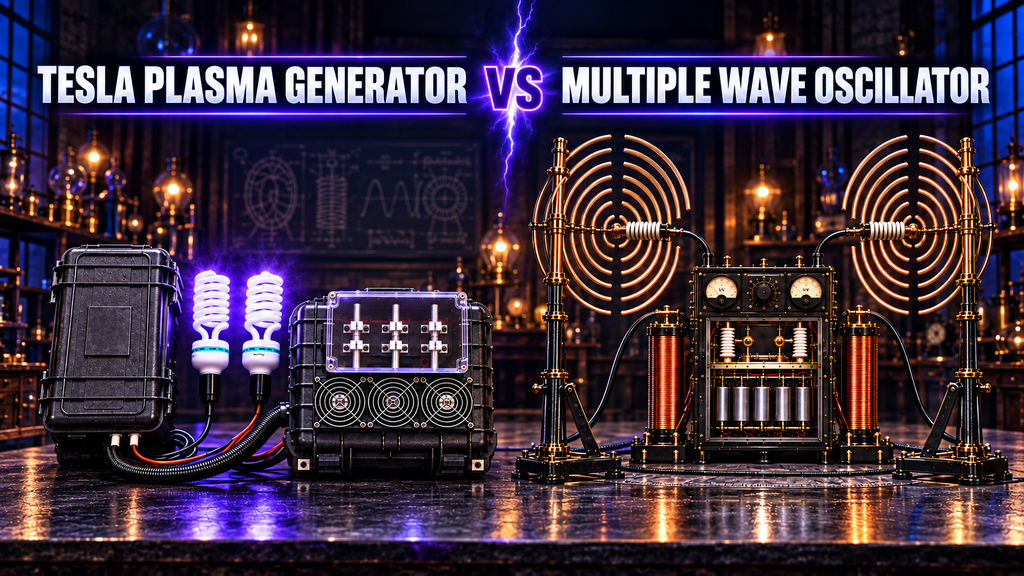
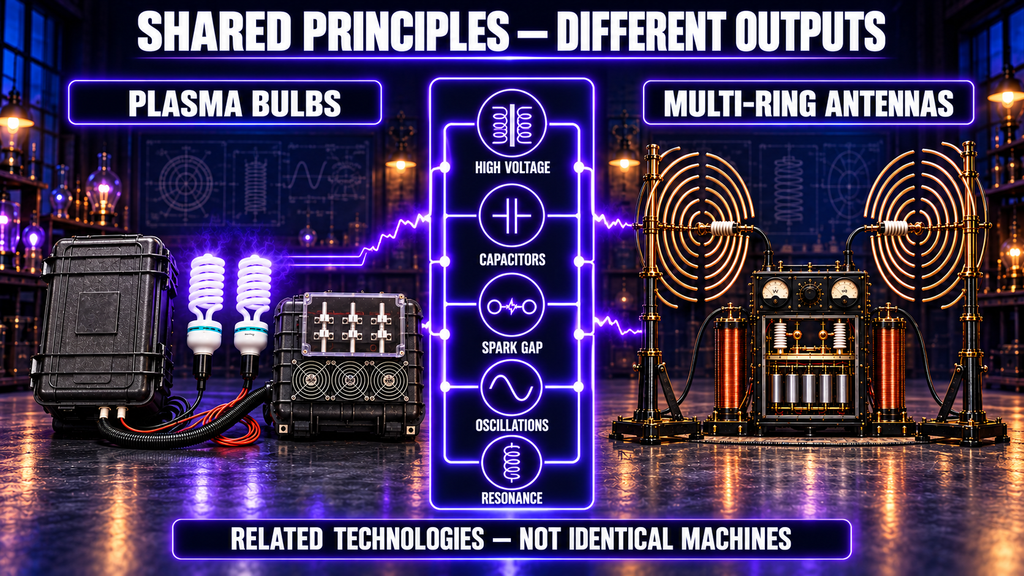
If you are comparing a Tesla plasma generator vs Multiple Wave Oscillator, the machines can appear to belong to the same family. Both may use high voltage, capacitors, coils, a spark gap and electrical resonance. However, they are not two names for the same machine.
The clearest difference is at the output. A traditional Multiple Wave Oscillator, or MWO, is recognised by its concentric open-ring antennas. A Tesla-inspired plasma generator such as mine sends its output to two sealed, gas-filled plasma bulbs. That difference changes the physical setup, user experience, space required and practicalities of ownership.
This guide compares them without presenting historical theories as established medical facts.
Tesla Plasma Generator vs Multiple Wave Oscillator: The Short Answer
A Tesla plasma generator is a broad name for high-frequency apparatus inspired by Tesla-era experiments. A spark-gap version may use a transformer, capacitors, an adjustable gap and a resonant coil. Its output can be connected to low-pressure gas bulbs, producing visible plasma.
A Multiple Wave Oscillator is a more specific design associated with Georges Lakhovsky. Its identifying feature is a set of concentric, incomplete conducting rings of different diameters. The rings act as resonant circuits excited by electrical impulses. Some systems use two antenna assemblies with an operating space between them.
In one sentence: the Tesla plasma generator produces a handheld, visible plasma output, while the MWO centres on a field formed around multi-ring antennas.
What Is a Tesla Plasma Generator?
“Tesla plasma generator” is not a tightly standardised category. It describes various high-frequency machines influenced by Tesla coils, Oudin coils, d’Arsonval circuits and related resonant systems.
In a classic spark-gap arrangement, electrical energy passes through several stages:
- A power section supplies the circuit.
- A transformer raises the voltage.
- Capacitors accumulate charge.
- The voltage rises until the spark gap fires.
- The discharge excites a resonant circuit.
- High-frequency output reaches the bulbs.
- Low-pressure gas in each bulb becomes partly ionised and glows.
The plasma stays inside the sealed glass. When a bulb is held, the body alters the surrounding electrical conditions through capacitive coupling, so the glow may brighten or concentrate towards the hand.
My High Frequency Plasma Generator follows this tradition. It combines a high-frequency producer with a separate spark-gap and resonant-coil enclosure, adjustable zinc electrodes, cooling and two handheld plasma bulbs. It is a complete, serviceable system rather than a bare circuit.
For a fuller explanation of this type of machine, see my guide to the Tesla plasma machine.
What Is a Multiple Wave Oscillator?
The Multiple Wave Oscillator was developed by Georges Lakhovsky. Its design is documented in US Patent 1,962,565, filed in 1931 and granted in 1934.
The patent describes open circuits with natural inductance and capacitance that oscillate when excited by electrical impulses. In the best-known arrangement, split rings of different sizes are mounted concentrically. Small spheres may be fitted at the open ends, adding capacitance and influencing their behaviour.
Because every ring has different dimensions, each has a different natural response. Spark discharge and resonant circuitry also introduce harmonics and transients, producing something more complex than one continuous tone.
This is the origin of “multiple wave.” It is not a digital menu containing thousands of independently programmed frequencies. Actual output depends on the generator, coils, antenna geometry, spacing, surroundings and measurement method.
Lakhovsky connected his invention with a theory that living cells behaved as oscillating circuits. That explains his historical purpose, but it is not established clinical science. A patent documents an invention; it does not prove medical effectiveness.
You can explore the history and working stages in my separate guide, What Is an MWO Device and How Does It Work?. This page concentrates on the direct comparison.
Tesla Plasma Generator vs Multiple Wave Oscillator Comparison
| Feature | Tesla-inspired plasma generator | Traditional Multiple Wave Oscillator |
|---|---|---|
| Historical influence | Tesla, d’Arsonval, Oudin and related high-frequency work | Georges Lakhovsky, drawing on the wider high-frequency tradition |
| Defining output | Sealed, gas-filled plasma bulbs | Concentric split-ring antenna assemblies |
| Typical interaction | One bulb held comfortably in each hand | User or test area positioned in relation to one or two antennas |
| Visible effect | Coloured plasma inside the bulbs | Spark-gap discharge and possible corona around antenna terminals, depending on design |
| Frequency behaviour | Pulsed, resonant high-frequency output; not necessarily one exact frequency | Multiple resonant responses, harmonics and transients; not a digital programme list |
| Space required | Can be built as a compact home system | Full historical-style installations can be large and heavy |
| Main maintenance | Ventilation, bulb care and spark-gap inspection, cleaning and adjustment | Spark gap plus coils, supports, antenna rings, terminals, spacing and connections |
| Standardisation | Low; machines with the same label may differ greatly | Low; historical reproductions and modern interpretations vary |
| Medical status | Not automatically a medical device | Historical apparatus, not established as a disease treatment |
What Do the Two Machines Have in Common?
Both transform a supply into high voltage and use rapidly changing electrical conditions. Capacitors store charge until the air in a spark gap breaks down; the discharge then excites a resonant circuit.
Both depend on inductance, capacitance and coupling. The dimensions and surroundings of a coil, conductor or ring affect its response. Lakhovsky worked within a high-frequency tradition already explored by Tesla and European researchers, but shared components do not make the complete machines interchangeable.
Difference 1: Plasma Bulbs vs Multi-Ring Antennas
The output component is the quickest way to identify the two systems.
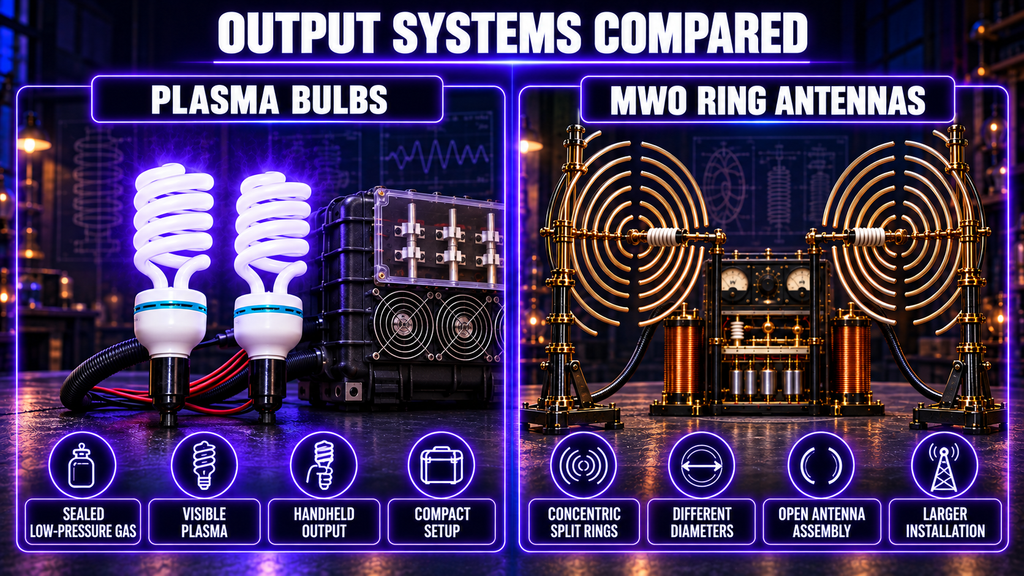
My plasma generator terminates in two white spiral bulbs containing low-pressure gas. High-frequency energy ionises part of it, making the output visible inside the glass. During normal use, one bulb can be held in each hand.
An MWO terminates in antenna assemblies containing nested rings of different diameters, normally with a gap in each ring. The pattern is functional: different sizes are fundamental to the multiple-resonance concept.
The user arrangement therefore differs. Plasma output is localised at two handheld bulbs and their surrounding fields. An MWO creates its environment around larger antennas, with the subject or experiment positioned relative to them.
Two glowing bulbs do not make a traditional MWO, even if the machine has a spark gap. Likewise, passive rings are not a complete MWO without the appropriate generator and coupling.
Difference 2: What “Frequency” Means
Frequency terminology is often the most confusing part of this market.
Neither label guarantees one selectable sine-wave output. Spark-gap impulses can excite oscillations, resonances, harmonics and broadband noise. Nearby objects, cable position and loading can alter measurements.
With an MWO, “multiple wave” principally refers to differently sized resonant circuits being excited together. In a plasma generator, the transformer, capacitors, gap and resonator shape the energy delivered to the bulbs.
Sellers should distinguish between:
- theoretical resonance;
- switching or repetition rate;
- a measured dominant component;
- harmonics and transients;
- and claims about named frequencies.
If an exact frequency matters, ask where and under what load it was measured. One advertised number rarely describes an entire spark-gap output.
Difference 3: Size, Positioning and Home Use
Traditional-style MWOs can be impressive installations. Large antennas need sturdy stands, adequate spacing and a safe operating area. A two-antenna arrangement also requires room around the person or experiment between them. Shipping and storage matter too.
A Tesla plasma generator can be more manageable at home. My system uses two enclosures, yet remains much smaller than a full MWO installation. The bulbs connect to the machine, and no large frames must be positioned around a chair.
“More compact” does not mean suitable for every room. A spark-gap machine still needs a dry, stable surface, clear ventilation and distance from sensitive electronics. Its sound also matters in a shared space.
The extra space may be worthwhile for someone interested in Lakhovsky’s history and antenna geometry. For visible plasma, handheld outputs and simpler placement, a plasma generator is likely more practical.
Difference 4: Construction and Maintenance
Both types of equipment should be judged by their construction, not just their category name.
A spark gap develops deposits and electrode wear, so it may need inspection, cleaning, realignment and replacement. Cooling paths must remain clear and high-voltage sections enclosed.
An MWO adds antenna questions: are its rings, gaps and terminals consistent, how are they coupled, and can the antennas be positioned correctly?
My generator’s solid zinc rods are visible beneath a clear cover and can be adjusted or replaced after disconnection. Its cooled, serviceable design comes with two bulbs, guidance, support and a written warranty.
Never open, clean or adjust either machine while powered. Capacitors can retain energy; do not modify high-voltage circuitry.
Difference 5: Consistency Between Machines
There is no single specification shared by every product sold as a Tesla plasma generator. The same is true of MWO replicas.
Machines can differ in input power, transformer design, capacitance, electrodes, gap spacing, coils, output, duty cycle and cooling. MWO reproductions may also vary in ring count, diameter, metal, terminals, antenna spacing and energising circuit.
A category comparison cannot reveal a unit’s exact power, spectrum or field strength. Those require model-specific documentation and competent measurement.
Be cautious when a seller uses historical photographs to support precise claims about a modern replica without showing its construction or testing. Ask for genuine photographs, specifications, instructions, dimensions, warranty terms and intended use.

Historical Wellness Claims and Modern Evidence
The Multiple Wave Oscillator is often discussed alongside Lakhovsky’s ideas about cellular oscillation. Tesla-inspired apparatus is also frequently surrounded by stories about energy, vitality or “healing frequencies.” These subjects need careful language.
Historical experiments and personal experiences are not controlled clinical evidence. Robust modern clinical evidence has not established a traditional MWO as a cure for disease. My generator is not a medical device and is not intended to diagnose, treat, cure, mitigate or prevent disease.
In Great Britain, medical-device status depends importantly on intended purpose and mode of action. See the MHRA’s borderline-products guidance.
For symptoms or treatment decisions, consult a qualified healthcare professional. Do not delay established care because of wellness claims.
Which Is Better for Home Use?
There is no universal winner in a Tesla plasma generator vs Multiple Wave Oscillator comparison. The choice depends on what you want to own.
A traditional MWO may suit you if:
- you want Lakhovsky’s historical ring design;
- you have the space and budget;
- or you collect or research early apparatus.
A plasma generator may suit you if:
- you want visible plasma in sealed bulbs;
- you prefer a compact, repeatable setup;
- serviceable spark-gap parts matter;
- or you value direct builder support.
Do not choose from the words “Tesla,” “frequency” or “multiple wave” alone. Decide whether you want bulb or ring-antenna output, then compare real machines.
Questions to Ask Before Buying Either Machine
Before spending money, ask the seller:
- Is it a complete system or only an antenna, coil or accessory?
- What is included?
- Does it output through bulbs, ring antennas or something else?
- Which parts are adjustable or replaceable?
- What maintenance is required?
- What space and ventilation does it need?
- Are measurements from this model and test arrangement?
- What instructions, warranty, parts and support are supplied?
This is more reliable than choosing the brightest arc or longest list of unexplained frequencies.
Why I Chose Plasma Bulbs for My Generator
I built my High Frequency Plasma Generator for people who are interested in traditional spark-gap technology but do not necessarily want a large MWO reproduction.
The bulbs make the output visible and provide a simple method of interaction: after completing the safety checks, the user holds one bulb in each hand. The generator retains an audible spark gap, adjustable zinc electrodes and resonant high-frequency character.
The current package includes the producer, separate spark-gap and resonator enclosure, two bulbs, instructions, direct support, owner-community access and a 12-month machine warranty. Bulbs are excluded from that warranty. The price is £3,333, with shipping under the product-page terms.
It is not a miniature MWO or a substitute for medical care. It is a distinct Tesla-inspired system for education, experimentation, research, meditation, relaxation and general personal wellness.
Essential Safety and Electronic Interference
Both machines involve high voltage. Use only a finished, enclosed device and follow its instructions.
- Keep it dry and place it on a stable surface.
- Do not obstruct cooling fans or ventilation openings.
- Keep children and pets away during operation.
- Do not operate near flammable vapours or oxygen-enriched environments.
- Never touch internal components or adjust the spark gap while powered.
- Disconnect the machine before any permitted inspection or maintenance.
- Keep it away from televisions, computers, storage drives, routers and sensitive test equipment.
Spark-gap circuits can generate interference. The UK government’s Electromagnetic Compatibility Regulations guidance explains requirements for equipment capable of producing electromagnetic disturbance.
Do not use my generator if pregnant or if you have a pacemaker or other implanted electronic device. For body-worn medical electronics, obtain advice from the manufacturer and a qualified healthcare professional.
Frequently Asked Questions
Is a Tesla plasma generator the same as a Multiple Wave Oscillator?
No. They share high-voltage, spark-gap and resonance principles, but a plasma generator uses gas-filled bulbs while a traditional MWO uses concentric split-ring antennas.
Does “multiple wave” mean selectable frequency programmes?
Not in the digital sense. It relates to differently sized resonant circuits responding together, plus harmonics and transients from impulsive excitation.
Can I convert a plasma generator into an MWO by adding rings?
Do not improvise high-voltage modifications. An antenna changes loading, coupling, clearances and field distribution. A functional MWO is a complete system, not decorative rings on an unknown output.
Which machine takes up less space?
A bulb-based generator is generally more compact than a two-antenna MWO. Check each model’s dimensions and required clearance.
Can either machine treat disease?
Neither should be assumed to treat disease. Theories, patents and testimonials are not clinical proof. My generator is not a medical device and is not offered to diagnose, treat or prevent illness.
Final Thoughts: Tesla Plasma Generator vs Multiple Wave Oscillator
Look beyond the shared spark gap. An MWO is defined by Lakhovsky’s differently sized open-ring resonators. A Tesla plasma generator uses related principles but delivers output through sealed plasma bulbs.
Choose an MWO to explore its multi-ring apparatus and history. Choose a plasma generator for visible bulb output, compact setup and serviceable components.
Whichever interests you, compare complete systems, request model-specific information and keep history separate from medical proof. For the construction, package and purchase details of my machine, visit the High Frequency Plasma Generator page.
Important Disclaimer
This article is provided for historical, technical and educational information. The High Frequency Plasma Generator is intended for education, experimentation, research, meditation, relaxation and general personal wellness. It is not a medical device and is not intended to diagnose, treat, cure, mitigate or prevent any disease or medical condition. Nothing on this page replaces advice, diagnosis or treatment from a suitably qu