The phrase plasma healing device is appearing more often in online searches as people discover Tesla-inspired technology, glowing plasma bulbs and high-frequency equipment. Yet the name can be confusing. It is used for very different products, from regulated cold atmospheric plasma equipment to beauty tools, violet-ray wands and spark-gap plasma generators.
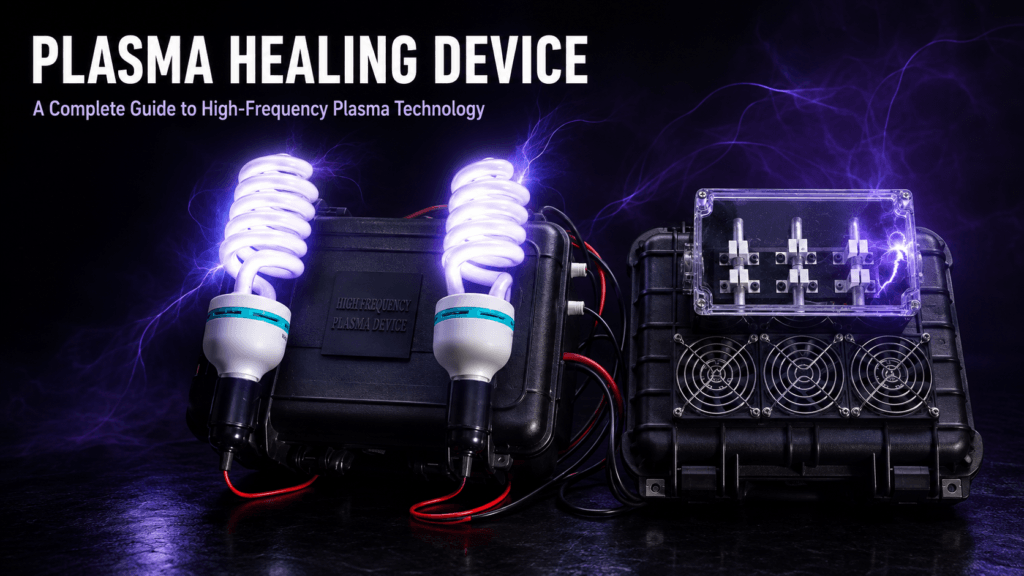
This guide focuses on the last category: a high-frequency plasma generator designed for education, personal exploration, meditation, relaxation and general wellness. You will learn how it produces plasma, how it differs from clinical equipment and what to check before buying.
In this article, “plasma healing device” describes the term people type into search engines. The High Frequency Plasma Generator discussed here is not a medical device and is not offered to diagnose, treat, cure, mitigate or prevent illness.
What Is a Plasma Healing Device?
In the home-wellness community, a plasma healing device usually means an electrical generator that energises gas sealed inside glass bulbs or tubes. The gas becomes ionised and produces a visible glow called plasma, often described as the fourth state of matter.
A traditional system combines a power supply, high-frequency producer, high-voltage transformer, capacitors, a spark gap, output wiring and gas-filled bulbs. Together, they transform ordinary electrical input into rapidly changing electrical activity that excites the gas.
The word “healing” reflects search language and the way some early electrical apparatus was marketed. It does not prove that every plasma product has a therapeutic action. A more accurate description for a non-medical home product is high-frequency plasma generator, plasma wellness device or Tesla-inspired plasma energy device.
People explore these machines because of Tesla’s history, the visual display, meditation or an interest in plasma, resonance and spark-gap oscillation. Understanding your purpose is the first step towards choosing the right equipment.
Plasma Is the Fourth State of Matter
Plasma is produced when enough energy is supplied to a gas for some atoms or molecules to lose electrons. The result contains charged particles that respond to electric and magnetic fields.
The Sun and other stars are largely plasma; lightning and the aurora are familiar examples closer to Earth. Human-made plasma appears in neon signs, fluorescent lamps, plasma globes and welding arcs.
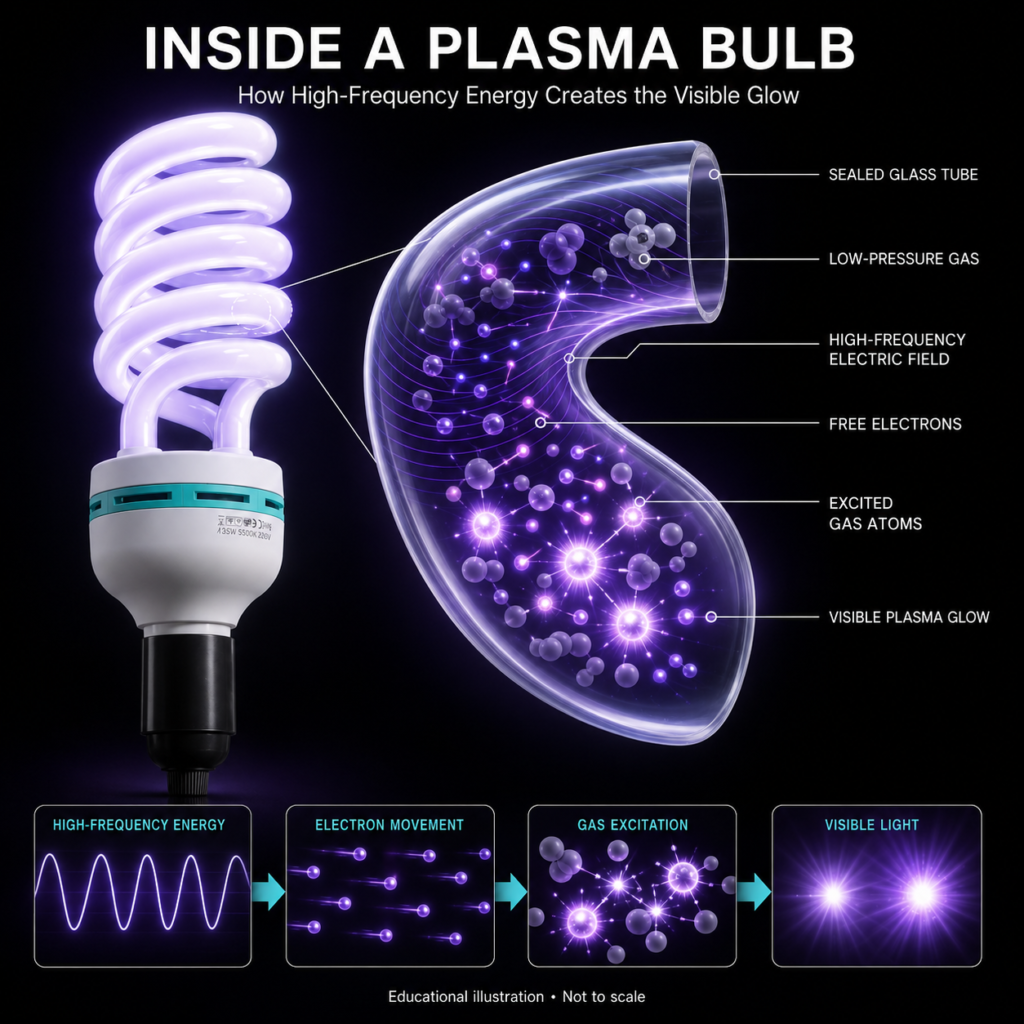
Inside a plasma bulb wellness device, gas is contained in a sealed glass envelope. The changing electric field accelerates electrons, which collide with gas atoms. Excited atoms release light as they return to lower-energy states. Colour depends mainly on the gas, pressure and electrical conditions. The glow comes from the energised gas, not the glass.
You can explore this process in more detail in Why Are Plasma Bulbs Used?.

How Does a High-Frequency Plasma Generator Work?
Traditional spark-gap plasma machines follow a recognisable sequence.
1. Electrical power enters the system
The generator begins with an ordinary power source. Internal power and high-frequency sections convert the input before it reaches the bulbs.
2. The voltage is increased
A transformer and associated circuitry raise the voltage. Because high voltage is dangerous, live components require suitable insulation, separation, ventilation and protective enclosures.
3. Capacitors store electrical energy
Capacitors temporarily accumulate charge. When voltage reaches the spark gap’s breakdown level, stored energy is released quickly. Component values, spacing, layout and insulation all influence system behaviour.
4. The spark gap repeatedly discharges
The spark gap contains two separated electrodes. As voltage rises, the air becomes conductive and a spark crosses the gap. This repeats during operation and helps excite electrical oscillations.
An adjustable gap can alter the conditions at which breakdown occurs and therefore change the character of the discharge. It should not be confused with a calibrated medical-frequency selector. Read What Is a Spark Gap? for a beginner-friendly explanation.
5. High-frequency activity reaches the bulbs
The oscillating output travels through the intended wiring and bulb connections. A changing electric field acts on low-pressure gas inside each sealed bulb, ionising it and producing visible plasma streams.
This journey—from input power to a glowing plasma discharge—is explored step by step in How Does a Plasma Generator Work?.
Why Is It Called a High-Frequency Device?
Frequency measures how often an event repeats each second. UK mains electricity alternates at 50 hertz. A high-frequency plasma device contains much faster changes, although its output may be complex rather than one clean, fixed waveform.
Spark-gap systems can produce bursts, harmonics and broadband emissions. A prominent peak on a meter does not mean the machine operates at only one frequency. Results can change with probe design, distance, orientation, bandwidth, surroundings and the circuit area measured.
This matters when comparing a spark-gap generator with a digital box displaying a chosen frequency. They do not automatically produce the same output. Ask what is generated, how it was measured and whether the value represents the whole system or one part.
For a straightforward introduction, visit What Is High-Frequency Electricity?.
The Historical Link to Tesla, d’Arsonval and Oudin
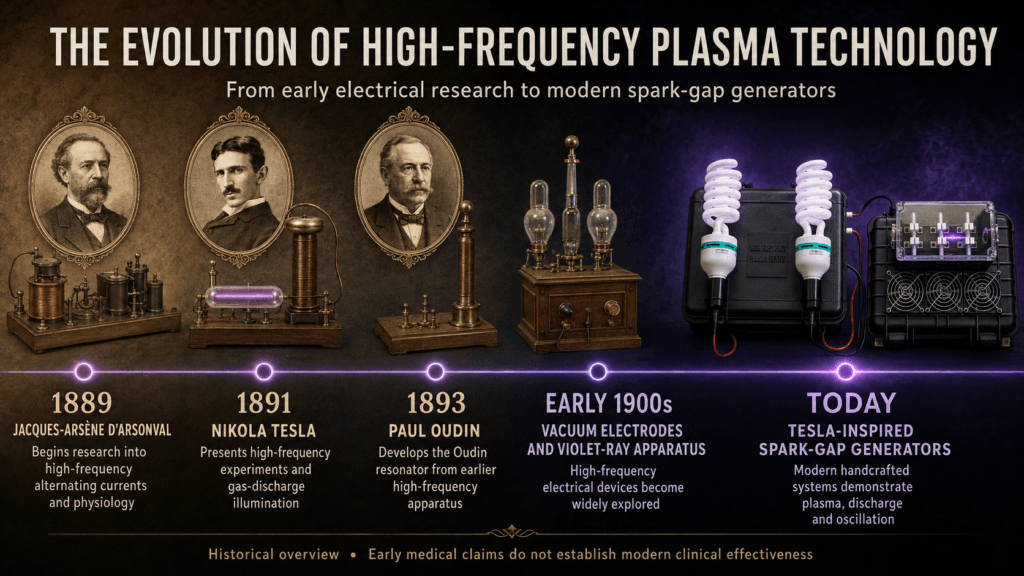
Interest in high-frequency electrical apparatus grew during the late nineteenth and early twentieth centuries. Nikola Tesla became famous for experiments with alternating current, resonant transformers, electrical discharges and wireless illumination. He demonstrated gas-filled tubes glowing in strong high-frequency fields.
Jacques-Arsène d’Arsonval and Paul Oudin developed high-frequency circuits explored in early electrotherapy. Period catalogues show violet-ray machines, vacuum electrodes and resonator systems promoted for many complaints.
History alone is not evidence of modern clinical effectiveness. Many early claims would not satisfy today’s standards for controlled trials, certification or advertising substantiation. The record does show how long researchers have investigated high-frequency currents, gas discharges and biological systems.
A 2018 paper in IEEE Transactions on Radiation and Plasma Medical Sciences, Lessons From Tesla for Plasma Medicine, discusses this historical connection. It should be read as a scientific historical perspective, not as clinical proof for every modern Tesla-inspired wellness device.
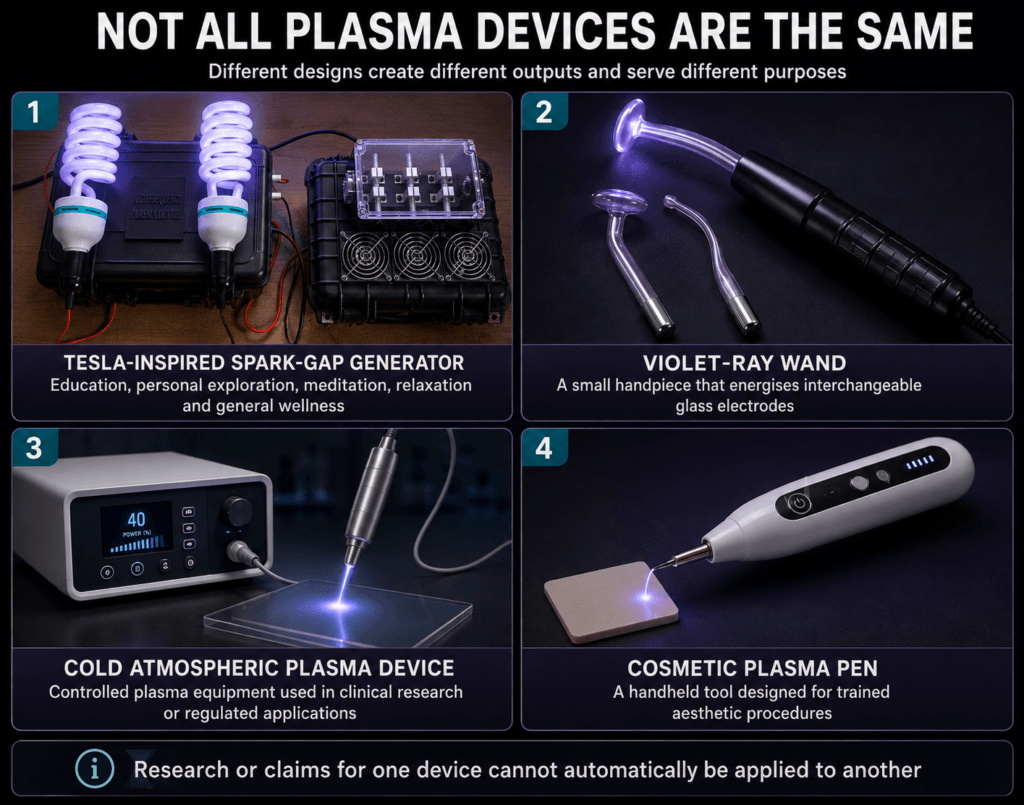
Plasma Healing Device, Cold Plasma and Plasma Pens: What Is the Difference?
“Plasma device” describes technologies with different outputs, purposes and risks.
| Device category | Typical purpose | How it operates | Important distinction |
|---|---|---|---|
| Tesla-inspired spark-gap generator | Education, meditation, relaxation and wellness | A spark-gap circuit energises gas-filled bulbs | Not the same as clinical CAP |
| Violet-ray wand | Collecting, demonstrations or cosmetic use | A handpiece energises glass electrodes | Different circuit, size and output |
| Cold atmospheric plasma equipment | Clinical research or regulated applications | Produces a controlled low-temperature plasma jet | CAP evidence cannot be transferred to a home spark-gap generator |
| Cosmetic plasma pen | Aesthetic procedures | Produces a small arc or thermal effect | Requires training; not a plasma-bulb machine |
| PEMF device | Pulsed magnetic-field applications | Drives current through coils | Does not need to create plasma |
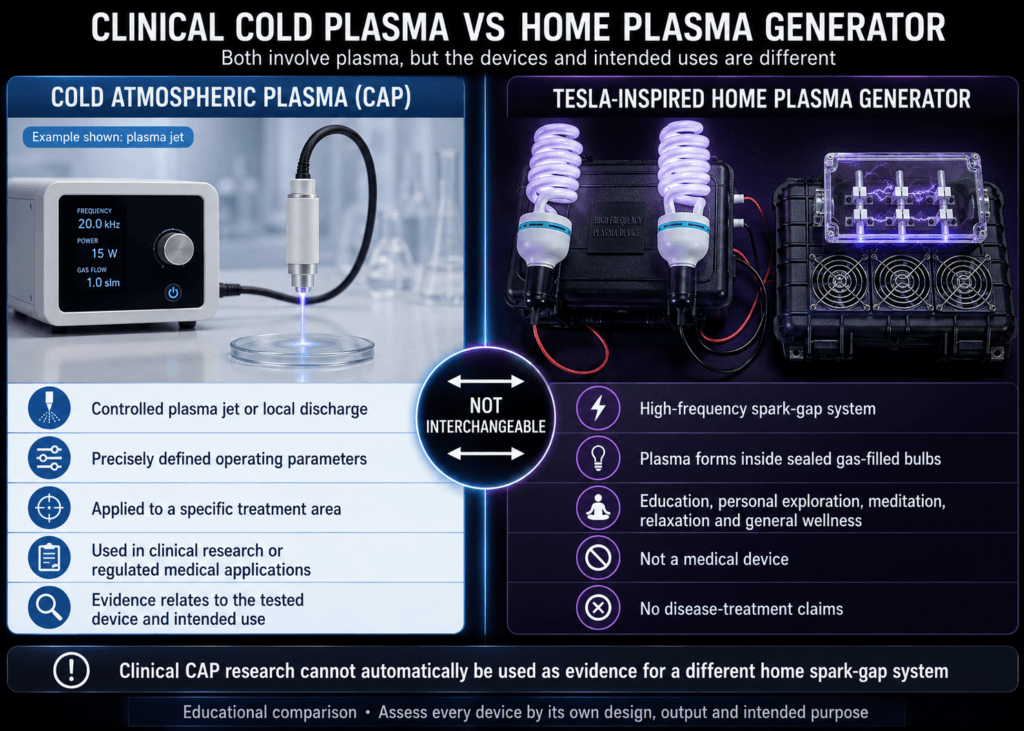
Clinical studies may use characterised equipment, controlled doses, direct treatment and trained supervision. A home generator with handheld bulbs is different. Results from one category do not prove that another will deliver the same outcome.
What Does the Research Actually Show?
Plasma medicine is a real research field. Scientists have studied cold atmospheric plasma (CAP) for microbial reduction and wound care, with some promising results from particular devices under defined conditions.
However, “plasma” is not one uniform treatment. Temperature, gas, voltage, current, waveform, reactive species, distance and dose can differ. Two visible discharges may have very different outputs.
CAP research does not demonstrate that an untested home plasma energy device treats wounds, pain, inflammation, infection or disease. Testimonials are personal accounts, not controlled evidence, and a striking visual effect does not establish a biological benefit.
The UK Advertising Standards Authority requires robust support for objective health claims. The MHRA considers a product’s intended purpose, labelling, instructions and promotion when deciding whether it has a medical purpose.
A trustworthy seller should therefore describe measurable engineering features accurately, explain intended non-medical uses and avoid presenting anecdotal reports as guaranteed results.
Why Do People Explore Plasma Wellness Devices?
People can explore a plasma wellness device without treating it as a replacement for medical care.
A structured relaxation ritual
Some owners sit comfortably, hold the supplied bulbs as instructed and use the session for meditation or relaxation. A calming routine is not proof of medical treatment.
Visible, engaging science
The bulb glow and spark gap turn ionisation, capacitance, discharge and oscillation into observable phenomena.
Interest in Nikola Tesla
A Tesla-inspired wellness device lets enthusiasts explore broad principles associated with high-frequency electricity and gas-discharge illumination.
Personal experimentation
Some buyers record operating conditions and observe how distance affects readings. A meter reading is not a health measurement, and energised high-voltage circuitry must never be altered.
Community and support
Instructions, setup videos, direct support and an owner community can be as valuable as the hardware.
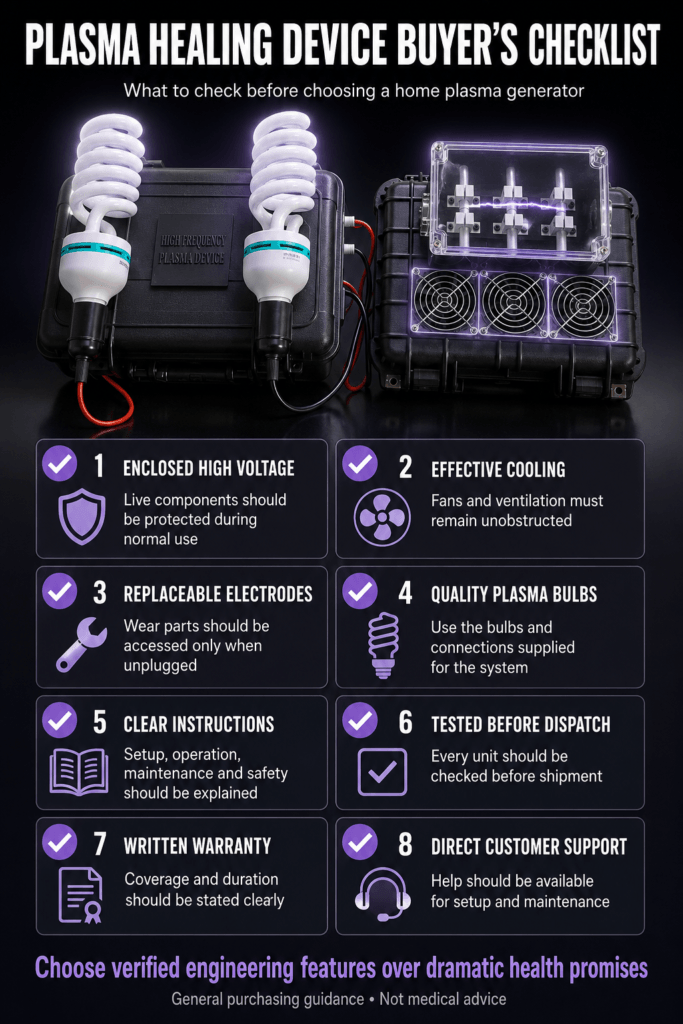
What Should You Check Before Buying a Plasma Healing Device?
A personal plasma generator UK buyer should look beyond dramatic images and ask practical questions.
What type of plasma device is it?
Confirm whether it is a spark-gap generator, cold plasma tool, violet-ray wand or cosmetic plasma pen. Similar terminology does not mean identical hardware.
Is the intended purpose stated honestly?
The seller should state whether the product is for wellness and education or is a regulated medical device. Be cautious of unregulated systems promising to cure disease, eliminate pain or replace treatment.
How is the high voltage enclosed?
Look for protected live components, suitable insulation, a stable enclosure and clear warnings. Normal operation must not require touching exposed high-voltage parts.
Does it have adequate cooling?
Transformers, electronics and spark gaps generate heat. Cooling must remain unobstructed, with clear operating-time guidance.
Can wear parts be maintained?
Spark-gap electrodes wear through repeated arcing. Replaceable electrodes make ownership more practical, but maintenance must only be performed when the machine is unplugged and made safe.
What exactly is included?
Check whether the price includes bulbs, cables, generator sections, instructions, delivery, warranty and support. Compare complete packages.
Is the builder available after the sale?
A good guide, setup videos and direct contact are valuable. Ask what happens if a bulb breaks or an electrode needs replacing.
Are testimonials presented responsibly?
Reviews can describe build quality, service and subjective experiences, but are not medical proof or a guarantee.
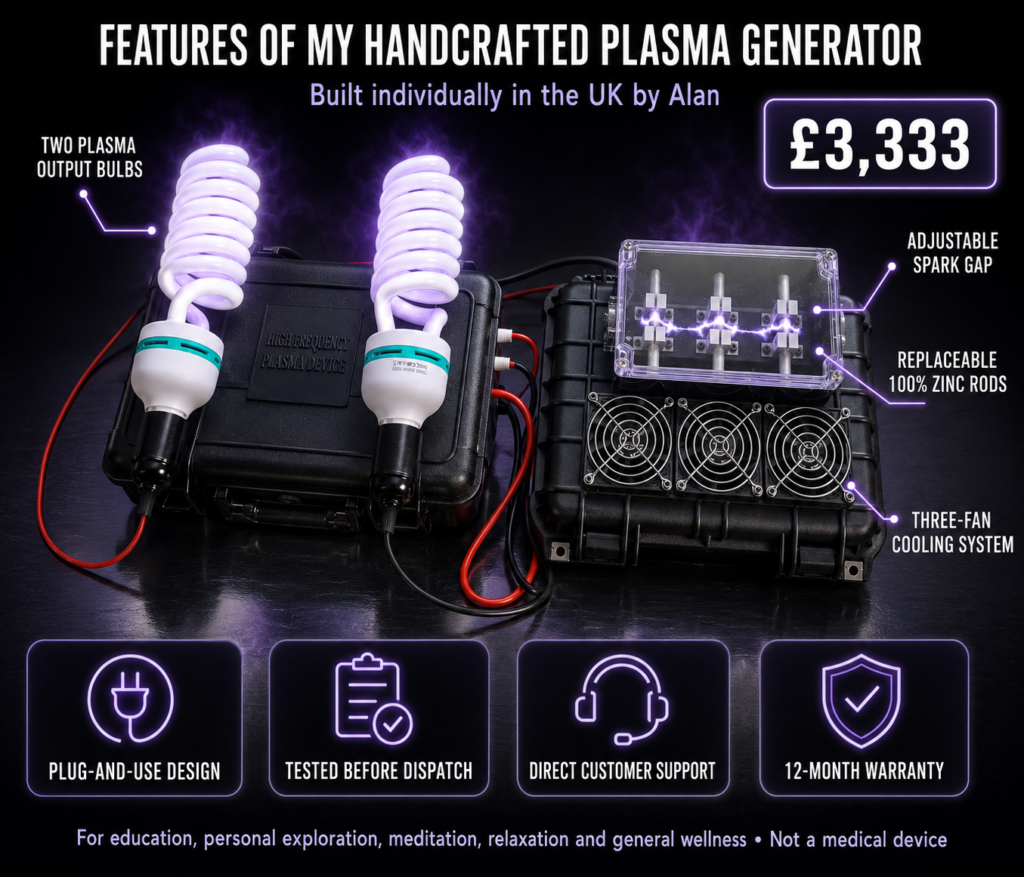
A Handcrafted High-Frequency Plasma Device for Home Use
For people looking for a high-voltage plasma generator for home exploration, the High Frequency Plasma Generator is individually assembled by Alan in the UK. It uses a traditional Tesla-inspired spark-gap approach rather than presenting itself as a clinical cold-plasma treatment.
The complete system includes two plasma output bulbs, a high-frequency producer and an adjustable spark-gap generator using replaceable 100% zinc rods. Built-in cooling supports operation, while the plug-and-use layout avoids the complicated assembly associated with many experimental systems. Every unit is tested before dispatch.
Owners also receive clear operating guidance, direct customer support, access to educational resources and a 12-month warranty covering manufacturing defects and workmanship. The current price is £3,333. Full specifications, package details and purchasing information are available on the High Frequency Plasma Generator product page.
The adjustable zinc spark gap is a practical engineering feature. The rods can be inspected, cleaned and replaced when required rather than being permanently sealed inside an inaccessible section. Adjustment changes the behaviour of the discharge; it is not marketed as a way to select a clinically proven frequency for a particular illness.
This distinction reflects the purpose of the machine. It is created for adults interested in plasma technology, electrical history, meditation, relaxation and general wellness—not as a substitute for diagnosis, medication, rehabilitation or any treatment recommended by a qualified healthcare professional.
Responsible Use and Electrical Safety
A spark-gap plasma device contains high voltage and can produce strong electromagnetic interference. Always follow the instructions supplied with the exact model rather than copying settings or procedures from an unrelated machine.
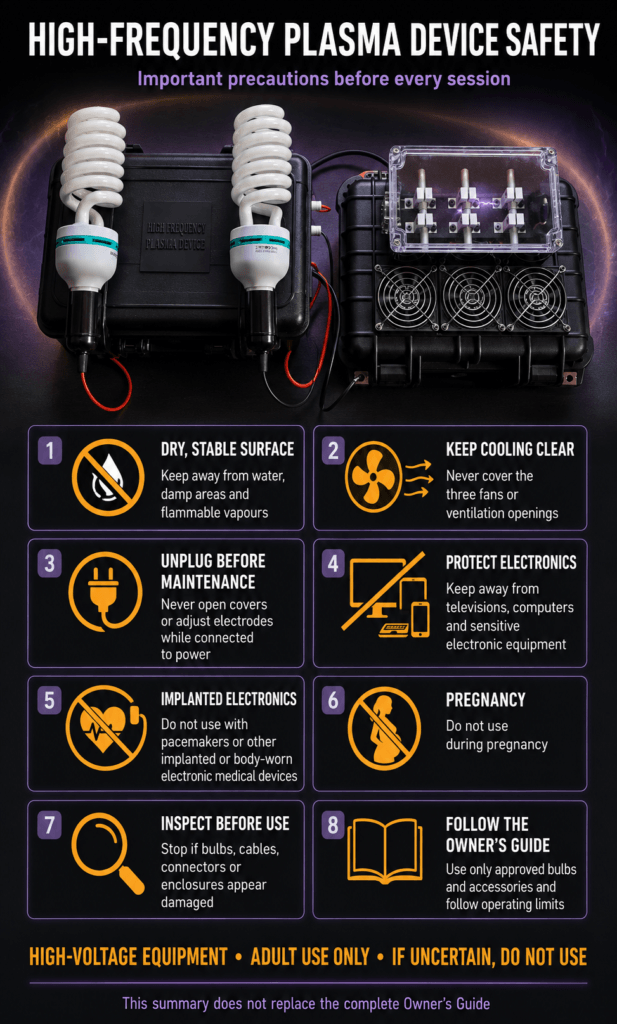
Basic precautions include:
- Place the generator on a dry, stable surface with space around every ventilation opening.
- Keep the system away from water, damp conditions, flammable vapours and oxygen-enriched environments.
- Do not open covers, adjust internal wiring or clean the spark gap while the equipment is connected to power.
- Use only the bulbs, leads and accessories approved by the builder.
- Keep sensitive electronics, televisions, computers and data-storage devices away from the operating area.
- Stop using the equipment if a cable, bulb, enclosure or connector appears damaged.
- Keep children and pets away from the machine while it is operating.
People who are pregnant or who have pacemakers, implanted defibrillators, neurostimulators, insulin pumps, cochlear implants or other implanted or body-worn electronic medical equipment should not use this type of generator unless the device manufacturer and an appropriately qualified healthcare professional have confirmed that it is safe for their individual circumstances. When in doubt, do not use it.
The Owner’s Guide provides model-specific setup and operating information.
Frequently Asked Questions
Does a plasma healing device actually heal the body?
The phrase is widely used online, but this generator is not a medical device and no claim is made that it heals or treats disease. It is intended for education, exploration, meditation, relaxation and general wellness. Clinical CAP research cannot automatically be applied to a home spark-gap system.
Is a plasma healing device the same as a Rife machine?
No. Their circuits, outputs and operating principles can differ. A plasma generator creates ionised gas in bulbs; another device producing electrical frequencies is not necessarily equivalent.
Is it the same as PEMF?
No. PEMF equipment drives coils to produce pulsed magnetic fields. A spark-gap generator uses high voltage and changing electrical activity to create plasma inside bulbs. The technologies should be evaluated separately.
Can I choose a specific healing frequency?
This generator has no disease-specific or clinically validated programmes. Adjusting the spark gap changes discharge behaviour; it does not select a proven treatment frequency.
Why are two plasma bulbs supplied?
Two bulbs form the intended output arrangement. Gas inside each bulb becomes ionised when energised, producing the visible glow.
Can I use the machine beside a television or computer?
No. Spark-gap equipment can cause electromagnetic interference. Keep it away from televisions, computers, sensitive electronics and data-storage devices.
How do I know whether a plasma device is well made?
Look for enclosed high voltage, insulation, cooling, clear instructions, replaceable wear parts, testing, warranty and responsive support. Avoid buying on dramatic health promises.
Final Thoughts: Choosing Knowledge Over Hype
A plasma healing device can be a captivating piece of Tesla-inspired technology, but a good decision begins with accurate expectations. A spark-gap generator demonstrates plasma formation, electrical discharge and oscillation and may form part of a meditation or relaxation routine. It does not need exaggerated medical promises.
Before purchasing, identify the technology, understand its output, compare the package and read the safety guidance. Choose a builder who explains capabilities and limits.
To explore a handcrafted plasma energy device made in the UK, view the High Frequency Plasma Generator. Each system is tested and supplied with two plasma bulbs, an adjustable zinc spark gap, instructions, direct support and a 12-month warranty.
Important disclaimer: This product is intended for educational, research, personal exploration, meditation, relaxation and general wellness purposes only. It is not a medical device and is not intended to diagnose, treat, cure, mitigate or prevent any disease or medical condition. Information on this page is educational and must not be regarded as medical advice or a substitute for professional care.